

P0108 on 2012-2019 Kia Forte: MAP Sensor Circuit High Causes and Fixes
On a 2012-2019 Kia Forte, code P0108 almost always means the Manifold Absolute Pressure (MAP) sensor has failed and is stuck sending a high voltage signal, typically over 4.8V. Replacing the sensor is the most common fix, costing about $20-$60 for an aftermarket part and $70-$110 for OEM. It's a very easy DIY repair, typically taking less than 30 minutes as the sensor is easily accessible on the intake manifold.
- P0108 on your Forte means the MAP sensor circuit is reading high, which almost always points to a failed MAP sensor.
- Symptoms are noticeable and include rough idle, poor acceleration, and bad gas mileage.
- This is an easy and inexpensive DIY repair, typically taking less than 30 minutes.
- Driving with this code for too long can damage your catalytic converter, a much more expensive repair.
- Always confirm the correct MAP sensor part number for your specific year and engine before purchasing.
What's Unique About the 2012-2019 Kia Forte
The 2012-2019 Kia Forte spans three distinct generations and multiple engines (1.8L Nu, 2.0L Nu, 2.0L Theta II, 1.6L Gamma GDI-T). While the specific MAP sensor part number varies, the failure mode is consistent: the sensor's internal electronics fail, causing it to send a constant high voltage signal. Unlike some vehicles where wiring or vacuum leaks are common culprits for MAP codes, on the Forte, the sensor itself is the overwhelming cause. The sensor is generally easy to access on the top or front of the intake manifold, making this a straightforward and common repair for Forte owners.
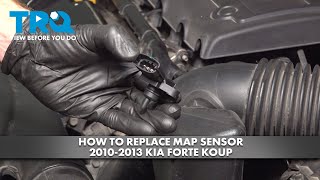
Generation note: The 2012-2019 range covers the end of the first generation (TD, 2012-2013) 🎬 Watch: How to replace the MAP sensor on 2010-2013 models., the full second generation (YD, 2014-2018), and the start of the third generation (BD, 2019). Engine options included 1.8L Nu, 2.0L Nu, 2.4L Theta II, and a 1.6L Gamma turbo. While the cause of P0108 is consistent, the exact MAP sensor part number and location may differ slightly. For example, part 39300-2B000 is common on first-gen 2.0L/2.4L Theta II engines, while 39300-2E600 is used on later 2.0L Nu engines (2019+). Always verify the part number with your VIN.
Symptoms You May Notice
- Check Engine Light is on
- Rough, unstable, or surging idle
- Hesitation or stumbling during acceleration
- Noticeable loss of engine power
- Poor fuel economy
- Black smoke from the exhaust pipe (due to rich fuel mixture)
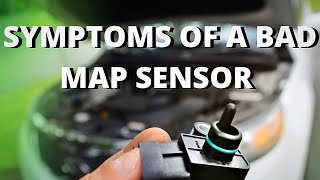
- Engine stalling, especially when coming to a stop 🎬 See a breakdown of common bad MAP sensor symptoms.
- Replacing the Mass Air Flow (MAF) sensor instead of the Manifold Absolute Pressure (MAP) sensor.
- Replacing spark plugs or ignition coils to fix a rough idle, when the idle issue is a symptom of the incorrect fuel mixture caused by the P0108 fault.
- Replacing the throttle body when the issue is the MAP sensor mounted on it.
Most Likely Causes
- Failed Manifold Absolute Pressure (MAP) Sensor 🔴 High Probability This is the most common failure point for this code on most modern vehicles, including the Forte. The sensor's internal electronics fail, causing it to send a constant, incorrect high-voltage signal. This is a well-documented failure on related Hyundai and Kia models as well.
How to confirm: Use a scan tool to monitor live data. With the Key On, Engine Off (KOEO), the MAP sensor voltage should be high (around 4.5V), matching the barometric pressure. When the engine is started and idling, the voltage should drop significantly (to around 1.0-1.8V) due to engine vacuum. If the voltage remains stuck high (e.g., >4.5V) at idle, the sensor has failed.
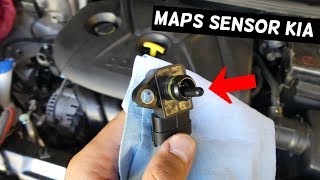
Typical fix: Replace the MAP sensor. It is typically located directly on the intake manifold and secured with a single 10mm bolt, making it a 15-minute DIY job.
Est. part cost: $20-$110 - MAP Sensor Wiring or Connector Issue 🟡 Medium Probability
How to confirm: Visually inspect the wiring harness and connector going to the MAP sensor for any signs of damage, corrosion, or loose pins. With the connector unplugged and key on, use a multimeter to verify you have a 5-volt reference wire, a good ground, and check the signal wire for any shorts to power. Rodent damage to wiring harnesses is a possible cause.
Typical fix: Repair the damaged section of wiring or clean/replace the connector.
Est. part cost: $5-$50 - Major Vacuum Leak ⚪ Low Probability
How to confirm: While a vacuum leak typically causes a P0171 (System Too Lean) code, a very large, unmetered air leak could theoretically prevent the manifold from achieving sufficient vacuum at idle, keeping the MAP reading high. Inspect all vacuum hoses connected to the intake manifold for cracks or disconnections. A smoke test is the most effective way to find a hidden leak.
Typical fix: Replace the cracked or broken vacuum hose or intake gasket.
Est. part cost: $10-$40
Rare But Worth Checking
- Clogged Catalytic Converter: A severe exhaust restriction can cause pressure to back up into the intake manifold, leading to an abnormally high MAP sensor reading. This would typically be accompanied by a severe loss of power, especially at higher RPMs, and potentially a sulfur smell from the exhaust.
- Faulty Engine Control Module (ECM): This is extremely rare. The ECM's internal circuitry for the MAP sensor could fail. This should only be considered after all other possibilities, including the sensor and wiring, have been definitively ruled out.
Diagnosis Steps
- Connect an OBD-II scanner and check for any other stored codes. Address other codes first if they are present.
- View live data on the scanner. Select the MAP sensor parameter (usually displayed in volts or kPa).
- With the Key On, Engine Off (KOEO), observe the reading. It should be high, corresponding to atmospheric pressure (around 4.5-5.0 volts).
- Start the engine and let it idle. The MAP sensor reading should drop sharply to a low voltage (typically 1.0-1.8 volts) or a low pressure reading, indicating engine vacuum.
- If the reading remains stuck high at idle (above ~4.5V), the sensor or its circuit is faulty.
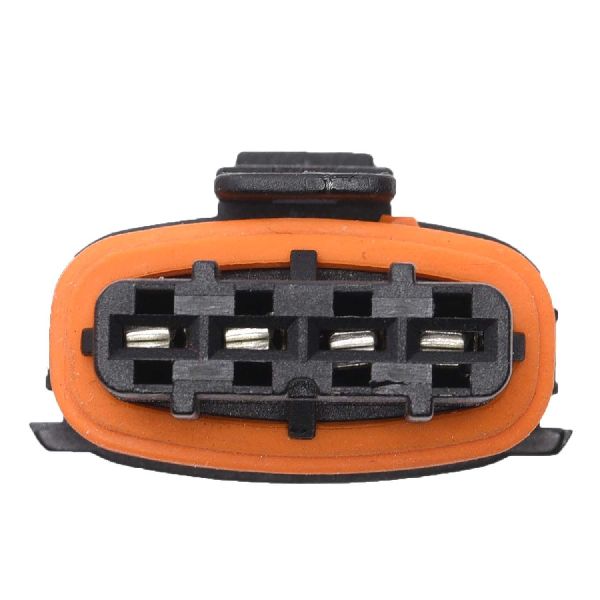
- Turn the engine off. Visually inspect the MAP sensor's electrical connector for corrosion, damage, or loose pins. Inspect the visible wiring for any obvious damage, including from rodents.
- If the visual inspection is clear, disconnect the sensor. With the key on, use a multimeter to test the connector's terminals. You should find one with a 5-volt reference, one with a good ground (near 0 ohms to the battery negative), and the signal wire.
- If the 5V reference or ground is missing, you have a wiring or ECM issue. If both are present, the problem is most likely a failed MAP sensor.
- As a final check, if accessible, you can apply vacuum to the sensor with a hand pump and watch the signal voltage on the multimeter 🎬 Watch: How to test and replace a faulty MAP sensor. to see if it changes. If it doesn't, the sensor is bad.
- If the sensor and wiring test good, investigate rare causes like a clogged exhaust or a major vacuum leak.
Parts You'll Likely Need
- Manifold Absolute Pressure (MAP) Sensor
(OEM #39300-2B000, 39300-2E600, 39300-2B100)— This is the component that fails most frequently, getting stuck and sending a constant high voltage signal to the ECM. Part numbers vary by year and engine. 39300-2B000 is common on first-gen (TD) 2.0L/2.4L Theta II engines. 39300-2E600 is common on third-gen (BD) 2.0L Nu engines. 39300-2B100 is used on some 1.6L Gamma engines and 2014-2018 1.8L/2.0L Nu engines. Always verify the correct part number for your specific vehicle VIN.
Trusted brands: Kia/Hyundai (OEM), Bosch, Delphi, NGK/NTK, Standard Motor Products
OEM price range: $70-$110
Aftermarket price range: $20-$60
Related Codes That Often Appear With This One
- P0106 — Indicates a MAP sensor performance/range issue. It can appear if the sensor signal is erratic or intermittent before it fails completely and gets stuck high.
- P0107 — The opposite of P0108, indicating a low circuit input. Seeing both intermittently could point to a severe wiring problem or a failing sensor.
- P0172 — Indicates "System Too Rich (Bank 1)". This is a direct result of the P0108 fault, as the high MAP signal causes the ECM to command an excessively rich fuel mixture.
Platform-Specific Known Issues
- Owner Experience: Intermittent Stalling and P0108: A user on Reddit with a Kia reported intermittent stalling issues that eventually became more frequent. After a mechanic initially couldn't diagnose it, replacing the MAP sensor temporarily fixed the problem, confirming the sensor as the likely culprit even when the failure is not constant at first.
Mechanic-Grade Diagnostic Values
- MAP Sensor Signal Voltage at Idle — expected: 1.0V - 1.8V. Failure: A reading stuck at or above 4.5V indicates a 'High Input' fault.
- MAP Sensor vs. BARO Sensor (KOEO) — expected: MAP sensor voltage/pressure reading should be nearly identical to the Barometric Pressure (BARO) sensor reading.. Failure: A difference greater than 0.5V between the MAP and BARO readings suggests a sensor fault.
- MAP Sensor Internal Resistance — expected: Approximately 2.4 kΩ (kilo-ohms). Failure: A reading that is significantly different or shows no continuity (Open Loop) indicates a defective sensor.
- MAP Sensor Ground Wire Resistance — expected: Less than 0.5 Ω to a known good ground.. Failure: A reading higher than 0.5 Ω indicates high resistance in the ground circuit; a reading of OL (Open Loop) indicates a break in the wire.
Scan Tool Commands That Help
- Kia GDS (Global Diagnostic System): Trigger Module (Flight Record) — This function is used for diagnosing intermittent P0108 faults. It allows a technician to record sensor data during a drive cycle to capture the exact moment the fault occurs, which is useful for identifying intermittent wiring shorts or sensor glitches that don't happen at idle.
Wiring & Ground Locations
- Engine Ground Wiring Assembly (2014-2018) — This is the main ground strap/cable connecting the engine/transmission assembly to the vehicle chassis.. A corroded or loose main engine ground can cause floating voltages and erratic sensor readings, including the MAP sensor. Verifying this connection is a key step if sensor and wiring tests are inconclusive. The OEM part number for this assembly is 91860A7140.
- Engine Ground Wiring Assembly (2017-2018) — Main ground cable for the engine.. A poor ground connection can lead to incorrect sensor voltage readings. This specific assembly is part number 91860-B0130.
- Engine Ground Wiring Assembly (2019+ Manual Trans) — Transmission to ground wiring assembly for the third generation (BD) Forte with a manual transmission.. Ensures the engine and its sensors have a solid ground reference. The OEM part number is 91862-M7010.
OEM Part Supersession History
39300-2B100→39300-2B000— Unknown, likely a revision for improved reliability or manufacturing.
Heads up: According to one parts supplier, 39300-2B000 is the superseding part for 39300-2B100, which is important as technicians might assume the higher number is the newer part. Always verify with a dealer using the VIN.
Model Year Variations Within This Range
- 2012-2013 (First Gen 'TD' and early Second Gen 'YD'): Primarily use MAP sensor P/N 39300-2B000, especially on the 2.0L and 2.4L Theta II engines.
- 2014-2018 (Second Gen 'YD'): Commonly use MAP sensor P/N 39300-2B100 (which is superseded by 39300-2B000) for the 1.8L and 2.0L Nu engines.
- 2019 (Third Gen 'BD'): The 2.0L Nu engine in the 2019 model year switches to a different MAP sensor, P/N 39300-2E600.
Diagnostic Flowchart
Other Known Issues on This Vehicle
Issues unrelated to this code that are worth knowing about as an owner of this generation:
- Engine Failure / Excessive Oil Consumption 🔴 High — Widespread across multiple engine families (Theta II, Nu, Gamma). Can occur at various mileages, sometimes as low as 35k-60k miles. Problems range from oil consumption to catastrophic connecting rod failure. (Ref: Multiple recalls (e.g., SC147) and class-action lawsuits have been issued, extending warranties to 15 years/150,000 miles for affected vehicles and providing for engine inspection and replacement. TSB ENG123 also addresses oil consumption testing.)
- Worn Steering Coupler 🟠 Medium — Very common across many Hyundai/Kia models of this era. Causes a distinct clicking or knocking noise in the steering column when turning the wheel, especially when stationary. (Ref: Kia issued TSB CHA074 (and revisions) detailing the replacement procedure for the flexible rubber coupler in the electronic power steering motor.)
- Faulty Ignition Coils 🟡 Low — Some owners, particularly of the 2017 model year, report premature ignition coil failure leading to misfires, rough idle, and stalling. Can occur as early as 20,000-40,000 miles.
- IVT/CVT Transmission Issues 🟠 Medium — Affects later models (2019+) equipped with the Intelligent Variable Transmission (IVT). Symptoms include hesitation, delayed acceleration, or transmission slippage. (Ref: TSB TRA102 provides a procedure to update the transmission control module (TCM) software and, if necessary, replace the IVT assembly for DTCs like P0730, P0731, etc.)
Used vs. New Parts: Buying Guide for This Vehicle
When a used part is the smart pick: For this specific repair, buying a new aftermarket part is generally a better choice than a used OEM part. The cost of a new, quality aftermarket sensor is low ($20-$60), and it comes with a warranty. A used sensor from a junkyard carries unknown history and risk of premature failure for minimal cost savings.
Donor-vehicle mileage cap: roughly under 60000 miles for the part to have meaningful remaining life.
What to inspect on the donor part:
- Ensure the donor vehicle was not in a front-end collision.
- Inspect the plastic housing for any cracks or heat damage.
- Check the electrical connector pins for any signs of corrosion or damage.
- Look at the O-ring to ensure it is pliable and not flattened or cracked.
OEM-only on this vehicle (don't cheap out):
- Engine Control Module (ECM)
Aftermarket brands forum-validated for this vehicle:
- NGK / NTK
- Delphi
- Standard Motor Products (SMP)
- Hella
- Beck Arnley
Real Owner Stories
Aggregated from forums and TSBs cited above. Mileages and costs reflect what owners reported in those sources.
Kia Forte (Nu or Gamma engine)
Symptoms: Intermittent stalling issues that eventually became more frequent.
What fixed it: Replacing the MAP sensor temporarily fixed the problem, confirming the sensor was the culprit even though the failure wasn't constant initially.
Source hint: Reddit r/AskMechanics thread titled 'someone please solve this mystery/' cited in vehicle_specific_issues
Kia (General Platform)
Symptoms: Rough idle and Check Engine Light illumination.
What fixed it: NHTSA ODI #11390539 describes a scenario where a vehicle exhibited a rough idle and pulled codes P0108 and P0068; while the dealer initially could not find the issue, these codes are directly linked to manifold pressure and air induction faults.
Source hint: NHTSA ODI #11390539
Related OBD-II Codes
Frequently Asked Questions
Is there a specific TSB for the transmission issues I'm having alongside engine codes on my 2019 Forte?
Could my P0108 code be related to the engine oil consumption issues common in Kias?
What MAP sensor brands are recommended for the Kia Forte?
How long does it take to replace the MAP sensor on a 2012-2019 Forte?
My steering is clicking while I turn; is this related to the P0108 code?
Can I use a MAP sensor from a Kia Soul or Hyundai Elantra to fix my Forte?
Helpful Videos

We Have This Part in Stock

The information in this article is provided for general reference and educational purposes only. Vehicle specifications, procedures, and part compatibility can vary by production date, trim level, and region. Always consult your vehicle's factory service manual and verify part numbers before purchasing or performing repairs. Safety-critical components such as airbags, seat belts, and braking systems should be installed by a qualified professional.
- Kia Forte:
- 🎬 Helpful Videos
- 🛍️ Shop This Part
- What's Unique About the 2012-2019 Kia Forte
- Symptoms You May Notice
- Most Likely Causes
- Rare But Worth Checking
- Diagnosis Steps
- Parts You'll Likely Need
- Related Codes That Often Appear With This One
- Platform-Specific Known Issues
- Mechanic-Grade Diagnostic Values
- Scan Tool Commands That Help
- Wiring & Ground Locations
- OEM Part Supersession History
- Model Year Variations Within This Range
- Diagnostic Flowchart
- Other Known Issues on This Vehicle
- Used vs. New Parts: Buying Guide for This Vehicle
- Real Owner Stories
- Kia Forte (Nu or Gamma engine)
- Kia (General Platform)
- Related OBD-II Codes
- Frequently Asked Questions
- 🎟️ Get 5% Off