

P0107 on 2018-2019 Ford Flex: Causes and Fixes for MAP Sensor Circuit Low
On a 2018-2019 Ford Flex, code P0107 is most often caused by a faulty Manifold Absolute Pressure (MAP) sensor, an issue documented by Ford in a Technical Service Bulletin (TSB 19-2212). Replacing the sensor is a straightforward DIY fix, with the part costing between $50 and $125. This issue is especially common on the 3.5L EcoBoost engine and also affects the Ford Explorer, Taurus SHO, and Lincoln MKT.
- P0107 on a 2018-2019 Flex strongly points to a bad MAP sensor, especially on the 3.5L EcoBoost engine.
- Ford has acknowledged this issue in TSB 19-2183 and 19-2212, making diagnosis more certain.
- Symptoms are more than just a check engine light; they include a lack of power and multiple dash warnings like "Service AdvanceTrac".
- Replacement is simple, requiring basic tools, and is located on top of the intake manifold for the EcoBoost engine.
- The same issue affects 2018-2019 Ford Explorers, Taurus SHOs, and Lincoln MKTs with the 3.5L EcoBoost engine.
What's Unique About the 2018-2019 Ford FLEX
For the 2018-2019 Ford Flex, particularly those with the 3.5L EcoBoost engine, the P0107 code is a known issue. Ford issued Technical Service Bulletins (first 19-2183, later superseded by 19-2212) acknowledging that a faulty Manifold Absolute Pressure and Temperature (MAPT) sensor is a common cause for this code. This issue often appears with a cascade of other warnings like "Service AdvanceTrac" and a noticeable lack of power, sometimes with the turbo boost gauge showing maxed out despite the power loss. This TSB makes diagnosis more direct compared to other vehicles where the cause might be more ambiguous. It's also important for technicians to distinguish the correct sensor; the 3.5L EcoBoost engine uses both a MAPT sensor on the intake manifold and a separate T-MAP/TIP (Throttle Inlet Pressure) sensor near the throttle body. The TSB specifically points to the MAPT sensor on the manifold as the cause of this issue.
Diagnostic Flowchart
Tap your situation to follow the diagnostic path that matches what you're seeing on this vehicle.
Symptoms You May Notice
- Check Engine Light or wrench light is on.
- Lack of power or sluggish acceleration.
- "Service AdvanceTrac" message displayed.
- "Hill Start Assist Not Available" message displayed.
- Turbo boost gauge may read maximum, but with no actual power.
- Rough or erratic idle.
- Poor fuel economy.
- Hesitation or stalling.
- Replacing the throttle body when the issue is a faulty MAP sensor.
- Assuming a transmission problem due to the sluggish performance and warning lights.
- Confusing the MAP (Manifold Absolute Pressure) sensor on the intake manifold with the T-MAP/TIP (Throttle Inlet Pressure) sensor located near the throttle body on EcoBoost models.
Most Likely Causes
- Faulty Manifold Absolute Pressure (MAP) Sensor 🔴 High Probability Ford issued TSB 19-2183 and its successor 19-2212 specifically for the 2018-2019 Flex with the 3.5L EcoBoost engine, identifying a faulty MAPT sensor as the likely culprit. This is the most common point of failure for this code on this specific vehicle.
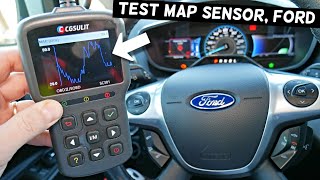
How to confirm: With a scan tool, monitor the MAP sensor voltage with the Key On, Engine Off (KOEO). For a turbocharged engine, the voltage should be between 2.0V and 3.0V. If the reading is below the specified threshold (Ford documentation indicates a fault below 0.19V), the sensor is bad. At idle, a healthy sensor on a turbo engine should read between 2.0-2.5 volts.
Typical fix: Replace the MAP sensor. On the 3.5L EcoBoost, it is located on top of the intake manifold and secured by a single T20 Torx screw, making for a quick replacement. 🎬 Watch: 3.5L EcoBoost MAP sensor replacement walkthrough. On the 3.5L Ti-VCT (naturally aspirated) engine, it is on the rear left corner of the intake manifold.
Est. part cost: $50-$125 - Wiring or Connector Issue 🟡 Medium Probability The MAP sensor wiring harness is in the engine bay, exposed to heat and vibration which can cause wires to break or the connector to become loose or corroded over time. This can cause an open or short in the circuit.
How to confirm: Visually inspect the MAP sensor connector and wiring for any signs of damage, corrosion, or loose pins. Use a multimeter to check for a 5-volt reference signal (typically between 4.8V and 5.2V) and a good ground at the connector. If the 5V reference and ground are present with the sensor unplugged, the wiring from the PCM is likely okay.
Typical fix: Repair the damaged section of wiring or clean/replace the connector pigtail.
Est. part cost: $5-$50 - Engine Vacuum Leak ⚪ Low Probability
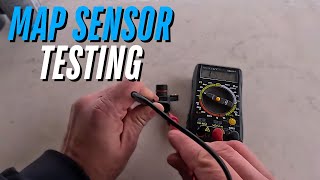
How to confirm: A large vacuum leak could theoretically affect MAP readings, though it's less likely to cause a 'circuit low' code, which points more to an electrical fault. A smoke test is the most effective way to find leaks 🎬 See this step-by-step guide on testing any MAP sensor. in the intake system.
Typical fix: Replace the leaking vacuum hose or gasket.
Est. part cost: $10-$100
Rare But Worth Checking
- Faulty Powertrain Control Module (PCM): This should only be considered after the sensor and wiring have been thoroughly tested and proven to be good. PCM failure is uncommon but possible.
Diagnosis Steps
- Check for other Diagnostic Trouble Codes (DTCs). P0108 and P0109 are commonly seen with P0107 and reinforce the diagnosis of a bad MAP sensor per Ford's TSB.
- Perform a thorough visual inspection of the MAP sensor on the intake manifold, its electrical connector, and the surrounding wiring for any obvious damage, corrosion, or loose connections.
- Using a scan tool, observe the live data for the MAP sensor PID. With the Key On, Engine Off (KOEO), the voltage for the 3.5L EcoBoost should be between 2.0V and 3.0V. A reading below Ford's fault threshold of 0.19V confirms a problem.
- Per TSB 19-2212, the primary diagnostic is to replace the MAPT sensor if the characteristic symptoms and codes are present.
- If further testing is desired, disconnect the sensor. Check for a 5-volt reference signal and a good ground at the connector with a multimeter. The reference voltage should be between 4.8V and 5.2V.
- If the 5V reference and ground are present, the sensor is almost certainly the fault. If they are missing, there is a wiring issue or a problem with the PCM.
- If you suspect a vacuum leak, perform a smoke test on the intake manifold to check for leaks.
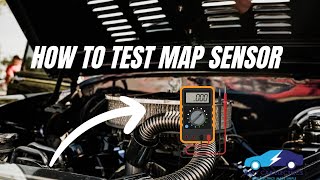
- If all wiring and connections are good, and the sensor has been replaced without resolving the issue, the PCM may be at fault, 🎬 Learn how to test a MAP sensor using a multimeter. which requires professional diagnosis.
Parts You'll Likely Need
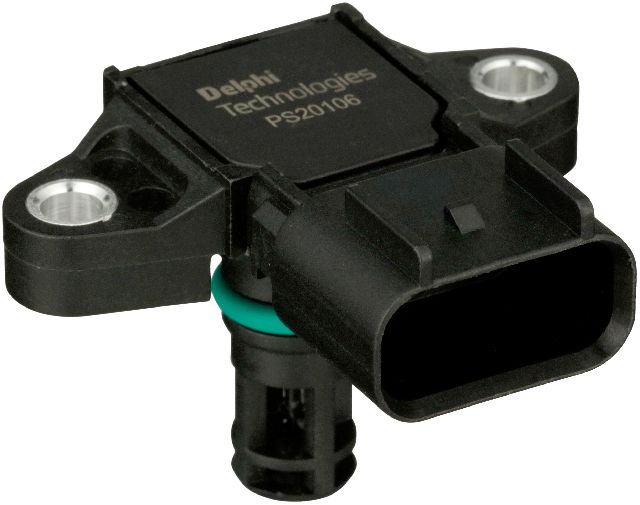
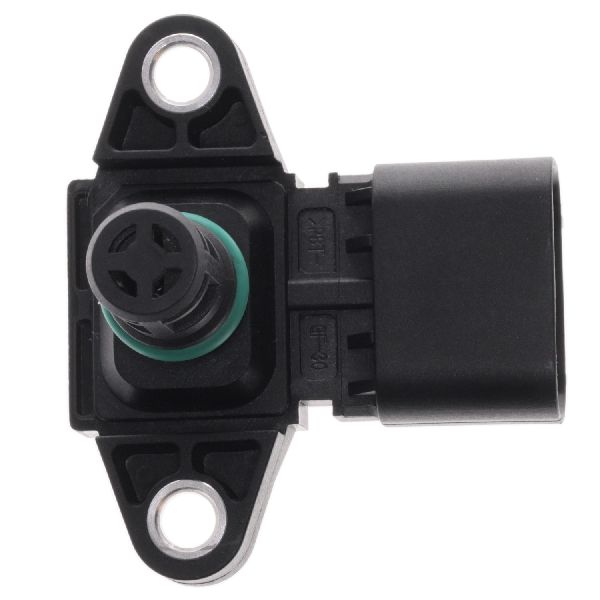
- Manifold Absolute Pressure (MAP) Sensor
(OEM #AA5Z-9F479-E)— This is the most common failure part for this code on this vehicle, as confirmed by Ford TSB 19-2212. The Motorcraft service part number may be CX-2403.
Trusted brands: Motorcraft, Bosch, Delphi, NGK, Walker Products
OEM price range: $99-$126
Aftermarket price range: $30-$75
Related Codes That Often Appear With This One
- P0108 — This code for 'MAP/Barometric Pressure Circuit High Input' can appear with P0107 when the sensor is failing erratically, as noted in Ford's TSB 19-2212.
- P0109 — This code for 'MAP/Barometric Pressure Circuit Intermittent' also points to a failing sensor or connection issue and is mentioned in the same TSB as P0107.
Technical Service Bulletins (TSBs) & Recalls
- TSB 19-2212: This bulletin supersedes TSB 19-2183. It addresses an illuminated malfunction indicator lamp (wrench light), various warning messages, and lack of power with DTCs P0107, P0108, and/or P0109 due to a faulty MAPT sensor on 2018-2019 Flex, Explorer, Taurus, and MKT models with the 3.5L EcoBoost engine.
- TSB 19-2183: The original bulletin outlining the MAPT sensor issue, symptoms, affected vehicles (including the Flex), and diagnostic procedure. It confirms the causal part is AA5Z-9F479-E.
Platform-Specific Known Issues
- A Ford Technical Service Bulletin (TSB 19-2212) was issued for 2018-2019 Ford Flex models with the 3.5L EcoBoost engine for DTCs P0107, P0108, and/or P0109. The bulletin states the cause is likely a faulty MAPT sensor and advises replacement.
- Owners on forums for platform-mate vehicles like the F-150 and Super Duty report the simultaneous appearance of P0107 and P0108, along with a maxed-out boost gauge on the dash but a complete lack of power, which directly aligns with the TSB symptoms.
Mechanic-Grade Diagnostic Values
- MAP Sensor Signal Voltage (Fault Trigger) — expected: >0.19 Volts. Failure: A voltage reading less than 0.19V will trigger the P0107 DTC.
- MAP Sensor Signal Voltage (KOEO, 3.5L EcoBoost) — expected: 2.0V - 3.0V. Failure: A reading significantly outside this range, especially below 0.5V, indicates a fault.
- MAP Sensor Signal Voltage (Idle, 3.5L EcoBoost) — expected: 2.0V - 2.5V. Failure: A reading significantly outside this range indicates a fault.
- Sensor 5V Reference at Connector — expected: 4.8V - 5.2V. Failure: No voltage or low voltage indicates a wiring or PCM issue, not a sensor failure.
Scan Tool Commands That Help
- Ford IDS (or equivalent): Reset/Clear Specified Function (e.g., MAF Sensor Reset) — After replacing certain sensors, a parameter reset may be required. While not explicitly required for a MAP sensor by the TSB, the diagnostic path exists under Toolbox > Powertrain > Service Functions. This is used to clear adaptive learning related to the sensor.
Wiring & Ground Locations
- MAPT Sensor Connector — On top of the plastic intake manifold, easily accessible after removing the engine cover.. This is the primary point for visual inspection and electrical testing (5V reference, ground, and signal wire).
- T-MAP / TIP Sensor — Located on the intake piping near the throttle body inlet.. This is a different pressure sensor. Technicians must not confuse it with the MAPT sensor on the manifold that is the subject of TSB 19-2212 to avoid incorrect parts replacement.
Real Owner Repair Stories
- YouTube Channel 'Gears and Gaskets' (2018-2019 Ford with 3.5L EcoBoost Engine (Explorer, Flex, Taurus, MKT)) — Sluggishness from a stop, lack of power, feels like a transmission concern, DTCs P0107, P0108, P0109.
❌ Tried (didn't work) The video directly follows the TSB, so no other steps were attempted first.
✅ What actually fixed it Replaced the Manifold Absolute Pressure and Temperature (MAPT) sensor on the intake manifold, part number AA5Z-9F479-E, using a T20 Torx driver. After replacement, all codes were cleared.
OEM Part Supersession History
AA5Z-9F479-A, 2R3Z-9F479-AA→AA5Z-9F479-E— Part revision and consolidation by the manufacturer.
Heads up: The older part numbers are superseded by AA5Z-9F479-E, which is the correct part specified in TSB 19-2212 for this repair.
Helpful Videos


We Have This Part in Stock




The information in this article is provided for general reference and educational purposes only. Vehicle specifications, procedures, and part compatibility can vary by production date, trim level, and region. Always consult your vehicle's factory service manual and verify part numbers before purchasing or performing repairs. Safety-critical components such as airbags, seat belts, and braking systems should be installed by a qualified professional.
- Ford FLEX:
- 🎬 Helpful Videos
- 🛍️ Shop This Part
- What's Unique About the 2018-2019 Ford FLEX
- Diagnostic Flowchart
- Symptoms You May Notice
- Most Likely Causes
- Rare But Worth Checking
- Diagnosis Steps
- Parts You'll Likely Need
- Related Codes That Often Appear With This One
- Technical Service Bulletins (TSBs) & Recalls
- Platform-Specific Known Issues
- Mechanic-Grade Diagnostic Values
- Scan Tool Commands That Help
- Wiring & Ground Locations
- Real Owner Repair Stories
- OEM Part Supersession History
- 🎟️ Get 5% Off