

P0106 on 2004-2011 GMC Canyon: MAP Sensor Performance, Causes, and Fixes
For a 2004-2011 GMC Canyon, code P0106 most often points to a faulty Manifold Absolute Pressure (MAP) sensor, a dirty throttle body, or a wiring issue. A dirty throttle body is a very common culprit, especially after a battery disconnect, and cleaning it is a key first step. A thorough inspection of the wiring for internal breaks, as noted in TSB PIP4409F, is also crucial before replacing the sensor.
- P0106 on a GMC Canyon indicates a performance problem with the MAP sensor circuit.
- Before replacing the MAP sensor, thoroughly inspect the wiring harness for breaks, even inside the insulation, as highlighted by a GM Technical Service Bulletin.
- Common causes include the sensor itself, vacuum leaks, and a dirty throttle body.
- If you also have codes P0014 or P0017, the root cause may be related to the camshaft actuator solenoids.
- The fix is usually inexpensive and DIY-friendly, often involving a new sensor or a simple wiring repair.
What's Unique About the 2004-2011 Gmc CANYON
On this generation of GMC Canyon and its platform mates, P0106 has a well-documented history tied to specific component failures. A key issue, highlighted in Manufacturer TSB PIP4409F, is the potential for the MAP sensor circuit wires to be broken *inside* the insulation, making a visual-only inspection insufficient. This is corroborated by owner experiences on shared platforms like the Hummer H3. Furthermore, a dirty throttle body frequently sets a 'false' P0106 code; carbon buildup restricts idle airflow, and if the battery is disconnected, the PCM loses its idle memory and cannot compensate, leading to an implausible MAP reading. Lastly, TSB PIP3694F links P0106 to mechanical issues, specifically with camshaft actuator solenoids, if it appears alongside cam-related codes like P0014 or P0017.
Diagnostic Flowchart
Tap your situation to follow the diagnostic path that matches what you're seeing on this vehicle.
Symptoms You May Notice
- Rough or unstable idle.
- Engine stalling, especially at idle or when coming to a stop.
- Hesitation or stumbling during acceleration.
- Poor fuel economy.
- Black smoke from the exhaust.
- Engine running rough, as mentioned in TSB #PIP4409F.
- Difficulty starting the vehicle.
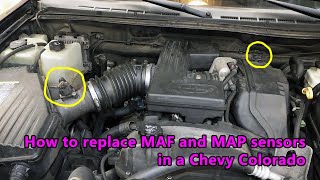
- Replacing the Mass Airflow (MAF) sensor instead of the MAP sensor.
- Replacing the MAP sensor without first thoroughly checking the wiring harness for hidden breaks as specified in TSB PIP4409F.
- Replacing the MAP sensor when the actual root cause is a dirty throttle body causing a 'false' code.
Most Likely Causes
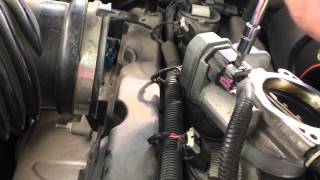
- Dirty or Clogged Throttle Body 🔴 High Probability Carbon buildup around the throttle plate is extremely common. It restricts airflow, and when the PCM's idle memory is reset (e.g., after a battery change), 🎬 Watch how a dirty throttle body triggers a false P0106. it can no longer compensate. The computer sees a throttle angle that doesn't match the resulting low manifold pressure, and incorrectly flags the MAP sensor.
How to confirm: Remove the air intake tube and inspect the throttle body bore and plate for black carbon deposits. The issue is very likely if the P0106 code appeared shortly after the battery was disconnected or died.
Typical fix: Clean the throttle body thoroughly with a dedicated throttle body cleaner and a soft brush. Afterwards, 🎬 Watch this step-by-step guide to cleaning your Canyon's throttle body. a throttle body relearn procedure is necessary. This usually involves letting the engine idle for several minutes to allow the PCM to learn the new idle position.
Est. part cost: $10-$15 (for cleaner) - Faulty Manifold Absolute Pressure (MAP) Sensor 🔴 High Probability The sensor can fail from age, heat cycles, or internal electronic faults, sending incorrect voltage signals.
How to confirm: Test the sensor's voltage output with a multimeter while applying vacuum with a hand pump. With the key on and engine off, the voltage should be high (around 4.5-5V) and drop as vacuum is applied. A scan tool can also show live data; KOEO reading should match local barometric pressure.
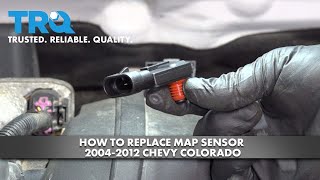
Typical fix: Replace the MAP sensor. It is located on the intake manifold and secured by a small clip 🎬 See how to properly remove and replace the MAP sensor. or bolt.
Est. part cost: $30-$80 - Broken or Damaged MAP Sensor Wiring/Connector 🔴 High Probability TSB #PIP4409F specifically calls out that MAP sensor circuits can be broken inside the wire's insulation, making the damage invisible. Engine vibration and heat contribute to this failure over time, often within inches of the connector.
How to confirm: Perform a continuity test on the signal, ground, and reference voltage wires between the PCM and the sensor connector. Wiggle the harness during testing to expose intermittent breaks. Check the connector for corrosion or pushed-out pins.
Typical fix: Repair the broken section of wire or replace the connector pigtail.
Est. part cost: $10-$30 - Engine Vacuum Leak 🟡 Medium Probability Vacuum hoses (especially PCV lines) and intake manifold gaskets can become brittle and crack with age, introducing unmetered air into the engine and causing MAP readings to be out of range.
How to confirm: Visually inspect all all vacuum lines connected to the intake manifold. Perform a smoke test to find leaks that are not visible. A DIY method involves blowing cigar smoke into the intake system to see where it escapes.
Typical fix: Replace the cracked hose or leaking gasket.
Est. part cost: $5-$100
Rare But Worth Checking
- Clogged Camshaft Actuator Solenoid Screens: As per TSB #PIP3694F, this should be investigated if P0106 is present with a rough idle and camshaft position codes like P0014 or P0017. Dirty oil can clog the fine mesh screens on the solenoids, affecting valve timing and causing a rough idle that the PCM misinterprets as a MAP sensor issue.
- Clogged Catalytic Converter: A severe exhaust restriction can create backpressure in the intake manifold, leading to implausible MAP sensor readings. This is usually accompanied by a significant loss of power, especially at higher RPMs.
- Faulty Powertrain Control Module (PCM): This is extremely rare and should only be considered after all other possibilities, including wiring, have been exhaustively ruled out.
Diagnosis Steps
- Scan for all DTCs. If camshaft codes (P0014, P0017) are present, investigate the camshaft actuator solenoids per TSB #PIP3694F first.
- Inspect and clean the throttle body. If the battery has been recently disconnected or replaced, this is a highly probable fix. Perform a throttle relearn procedure after cleaning by letting the engine idle for 3 minutes, turning it off for 60 seconds, and idling for another 3 minutes.
- With a scan tool, observe the MAP sensor reading (KOEO - Key On, Engine Off). It should read close to the local barometric pressure. At idle, it should drop significantly.
- Visually inspect all vacuum hoses connected to the intake manifold for cracks, disconnection, or collapse. Consider a smoke test for hard-to-find leaks.
- Inspect the MAP sensor electrical connector for corrosion or loose pins.
- Following TSB #PIP4409F, carefully inspect the MAP sensor wiring harness. Perform a wiggle test while checking for continuity on the signal, reference, and ground wires to find internal breaks.
- If wiring and vacuum are good, test the MAP sensor directly with a vacuum pump and multimeter to see if its voltage responds correctly to pressure changes.
- If all else fails, consider the possibility of a restricted exhaust or, as a last resort, a faulty PCM.
Parts You'll Likely Need
- Manifold Absolute Pressure (MAP) Sensor
(OEM #12623671)— This is a common component to fail, causing incorrect pressure readings to be sent to the PCM.
Trusted brands: ACDelco (GM Genuine), ACDelco Professional (p/n 213-4658), Bosch, Standard Motor Products
OEM price range: $50-$90
Aftermarket price range: $30-$60 - Throttle Body Cleaner — A dirty throttle body is a frequent and often overlooked cause of a false P0106 code on this platform.
Trusted brands: CRC, Gumout
Aftermarket price range: $10-$15
Related Codes That Often Appear With This One
- P0300 — A random misfire code often occurs because the incorrect MAP sensor readings lead to an improper air/fuel mixture, causing cylinders to misfire. This is cited in both TSB #PIP4409F and owner complaint #10151176.
- P0107 — This code indicates 'MAP Sensor Circuit Low Voltage.' It can appear with P0106 if the wiring issue involves a short to ground or if the sensor fails in a low-voltage state. TSB #PIP4409F lists this as a related code.
- P0014 / P0017 — These are camshaft position performance codes. TSB #PIP3694F notes that a rough idle caused by a cam actuator issue can also trigger P0106.
- P0506 — This code for 'Idle Air Control System RPM Lower Than Expected' was reported alongside P0106 in owner complaint #10151176, indicating the MAP sensor issue is directly affecting the engine's ability to maintain a stable idle.
Technical Service Bulletins (TSBs) & Recalls
- PIP4409F: Mentions P0106 in conjunction with a rough running engine and advises checking for broken MAP sensor circuit wires inside the insulation.
- PIP3694F: Links P0106 to rough idle conditions that may also be caused by issues with camshaft actuator solenoid screens, especially when P0014 or P0017 are also present.
Platform-Specific Known Issues
- Internal Wiring Breaks: TSB #PIP4409F warns technicians that for P0106 and other related codes, they should inspect the MAP sensor circuits for being broken inside the insulation. This is a known failure point that can be missed with a simple visual check and is corroborated by owner experiences.
- False Code from Dirty Throttle Body: A significant amount of carbon buildup in the throttle body can cause the PCM to set a P0106 code incorrectly. The computer opens the throttle plate more than expected to maintain idle speed, creating a discrepancy between throttle angle and MAP sensor readings that it interprets as a MAP sensor fault. This is especially common after a battery disconnect resets the idle trim values.
Mechanic-Grade Diagnostic Values
- MAP Sensor 5V Reference Wire — expected: ~5.0 Volts DC with key on, engine off.. Failure: Voltage significantly lower than 4.8V or higher than 5.2V indicates a problem with the PCM or wiring.
- MAP Sensor Ground Wire — expected: Less than 0.05 Volts (50 millivolts) when tested against the negative battery terminal.. Failure: Higher voltage indicates a poor ground connection, which is a known issue on this platform.
- MAP Sensor Signal Wire (KOEO - Key On, Engine Off) — expected: ~4.5 - 5.0 Volts at sea level. This should correlate with local barometric pressure.. Failure: Voltage significantly outside this range suggests a faulty sensor or wiring issue.
- MAP Sensor Signal Wire (Engine Idling) — expected: ~1.0 - 1.5 Volts once the engine is warm and idling smoothly.. Failure: Voltage that is too high (e.g., >2.0V) at idle suggests a vacuum leak or poor engine vacuum. Voltage that doesn't change with RPM is a sign of a failed sensor.
- MAP Sensor Signal Wire (Bench Test with Vacuum Pump) — expected: Starting at ~4.5V with 0 in. Hg, the voltage should drop smoothly to ~1.0-1.3V as vacuum is increased to ~20 in. Hg.. Failure: No change in voltage, or erratic jumps, indicates a failed sensor.
Scan Tool Commands That Help
- GM Tech2 / GDS2 or equivalent professional scanner: Throttle/Idle Learn — This function should be used after cleaning or replacing the throttle body to reset the learned idle position. Failure to do so is a primary cause of a 'false' P0106 code after service.
- Any OBD2 scanner with live data: View MAP Sensor (kPa/inHg/Volts) and Barometric Pressure (BARO) — With Key On, Engine Off, the MAP and BARO readings should be nearly identical. If they differ significantly, it points towards a faulty MAP sensor. At idle, the MAP reading should drop to a low value (high vacuum).
Wiring & Ground Locations
- MAP Sensor Connector — On the intake manifold, typically near the firewall. It is a 3-wire connector.. The connector itself or the wiring within 6 inches is a common failure point due to heat and vibration, as noted in TSB PIP4409F. The pins are typically: Pin A - Ground, Pin B - Signal, Pin C - 5V Reference.
- SP106 (Ground Pack) — On the passenger side of the engine compartment, behind the air filter housing.. This is a major ground point for the HVAC control module and Data Link Connector. While not a direct ground for the MAP sensor, poor grounding here can cause bizarre electrical issues and codes, and is a well-documented problem on the 1st Gen Canyon/Colorado platform.
- SP105 (Ground Pack) — On the driver's side of the engine compartment, near the battery and fuse box.. This ground pack serves the fuel pump, EBCM, and various lighting/control modules. A loose or corroded connection here can lead to low voltage conditions and erratic sensor behavior system-wide.
- ECM/PCM Ground — Typically grounded to the engine block itself, often near the front of the engine on the lower block (G101 on similar GM platforms).. The MAP sensor's ground and 5V reference originate at the PCM. If the PCM's own ground is compromised, all sensor readings become unreliable.
Real Owner Repair Stories
- 355nation.net forum user (2005 Chevrolet Colorado (platform twin)) — P0106 code, rough idle, stalling at stops.
❌ Tried (didn't work) Replaced MAP sensor (code returned), Cleaned throttle body (temporary improvement, but code returned)
✅ What actually fixed it The user found a broken wire inside the insulation right at the MAP sensor connector, exactly as described in TSB PIP4409F. After repairing the wire with a new pigtail connector, the code was resolved permanently.
OEM Part Supersession History
Unknown, multiple revisions likely existed→12623671 (also listed as ACDelco 213-4658)— Standard part evolution for improved reliability or manufacturing changes.
Heads up: This part number is widely used across many GM vehicles, including Duramax diesels, but is the correct specified part for the 2004-2011 Canyon/Colorado gasoline engines.
Model Year Variations Within This Range
- 2007-2011: In 2007, the base I4 engine was updated from the 2.8L (LK5) to the 2.9L (LLV), and the I5 was updated from the 3.5L (L52) to the 3.7L (LLR). While the P0106 code's diagnosis remains fundamentally the same, the physical location of some components and vacuum lines may differ slightly. The underlying causes (wiring, throttle body, sensor failure) are common to all 2004-2011 models.
Helpful Videos
Used OEM Parts in Stock


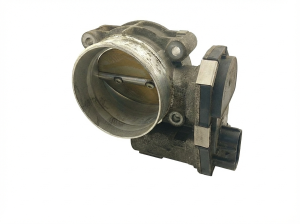
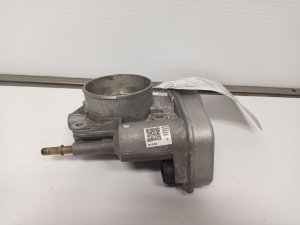
New Aftermarket Parts Available





The information in this article is provided for general reference and educational purposes only. Vehicle specifications, procedures, and part compatibility can vary by production date, trim level, and region. Always consult your vehicle's factory service manual and verify part numbers before purchasing or performing repairs. Safety-critical components such as airbags, seat belts, and braking systems should be installed by a qualified professional.
- Gmc CANYON:
- 🎬 Helpful Videos
- 🛍️ Shop This Part
- What's Unique About the 2004-2011 Gmc CANYON
- Diagnostic Flowchart
- Symptoms You May Notice
- Most Likely Causes
- Rare But Worth Checking
- Diagnosis Steps
- Parts You'll Likely Need
- Related Codes That Often Appear With This One
- Technical Service Bulletins (TSBs) & Recalls
- Platform-Specific Known Issues
- Mechanic-Grade Diagnostic Values
- Scan Tool Commands That Help
- Wiring & Ground Locations
- Real Owner Repair Stories
- OEM Part Supersession History
- Model Year Variations Within This Range
- 🎟️ Get 5% Off