

P0106 on 2021 Ford Explorer: MAP Sensor Performance and Altitude Fixes
On a 2021 Ford Explorer, especially the 3.3L Police Interceptor, code P0106 is often a temporary glitch caused by altitude changes during vehicle transport, as noted in Ford TSBs SSM 50156 and SSM 49446. The official fix is to simply clear the code. If the code returns, the Manifold Absolute Pressure (MAP) sensor is the next most likely cause, followed by vacuum leaks or wiring issues.
- For a 2021 Ford Explorer, the first step for P0106 is to consider if the vehicle was recently transported; if so, simply clearing the code may be the only fix needed.
- If the code returns, the most likely culprit is a faulty MAP sensor.
- Before replacing the sensor, always check for obvious vacuum leaks around the intake manifold, as they can cause the same code.
- Replacing the MAP sensor is a relatively simple DIY job that requires basic tools.
What's Unique About the 2021-2021 Ford EXPLORER
What's unique about the 2021 Explorer, particularly the 3.3L Police Interceptor Utility, is a documented sensitivity that can trigger a P0106 code without any part failure. Ford issued Technical Service Bulletins (TSBs) explaining that transporting the vehicle to higher altitudes can cause the code to set when the vehicle is in transport mode. The PCM's stored barometric pressure reading from the original location conflicts with the new, higher-altitude reading at the next key-on event. In these specific cases, the only required action is to clear the diagnostic trouble code.
Diagnostic Flowchart
Tap your situation to follow the diagnostic path that matches what you're seeing on this vehicle.
Symptoms You May Notice
- Check Engine Light is on
- Rough or unstable idle
- Hesitation or surging during acceleration
- Decreased fuel economy
- Lack of engine power
- Black smoke from the exhaust (indicating a rich fuel mixture).
- Difficulty starting the engine
- Engine stalling, especially at idle or in stop-and-go traffic.
- Replacing the Mass Airflow (MAF) sensor. Some Ford engines use both a MAF and MAP sensor, but P0106 specifically points to the MAP sensor circuit. The 2.3L and 3.0L EcoBoost engines, for example, use multiple MAP/TIP (Throttle Inlet Pressure) sensors instead of a traditional MAF sensor.
- Replacing the EGR valve. On some older Ford models, the MAP sensor was integrated into the EGR components, leading to confusion. On the 2021 Explorer, they are separate components.
Most Likely Causes
- Altitude Change During Vehicle Transport 🔴 High Probability As documented in Ford TSBs SSM 50156 and SSM 49446, 2021 models (especially 3.3L Police Interceptors) can set this code after being transported to a higher altitude while in transport mode. The PCM sees a discrepancy between the stored barometric pressure and the new reading at key-on.
How to confirm: Check the vehicle's history. If it was recently transported or purchased and delivered from a different region, this is a strong possibility. The code will likely not return after being cleared.
Typical fix: Clear the Diagnostic Trouble Code (DTC) with an OBD-II scanner.
Est. part cost: $0 - Faulty Manifold Absolute Pressure (MAP) Sensor 🟡 Medium Probability The MAP sensor is a critical electronic component that operates in a harsh engine bay environment. Over time, it can fail, become contaminated with oil or carbon, or lose accuracy. Turbocharged EcoBoost engines, in particular, rely heavily on accurate pressure readings for performance.
How to confirm: Using a scan tool, compare the MAP sensor reading to the BARO reading with the key on and engine off. They should be nearly identical. You can also test the sensor's voltage output with a multimeter; it should typically be between 0.5 to 1.5 volts at idle and rise toward 4.5 volts under load. 🎬 Watch: How to diagnose a MAP sensor using a multimeter.
Typical fix: Replace the MAP sensor. It is often located directly on the intake manifold.
Est. part cost: $35-$85 - Vacuum Leak 🟡 Medium Probability Hoses connected to the intake manifold, PCV system, or brake booster can crack, become loose, or break, allowing unmetered air to enter the engine. This throws off the pressure reading that the MAP sensor expects to see. The o-ring seal for the MAP sensor itself can also be a leak point.
How to confirm: Visually inspect all vacuum lines and the air intake hose for cracks or loose connections. A smoke test is the most effective way to find small, 🎬 See how to perform a smoke test for vacuum leaks. hard-to-see leaks. Spraying brake cleaner or starter fluid near suspected leak areas and listening for a change in engine idle can also help pinpoint a leak, but this should be done with caution.
Typical fix: Repair or replace the leaking hose or gasket.
Est. part cost: $5-$50 - Clogged Air Filter ⚪ Low Probability A severely restricted air filter can reduce the amount of air entering the intake manifold, causing an abnormally low pressure reading which the PCM may interpret as a performance issue.
How to confirm: Visually inspect the engine air filter. If it is visibly dirty or clogged, it needs replacement.
Typical fix: Replace the engine air filter.
Est. part cost: $15-$40
Rare But Worth Checking
- Damaged Wiring or Connector: The wiring to the MAP sensor can become damaged, or the connector pins can get corroded or loose, causing an intermittent or incorrect signal. This should be checked before replacing the sensor itself by inspecting for 5V reference voltage, ground, and a signal wire that changes voltage with pressure.
- Clogged Catalytic Converter: A blocked exhaust can create backpressure in the engine, which can affect the intake manifold pressure and potentially trigger a P0106 code. This is usually accompanied by other codes and a severe loss of power.
- Faulty Powertrain Control Module (PCM): This is the least likely cause. The PCM should only be considered after all other possibilities, including sensors, wiring, and mechanical issues, have been thoroughly ruled out.
Diagnosis Steps
- Connect an OBD-II scanner to read the code and check for any other stored codes. Record the freeze frame data to see the engine conditions when the code was set.
- Review the vehicle's recent history. If it was just delivered or transported from a different altitude, clear the code as per TSBs SSM 50156 and SSM 49446. Drive the vehicle to see if the code returns.
- If the code returns, perform a thorough visual inspection of the engine bay. Look for any cracked, disconnected, or broken vacuum hoses connected to the intake manifold, including the PCV and brake booster lines.
- Inspect the MAP sensor's electrical connector for damage, corrosion, or loose pins. Check for a stable 5-volt reference, good ground, and a signal wire.
- With the key on and engine off (KOEO), use a scan tool with live data capability to compare the MAP sensor reading (in kPa or Hg) with the BARO sensor reading. They should be very close to each other.
- Start the engine and observe the MAP sensor reading at idle. It should drop significantly (indicating vacuum). Briefly snap the throttle open; the reading should jump up towards the BARO reading.
- If the sensor readings are illogical, do not change, or are stuck at 5V, the sensor is likely faulty and should be replaced.
- If the sensor appears to function but the code persists, perform a smoke test to definitively check for hard-to-find vacuum leaks, paying close attention to the intake manifold gaskets and the MAP sensor's own O-ring seal.
Parts You'll Likely Need
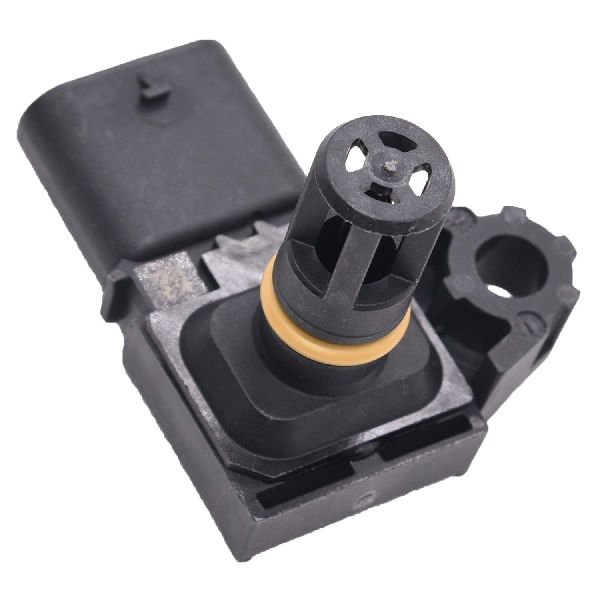
- Manifold Absolute Pressure (MAP) Sensor
(OEM #JG9Z-9F479-B)— This sensor is the most common hardware failure for a P0106 code after the TSB-related glitch is ruled out. It directly measures the pressure the code is reporting as out of range. This part number fits various Ford engines including the 2.3L EcoBoost.
Trusted brands: Motorcraft, Bosch, Standard Motor Products, Walker
OEM price range: $65-$105
Aftermarket price range: $35-$80
Technical Service Bulletins (TSBs) & Recalls
- SSM 50156: Addresses DTC P0106 setting after key-off transportation to higher altitudes on 3.3L engines.
- SSM 49446: An earlier bulletin describing the same issue with P0106 being set in transport mode, especially at higher altitudes.
Platform-Specific Known Issues
- TSB SSM 50156 & SSM 49446: On 2021 Explorer and Police Interceptor Utility vehicles with the 3.3L engine, DTC P0106 may be stored after the vehicle has been transported to a higher altitude while in transport mode. The official Ford procedure is to clear the DTC and verify the issue does not return under normal operation.
- EcoBoost Engine Complexity: The 2.3L and 3.0L EcoBoost engines utilize a speed-density system with multiple pressure sensors (often called MAP and TIP sensors) instead of a single MAF sensor. One is typically located on the intake manifold post-throttle body, and another is on the charge air cooler piping pre-throttle body. A failure or leak related to either can contribute to pressure rationality codes like P0106.
Mechanic-Grade Diagnostic Values
- MAP vs. BARO Sensor Reading (KOEO) — expected: Readings should be nearly identical, within 1.0 inHg (3.3 kPa) of each other.. Failure: A significant difference between the two readings points to a faulty MAP sensor or a biased BARO sensor.
- MAP Sensor Signal Voltage at Idle — expected: Approximately 1.0V to 1.5V.. Failure: Voltage that is significantly higher or lower, or does not respond to throttle changes, indicates a sensor or circuit problem.
- MAP Sensor Signal Voltage at Wide Open Throttle (WOT) — expected: Approximately 4.5V.. Failure: Failure to reach near 4.5V at WOT suggests a faulty sensor or a restriction in the intake.
- MAP Sensor Reference Voltage — expected: Approximately 5.0V on the VREF wire with key on, engine off.. Failure: No voltage or low voltage indicates a wiring issue or a problem with the PCM's 5V reference circuit.
Hidden / Shadow Codes Worth Checking
- Mode 6, Test ID $81: On many Ford CAN-bus systems, Test ID $81 relates to MAP sensor rationality and performance checks. Monitoring the values and status of this test can reveal intermittent sensor issues before a hard P0106 code is stored. (see via A professional scan tool or advanced DIY scanner (like FORScan) with Mode 6 capabilities.)
Scan Tool Commands That Help
- Ford IDS, FORScan, or equivalent professional scanner: Reset All Adaptations / Clear Transmission Adaptive Tables / Keep Alive Memory (KAM) Reset — After replacing a MAP sensor or fixing a significant vacuum leak, performing a KAM reset is crucial. This forces the Powertrain Control Module (PCM) to erase its learned fuel and air tables and start a new learning process with the corrected sensor inputs, preventing the old, incorrect data from causing persistent driveability issues.
Wiring & Ground Locations
- MAP Sensor Connector — Directly on the MAP sensor, which is typically mounted on the intake manifold.. The 3-pin connector provides the sensor with a 5V reference (VREF), a ground (Signal Return/SIGRTN), and sends the pressure signal back to the PCM. Corrosion, moisture, or a loose connection at these pins will directly cause a P0106 code.
- Ground G103 — Typically located on the right-front of the engine compartment on the body structure.. This is a major engine bay ground point. Many engine sensors, including potentially the MAP sensor's reference ground circuit, rely on this point for a clean signal. A loose or corroded G103 can introduce electrical noise and cause erratic readings for multiple sensors, including the MAP.
Real Owner Repair Stories
- Forum report on a platform-sharing Lincoln Aviator (2020 Lincoln Aviator (shares platform and engine architecture with Explorer)) — P0106 and P0068 (MAP/MAF - Throttle Position Correlation) codes present, along with rough running.
❌ Tried (didn't work) Cleaning the MAP sensors
✅ What actually fixed it Replacement of the entire throttle body. The internal throttle position sensor was failing, causing the PCM to see a conflict between the expected airflow (from the MAP sensor) and the reported throttle angle, triggering both codes. This highlights that P0106 can be a secondary code caused by a related component. - Ford F-150 forum user with similar engine architecture (Ford F-150 with EcoBoost engine) — Persistent P0106 code and rough idle.
❌ Tried (didn't work) Replacing the MAP sensor
✅ What actually fixed it A small, hard-to-see vacuum line under the intake manifold had cracked. This line was not easily visible during initial inspection and was only found during a more thorough search for leaks. It emphasizes the need for meticulous inspection or a smoke test for vacuum leaks.
"I Checked Everything" — The Actual Cause
- On EcoBoost engines, a hairline crack in the plastic intake manifold can be the cause. This type of leak may not show up during a standard vacuum-based smoke test at idle. However, under boost pressure during acceleration, the crack opens up, causing a significant pressure leak that the PCM detects as a MAP sensor performance issue. The diagnosis is often confirmed by pressurizing the intake system instead of applying vacuum, and the fix is a complete intake manifold replacement.
OEM Part Supersession History
JG9Z-9F479-A→JG9Z-9F479-B— Standard part revision, likely for improved durability, material, or manufacturing process.
Heads up: The parts are interchangeable, with the 'B' revision being the recommended replacement. The Motorcraft service part number is often DY1337, which cross-references to the OEM part.
Helpful Videos

We Have This Part in Stock


The information in this article is provided for general reference and educational purposes only. Vehicle specifications, procedures, and part compatibility can vary by production date, trim level, and region. Always consult your vehicle's factory service manual and verify part numbers before purchasing or performing repairs. Safety-critical components such as airbags, seat belts, and braking systems should be installed by a qualified professional.
- Ford EXPLORER:
- 🎬 Helpful Videos
- 🛍️ Shop This Part
- What's Unique About the 2021-2021 Ford EXPLORER
- Diagnostic Flowchart
- Symptoms You May Notice
- Most Likely Causes
- Rare But Worth Checking
- Diagnosis Steps
- Parts You'll Likely Need
- Technical Service Bulletins (TSBs) & Recalls
- Platform-Specific Known Issues
- Mechanic-Grade Diagnostic Values
- Hidden / Shadow Codes Worth Checking
- Scan Tool Commands That Help
- Wiring & Ground Locations
- Real Owner Repair Stories
- "I Checked Everything" — The Actual Cause
- OEM Part Supersession History
- 🎟️ Get 5% Off