

P0106 on 2007-2010 Chevrolet Silverado 2500: MAP Sensor Causes and Fixes
On a 2007-2010 Silverado 2500, P0106 is most often caused by a faulty or contaminated Manifold Absolute Pressure (MAP) sensor. In cold climates, sensor icing is a known issue addressed in GM service bulletins. Cleaning the sensor and its port in the intake manifold is a crucial first step, but replacement is the most common fix, costing $30-$80 for the part. In some cases, a dirty throttle body or a more severe mechanical issue like a broken valve spring can also trigger this code.
- P0106 on a 2007-2010 Silverado almost always points to the Manifold Absolute Pressure (MAP) sensor or its immediate environment.
- Before replacing any parts, remove the MAP sensor and inspect its port in the intake manifold for ice, oil, or carbon buildup, as this is a very common issue on this truck.
- If the sensor and port are clean, or if cleaning doesn't fix the issue, replacing the MAP sensor is the next logical step and has a high probability of success.
- Be aware of TSBs related to sensor icing in cold climates for both gasoline and diesel engines; this is a known design quirk.
- While less common, check for vacuum leaks and a dirty throttle body before assuming a more complex problem.
What's Unique About the 2007-2010 Chevrolet SILVERADO 2500
For this generation of Silverado (GMT900), the MAP sensor is particularly susceptible to contamination. GM issued technical service bulletins for both gasoline and diesel engines regarding this code. For gasoline models, moisture can freeze on the sensor in cold weather, a problem addressed by TSB PI1257 which involved a redesigned intake manifold to relocate the sensor. For Duramax diesel models (LMM, LBZ, LLY), a similar issue of icing or oily residue can occur, with TSB PIP4307H detailing a fix that involves fabricating and retrofitting an extension to move the sensor's inlet farther into the air intake tube. These known issues make contamination a primary suspect on this truck, often more so than outright sensor failure, especially in freezing temperatures.
Diagnostic Flowchart
Tap your situation to follow the diagnostic path that matches what you're seeing on this vehicle.
Symptoms You May Notice
- Check Engine Light (Service Engine Soon lamp) is on.
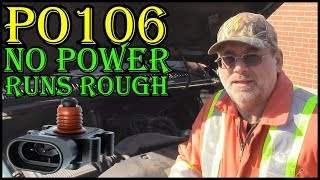
- Reduced engine power message displayed on the driver information center. 🎬 See how these symptoms look and feel in this video.
- Rough or unstable idle.
- Poor acceleration or hesitation.
- Decreased fuel economy.
- Black smoke from the exhaust.
- Engine stalling, especially when coming to a stop.
- Engine backfire.
- Audible ticking or clicking noise from the engine (if related to a broken valve spring).
- Replacing the Mass Airflow (MAF) sensor. The MAF and MAP sensors work together, but P0106 specifically points to a performance issue in the MAP sensor circuit.
- Replacing the throttle body when it only needs cleaning.
- Replacing the MAP sensor without first cleaning the port in the intake manifold, which is often the actual source of the problem.
Most Likely Causes
- Contaminated or Faulty MAP Sensor 🔴 High Probability As documented in TSBs PI1257 (gas) and PIP4307H (diesel), the MAP sensor location is prone to contamination from moisture, ice, or oil blow-by, especially in cold climates. This is a well-known issue for this platform, with many owner reports of the code appearing in freezing weather. The sensor can also simply fail electronically over time due to heat and vibration.
How to confirm: Remove the MAP sensor from the top of the intake manifold. Visually inspect the sensor's tip and the port in the manifold for any oil, carbon, or moisture/ice. Even if clean, the sensor can fail electronically. Use a scan tool to monitor MAP sensor voltage with Key On, Engine Off (KOEO); it should read ~4.5-4.8V. At idle, it should drop to ~1.0-2.0V. If readings are stuck or erratic, the sensor is likely bad.
Typical fix: Clean the intake manifold port thoroughly with a pick and cleaner. Clean the sensor with dedicated MAF/electrical cleaner (do not use harsh chemicals like brake cleaner). If cleaning doesn't resolve the code, replace the MAP sensor.
Est. part cost: $30 - $80 - Vacuum Leak 🟡 Medium Probability Hoses and intake manifold gaskets can become brittle and crack over time due to age and heat cycles, leading to unmetered air entering the engine, which confuses the MAP sensor.
How to confirm: Visually inspect all vacuum hoses connected to the intake manifold for cracks or disconnections, especially the PCV and brake booster lines. A smoke test is the most effective way to find hard-to-see leaks. You can also spray carburetor cleaner around suspected areas while the engine is idling; a change in idle RPM indicates a leak.
Typical fix: Replace the cracked hose or leaking gasket.
Est. part cost: $10 - $150 - Dirty Throttle Body 🟡 Medium Probability Carbon can build up around the throttle plate, restricting airflow at idle. The ECM compensates by opening the throttle plate more than expected, creating a mismatch between the throttle position and the MAP sensor reading, which can falsely trigger P0106. This is a common issue on GM's electronic throttle control systems.
How to confirm: Remove the air intake tube from the throttle body and inspect for significant black carbon buildup on the throttle plate and bore.
Typical fix: Clean the throttle body thoroughly with a dedicated throttle body cleaner and a soft brush or rag. Do not spray excessive cleaner into the electronic components. An idle relearn procedure may be necessary after cleaning.
Est. part cost: $10 - $20 - Damaged Wiring or Connector ⚪ Low Probability The wiring harness in the engine bay is exposed to heat and vibration, which can lead to chafing, corrosion, or loose connections at the MAP sensor connector over time. The plastic locking tabs on the connector can also become brittle and break.
How to confirm: Inspect the MAP sensor's electrical connector for corrosion, damage, or a loose fit. Wiggle the harness while the engine is running to see if it affects the idle. Use a multimeter to check for a 5V reference, ground, and a signal voltage at the connector.
Typical fix: Repair the damaged wiring or replace the connector pigtail.
Est. part cost: $15 - $50
Rare But Worth Checking
- Broken Valve Spring: While rare, GM TSB #PIP5423B specifically links P0106 (often with P0506) to a broken valve spring. This would cause a very rough idle, significant performance issues, and potentially a ticking noise. If a broken spring is found, the TSB also advises inspecting the intake manifold for a collapsed runner.
- Clogged Air Filter: A severely clogged engine air filter can restrict airflow enough to affect manifold pressure and trigger a P0106 code. This is a simple and inexpensive item to check first.
Diagnosis Steps
- Check for other DTCs with a scanner. If codes like P0506 or P0300 are present, it may point toward a more serious mechanical issue like a broken valve spring.
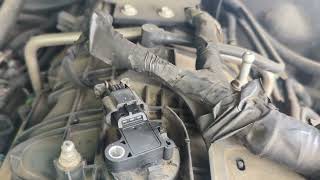
- Visually inspect the MAP sensor, which is located on top of the intake manifold. Check its connector and wiring for any signs of damage, corrosion, or loose connections.
- Remove the MAP sensor. It is typically held in by a clip or a small Torx/hex bolt. Inspect the sensor tip and the port in the intake manifold for contamination like oil, carbon, or ice.
- Clean the intake manifold port thoroughly using a small pick or brush and an appropriate cleaner. Clean the sensor tip gently with MAF or electrical contact cleaner. Ensure it is completely dry before reinstalling.
- Inspect all vacuum lines connected to the intake manifold for cracks, brittleness, or disconnection. Pay close attention to the PCV and brake booster hoses.
- If the code persists after cleaning and inspection, the MAP sensor is likely faulty and should be replaced. This is the most common repair.
- If a new sensor does not resolve the issue, inspect and clean the throttle body for heavy carbon buildup, as this is a known cause of false P0106 codes.
- If all else fails, perform a smoke test to find a hidden vacuum leak or consider a more advanced mechanical inspection for issues like a broken valve spring, especially if a rough idle persists.
Parts You'll Likely Need
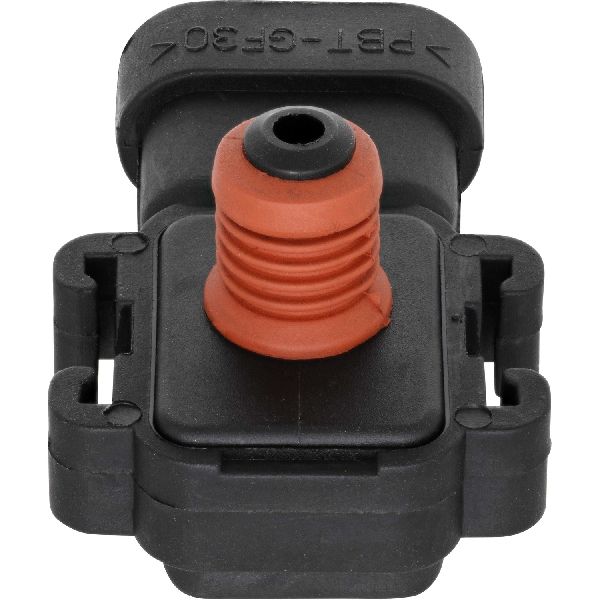
- Manifold Absolute Pressure (MAP) Sensor
(OEM #12644228, 12591290)— This is the most common cause of P0106 on this vehicle, due to either electronic failure or contamination as noted in multiple TSBs. Part number 12644228 is a common replacement, while 12591290 was used on some original applications. Always verify the correct part for your specific vehicle.
Related Codes That Often Appear With This One
- P0108 — This code for 'MAP Circuit High Input' can appear with P0106 if the sensor is failing and sending erratic voltage signals. TSB N212330660 also mentions these two codes appearing together, recommending a MAP sensor replacement.
- P0506 — This code for 'Idle Air Control System RPM Lower Than Expected' is specifically mentioned in TSBs PIP5423 and PIP5752M as appearing with P0106 when a broken valve spring is the cause.
- P0107 — This code for 'MAP Circuit Low Input' can appear with P0106 as it indicates another type of implausible signal from a failing MAP sensor or a significant vacuum leak.
- P0300 — A random misfire code can accompany P0106, especially if the root cause is a major vacuum leak or a mechanical issue like a broken valve spring (as noted in TSB PIP5752M).
Technical Service Bulletins (TSBs) & Recalls
- N212330660: Recommends replacing the MAP sensor when P0106 and/or P0108 are present.
- 21-NA-214: Lists P0106 among many other codes that can be set due to engine vibration or exhaust brake issues.
- PIP5344: Connects P0106 with 'Reduced Power' messages and advises following standard diagnostics.
- PIP5423B: Links P0106 and P0506 to a possible broken valve spring.
- PI1257: Details a procedure to install a new design upper intake manifold to prevent MAP sensor icing on 2007 gasoline models.
- PIP4307H: Details a procedure to fabricate an extension for the MAP sensor on 6.6L Duramax engines to prevent icing.
Platform-Specific Known Issues
- TSB PI1257 (for gasoline engines): Notes that the original upper intake manifold design on 2007 models can allow ice to form on the MAP sensor, causing P0106 in cold weather. The official fix was a redesigned intake manifold that relocates the sensor.
- TSB PIP4307H (for 6.6L Duramax diesel engines): Describes a similar issue where condensation or oil can freeze in the MAP sensor. The fix involves fabricating an extension to move the sensor's inlet farther into the air intake tube. The bulletin advises cleaning the sensor with soap and water only.
- TSB PIP5423B: Points to a potential for a broken valve spring to cause codes P0106 and P0506, which would result in a rough idle. This requires removing the valve cover to inspect.
- TSB 20-NA-043 / Bulletin 19-NA-233 (Newer models but relevant principle): Discusses ice forming on the TMAP sensor during long drives in freezing temperatures, causing P0106. The recommended solution is installing a winter grille cover to reduce the effect.
Mechanic-Grade Diagnostic Values
- MAP Sensor 5V Reference Circuit (Pin A or 1) — expected: 4.8 - 5.2 Volts DC with key on, engine off.. Failure: Voltage below 4.8V or above 5.2V points to a wiring issue or a fault in the Engine Control Module (ECM).
- MAP Sensor Low Reference Circuit (Pin C or 2) — expected: Less than 5 ohms of resistance to ground.. Failure: Resistance greater than 5 ohms indicates an open or high resistance in the ground circuit, which could be a wiring or ECM issue.
- MAP Sensor Signal (Key On, Engine Off) — expected: 4.5 - 4.8 Volts DC (should reflect barometric pressure).. Failure: Voltage significantly outside this range suggests a faulty sensor.
- MAP Sensor Signal (Engine at Idle) — expected: 1.0 - 2.0 Volts DC.. Failure: Voltage higher than 2.0V at idle suggests low engine vacuum, which could be caused by a vacuum leak or a mechanical engine problem.
- MAP Sensor Signal with Vacuum Applied — expected: Voltage should drop as vacuum increases. At 5 in. Hg, expect 3.9-4.1V. At 10 in. Hg, expect 2.8-3.0V.. Failure: Voltage does not drop smoothly or is erratic as vacuum is applied, indicating a faulty sensor.
Wiring & Ground Locations
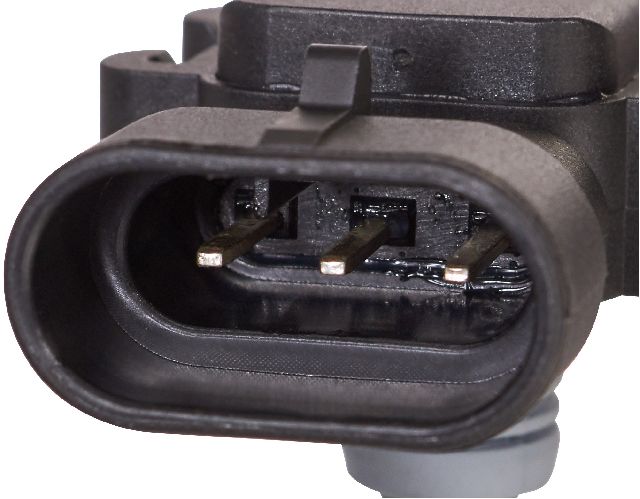
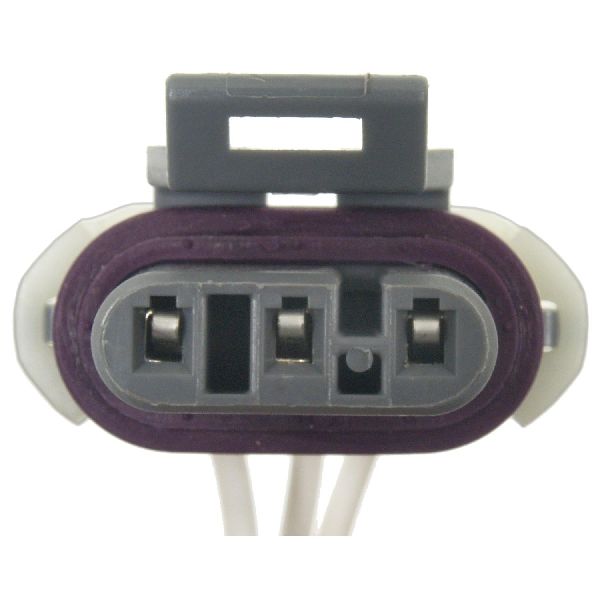
- MAP Sensor Connector — On the MAP sensor, which is located on top of the intake manifold.. The three wires in the connector provide power, ground, and signal for the sensor. Pin A (or 1) is the 5-volt reference, Pin B (or 3) is the signal wire, and Pin C (or 2) is the low reference (ground). Testing voltage and resistance at these specific pins is critical for diagnosis.
- G103 — On the front of the right (passenger side) cylinder head.. This is a primary ground location for the Powertrain Control Module (PCM/ECM). A poor connection here can cause erratic behavior from multiple sensors, including the MAP sensor, and may lead to various codes like P0300 and P0106.
- G104 — On the front of the left (driver side) cylinder head.. This is another critical engine ground. Ensuring all engine-to-chassis grounds are clean and tight is a key step when diagnosing unexplained electrical or sensor performance codes.
- J106 — A splice point located in the engine harness, approximately 23cm (9 inches) from the MAP sensor breakout.. This splice connects multiple sensor grounds. Corrosion or a break at this hidden point in the harness could cause the MAP sensor to lose its reference ground, leading to a P0106 code.
Real Owner Repair Stories
- Reddit user on r/AlfaRomeo (similar issue, different vehicle) (2018 Alfa Romeo Stelvio) — No-start condition that seemed like a dead battery, followed by a cloud of white smoke from the driver's side wheel well after a few start attempts.
❌ Tried (didn't work) Attempting to restart the car.
✅ What actually fixed it The root cause was a corroded main engine-to-transmission ground strap. The starter motor overloaded a smaller ground wire, melting parts of the main engine wiring harness. The fix required replacing the entire engine wiring harness and the faulty ground strap. This highlights how a bad ground can cause catastrophic electrical issues that may present as sensor codes.
"I Checked Everything" — The Actual Cause
- In a documented case on a Silverado, a P0106 code with a rough run condition persisted after a smoke test showed no external leaks. The actual cause was a broken valve spring on one cylinder. The broken spring allowed hot exhaust gas to push back into the plastic intake manifold, melting an intake runner from the inside and creating a large internal vacuum leak that a smoke test could not easily identify.
OEM Part Supersession History
12591290→55573248— Part update/revision by GM.
Heads up: While 55573248 is the official replacement, 12591290 is still widely sold and used for 2007-2010 applications.12644228→12711681— Part update/revision by GM.
Heads up: 12644228 is a very common replacement part for this generation. While technically superseded, it remains a primary service part.
Helpful Videos
We Have This Part in Stock



The information in this article is provided for general reference and educational purposes only. Vehicle specifications, procedures, and part compatibility can vary by production date, trim level, and region. Always consult your vehicle's factory service manual and verify part numbers before purchasing or performing repairs. Safety-critical components such as airbags, seat belts, and braking systems should be installed by a qualified professional.
- Chevrolet SILVERADO 2500:
- 🎬 Helpful Videos
- 🛍️ Shop This Part
- What's Unique About the 2007-2010 Chevrolet SILVERADO 2500
- Diagnostic Flowchart
- Symptoms You May Notice
- Most Likely Causes
- Rare But Worth Checking
- Diagnosis Steps
- Parts You'll Likely Need
- Related Codes That Often Appear With This One
- Technical Service Bulletins (TSBs) & Recalls
- Platform-Specific Known Issues
- Mechanic-Grade Diagnostic Values
- Wiring & Ground Locations
- Real Owner Repair Stories
- "I Checked Everything" — The Actual Cause
- OEM Part Supersession History
- 🎟️ Get 5% Off