

P0106 on 2007-2013 BMW M3 S65: MAP Sensor, ICV, and Throttle Actuator Causes
On the S65 V8, P0106 is often caused by a faulty Manifold Absolute Pressure (MAP) sensor itself, a failing Idle Control Valve (ICV), or as a secondary code from failing Throttle Body Actuators. Start by checking for other codes; if P0106 is isolated, the MAP sensor is the most likely culprit, costing around $100-$170 for the part. Accessing the sensor is difficult as it requires removing the intake plenum.
- On the E9x M3, P0106 points to a problem with the MAP sensor's reading, which is critical for this MAF-less engine.
- Before buying parts, perform a full scan of the DME. If you see codes like 2B15 or 2B16, the problem is your Throttle Body Actuators, not the MAP sensor.
- If P0106 is the only code, the MAP sensor itself is the most likely failure point and the cheapest part to replace.
- If your main symptom is a wild, hunting idle and stalling, the Idle Control Valve (ICV) is a very strong possibility, even if it only throws a P0106 code.
- Replacing the ICV or Throttle Body Actuators requires removing the intake plenum and is a significantly more involved job than replacing the MAP sensor.
What's Unique About the 2007-2013 BMW M3
Unlike typical engines, the high-performance S65 V8 uses eight individual throttle bodies and is MAF-less, making the MAP sensor's role in fuel calculations absolutely critical. While a P0106 code on another car might point to a simple vacuum leak, on the E9x M3 it is frequently linked to one of the platform's well-known failure points: the Idle Control Valve (ICV) or the Throttle Body Actuators (TBAs). These components can cause erratic manifold pressure when they fail, leading the DME to flag the MAP sensor's readings as out of range.
Symptoms You May Notice
- Check Engine Light and/or 'Service Engine Soon' message
- Rough, erratic, or hunting idle speed, sometimes shaking the car violently.
- Engine stalling, especially when coming to a stop or after refueling.
- Hesitation or stumbling during acceleration.
- Reduced engine power or 'limp mode' activation.
- Increased fuel consumption.
- Black smoke from the exhaust, indicating a rich fuel mixture.
- Engine backfiring due to incorrect air-fuel mixture timing.
- Replacing O2 sensors. A bad MAP sensor can throw off the air-fuel mixture, which may lead to secondary oxygen sensor codes (like P0152d). A user on an M3 forum noted they had both MAP and O2 sensor codes, and replacing the MAP sensor resolved both. Always address the primary MAP sensor code first before replacing O2 sensors.
Most Likely Causes
- Faulty Manifold Absolute Pressure (MAP) Sensor 🔴 High Probability The S65 engine is MAF-less, placing a high reliance on the MAP sensor for fueling. The sensor's O-ring can degrade over time, causing a poor seal, or the sensor itself can fail electronically. Its location at the rear of the engine valley subjects it to significant heat.
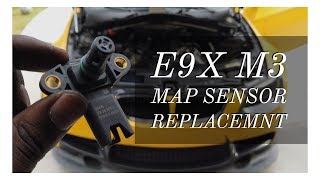
How to confirm: Scan for codes. If P0106 is the primary or only code present and returns immediately after clearing, the MAP sensor is a strong suspect. Visually inspect the sensor and its connector for damage or oil contamination. The sensor is located on the back of the intake plenum near the firewall and is very difficult to access, requiring removal of the plenum and secondary air pump. 🎬 Watch: Step-by-step guide to replacing the MAP sensor.
Typical fix: Replace the MAP sensor and its O-ring seal. Ensure the mounting surface on the intake plenum is clean before installing the new sensor. Due to the labor involved, it's wise to have the new part on hand before starting the job.
Est. part cost: $100 - $170 - Failing Idle Control Valve (ICV) 🟡 Medium Probability The ICV is a known common failure item on the S65 engine, often discussed alongside throttle actuators as a key weak point. It is an electronic actuator that regulates airflow at idle, and when it fails, it causes erratic idle and stalling. A service bulletin, SI B 13 05 08, was issued for this component.
How to confirm: Symptoms are the key indicator: a wildly fluctuating idle ('hunting'), engine struggling to maintain RPMs, and stalling are classic signs of a bad ICV. The erratic airflow caused by a failing ICV can lead to manifold pressure readings that the DME interprets as a MAP sensor fault, triggering P0106. Sometimes, cleaning the ICV can resolve the issue, but replacement is often necessary.
Typical fix: Replacement of the Idle Control Valve. This part is located deep in the engine valley underneath the intake plenum, making replacement a labor-intensive job often performed at the same time as throttle actuator replacement. 🎬 See this walkthrough for replacing the idle control valve.
Est. part cost: $400 - $700 - Failing Throttle Body Actuators (TBA) 🟡 Medium Probability TBAs are one of the most notorious failure points on the S65 engine, with a near 100% failure rate over the life of the vehicle. Internal plastic gears and electronics wear out due to heat and age, causing an inability to control the throttle banks.
How to confirm: Check for specific TBA fault codes like 2B15, 2B16, 2B21, 2B22, 2B57, or CDC0. Failure often results in immediate limp mode with DSC and EML lights. While not a direct cause, the erratic throttle control from a failing TBA can create manifold pressure conditions that trigger a P0106 code as a secondary, symptomatic fault.
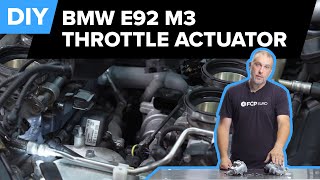
Typical fix: Replace both throttle body actuators. They are sold individually but should always be replaced in pairs. This is an involved DIY or an expensive shop repair. 🎬 Watch: The ultimate DIY guide for replacing throttle actuators.
Est. part cost: $1000 - $1800 for a pair - Vacuum Leak ⚪ Low Probability The complex intake system has multiple sealing points. The main intake plenum seals against eight individual throttle bodies with clamps that can loosen, and various vacuum hoses (like the fuel tank breather valve) can crack with age.
How to confirm: Perform a visual inspection of all intake tract components. Check that all eight throttle body clamps are secure. A smoke test is the most effective way to find a leak in the intake system.
Typical fix: Tighten loose clamps or replace cracked hoses or gaskets. The fuel tank breather valve (PN 13907838281) is a common source of idle issues and is relatively inexpensive to replace.
Est. part cost: $5 - $100
Rare But Worth Checking
- Wiring Harness Issue: Damage to the wiring or connector for the MAP sensor can cause an open or short, mimicking a failed sensor. This is worth checking, especially given the sensor's location near the hot firewall where wiring can become brittle. A user on M3Post noted that if the code returns instantly after clearing, a wiring short is a possibility.
- Faulty DME (Engine Computer): This is extremely rare, but a failure within the DME's internal processing for the MAP sensor circuit could theoretically cause this code. All other possibilities should be exhausted before considering the DME.
Diagnosis Steps
- Scan for all stored fault codes using a BMW-specific scanner (like ISTA) if possible. Pay close attention to any codes for Throttle Body Actuators (e.g., 2B15, 2B16, 2B21) or Idle Control Valve.
- If P0106 is the only relevant code and returns immediately after clearing, your primary suspect is the MAP sensor itself.
- If codes for TBAs are present, diagnose the TBA system first. P0106 is likely a secondary code and may resolve after TBA replacement.
- If no other codes are present but the idle is extremely erratic and the engine is stalling, suspect the Idle Control Valve or the fuel tank breather valve.
- Inspect the intake system for vacuum leaks. Check that the eight hose clamps securing the intake plenum to the throttle bodies are tight. Listen for hissing sounds at idle. A smoke test is the most definitive method.
- Inspect the MAP sensor's electrical connector for damage, corrosion, or a loose fit. The sensor is located on the intake plenum against the firewall, which is very difficult to see without a mirror.
- If accessible, use a multimeter to test the MAP sensor's voltage. It should have a 5V reference wire, a ground, and a signal wire that changes voltage with engine RPM/load. Use ISTA to identify the specific pin functions (Supply, Ground, Signal).
- If the sensor, wiring, and vacuum integrity seem good, consider cleaning the MAP sensor port and the sensor itself with a dedicated electronics cleaner. However, given the labor to access it, replacement is often the more prudent choice.
Parts You'll Likely Need
- Manifold Absolute Pressure (MAP) Sensor
(OEM #13627843206)— This is the most direct cause for a P0106 code when no other faults are present. The sensor itself can fail or its O-ring seal can degrade.
Trusted brands: Bosch, Genuine BMW
OEM price range: $150-$180
Aftermarket price range: $90-$130 - Idle Control Valve (ICV)
(OEM #13417838024)— A very common failure on the S65 that causes erratic idle and stalling, which can trigger a P0106 code due to the unstable manifold pressure.
Trusted brands: VDO, Genuine BMW
OEM price range: $600-$700
Aftermarket price range: $400-$550 - Throttle Body Actuator (TBA)
(OEM #13627838085)— The most notorious failure point on the S65. A failing TBA creates erratic airflow that can trigger P0106 as a secondary fault. Always replace in pairs.
Trusted brands: Genuine BMW, VDO (OEM Supplier), Rebuilt (e.g., Evolve, Euro Power Motorsports)
OEM price range: $900-$1100 each
Aftermarket price range: $500-$700 each (rebuilt)
Related Codes That Often Appear With This One
- P0171 / P0174 — System Too Lean. A vacuum leak or a MAP sensor that is incorrectly reporting low engine load (high vacuum) can cause the DME to not inject enough fuel, leading to a lean condition.
- 2B15 / 2B16 / 2B21 / 2B57 / 2B2D — Throttle Body Actuator codes. If P0106 appears with these codes, the root cause is almost certainly the throttle actuators, and P0106 is just a symptom of the resulting erratic airflow.
- P030x (e.g., P0300, P0301, P0305) — Cylinder Misfire codes. An incorrect MAP signal can lead to improper fueling and cause misfires across multiple cylinders. One owner reported P0106 along with misfires on all four cylinders of one bank.
Platform-Specific Known Issues
- The S65 engine is known for three major electronic component failures in the intake system: the MAP sensor, the Idle Control Valve, and the Throttle Body Actuators. The symptoms can overlap, so a full code scan is critical to differentiate the root cause.
Mechanic-Grade Diagnostic Values
- MAP Sensor Signal Voltage (KOEO) — expected: ~4.5 V, corresponding to atmospheric pressure (approx. 1000 mbar).. Failure: Voltage significantly different from expected, or not matching the barometric pressure sensor reading in live data.
- MAP Sensor Signal Voltage (Engine Idling) — expected: ~1.0 - 2.0 V, corresponding to engine vacuum.. Failure: Voltage does not drop from the KOEO reading, or is erratic and does not correlate with engine load.
- MAP Sensor 5V Reference — expected: Approx. 5.0 V on the supply pin.. Failure: Voltage is significantly lower or absent, indicating a wiring or DME issue.
- MAP Sensor Ground Circuit — expected: Less than 0.1 V (100 mV).. Failure: Higher voltage indicates a poor ground connection, which can skew sensor readings.
- MAP Sensor Live Data (Unplugged) — expected: The DME will see the 5V bias voltage and report a fixed high pressure value, such as 1239 mbar.. Failure: No change in reading when unplugged, or a zero reading, may indicate a wiring short to ground.
Hidden / Shadow Codes Worth Checking
- 2B2D: Throttle valve actuator. This is another BMW-specific code indicating a fault with the throttle body actuator system, which is a primary cause of secondary P0106 codes. (see via BMW-specific diagnostic software such as ISTA or a high-end scanner capable of reading manufacturer codes.)
Scan Tool Commands That Help
- ISTA: System Test Throttle Actuator — Use this when TBA-related codes (2B15, 2B16, 2B21, etc.) are present alongside P0106. It actively tests the sweep of each actuator to confirm mechanical or electronic failure. The path is Vehicle Management -> Service Functions -> Engine Electronics -> Throttle Valve -> System Test.
- ISTA: Read Live Data / Call Up ECU Functions — To diagnose the MAP sensor directly. Navigate to the DME, select 'Call up ECU functions', and find 'Intake manifold pressure sensor' to view live pressure readings (mbar) and compare them to the ambient barometric pressure sensor with the engine off.
- ISTA: Display Wiring Diagram (SSP) — To confirm the pinout (supply, ground, signal) for the MAP sensor connector before performing multimeter tests. The path is found under the component's functional description.
Wiring & Ground Locations
- Main Engine Ground Strap (PN 12427840580) — Located on the driver's side (US models), connecting the engine block/mount area to the chassis frame rail, near the header-to-x-pipe connection.. A corroded or broken main ground strap can cause erratic electrical behavior and fluctuating voltages across the entire engine management system. This can lead to an unstable sensor ground reference, causing the DME to see an irrational signal from the MAP sensor and trigger a P0106 code.
- MAP Sensor Connector Pins (on S65) — On the sensor connector at the back of the intake plenum.. ISTA wiring diagrams identify the three active pins as Supply (5V reference), Ground, and Signal ('asdf'). Knowing the correct pin function is critical for accurate multimeter testing to isolate a faulty sensor from a wiring problem.
Real Owner Repair Stories
- Euro Power Motorsports Customer Review (BMW E9x M3 (S65)) — Limp mode, multiple fault codes.
❌ Tried (didn't work) Not specified, but the implication is that simply clearing codes was ineffective.
✅ What actually fixed it Replacing the original throttle body actuators with rebuilt units from Euro Power Motorsports resolved codes 2B2D, 2B22, 2B21, and 2B57. This confirms that P0106, when seen with these codes, is a symptom of TBA failure.
OEM Part Supersession History
13417838024 (ICV)→N/A— A BMW Technical Service Bulletin (SI B 13 05 08) was released for this part, indicating a known issue, though the part number itself has not been superseded.
Diagnostic Flowchart
Other Known Issues on This Vehicle
Issues unrelated to this code that are worth knowing about as an owner of this generation:
- Rod Bearing Failure 🔴 High — A highly discussed issue. Failure rate is debated, but risk increases with mileage. Many owners perform preventative replacement between 60,000-80,000 miles. Early 2007-2008 models had tighter clearances, potentially increasing risk.
- Throttle Body Actuator (TBA) Failure 🔴 High — Considered a 'when, not if' failure item, with a very high failure rate over the vehicle's lifetime. Can occur at various mileages, often without warning. The cause is a combination of wear on internal plastic gears and failure of the circuit board due to heat.
- Idle Control Valve (ICV) Failure 🟠 Medium — A common failure that typically presents as a rough, hunting idle and stalling. It is located under the intake plenum and is often replaced alongside the throttle actuators due to the overlapping labor.
- Main Bearing Failure 🔴 High — A more recently discussed issue, considered less frequent than rod bearing failure but potentially a root cause. Some theories suggest excessive tension from the timing chain on the #1 main bearing can lead to wear and eventual engine failure, typically at higher mileage (100k+ miles).
Used vs. New Parts: Buying Guide for This Vehicle
When a used part is the smart pick: For this specific repair, due to the high labor cost to access the components under the intake plenum, using used parts is strongly discouraged. The only exception might be a low-mileage intake plenum itself if it were damaged, but not for the electronic components.
Donor-vehicle mileage cap: roughly under 30000 miles for the part to have meaningful remaining life.
What to inspect on the donor part:
- For any part from this area, verify the donor car had no fire or flood damage.
- Check for a documented service history, especially for throttle actuators.
OEM-only on this vehicle (don't cheap out):
- Manifold Absolute Pressure (MAP) Sensor: The labor to replace this sensor is extensive. The risk of a used or cheap aftermarket sensor failing prematurely is too high. Always use a new Genuine BMW or OEM Bosch part.
- Idle Control Valve (ICV): This is a known high-failure electronic part. Given the labor involved, installing a used one is a significant gamble that is not cost-effective if it fails.
Aftermarket brands forum-validated for this vehicle:
- Throttle Body Actuators: Rebuilt units from specialists like Evolve Automotive or Euro Power Motorsports are highly recommended by the community. They often come with lifetime warranties and feature upgraded internal components (gears and electronics) that are more durable than the original OEM parts.
- VDO: Mentioned as the OEM supplier for throttle actuators, buying a VDO-branded part can offer OEM quality at a lower price than the Genuine BMW equivalent.
Brands owners have reported issues with on this vehicle:
- Unbranded/generic electronic sensors: For critical sensors like the MAP, unbranded parts from online marketplaces often have poor quality control and can be dead-on-arrival or fail quickly, forcing a repeat of a very labor-intensive job.
Real Owner Stories
Aggregated from forums and TSBs cited above. Mileages and costs reflect what owners reported in those sources.
2008 BMW M3 S65 4.0L V8
Symptoms: Rough, erratic, or hunting idle speed that sometimes shakes the car violently; engine stalling when coming to a stop.
What fixed it: Replacement of the Idle Control Valve (ICV), which was causing manifold pressure readings that the DME interpreted as a MAP sensor fault.
Source hint: M3Post.com: 'Rough Idle E90 M3' - https://www.m3post.com/forums/showthread.php?t=1474586
2010 BMW M3 S65 4.0L V8
Symptoms: Immediate limp mode activation with DSC and EML lights; secondary P0106 code present alongside actuator-specific faults.
What fixed it: Replacement of both throttle body actuators due to worn internal plastic gears and heat-damaged electronics.
Source hint: M3Post.com: 'Need diagnosis for engine misfire with MAP sensor error code' - https://www.m3post.com/forums/showthread.php?t=977005
2009 BMW M3 S65 4.0L V8
Symptoms: P0106 code returns immediately after clearing; visual inspection showed oil contamination on the sensor connector.
What fixed it: Replacement of the MAP sensor and its O-ring seal located on the back of the intake plenum.
Source hint: M3Post.com: 'map sensor location? p0106 dtc' - https://www.m3post.com/forums/showthread.php?t=728970
Related OBD-II Codes
Frequently Asked Questions
Is there a technical service bulletin for the idle issues causing my P0106 code?
My M3 is in 'limp mode' with DSC and EML lights; could this be related to P0106?
Since the S65 is MAF-less, how does the car measure air for the P0106 code?
Can I just clean the sensor to fix P0106, or do I need to pull the intake plenum?
Is there a specific part number for the vacuum leak source often associated with idle issues?
Should I replace both Throttle Body Actuators if only one is causing pressure fluctuations?
Helpful Videos


We Have This Part in Stock



The information in this article is provided for general reference and educational purposes only. Vehicle specifications, procedures, and part compatibility can vary by production date, trim level, and region. Always consult your vehicle's factory service manual and verify part numbers before purchasing or performing repairs. Safety-critical components such as airbags, seat belts, and braking systems should be installed by a qualified professional.
- BMW M3:
- 🎬 Helpful Videos
- 🛍️ Shop This Part
- What's Unique About the 2007-2013 BMW M3
- Symptoms You May Notice
- Most Likely Causes
- Rare But Worth Checking
- Diagnosis Steps
- Parts You'll Likely Need
- Related Codes That Often Appear With This One
- Platform-Specific Known Issues
- Mechanic-Grade Diagnostic Values
- Hidden / Shadow Codes Worth Checking
- Scan Tool Commands That Help
- Wiring & Ground Locations
- Real Owner Repair Stories
- OEM Part Supersession History
- Diagnostic Flowchart
- Other Known Issues on This Vehicle
- Used vs. New Parts: Buying Guide for This Vehicle
- Real Owner Stories
- 2008 BMW M3 S65 4.0L V8
- 2010 BMW M3 S65 4.0L V8
- 2009 BMW M3 S65 4.0L V8
- Related OBD-II Codes
- Frequently Asked Questions
- 🎟️ Get 5% Off