

P0103 on 2017-2024 Mazda CX-5 2.5L: MAF Circuit High Causes and Fixes
On a 2017-2024 Mazda CX-5, code P0103 is most often caused by a dirty Mass Airflow (MAF) sensor. Cleaning the sensor with a dedicated MAF cleaner for about $10 is the most likely fix. If that fails, replacing the sensor costs between $70 (aftermarket) and $275 (OEM). A loose connector or damaged wiring can also trigger this code intermittently.
- P0103 on a Mazda CX-5 almost always points to the Mass Airflow (MAF) sensor.
- The most common and cheapest first step is to clean the MAF sensor with a special, dedicated cleaner. This fixes the problem in a majority of cases.
- The repair is very DIY-friendly, requiring only a Phillips head screwdriver and a can of MAF cleaner, and takes less than 30 minutes.
- If cleaning doesn't work, replacing the sensor is the next step. The OEM part number is PE01-13-215.
- Do not touch the internal wires of the MAF sensor or use any cleaner other than one specifically designed for MAF sensors, as it is a very delicate and expensive component.
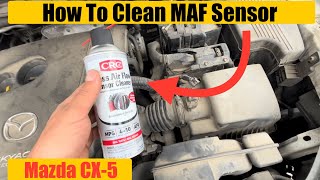
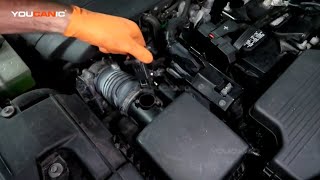
What's Unique About the 2017-2024 Mazda CX-5 🎬 Watch this quick tutorial on cleaning the CX-5 MAF sensor
For the second-generation Mazda CX-5 with the SkyActiv-G engine, the MAF sensor (OEM Part PE01-13-215) is generally reliable but sensitive to contamination. Owners often report that issues like rough idling can be resolved by simply cleaning the sensor, sometimes even before a code like P0103 is triggered. The issue is rarely a complex electrical fault; it's most often a simple case of the sensor's delicate hot-wire element getting dirty over time from dust or oil vapors, which is a straightforward DIY fix. Oiled aftermarket air filters are a known contributor to premature MAF sensor contamination if over-oiled.
Symptoms You May Notice
- Check Engine Light is on
- Rough or unstable idle
- Hesitation or stumbling during acceleration
- Noticeable loss of engine power
- Decreased fuel economy
- Engine stalling, especially when coming to a stop or at low speeds
- Black smoke from the exhaust, indicating a rich fuel mixture
- Car may enter a reduced power 'limp mode' where it struggles to accelerate above a few MPH
- Replacing the oxygen (O2) sensors. A rich condition caused by a bad MAF sensor might trigger a rich code (P0172), but the root cause is the MAF sensor's incorrect high reading, not the O2 sensor.
- Replacing the throttle body. A throttle body issue would typically set different trouble codes related to throttle position or actuator control.
Most Likely Causes
- Dirty or Contaminated MAF Sensor 🔴 High Probability The sensor's hot wire is exposed to the intake airstream and can become coated with dust, oil from a crankcase ventilation system, or residue from an over-oiled aftermarket air filter. This coating insulates the wire, causing incorrect readings.
How to confirm: Visually inspect the sensor's wire element after removing it. If it appears dirty, coated, or oily, it needs cleaning.
Typical fix: Remove the sensor and clean it thoroughly with a dedicated Mass Airflow Sensor cleaner spray. Do not touch the delicate wire element or use aggressive cleaners like brake cleaner.
Est. part cost: $10-$15 for a can of MAF cleaner. - Faulty MAF Sensor 🟡 Medium Probability Internal electronics can fail, causing the sensor to short and send a constant high voltage signal to the PCM. This can happen with age or heat cycles.
How to confirm: If cleaning the sensor does not resolve the code, and the wiring is confirmed to be good, the sensor itself has likely failed. A scan tool can monitor the live voltage output; if it's stuck high (near 5V) regardless of engine RPM, the sensor is bad.
Typical fix: Replace the MAF sensor. It is highly recommended to use an OEM or OEM-supplier (like Denso) part, as some aftermarket sensors are known to be unreliable.
Est. part cost: $70-$275 - Wiring or Connector Issue ⚪ Low Probability Less common, but the wiring harness to the MAF sensor can become frayed or damaged from engine vibration or improper routing. The connector pins can also become loose or corroded, leading to an intermittent or constant short circuit to power.
How to confirm: Inspect the wiring harness leading to the MAF sensor for any visible damage, chafing, or tight bends. Wiggle the connector with the engine running while monitoring live data to see if the signal fluctuates. Use a multimeter to check for a short to power on the signal wire with the key on, engine off.
Typical fix: Repair the damaged section of the wiring harness or clean/replace the connector. In some cases, a harness extender may be needed if the wiring is too tight.
Est. part cost: $5-$50 for wiring repair supplies. - Severely Clogged Engine Air Filter ⚪ Low Probability
How to confirm: Inspect the engine air filter. If it is black and heavily impacted with dirt and debris, it is overdue for replacement.
Typical fix: Replace the engine air filter.
Est. part cost: $20-$40
Rare But Worth Checking
- Vacuum Leak: A large vacuum leak in the intake hose *after* the MAF sensor can, in some circumstances, cause turbulent air across the sensor and trigger this code, though it more commonly causes lean codes (P0171/P0174).
- Faulty Powertrain Control Module (PCM): This is extremely rare. The PCM's internal circuits that process the MAF signal can fail. This should only be considered after all other possibilities have been exhaustively ruled out by a professional.
Diagnosis Steps
- Read all stored fault codes with an OBD-II scanner. Note any other codes that are present.
- Inspect the engine air filter and replace it if it's dirty.
- Locate the MAF sensor on the air intake tube, right after the air filter box.
- Carefully inspect the MAF sensor's electrical connector for a secure fit. Check the wiring harness for any signs of damage, corrosion, or looseness.
- With the ignition off, disconnect the sensor and remove the two Phillips head screws holding it in place.
- Gently remove the sensor and inspect the internal wire/element for dirt, oil, or debris.
- If dirty, spray the element liberally with a dedicated MAF sensor cleaner. Do NOT use brake cleaner, carburetor cleaner, or touch the element with a brush or Q-tip.
- Allow the sensor to air dry completely for at least 20-30 minutes. Do not use compressed air to speed this up.
- Reinstall the sensor, ensuring the connector clicks securely into place.
- Clear the codes with the scanner and perform a test drive, monitoring live data if possible.
- If the code returns, use a scan tool to monitor the MAF sensor's live data (Voltage and g/s). At idle with a warm engine, the reading should be stable and low (typically 2-7 g/s). When revving the engine, the reading should increase smoothly. If the voltage is stuck at a high value (e.g., ~4.9V) or the g/s reading is abnormally high at idle, the sensor is likely faulty.
- If the sensor and wiring appear good, consider checking for a large vacuum leak between the MAF and the throttle body.
- If all else fails, replacement of the MAF sensor with an OEM part is the next logical step.
Parts You'll Likely Need
- Mass Air Flow (MAF) Sensor
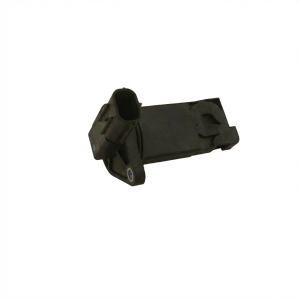
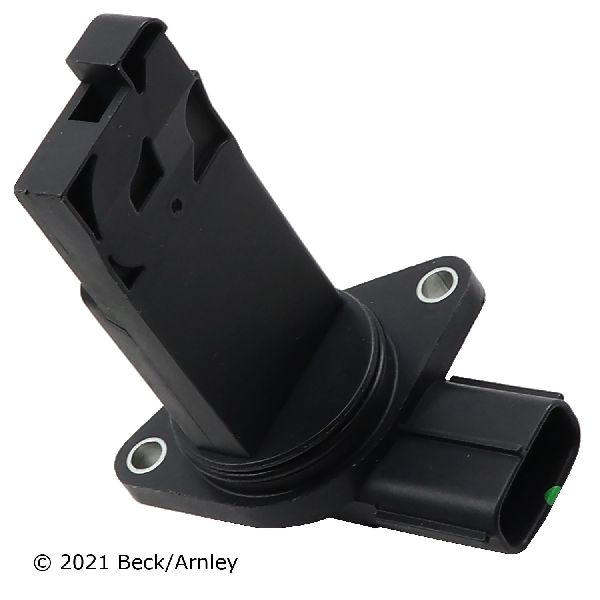
(OEM #PE01-13-215)— This is the sensor that fails or gets dirty, directly causing the P0103 code. If cleaning doesn't work, replacement is the definitive fix. The OEM supplier is often Denso, and the Denso part number may be printed on the original sensor.
Trusted brands: Mazda (OEM), Denso, Delphi, Spectra Premium
OEM price range: $250-$275
Aftermarket price range: $70-$150 - MAF Sensor Cleaner — Often, the sensor is just dirty and does not need to be replaced. A specific cleaner is required to safely remove contaminants without damaging the delicate sensing element.
Trusted brands: CRC Mass Air Flow Sensor Cleaner, WD-40 Specialist Air Sensor Clean
Aftermarket price range: $10-$15
Related Codes That Often Appear With This One
- P0101 — This code indicates 'MAF Circuit Range/Performance'. It can appear with P0103 if the sensor's signal is not just high, but also erratic or irrational compared to other sensor inputs like throttle position and engine RPM.
- P0102 — This code for 'MAF Circuit Low Input' can appear alongside P0103 if there is an intermittent wiring problem causing the signal to short to ground and then short to power, or if the sensor is failing erratically.
- P0172 — This code for 'System Too Rich' can occur because a false high airflow reading from the MAF sensor causes the PCM to inject too much fuel, which is then detected by the downstream oxygen sensors.
Platform-Specific Known Issues
- Intermittent Stalling and Limp Mode: In a forum thread, an owner of a modified vehicle experienced intermittent P0103 and P0104 codes, causing the car to run very rough, enter limp mode with no acceleration, and eventually stall. The issue was temporarily resolved by restarting the car or unplugging/re-plugging the MAF sensor. The root cause was found to be a tight wiring harness that had pulled a wire slightly out of the connector, creating an intermittent connection.
- Moisture Sensitivity After Relocating MAF: A user on Mazdas247 with a modified Mazda (relocated MAF sensor for a front-mount intercooler) reported that code P0103 would appear during periods of heavy rain, suggesting that moisture was affecting the sensor or its connection.
Mechanic-Grade Diagnostic Values
- MAF Sensor Signal Voltage (Code Trigger) — expected: < 4.94 V. Failure: Voltage is > 4.94 V for 5 seconds.
- MAF Sensor Signal Voltage (Live Data) — expected: ~0.5V - 1.5V at warm idle, rising smoothly to ~4.5V at wide-open throttle.. Failure: Voltage is stuck at a high value (near 5V) regardless of engine RPM.
- MAF Sensor Airflow Rate (Live Data) — expected: Approximately 4.0 - 5.0 g/s at warm idle for a 2.5L engine. Rises smoothly with RPM.. Failure: Reading is excessively high at idle or does not change with engine RPM.
Scan Tool Commands That Help
- Mazda M-MDS (or equivalent professional scanner): Read MAF PID (Parameter ID) — This is the primary method to view the live data (voltage or g/s) that the PCM is receiving from the MAF sensor. It's used to confirm if the sensor is reporting an impossibly high value at idle or is stuck high.
- OBD-II Scanner: Clear Fault Codes — After performing a repair (like cleaning or replacing the sensor), the code must be cleared from the PCM's memory. The vehicle should then be test-driven to see if the code returns.
Wiring & Ground Locations
- PCM Terminal 2BC — This is the pin on the Powertrain Control Module (PCM) connector that receives the signal from the MAF sensor.. If a short-to-power is suspected in the wiring, a technician can test for voltage at this specific pin to isolate the fault between the sensor and the PCM.
- G02 — Main ground point located under the left (driver's side in LHD) headlight assembly.. A poor ground at this location can cause a floating ground for various engine sensors, potentially creating a voltage offset that could trigger a 'Circuit High' code.
- G03 — Main ground point located on the left front of the engine compartment.. Similar to G02, corrosion or looseness at this primary chassis ground can lead to unpredictable electrical behavior for engine management components.
Real Owner Repair Stories
- Mazdas247 Forum User (Mazda Protege (older model, but demonstrates a relevant electrical principle)) — P0103 code, stumbling and misfiring at high RPM.
❌ Tried (didn't work) Cleaning MAF and IAT sensors, Cleaning EGR and throttle body, Checking coils, plugs, and wires, Checking for vacuum leaks
✅ What actually fixed it The user discovered a short circuit in an aftermarket boost gauge was causing power to flow into the ground circuit, creating a voltage offset that triggered the P0103 code. Removing the faulty gauge resolved the issue completely.
"I Checked Everything" — The Actual Cause
- In one documented case, a P0103 code was not caused by a vacuum leak or a faulty MAF sensor itself. The actual cause was an electrical short in an aftermarket accessory (a boost gauge) that was back-feeding voltage into a shared ground circuit. This raised the ground reference voltage for the MAF sensor, making the PCM interpret the signal as 'high'. A smoke test would be useless in this scenario as the fault is purely electrical and external to the intake system.
OEM Part Supersession History
PE01-13-215→No direct supersession found. This remains the primary OEM part number.— N/A
Heads up: Other part numbers like PYFS-13-215 and E5T62271 are often listed as compatible cross-references or supplier part numbers for the same component. No known incompatibility issues exist within the 2017-2024 generation.
Diagnostic Flowchart
Other Known Issues on This Vehicle
Issues unrelated to this code that are worth knowing about as an owner of this generation:
- Excessive Oil Consumption (2.5T) 🔴 High — Affects certain 2021 models with the 2.5L Turbo engine. A class-action lawsuit was filed regarding this issue. (Ref: TSB 01-012/21 (later revised) was issued to replace faulty valve stem seals, which were found to be the cause.)
- Cracked Cylinder Head (Cylinder Deactivation Models) 🔴 High — A number of owners of 2.5L non-turbo engines with cylinder deactivation (2018+ models) have reported cracked cylinder heads, leading to coolant loss and engine failure. While not extremely common, it is a known, severe potential failure. (Ref: Mazda issued service alerts and created new part numbers for replacement heads but no widespread recall.)
- Rocker Arm Failure (Cylinder Deactivation Models) 🔴 High — An issue on some 2018-2019 models with the 2.5L engine with cylinder deactivation could cause a rocker arm to come out of position, potentially causing engine stall. (Ref: Recall 3719F (NHTSA Campaign 19V495000) was issued to reprogram the PCM to correct the hydraulic valve adjustment control software.)
- Failing Low-Pressure Fuel Pump 🟠 Medium — Affects various 2018-2019 Mazda models, including the CX-5. The fuel pump impeller can crack and deform, leading to fuel pump failure and engine stalling. (Ref: Recall 4620H (NHTSA Campaign 20V664000) was issued to replace the low-pressure fuel pump.)
- Intake Valve Carbon Buildup 🟡 Low — As with most direct-injection (GDI) engines, the SkyActiv-G can be prone to carbon buildup on the intake valves over high mileage (typically 80k-100k+ miles), as fuel is not sprayed over the valves to clean them. This can lead to reduced performance and misfires.
Used vs. New Parts: Buying Guide for This Vehicle
When a used part is the smart pick: A used OEM MAF sensor from a reputable salvage yard is often a smarter choice than a new, non-OEM aftermarket sensor. Given the high cost of a new OEM part, a used one from a low-mileage donor vehicle can provide OEM reliability for a fraction of the price.
Donor-vehicle mileage cap: roughly under 60000 miles for the part to have meaningful remaining life.
What to inspect on the donor part:
- Check the donor vehicle's mileage; lower is always better.
- Inspect the sensor housing for any cracks or physical damage.
- Look at the electrical connector pins to ensure they are straight and free of corrosion.
- If possible, look inside the sensor bore to see if the delicate wire elements are physically intact and not broken.
OEM-only on this vehicle (don't cheap out):
- Mass Airflow Sensor
Aftermarket brands forum-validated for this vehicle:
- Denso (often the original OEM supplier)
- Hitachi
- Delphi
Brands owners have reported issues with on this vehicle:
- Unbranded sensors from online marketplaces (e.g., Amazon, eBay, AliExpress) are frequently reported as being dead-on-arrival or failing shortly after installation.
- One user specifically reported a 'BSE' brand sensor caused fluctuating acceleration and additional fault codes.
Real Owner Stories
Aggregated from forums and TSBs cited above. Mileages and costs reflect what owners reported in those sources.
2017-2024 Mazda CX-5 SkyActiv-G 2.5L
Symptoms: The car was running very rough, entered limp mode with no acceleration, and eventually stalled. The issue was temporarily resolved by restarting the car or unplugging/re-plugging the MAF sensor.
What fixed it: The root cause was a tight wiring harness that had pulled a wire slightly out of the connector. The fix involved reseating the wires and adding a harness extender to provide more slack.
Source hint: Mustang6G.com - Error codes p0103 and p0104 mass air flow issues?
Modified Mazda with SkyActiv-G 2.5L
Symptoms: The P0103 code would appear specifically during periods of heavy rain.
What fixed it: The issue was related to moisture sensitivity affecting the sensor or its connection after the MAF sensor was relocated for a front-mount intercooler.
Source hint: Mazdas247 - Dtc P0103, Maf Input Too High.......Problem Solved
Related OBD-II Codes
Frequently Asked Questions
What specific MAF sensor part should I use for my Mazda CX-5 if cleaning doesn't work?
Can an aftermarket air filter cause a P0103 code on my SkyActiv-G engine?
Why does my CX-5 struggle to accelerate above a few MPH when this code is active?
Is there a specific voltage that triggers the P0103 code in a Mazda?
Could a tight wiring harness be the reason for my intermittent P0103 and P0104 codes?
Can I use brake cleaner to clean the MAF sensor on my CX-5?
Helpful Videos
![How to Fix P0103 Engine Code in 2 Minutes [1 DIY Method / Only $9.53]](https://img.youtube.com/vi/yA4LkchbkeQ/mqdefault.jpg)
Used OEM Parts in Stock


New Aftermarket Parts Available


The information in this article is provided for general reference and educational purposes only. Vehicle specifications, procedures, and part compatibility can vary by production date, trim level, and region. Always consult your vehicle's factory service manual and verify part numbers before purchasing or performing repairs. Safety-critical components such as airbags, seat belts, and braking systems should be installed by a qualified professional.
- Mazda CX-5:
- 🎬 Helpful Videos
- 🛍️ Shop This Part
- What's Unique About the 2017-2024 Mazda CX-5
- Symptoms You May Notice
- Most Likely Causes
- Rare But Worth Checking
- Diagnosis Steps
- Parts You'll Likely Need
- Related Codes That Often Appear With This One
- Platform-Specific Known Issues
- Mechanic-Grade Diagnostic Values
- Scan Tool Commands That Help
- Wiring & Ground Locations
- Real Owner Repair Stories
- "I Checked Everything" — The Actual Cause
- OEM Part Supersession History
- Diagnostic Flowchart
- Other Known Issues on This Vehicle
- Used vs. New Parts: Buying Guide for This Vehicle
- Real Owner Stories
- 2017-2024 Mazda CX-5 SkyActiv-G 2.5L
- Modified Mazda with SkyActiv-G 2.5L
- Related OBD-II Codes
- Frequently Asked Questions
- 🎟️ Get 5% Off