

P0102 on 2007-2014 Mazda 2 2.2L Diesel: MAF Circuit Low Causes and Fixes
For a Mazda 2 with the 2.2L Skyactiv-D engine, code P0102 is most often caused by a dirty or failed Mass Airflow (MAF) sensor. The first and most cost-effective step is to clean the sensor with a dedicated MAF cleaner. If the problem persists, a replacement sensor is the likely solution. Owners strongly recommend using an OEM Denso sensor, as this engine is sensitive to aftermarket parts.
- P0102 on your Mazda 2.2L Diesel means the MAF sensor signal is too low, which will cause a noticeable loss of power.
- The first and cheapest step is to clean the MAF sensor with a dedicated cleaner spray.
- If cleaning doesn't work, inspect for intake air leaks between the sensor and the engine before buying parts.
- If you must replace the sensor, use an original Mazda part or a high-quality brand like Denso to ensure compatibility and avoid future issues.
- Do not ignore this code, as it prevents the diesel particulate filter (DPF) from cleaning itself, which can lead to a much more expensive repair down the line.
What's Unique About the 2007-2014 Mazda 2
On the Mazda 2.2L Skyactiv-D engine, a P0102 code is not just a simple emissions light. The PCM will actively restrict engine torque, inhibit the EGR (Exhaust Gas Recirculation) system, and prevent the diesel particulate filter (DPF) from regenerating. This means you'll feel a noticeable loss of power (often called 'limp mode') and other critical emissions components won't be able to clean themselves, potentially leading to a clogged DPF and more complex issues if the code is ignored. Owners and technicians strongly recommend using original equipment (OEM) replacement sensors, as aftermarket units can be unreliable on this platform. The engine's ECU is very sensitive to the specific calibration of the MAF sensor.
Symptoms You May Notice
- Check Engine Light is on
- Noticeable loss of engine power ('limp mode')
- Engine runs rough or stalls, especially at idle
- Difficulty starting the engine
- Poor fuel economy
- Hesitation or sputtering during acceleration
- Black smoke from the exhaust
- Replacing the MAF sensor without checking for intake air leaks first. If there's a leak, a new sensor will not fix the problem.
- Using a cheap aftermarket MAF sensor. The Skyactiv-D engine is notoriously picky, and an out-of-spec aftermarket sensor can cause the code to persist or return.
Most Likely Causes
- Dirty or Contaminated MAF Sensor 🔴 High Probability The MAF sensor uses a sensitive hot wire to measure airflow. Over time, oil vapor from the crankcase ventilation system or fine dust can coat this wire, insulating it and causing it to read low.
How to confirm: Visually inspect the sensor's sensing wire. If it appears dirty, cleaning is the first logical step. The sensor is located in the intake tube just after the air filter box. A scan tool may show grams/second readings that are abnormally low at idle (a healthy engine is typically 2.0-3.0 g/s).
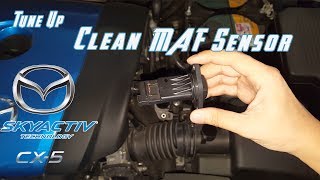
Typical fix: Remove the sensor and clean it carefully using only a dedicated Mass Airflow Sensor cleaner spray. 🎬 Watch this step-by-step guide on cleaning a Mazda MAF sensor Do not touch the delicate wires inside. Allow it to air dry completely before reinstalling.
Est. part cost: $10-$20 for cleaner spray - Faulty Mass Airflow (MAF) Sensor 🟡 Medium Probability Electronic components can fail over time. The Skyactiv-D engines are known to be sensitive to MAF sensor calibration, and internal electronic failure is a common reason for a persistent P0102 after cleaning.
How to confirm: After cleaning, if the code returns quickly, the sensor is the next likely culprit. A technician can use a scan tool to monitor the MAF sensor's voltage and g/s reading at idle to confirm it's out of spec. At operating temperature, the voltage should be approximately 1.085V to 1.235V at idle.
Typical fix: Replace the MAF sensor. It is highly recommended to use an OEM or a reputable OEM-supplier brand like Denso for this engine. The OEM part number is SH01-13-215. The Denso equivalent is DMA-0114.
Est. part cost: $150-$300 - Intake Air Leak (Post-MAF) ⚪ Low Probability Cracked plastic or rubber intake hoses, or loose clamps between the MAF sensor and the turbo/engine, allow un-metered air to enter. The sensor correctly reads low airflow because some air is bypassing it.
How to confirm: Visually inspect all intake ducting for cracks, especially around the flexible sections. Check that all hose clamps are tight. A smoke test is the most effective way to find small, hard-to-see leaks.
Typical fix: Replace the cracked intake hose or tighten the loose clamp.
Est. part cost: $50-$150 for a new intake hose - Wiring or Connector Issue ⚪ Low Probability Vibrations and heat can cause wires to break or connector pins to lose tension or corrode over time. On some CX-5s with the same engine, owners have reported that ensuring the main PCM connector is fully seated has resolved intermittent MAF codes.
How to confirm: Inspect the MAF sensor connector for corrosion or pushed-out pins. Check the wiring harness for any visible damage. A multimeter can be used to check for a short to ground or an open circuit in the signal wire between the sensor and the PCM, as outlined in Mazda's diagnostic procedure.
Typical fix: Repair the damaged section of the wiring harness or clean/replace the connector terminal.
Est. part cost: $5-$50 for wiring repair supplies
Rare But Worth Checking
- Severely Clogged Air Filter: A filter that is completely blocked can restrict airflow enough to cause the MAF to read below its expected threshold, triggering P0102. This is easy to check and should be part of routine maintenance.
- Faulty Powertrain Control Module (PCM): This is extremely rare. The PCM itself can fail, but all other potential causes, especially wiring, must be exhaustively ruled out before condemning the PCM.
Diagnosis Steps
- Read the code with an OBD-II scanner and confirm P0102 is present. Note any other codes, like P0101 or P0113.
- Inspect the engine air filter. If it is excessively dirty or clogged, replace it.
- Locate the MAF sensor in the intake tube after the air filter housing. Disconnect the electrical connector and inspect for corrosion or damage.
- Remove the MAF sensor. Visually inspect the sensing elements for dirt, oil, or debris.
- If dirty, clean the sensor using only dedicated MAF sensor cleaner spray. Allow it to dry completely before reinstalling.
- Reinstall the sensor, clear the code, and perform a test drive to see if the code returns.
- If the code returns, thoroughly inspect the entire air intake tract between the MAF sensor and the engine for any cracks, splits in hoses, or loose clamps. A smoke test is the most reliable method.
- If no leaks are found, use a multimeter to test the MAF sensor's wiring harness for proper voltage (5V reference), ground, and signal integrity, following the manufacturer's diagnostic procedure.
- If wiring is confirmed to be good and no leaks are present, the MAF sensor itself is likely faulty and should be replaced with an OEM or Denso part.
Parts You'll Likely Need
- Mass Airflow (MAF) Sensor
(OEM #SH01-13-215)— This sensor is the most common point of failure for P0102, either due to contamination that can't be cleaned or internal electronic failure.
Trusted brands: Mazda (OEM), Denso (DMA-0114)
OEM price range: $200-$300
Aftermarket price range: $80-$150 - Mass Airflow Sensor Cleaner — Often, the sensor is just dirty. This specialized solvent is the first and most cost-effective repair attempt.
Trusted brands: CRC, Liqui Moly
OEM price range: N/A
Aftermarket price range: $10-$20
Related Codes That Often Appear With This One
- P0101 — P0101 indicates the MAF sensor's readings are out of the expected *range* for the current engine load, while P0102 means the signal is consistently *low*. Both codes point to the same set of problems: a dirty/failing sensor, wiring issues, or an intake leak.
- P0113 — P0113 indicates a high input from the Intake Air Temperature (IAT) sensor. On many Mazda vehicles, the IAT sensor is integrated into the MAF sensor assembly. A failure of the assembly can cause both codes.
Platform-Specific Known Issues
- ECU/PCM Connector Seating: On platform-mate CX-5s with the same engine, some owners have resolved intermittent MAF-related codes by simply ensuring the main engine computer (PCM/ECU) connector is fully seated and free of corrosion. The PCM is located next to the battery.
Mechanic-Grade Diagnostic Values
- MAF Sensor Signal Voltage at Idle (Engine at operating temp, >70°C) — expected: 1.085V - 1.235V. Failure: A reading below this range, especially one that drops to or below 0.29V, indicates a fault.
- MAF Sensor Grams per Second (g/s) at Idle (Engine at operating temp) — expected: ~5.0 g/s. Failure: Significantly lower readings suggest a sensor, wiring, or airflow restriction issue.
- MAF Sensor 5V Reference Voltage (Key On, Engine Off) — expected: ~5.0V. Failure: A reading that is significantly lower or absent indicates a wiring or PCM problem.
- MAF Sensor Grams per Second (g/s) vs. RPM — expected: The g/s value should roughly double when the engine RPM is doubled from idle (e.g., from 750 RPM to 1500 RPM).. Failure: A slow or non-responsive change in g/s when revving the engine points to a sluggish or failing sensor.
Scan Tool Commands That Help
- FORScan / Mazda IDS: Reset KAM (Keep Alive Memory) — Should be performed after replacing the MAF sensor to clear the PCM's old learned airflow values and force it to relearn with the new sensor, preventing the code from returning during the adaptation period.
- FORScan / Mazda IDS: Initialize EGR / Calibrate Injectors — Use this after major intake system work, such as cleaning the intake manifold for carbon buildup. Old adaptation values can conflict with the new, higher airflow, causing MAF codes to appear even with good parts.
Wiring & Ground Locations
- MAF Sensor Connector (5-pin) — On the air intake tube, immediately following the air filter housing.. This is the primary connection point for all MAF sensor tests. For the 2007-2014 model years, the key wires are the Black (Signal Output) and Gray (5V Reference) wires. Damage or corrosion here is a direct cause of P0102.
- G01 (Ground Point) — On platform-sharing vehicles like the CX-5, this ground is located under the left headlight assembly.. A poor engine or sensor ground can cause low voltage readings and intermittent sensor faults. While location is from a CX-5, it provides a likely area to inspect for the Mazda 2.
Real Owner Repair Stories
- Reddit user Sufficient_Humor_236 (2015 Mazda 2.2L Skyactiv-D, 250,000 km) — Persistent P0101 code (MAF range/performance) for over a year.
❌ Tried (didn't work) Cleaned the intake manifold, Replaced the vacuum pump, Replaced the MAF sensor, Replaced the MAP sensor
✅ What actually fixed it Using FORScan software, the owner performed the 'initialize egr' and 'calibrate injectors' service functions. The code did not return, and the car ran smoothly. This suggests the PCM's learned adaptations from the previously clogged intake were causing the fault with the new, clean components.
"I Checked Everything" — The Actual Cause
- Severe carbon buildup in the intake manifold and EGR passages. This is a very common issue on the Skyactiv-D engine. It restricts the total volume of air the engine can ingest, causing the MAF sensor to correctly read a low value that the PCM interprets as a fault. A smoke test of the intake hoses will show no leaks because the restriction is internal.
Model Year Variations Within This Range
- 2007-2014: The MAF sensor wiring colors on this generation are typically a black signal wire and a gray 5V reference wire. Newer (post-2014) models use different colors like orange for the signal and brown for the reference.
Diagnostic Flowchart
Other Known Issues on This Vehicle
Issues unrelated to this code that are worth knowing about as an owner of this generation:
- DPF Blockage & Regeneration Failure 🔴 High — Very common, especially on vehicles used for frequent short trips which prevent the DPF from reaching temperature for active regeneration.
- Engine Oil Dilution 🔴 High — A well-known issue where failed DPF regeneration cycles cause diesel fuel to contaminate the engine oil, raising the oil level and reducing its lubricating properties, leading to premature engine wear.
- Turbocharger Failure 🔴 High — Failures of the twin-turbo setup are reported, often linked to oil starvation or contamination issues stemming from DPF and oil dilution problems. Can occur at moderate mileage.
- Timing Chain Stretch 🟠 Medium — While designed to last the engine's life, premature stretching of the timing chain can occur, often signaled by a rattling noise on startup.
- Injector Seal Failure / Carbon Buildup 🟠 Medium — Leaking injector seals can cause carbon buildup in the oil system, potentially blocking oil channels and leading to oil starvation.
Used vs. New Parts: Buying Guide for This Vehicle
When a used part is the smart pick: A used part is generally not recommended for the MAF sensor itself due to its sensitivity and electronic nature. However, a known-good used OEM sensor can be invaluable as a temporary diagnostic tool to confirm if your original sensor is faulty before spending money on a new one. Used intake hoses or clamps are acceptable if they are in excellent physical condition with no cracks or brittleness.
Donor-vehicle mileage cap: roughly under 75000 miles for the part to have meaningful remaining life.
What to inspect on the donor part:
- For a MAF sensor, only use one from a running, code-free vehicle if possible.
- Visually inspect the sensing wires; if they look contaminated or damaged, do not use it.
- For hoses, squeeze the rubber to ensure it is pliable and not hard or crunchy. Check for any surface cracks, especially in accordion sections.
OEM-only on this vehicle (don't cheap out):
- Mass Airflow (MAF) Sensor
Aftermarket brands forum-validated for this vehicle:
- Denso (Is the OEM supplier)
Brands owners have reported issues with on this vehicle:
- Unbranded, 'white-box' sensors from online marketplaces are frequently cited as being poorly calibrated and causing persistent codes on this engine.
Real Owner Stories
Aggregated from forums and TSBs cited above. Mileages and costs reflect what owners reported in those sources.
2014 Mazda 6 2.2L Skyactiv-D — 70000 miles
Symptoms: Owner expressed anxiety and worry after reading about known issues with the 2.2L diesel engine upon purchasing the vehicle.
What fixed it: The context notes that discussions for this platform often conclude with recommendations for OEM sensors and checking for intake leaks.
Source hint: r/mazda6 - 'Help… I've just bought a 2014 skyactiv d 2.2 diesel with 70k on clock and after reading some stuff I'm worried…'
2012-2017 Mazda CX-5 2.2L Skyactiv-D
Symptoms: Intermittent MAF-related codes.
What fixed it: Ensuring the main engine computer (PCM/ECU) connector is fully seated and free of corrosion.
Source hint: vehicle_specific_issues: ECU/PCM Connector Seating
Mazda 2.2L Skyactiv-D
Symptoms: P0102 mass or volume air flow a circuit code; carbon buildup in the crank caused by copper washers coming loose or wearing.
What fixed it: The report links the airflow meter codes to burnt exhaust gases resulting from failed copper washers.
Source hint: youtube_comment: Kennedy's garage
Related OBD-II Codes
Frequently Asked Questions
What is the specific OEM part number for a replacement MAF sensor on my 2.2L Skyactiv-D?
I've cleaned my MAF sensor but the P0102 code keeps returning. What should I check next on my Mazda?
What are the typical sensor readings I should see at idle for a healthy 2.2L diesel engine?
Can I use any generic cleaner to fix the P0102 code on my Mazda 2?
Is there a known connection between P0102 and the copper injector washers on this engine?
Could a problem with the PCM connector cause an intermittent P0102 on my Mazda?
Helpful Videos

We Have This Part in Stock


The information in this article is provided for general reference and educational purposes only. Vehicle specifications, procedures, and part compatibility can vary by production date, trim level, and region. Always consult your vehicle's factory service manual and verify part numbers before purchasing or performing repairs. Safety-critical components such as airbags, seat belts, and braking systems should be installed by a qualified professional.
- Mazda 2:
- 🎬 Helpful Videos
- 🛍️ Shop This Part
- What's Unique About the 2007-2014 Mazda 2
- Symptoms You May Notice
- Most Likely Causes
- Rare But Worth Checking
- Diagnosis Steps
- Parts You'll Likely Need
- Related Codes That Often Appear With This One
- Platform-Specific Known Issues
- Mechanic-Grade Diagnostic Values
- Scan Tool Commands That Help
- Wiring & Ground Locations
- Real Owner Repair Stories
- "I Checked Everything" — The Actual Cause
- Model Year Variations Within This Range
- Diagnostic Flowchart
- Other Known Issues on This Vehicle
- Used vs. New Parts: Buying Guide for This Vehicle
- Real Owner Stories
- 2014 Mazda 6 2.2L Skyactiv-D — 70000 miles
- 2012-2017 Mazda CX-5 2.2L Skyactiv-D
- Mazda 2.2L Skyactiv-D
- Related OBD-II Codes
- Frequently Asked Questions
- 🎟️ Get 5% Off