

P0101 on 2012-2019 Nissan Versa: MAF Sensor Causes and Fixes
On a 2012-2019 Nissan Versa, code P0101 is most often caused by a dirty Mass Airflow (MAF) sensor that needs cleaning or a simple vacuum leak. However, Nissan has issued multiple Technical Service Bulletins (TSBs) indicating the Engine Control Module (ECM) may need a software update from a dealer to correct overly sensitive diagnostic logic. Before replacing the sensor, always clean it, inspect the intake for cracks, and consider the well-documented software issue.
- Before buying any parts for a P0101 code, first clean the MAF sensor with dedicated cleaner.
- Thoroughly inspect the black plastic air intake hose for cracks, as this is a common source of vacuum leaks.
- If cleaning the MAF and checking for leaks doesn't fix the code, be aware that the problem is very likely the ECM software.
- Contact a Nissan dealer to see if your vehicle's VIN is covered by a TSB for an ECM reprogram before you spend money on a new MAF sensor.
- If you must replace the MAF sensor, use an OEM or Hitachi-branded part to avoid further issues.
What's Unique About the 2012-2019 Nissan VERSA

For the second-generation Nissan Versa, the P0101 code is frequently more than just a dirty sensor. Nissan has released several Technical Service Bulletins (TSBs), notably NTB12-051k and NTB19-045b, acknowledging that the original ECM software can improperly trigger this code, sometimes with no noticeable driving issues. TSB NTB19-045b clarifies the reflash is not a direct fix for a faulty component, but rather an update to "the way the permanent DTC is stored and allowed to be erased." This makes it crucial to not automatically assume the MAF sensor is faulty without considering this well-documented software sensitivity, which may require a dealer visit for a reflash even after other issues are fixed.
Diagnostic Flowchart
Tap your situation to follow the diagnostic path that matches what you're seeing on this vehicle.
Symptoms You May Notice
- Check Engine Light is on
- Rough or unstable idle, sometimes dipping low after starting
- Hesitation or stumbling during acceleration
- Reduced engine power and sluggish performance, sometimes described as 'limp mode'
- Poor fuel economy
- Engine stalling, especially shortly after starting
- Black smoke from the exhaust in some cases
- On newer models with advanced driver aids, the P0101 code can also trigger other warnings like the collision avoidance and traction control lights.
- Replacing the MAF sensor immediately without first cleaning it and checking for vacuum leaks.
- Using a cheap aftermarket MAF sensor, which often fail quickly or do not work correctly on Nissans.
- Replacing the MAF sensor when the actual problem is a small, undetected vacuum leak in the intake boot.
- Continuously replacing MAF sensors without addressing the underlying ECM software issue that requires a dealer reflash.
Most Likely Causes

- Dirty or Contaminated MAF Sensor 🔴 High Probability The MAF sensor's delicate hot wire or film can become contaminated with dirt, oil, or moisture from the intake system over time, skewing its readings. This is the most common and easiest first step in diagnosis.
How to confirm: Visually inspect the sensor elements inside the MAF housing. If they appear dirty or coated, cleaning is warranted.
Typical fix: Remove the sensor and clean it carefully using only dedicated Mass Airflow Sensor cleaner spray. Do not touch the internal elements. Let it dry completely before reinstalling.
Est. part cost: $8-$15 for a can of MAF cleaner - Outdated Engine Control Module (ECM) Software 🔴 High Probability Nissan has issued multiple TSBs (e.g., NTB12-051k, NTB19-045b) for this generation of Versa, stating the ECM may improperly store a P0101 code due to overly sensitive calibration logic. The update adjusts the parameters for setting the code.
How to confirm: A Nissan dealership or a qualified shop with advanced scan tools (like CONSULT-III plus or a capable aftermarket tool) can check the current software calibration version of your ECM against the latest version available from Nissan.
Typical fix: Reprogramming (reflashing) the ECM with updated software. This must be done by a dealer or a specialized shop. Dealer cost is typically one hour of labor ($100-$200).
Est. part cost: $0 (parts), but shop labor applies - Vacuum Leak 🟡 Medium Probability The flexible rubber intake hose (accordion tube) between the MAF sensor and the throttle body can develop small, hard-to-see cracks over time, allowing unmetered air to enter the engine and conflict with MAF readings.
How to confirm: Visually inspect all intake ducting for cracks or loose clamps, paying close attention to the folds of the accordion section. A smoke test is the most effective way to find small, hidden leaks.
Typical fix: Replace the cracked intake hose or tighten any loose connections. The OEM part number is 16576-1HK0A or 16576-1HK1A.
Est. part cost: $40-$80 for a new intake hose - Dirty or Clogged Engine Air Filter 🟡 Medium Probability
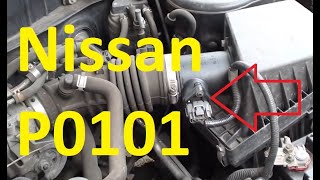
How to confirm: Remove and inspect the engine air filter. 🎬 See how to service the air filter and MAF sensor. If it is visibly dirty, clogged with debris, or past its service interval, it needs replacement.
Typical fix: Replace the engine air filter. A clogged filter can restrict airflow and cause the MAF to read incorrectly.
Est. part cost: $15-$30 - Faulty MAF Sensor ⚪ Low Probability While less common than being dirty, the sensor can fail electronically. Nissans are notoriously sensitive to aftermarket electronic parts. Many forum users report that only a genuine Nissan or Hitachi (the OE manufacturer) will work reliably.
How to confirm: After confirming no vacuum leaks and cleaning the sensor, use a scan tool to monitor the MAF sensor's data (g/s reading). If the readings are erratic, stuck, or do not change with engine RPM, the sensor is likely bad.
Typical fix: Replace the MAF sensor. It is highly recommended to use an OEM or a reputable OE-supplier part. The Hitachi part is MAF0031 or MAF0133. The Nissan OEM part number is often 22680-7S000 or 22680-5RB0A.
Est. part cost: $140-$250 for an OEM/Hitachi sensor
Rare But Worth Checking
- Dirty Throttle Body: A buildup of carbon on the throttle plate can disrupt airflow enough to contribute to a P0101 code. Cleaning the throttle body is a common recommendation on Nissan forums, but it often requires an Idle Air Volume Relearn procedure afterwards, which may need a scan tool. 🎬 Watch: How to perform the idle air volume relearn procedure.
- Clogged Catalytic Converter: A severely restricted exhaust can back up pressure and disrupt the airflow readings at the MAF sensor. One technician on a forum reported a plugged catalytic converter was the ultimate cause of a persistent P0101 after all other common causes were ruled out. This will typically be accompanied by other codes and more severe performance loss.
- Wiring or Connector Issue: A damaged wire or a loose/corroded connector at the MAF sensor can interrupt the signal to the ECM, causing the same symptoms as a failed sensor. One owner found a poorly patched wire to the MAF sensor was causing issues.
Diagnosis Steps
- Read the code with an OBD-II scanner and check for any other stored codes. Note them down.
- Inspect the engine air filter and replace it if it is dirty.
- Carefully inspect the air intake hose (accordion boot) between the air filter box and the throttle body for any cracks, tears, or loose clamps. Pay special attention to the creases.
- Remove the MAF sensor. Visually inspect it for contamination. Clean it using only dedicated MAF sensor cleaner spray. Let it dry completely for at least 30 minutes before reinstalling.
- Inspect the MAF sensor connector and wiring for any signs of corrosion, looseness, or damage.
- Clear the codes and drive the vehicle to see if the code returns. If it does, proceed to the next steps.
- If possible, use a scan tool to monitor the MAF sensor's readings in grams per second (g/s). The reading should be low at idle (around 1.5-2.5 g/s for the 1.6L engine) and increase smoothly and proportionally as you rev the engine. 🎬 Watch: A professional diagnostic walkthrough for the P0101 code. It should not be stuck or jump erratically.
- If readings are stuck or erratic, and you have ruled out vacuum leaks, the sensor is likely faulty. Replace with an OEM or Hitachi part.
- If the sensor appears to be reading correctly, consider cleaning the throttle body, but be prepared to perform an Idle Air Volume Relearn procedure.
- If the code persists, the issue is very likely software-related. Contact a Nissan dealership, mention your vehicle and code P0101, and inquire about TSBs NTB12-051k and NTB19-045b regarding an ECM reflash.
Parts You'll Likely Need

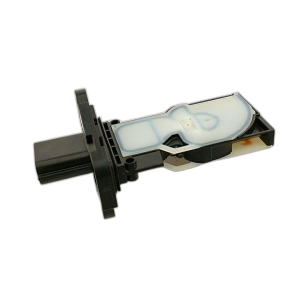
- Mass Airflow Sensor
(OEM #22680-7S000, 22680-5RB0A)
Related Codes That Often Appear With This One
- P0087 — Nissan TSB NTB19-045b lists P0101 alongside P0087 (Fuel Rail/System Pressure - Too Low), suggesting a related ECM software calibration issue can trigger multiple codes.
- P0448 — Nissan TSBs NTB19-045b and P9328_P9343_P934 group P0101 with this EVAP system code, pointing to a common ECM software problem.
- P2008 — Also listed in TSBs NTB19-045b and P9328_P9343_P934 as being related to the same ECM software issue that can cause P0101.
- P0507 — TSB NTB21-049 for the 2020+ Versa and Kicks links P0101 with P0507 (Idle Speed Control System RPM Higher Than Expected), often pointing to a dirty throttle body or weak battery.
Technical Service Bulletins (TSBs) & Recalls
- NTB19-045b: MIL ON WITH DTC P0087, P0101, P0448, OR P2008
- NTB12-051k: MIL ON WITH DTC P0101
- P9328_P9343_P934: ECM P-DTC REPROGRAM
- NTB12051J: MIL ON WITH DTC P0101
Platform-Specific Known Issues
- The ECM Reflash Cycle: A common story on forums involves an owner cleaning the MAF (no fix), replacing the MAF with an aftermarket part (no fix), replacing it again with an OEM/Hitachi part (temporary fix), and finally visiting the dealer for an ECM reflash which permanently solves the problem. This cycle highlights the central role of the ECM software.
- Heat and Driving Condition Sensitivity: Some owners report the P0101 code and associated limp mode only appear after the car has been driven for a while and is fully warmed up, or during specific conditions like stop-and-go traffic or climbing hills. This can make it difficult for shops to replicate the issue.
Mechanic-Grade Diagnostic Values
- Mass Airflow (g/s) at warm idle — expected: Approximately 1.6 g/s to 2.0 g/s. A general rule for Nissans is that the g/s reading should be close to the engine's displacement in liters.. Failure: Readings that are significantly higher or lower, or do not increase smoothly with RPM.
- MAF Sensor Signal Voltage at warm idle — expected: Approximately 1.0V to 1.4V.. Failure: Voltage that is stuck, erratic, or significantly outside this range at idle.
- MAF Sensor Signal Voltage at Key-On Engine-Off (KOEO) — expected: Approximately 0.2V to 0.35V.. Failure: A reading of 0V or a reading significantly higher than expected.
- MAF Sensor Signal Voltage at 2,000-2,500 RPM — expected: Approximately 1.5V to 2.5V, increasing smoothly from idle.. Failure: Voltage that lags behind RPM changes, spikes erratically, or fails to increase.
Hidden / Shadow Codes Worth Checking
- Permanent DTC (P-DTC): This is not a hidden code, but a specific status of a standard DTC. A P-DTC cannot be cleared by a standard scanner or by disconnecting the battery. It can only be cleared by the ECM itself after it runs and passes the specific self-test for that monitor on subsequent drive cycles. TSBs NTB19-045b and P9328_P9343_P934 state that an ECM reflash may be needed to update the logic for how this P-DTC is stored and erased, which is a common issue for P0101 on this vehicle. (see via Visible on most standard OBD-II scanners, but designated as 'permanent'.)
Scan Tool Commands That Help
- Nissan CONSULT or capable aftermarket scanner: Idle Air Volume Learning (or 'Idle air vol learn') — This function is required after cleaning or replacing the throttle body, or sometimes after disconnecting the battery. It recalibrates the base idle airflow. Failure to perform this can cause a high or unstable idle and may even trigger a P0101 code because the actual airflow at the new throttle plate angle doesn't match what the ECM expects.
- Manual Procedure (no scan tool): Idle Air Volume Learning ('Pedal Dance') — Can be used if a compatible scan tool is not available. It involves a precise sequence of turning the ignition on/off and depressing/releasing the accelerator pedal within specific time windows to put the ECM into a learning mode. The sequence includes 'Accelerator Pedal Released Position Learning' and 'Throttle Valve Closed Position Learning' as prerequisites.
Wiring & Ground Locations

- ECM Ground Pins — On the main ECM connector (often designated E16). For a 2018 Versa, pins 159 and 162 (both Black wires) are direct ECM grounds.. A poor ground connection at the ECM can cause incorrect sensor readings and faulty calculations, potentially triggering a P0101 code even with a good sensor. Verifying ground integrity is a key electrical diagnostic step.
- Engine Compartment Grounds (E14, E15, F9) — For a 2011 Versa, major ground points are located on the left side of the engine compartment (E14, E15) and on the left front of the engine (F9). The ECM and its related components rely on these chassis grounds.. Corrosion or looseness at these main ground points can affect the entire engine management system, leading to erratic sensor behavior and codes like P0101.
- MAF Sensor Connector (2016 Versa) — The 5-pin connector on the MAF sensor itself.. A video testing a 2016 Versa identified the following: Pin 1 (Green w/ Gray dots) is 12.7V power supply. Pin 2 (Green) is ground. Pin 3 (Green w/ Black), the signal wire, read ~1.1V at idle. Verifying these voltages is a direct test of the sensor's circuit.
Real Owner Repair Stories
- YouTube channel 'HMAR Mobile Tech' (2012 Nissan Versa 1.6L) — Check Engine Light with code P0101.
❌ Tried (didn't work) The technician emphasized inspecting before replacing parts.
✅ What actually fixed it The air intake hose (accordion boot) had a large, visible crack, causing a massive unmetered air leak. Replacing the hose with OEM part number 16576-1HK0A resolved the code. - Reddit user in /r/MechanicAdvice (2012 Nissan Versa) — Persistent P0101 code.
❌ Tried (didn't work) Replacing the MAF sensor., Cleaning the old MAF sensor., Professional inspection that found no vacuum leaks or grounding issues., Getting an ECM reflash performed at a Nissan dealership.
✅ What actually fixed it The issue was not resolved. After all common fixes failed, the independent shop suspected a faulty ECM and recommended returning to the dealer for further diagnosis. This story highlights that in rare cases, the ECM itself can be the root cause after all other possibilities, including the official TSB reflash, are exhausted.
"I Checked Everything" — The Actual Cause
- In one documented case, a 2012 Versa owner had the vehicle professionally inspected where it passed a check for vacuum leaks and grounding issues. Despite this, and even after a dealer ECM reflash, the P0101 code persisted. The final diagnosis from the shop pointed towards a potential internal failure of the Engine Control Module (ECM) itself, a rare but possible cause when all other diagnostics come back clean.
When the Usual Fixes Don't Work
- While the standard diagnostic path for P0101 (clean/replace MAF, check for vacuum leaks, get ECM reflash) resolves the majority of cases, there are documented instances where this is not enough. One owner of a 2012 Versa followed all of these steps, including a dealer-performed software update, yet the code immediately returned. A professional inspection confirmed no vacuum leaks or wiring issues. The final, albeit costly, suspicion fell on an internally faulty ECM, demonstrating that in a small number of cases, the computer itself can be the root cause after all more common and prescribed fixes have failed.
OEM Part Supersession History
22680-7S00A, 22680-7S00B→22680-7S000— Standard part revision and consolidation.
Heads up: This part number is listed as fitting the Versa from 2007-2019, suggesting it's for earlier models or a specific trim within the generation.22680-BV80B→22680-5RB0A— Standard part revision.
Heads up: This part number is listed for the 2015-2019 Nissan Versa, suggesting it was introduced with the mid-generation facelift.
Model Year Variations Within This Range
- 2015-2019: Later models of the second-generation Versa (typically after the 2015 facelift) are more likely to use MAF sensor part number 22680-5RB0A, which superseded 22680-BV80B. Earlier models may use 22680-7S000. It is critical to verify the correct part number by VIN or by inspecting the original sensor.
Helpful Videos



We Have This Part in Stock


The information in this article is provided for general reference and educational purposes only. Vehicle specifications, procedures, and part compatibility can vary by production date, trim level, and region. Always consult your vehicle's factory service manual and verify part numbers before purchasing or performing repairs. Safety-critical components such as airbags, seat belts, and braking systems should be installed by a qualified professional.
- Nissan VERSA:
- 🎬 Helpful Videos
- 🛍️ Shop This Part
- What's Unique About the 2012-2019 Nissan VERSA
- Diagnostic Flowchart
- Symptoms You May Notice
- Most Likely Causes
- Rare But Worth Checking
- Diagnosis Steps
- Parts You'll Likely Need
- Related Codes That Often Appear With This One
- Technical Service Bulletins (TSBs) & Recalls
- Platform-Specific Known Issues
- Mechanic-Grade Diagnostic Values
- Hidden / Shadow Codes Worth Checking
- Scan Tool Commands That Help
- Wiring & Ground Locations
- Real Owner Repair Stories
- "I Checked Everything" — The Actual Cause
- When the Usual Fixes Don't Work
- OEM Part Supersession History
- Model Year Variations Within This Range
- 🎟️ Get 5% Off