

P0101 on 2011-2018 Nissan Pathfinder: MAF Sensor Circuit Range/Performance Fixes
On 2011-2018 Nissan Pathfinders, code P0101 is most often caused by a dirty Mass Airflow (MAF) sensor or a dirty throttle body. However, a very common fix for this specific vehicle is an Engine Control Module (ECM) software update performed by a Nissan dealer, as specified in multiple Technical Service Bulletins (TSBs). Cleaning the throttle body and performing an 'Idle Air Volume Learn' procedure is a critical step before replacing any parts.
- Do not immediately replace the MAF sensor. Start with the cheapest and easiest fixes first.
- Your first DIY steps should be to inspect the air intake for leaks, clean the MAF sensor with dedicated cleaner, and clean the throttle body.
- Be aware that an Idle Air Volume Learn procedure is required after cleaning the throttle body.
- This code on a 2011-2018 Pathfinder is very frequently caused by a software issue.
- If simple cleaning and inspection don't work, the most likely solution is an ECM reprogram at a Nissan dealership.
What's Unique About the 2011-2018 Nissan PATHFINDER

The 2011-2018 Pathfinder spans two distinct generations (the truck-based R51 and the crossover R52), which have different engines and electronics. Unlike many vehicles where P0101 is a straightforward sensor or vacuum leak issue, Nissan has released multiple Technical Service Bulletins (TSBs) for this code on both Pathfinder generations. These bulletins frequently identify the root cause as a software glitch where the ECM's monitoring parameters are too sensitive, requiring it to be reprogrammed by a dealer. This step is often overlooked by DIYers and independent shops. An owner complaint to the NHTSA and multiple forum discussions confirm that simply replacing the MAF sensor often does not resolve the code, highlighting the platform's unique diagnostic challenges.
Diagnostic Flowchart

Tap your situation to follow the diagnostic path that matches what you're seeing on this vehicle.
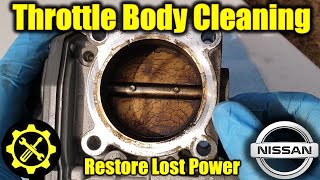
Generation note: The 2011-2018 range covers two Pathfinder generations with different architectures and engines, which affects diagnosis: - 2011-2012 (R51 Generation): A body-on-frame SUV with a 4.0L V6 (VQ40DE) or 5.6L V8 engine. TSB NTB12-051k specifically addresses P0101 on the 4.0L V6, often requiring an ECM reprogram, particularly when there are no other drivability symptoms. Cleaning the throttle body is also a very common fix for this generation. 🎬 See this step-by-step guide for cleaning the 4.0L throttle body. - 2013-2018 (R52 Generation): A unibody crossover, primarily with a 3.5L V6 (VQ35DE) and a CVT. TSB NTB20-018 addresses P0101 on 2017-2019 models with an ECM reprogram. Collapsed PCV hoses and cracked intake boots have also been noted as issues on this generation, allowing unmetered air to enter the engine.
Symptoms You May Notice

- Check Engine Light (MIL) is illuminated
- Hesitation or lack of power during acceleration.
- Vehicle struggles to gain speed, as noted by an owner: 'Vehicle struggles to get air flow into engine causes speed to strugg[le]'.
- Rough or unstable idle
- Stalling, especially at idle or when coming to a stop
- Poor fuel economy
- On some models, other warning lights like the traction control ('slippery road') or forward collision system may activate, as these systems rely on accurate engine data.
- Black smoke from the tailpipe under acceleration.
- Replacing the MAF sensor without first cleaning it, cleaning the throttle body, or checking for required ECM updates. An NHTSA owner complaint (ODI #11712378) and multiple forum threads explicitly state that replacing the MAF sensor did not fix the P0101 code.
Most Likely Causes

- Engine Control Module (ECM) Software Update Needed 🔴 High Probability Nissan has issued multiple TSBs (NTB12-051k for 2011-2012 V6, NTB20-018 for 2017-2019) indicating the logic for interpreting MAF data was too sensitive and required a software correction. The TSBs note this can cause a P0101 code even with no actual drivability problems. Forum discussions and videos confirm this is a common dealer-performed fix.
How to confirm: A Nissan dealership or a properly equipped independent shop must use a CONSULT scan tool to check the current ECM software part number against the numbers listed in the TSBs.
Typical fix: Reprogramming the ECM to the latest software version. This is not a DIY repair and requires specialized tools like Nissan's CONSULT-III plus.
Est. part cost: $0 - Dirty Throttle Body 🔴 High Probability Carbon and oil vapor from the Positive Crankcase Ventilation (PCV) system can build up in the throttle body, restricting airflow at idle and low speeds. This disruption makes the MAF sensor readings appear incorrect to the ECM. A sticking throttle plate from carbon buildup is a very common cause cited by owners.
How to confirm: Visually inspect the throttle plate and bore for a ring of black carbon buildup.
Typical fix: Clean the throttle body thoroughly with a dedicated throttle body cleaner and a soft cloth. An 'Idle Air Volume Learn' procedure MUST be performed after cleaning to reset the idle parameters.
Est. part cost: $5-$15 - Dirty or Faulty Mass Airflow (MAF) Sensor 🟡 Medium Probability Oil from aftermarket air filters or fine dust that gets past the engine air filter can coat the sensor's delicate hot-wire elements, causing inaccurate readings.
How to confirm: Remove the sensor and visually inspect the small wires inside for contamination. A scan tool can also monitor the g/s reading to see if it responds logically to throttle changes. At idle, a reading of 0.6 to 0.9 volts is typical. A rough rule of thumb is that the g/s reading at idle should be close to the engine's displacement in liters (e.g., ~3.5 g/s for the 3.5L V6).
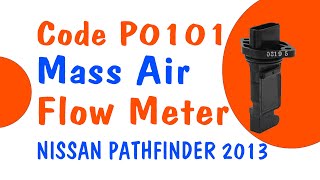
Typical fix: First, attempt to clean the sensor using only dedicated MAF sensor cleaner. 🎬 Watch: How to clean Nissan MAF sensors and fix this code. Do not touch the internal wires. If cleaning doesn't work, replace the sensor with a quality OEM or brand-name part like Hitachi. Avoid cheap aftermarket sensors, as they are a common source of repeat failures.
Est. part cost: $10-$20 (cleaner), $100-$250 (sensor) - Vacuum Leak (Cracked Intake Boot or Collapsed Hose) 🟡 Medium Probability
How to confirm: Visually inspect the flexible rubber intake boot between the air filter box and the throttle body for cracks, tears, or loose clamps, which are common failure points. Also inspect PCV hoses for softness or collapse. A smoke test is the most effective way to find hidden leaks.
Typical fix: Replace the cracked or collapsed hose.
Est. part cost: $30-$150 - Clogged Engine Air Filter ⚪ Low Probability
How to confirm: Remove and inspect the engine air filter. If it is visibly dirty or clogged, it can restrict airflow and, in some cases, cause debris to contaminate the MAF sensor.
Typical fix: Replace the engine air filter.
Est. part cost: $20-$50
Rare But Worth Checking
- Damaged MAF Sensor Wiring or Connector: Corrosion or damage to the pins in the connector or a break in the wiring can mimic a failed sensor. The connector can become brittle and the locking tab can break. Always inspect the connector when replacing the sensor.
- Restricted Exhaust: A clogged catalytic converter can prevent air from exiting the engine efficiently, which in turn affects the amount of air being drawn in, potentially confusing the MAF sensor. This usually presents with other symptoms like a severe lack of power and possibly a sulfur smell.
- Frozen PCV System (Cold Climates): TSB NTB20-013 notes that in very cold temperatures (below 14°F / -10°C), ice can form in the PCV hose or valve, causing a variety of issues including DTC P0101.
Diagnosis Steps

- Read all stored fault codes. Note if codes like P0087, P0507, or others are present.
- Inspect the engine air filter and replace if dirty.
- Carefully inspect the air intake boot between the MAF sensor and the throttle body for any cracks, tears, or loose clamps.
- Inspect PCV hoses for cracks or signs of collapse.
- Remove the MAF sensor and inspect its internal wires. If dirty, clean it ONLY with dedicated MAF sensor cleaner and let it dry completely before reinstalling.
- Remove the intake boot from the throttle body and inspect the throttle plate for carbon buildup. Clean with throttle body cleaner if necessary.
- Perform the Idle Air Volume Learn procedure. This is a critical step after cleaning the throttle body or disconnecting the battery. It can be done manually with a precise sequence of key turns and pedal presses, or with a capable scan tool.
- If the code returns, contact a Nissan dealer or qualified shop to check if your vehicle's ECM has a pending software update related to TSBs NTB12-051k (for 2011-2012 models) or NTB20-018 (for 2017-2019 models).
- If no update is available and the problem persists, use a scan tool to monitor live MAF sensor data (in grams/second or volts) to check for erratic readings that don't correspond to engine RPM changes.
- Perform a smoke test to definitively rule out any hidden vacuum leaks in the intake manifold or related hoses.
- If all else fails, test the MAF sensor's wiring for proper power, ground, and signal continuity back to the ECM.
Parts You'll Likely Need
- Mass Airflow Sensor
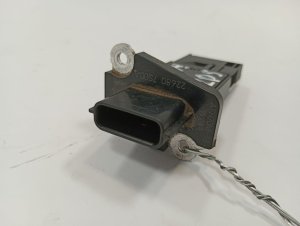
(OEM #22680-1MG0A (R52, VQ35DE), 22680-7S000 (R51, VQ40DE/VK56DE))— If cleaning the original sensor does not resolve the issue, replacement is the next step. Using a high-quality OEM or Hitachi sensor is strongly recommended.
Trusted brands: Hitachi (OEM)
Related Codes That Often Appear With This One
- P0087 — TSB #NTB19-045b lists P0101 along with P0087 (Fuel Rail/System Pressure - Too Low), suggesting a potential shared root cause or related software issue on some vehicles.
- P0448 — Also listed in TSB #NTB19-045b, P0448 (Evaporative Emission Control System Vent Control Circuit Shorted) can appear with P0101.
- P2008 — Also listed in TSB #NTB19-045b, P2008 (Intake Manifold Runner Control Circuit/Open Bank 1) can appear with P0101.
- P0507 — This code for 'Idle Speed Control System RPM Higher Than Expected' often appears after cleaning the throttle body if the Idle Air Volume Learn procedure is not performed correctly.
Technical Service Bulletins (TSBs) & Recalls
- NTB20-018: For 2017-2019 Pathfinders, addresses the MIL being on with P0101 stored, with the action being to confirm the ECM part number and reprogram if necessary.
- NTB12051J / NTB12-051k: For 2011-2012 Pathfinders (among other models), addresses P0101 with no drivability concerns, with the action being to reprogram the ECM.
- NTB19-045b: Mentions P0101 in conjunction with other codes like P0087, P0448, or P2008 for vehicles registered outside of California.
Platform-Specific Known Issues
- ECM Reprogramming Required: Nissan has issued multiple TSBs for this code. TSB #NTB20-018 is for 2017-2019 models and states the fix is to reprogram the ECM. TSB #NTB12051J (and its successor, NTB12-051k) applies to 2011-2012 models with the 4.0L engine, also recommending an ECM reprogram if there are no drivability issues.
- Throttle Chamber Issues: An owner complaint to the NHTSA (ODI #11630859) for a 2017 model specifically mentioned that a dealership suspected throttle chamber issues in conjunction with the P0101 code.
- MAF Replacement Ineffective: Another owner complaint (ODI #11712378) for a 2015 model explicitly states that the P0101 code remained even after replacing the MAF sensor, pointing to other underlying causes like software or a dirty throttle body.
Mechanic-Grade Diagnostic Values
- MAF Sensor Voltage at Idle — expected: 0.6 to 0.9 Volts. Failure: Readings that are erratic, stuck, or significantly outside this range.
- MAF Sensor Voltage at 2,000 RPM — expected: 1.5 to 2.5 Volts. Failure: Voltage does not increase smoothly with RPM or falls outside this range.
- MAF Sensor Airflow Rate at Idle (3.5L V6) — expected: ~3.5 grams/second. Failure: A reading significantly higher or lower than the engine's displacement in liters can indicate a vacuum leak (low reading) or other issues.
- MAF Sensor Airflow Rate at Idle (4.0L V6) — expected: ~4.0 - 6.0 grams/second. Failure: Readings significantly outside this range suggest a fault.
Hidden / Shadow Codes Worth Checking
- Permanent Diagnostic Trouble Code (P-DTC): A P-DTC is a trouble code stored in non-volatile memory that cannot be erased by a standard scan tool or by disconnecting the battery. TSB #P9328 specifically mentions that due to a calibration error, the ECM may improperly store a P-DTC for P0101. The code can only be cleared after the vehicle's own diagnostic monitors run and confirm the fault has been fixed over several drive cycles. This was implemented to prevent people from clearing codes to pass emissions tests. (see via A scan tool that can read Mode $0A data. Many professional scan tools will display this separately from current or pending codes.)
Scan Tool Commands That Help
- Nissan CONSULT-III plus: IDLE AIR VOL LEARN — This function, found under 'WORK SUPPORT', is the official dealer method for resetting idle parameters after cleaning the throttle body or replacing related components. It is required to prevent high idle or stalling issues.
- Nissan CONSULT-III plus: Re/programming, Configuration — This is the function used to perform an ECM software update as specified in TSBs NTB12-051k and NTB20-018. It is the definitive fix when the P0101 code is caused by overly sensitive monitoring logic.
- Many professional aftermarket scan tools (e.g., Autel): Idle Air Relearn / Throttle Position Relearn — Many higher-end aftermarket scan tools have a specific function to perform the Idle Air Volume Learn procedure, which is a viable alternative to the dealer's CONSULT tool.
Wiring & Ground Locations
- E15 / E9 — Located at the left rear of the engine compartment. For the VQ35DE (R52), a key ground is a braided strap from the passenger-side exhaust manifold heat shield to the firewall.. The ECM and multiple critical sensors, including the MAF sensor, rely on these ground points for a stable reference voltage. A corroded, loose, or broken ground strap at this location can introduce electrical noise and cause erratic sensor readings, leading to a P0101 code.
- MAF Sensor Connector — On the air intake housing, just after the air filter box.. The connector itself can become brittle, and the pins can corrode, causing a poor connection that mimics a failed sensor. A repair harness (p/n 24008-9DM2A) is available from Nissan for when the connector or its wiring is damaged.
Real Owner Repair Stories
- Reddit user in r/nissanpathfinder (2011 Nissan Pathfinder (R51)) — Persistent P0101 code.
❌ Tried (didn't work) Replacing the MAF sensor with a cheap aftermarket part from Autozone., Replacing the MAF sensor again with an OEM part from Nissan., Checking all fuses., Confirming the air filter was clean., Searching for vacuum leaks.
✅ What actually fixed it The issue was resolved after cleaning heavy carbon buildup from the throttle body. Another user noted a recall for a bad ECU relay on the R51 was a possible cause. - YouTube video by Charles L Rosario (2011 Nissan Pathfinder S (R51)) — DTC P0101 for years, with hesitation during driving.
❌ Tried (didn't work) Replacing the MAF sensor multiple times, including with a dealer part., Having the dealer reprogram the ECM., Checking for vacuum leaks and throttle body issues.
✅ What actually fixed it After years of dealing with the code, the final conclusion was that the catalytic converters were clogged and needed replacement.
When the Usual Fixes Don't Work
- While replacing the MAF sensor is a common suggestion, NHTSA complaint #11712378 and a Reddit repair story both explicitly state that replacing the sensor (even with an OEM part) did not resolve the P0101 code. In one case, the final fix was cleaning a carbon-fouled throttle body, and in another, the root cause was determined to be clogged catalytic converters after years of misdiagnosis. This underscores the importance of following the full diagnostic procedure, including checking for TSBs and cleaning the throttle body, before spending money on a new sensor.
OEM Part Supersession History
Not specified, but multiple revisions exist.→22680-1MG0A— Standard part evolution and updates.
Heads up: This part number (22680-1MG0A) is specific to the R52 generation (2013+) with the 3.5L VQ35DE or 2.5L Hybrid QR25DER. It is not compatible with the R51 generation (2011-2012) which uses part number 22680-7S000.
Model Year Variations Within This Range
- 2011-2012 (R51): These models use the 4.0L VQ40DE or 5.6L VK56DE engine and have a specific TSB (NTB12-051k) for a P0101 code without drivability issues, pointing to an ECM reprogram. The MAF sensor is part number 22680-7S000.
- 2017-2018 (R52): These models, part of the R52 generation, have a specific TSB (NTB20-018) that calls for an ECM reprogram to fix a P0101 code. This highlights that even later models in the generation are prone to software-related triggers for this code.
Helpful Videos
We Have This Part in Stock



The information in this article is provided for general reference and educational purposes only. Vehicle specifications, procedures, and part compatibility can vary by production date, trim level, and region. Always consult your vehicle's factory service manual and verify part numbers before purchasing or performing repairs. Safety-critical components such as airbags, seat belts, and braking systems should be installed by a qualified professional.
- Nissan PATHFINDER:
- 🎬 Helpful Videos
- 🛍️ Shop This Part
- What's Unique About the 2011-2018 Nissan PATHFINDER
- Diagnostic Flowchart
- Symptoms You May Notice
- Most Likely Causes
- Rare But Worth Checking
- Diagnosis Steps
- Parts You'll Likely Need
- Related Codes That Often Appear With This One
- Technical Service Bulletins (TSBs) & Recalls
- Platform-Specific Known Issues
- Mechanic-Grade Diagnostic Values
- Hidden / Shadow Codes Worth Checking
- Scan Tool Commands That Help
- Wiring & Ground Locations
- Real Owner Repair Stories
- When the Usual Fixes Don't Work
- OEM Part Supersession History
- Model Year Variations Within This Range
- 🎟️ Get 5% Off