

P0101 on 2014-2015 Infiniti Q60: MAF, Throttle Body, and ECM Fixes
On a 2014-2015 Q60, P0101 is most often caused by dirty MAF sensors or dirty throttle bodies. Cleaning both is a low-cost first step. If the light returns without driveability issues, an ECM software update may be needed per Infiniti TSB ITB13-054D, which specifically addresses this code for this model when no other symptoms are present.
- P0101 on a 2014-2015 Q60 is very often a 'soft' code, meaning it's caused by dirty components or software, not a failed part.
- Always start by cleaning the two MAF sensors and the two throttle bodies before considering part replacement.
- An Idle Air Volume Learning procedure is often required after cleaning the throttle bodies to restore a stable idle.
- If cleaning doesn't work, check with a dealer about an ECM software update, as this is a documented fix in multiple TSBs.
- If you must replace a MAF sensor, use a genuine OEM (Hitachi) part, as aftermarket sensors are known to cause issues on this platform.
What's Unique About the 2014-2015 Infiniti Q60
The 2014-2015 Q60 uses the 3.7L VQ37VHR engine, which features a dual air-intake design. This means it has two MAF sensors and two electronic throttle bodies—one for each cylinder bank. While P0101 points to Bank 1, the root cause is often an imbalance between the two banks, commonly caused by dirty throttle bodies creating an airflow discrepancy the sensitive ECM flags as a fault. Furthermore, Infiniti has issued Technical Service Bulletin (TSB) ITB13-054D specifically for the 2014-2015 Q60, stating this code can appear with no driveability issues and requires an ECM reprogram to fix an overly sensitive calibration. This TSB explicitly warns technicians: "DO NOT replace the mass air flow sensor(s)" if the bulletin's conditions are met.
Diagnostic Flowchart
Tap your situation to follow the diagnostic path that matches what you're seeing on this vehicle.
Symptoms You May Notice
- Check Engine Light is on
- No noticeable driveability issues (very common for this code on this car, as noted in TSB ITB13-054D)
- Rough or unstable idle, sometimes fluctuating or 'hunting'
- Engine hesitation or stumbling on acceleration
- Reduced fuel economy
- Vehicle enters 'limp mode', limiting RPMs
- Replacing the MAF sensor before cleaning it. Many sensors are replaced unnecessarily when they are simply dirty.
- Replacing the MAF sensor when the true cause is dirty throttle bodies. The symptoms can be identical, and this is a very common issue on the VQ37VHR engine.
- Replacing the MAF sensor when an ECM software update is all that is needed, as per TSB ITB13-054D.
Most Likely Causes
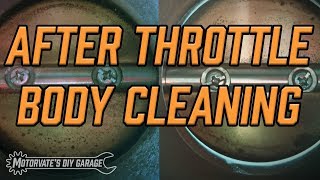
- Dirty Throttle Bodies 🔴 High Probability The VQ37VHR engine is known for carbon buildup on the throttle plates, which restricts airflow at idle. This causes an airflow imbalance between the two cylinder banks that the ECM detects as a MAF sensor range issue, even though the MAF sensor itself is fine.
How to confirm: Visually inspect the throttle plates for a ring of black carbon buildup. The engine may also have a slightly rough or hunting idle. This is a very common fix discussed in owner forums.
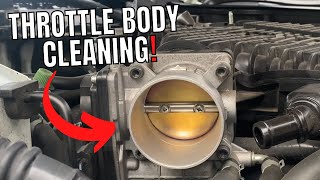
Typical fix: Clean both electronic throttle bodies with a dedicated throttle body cleaner and perform an Idle Air Volume Learning procedure. This is critical for the ECM to relearn the new clean baseline.
Est. part cost: $10-$20 - Dirty Mass Airflow (MAF) Sensor 🔴 High Probability Oil vapors from the PCV system or, more commonly, oil from aftermarket oiled air filters can contaminate the sensor's delicate hot wire, causing inaccurate readings.
How to confirm: Remove the MAF sensor from the intake tube and inspect the small wires inside for dirt or oil residue. The sensor is located just after the air filter box on each intake.
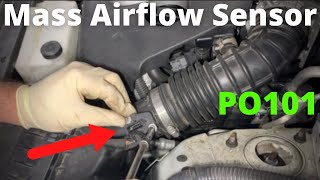
Typical fix: Spray the sensor wires with a dedicated Mass Airflow Sensor cleaner. 🎬 See how to safely clean or replace your MAF sensor. Do not touch the wires or use other chemicals like brake cleaner, which can damage the sensor.
Est. part cost: $10-$15 - Outdated Engine Control Module (ECM) Software 🟡 Medium Probability Infiniti has released multiple TSBs, most notably ITB13-054D for the 2014-2015 Q60, indicating the original ECM calibration can be too sensitive and improperly store a P0101 code even when no mechanical fault exists. Other TSBs like ITB19-027 also mention P0101 in relation to ECM software on similar platforms.
How to confirm: This can only be confirmed by an Infiniti dealer or a qualified shop with access to Infiniti's technical database (ASIST) and a CONSULT-III scan tool. They will check your vehicle's ECM software part number against the list of outdated versions in the TSB.
Typical fix: Reprogramming the ECM with updated software. This must be done by a dealer or a shop with a factory scan tool or a J2534 pass-through device with a NERS subscription.
Est. part cost: $0-$250 - Vacuum Leak ⚪ Low Probability Cracked or disconnected intake hoses, loose clamps on the intake tubes, or a leaking intake manifold gasket allows unmetered air to enter the engine after the MAF sensor. This causes the air-fuel mixture to be lean and triggers the code. Loose couplers on aftermarket intakes are a frequent culprit.
How to confirm: Perform a smoke test on the intake system to see if smoke escapes from any hoses, gaskets, or seals. A visual inspection of all intake tubing from the filters to the throttle bodies is also a good first step.
Typical fix: Replace the leaking hose or gasket, or tighten the loose clamp.
Est. part cost: $20-$150 - Faulty Mass Airflow (MAF) Sensor ⚪ Low Probability While less common than being dirty, the sensor itself can fail electronically. However, many are replaced unnecessarily. TSB ITB13-054D explicitly warns against replacing the MAF sensor if the only issue is the code itself.
How to confirm: After cleaning the sensors, swap the Bank 1 (passenger side) and Bank 2 (driver side) MAF sensors. They are identical parts. Clear the codes and drive. If the code returns as P010B (for Bank 2), the sensor is faulty. If P0101 returns, the sensor is likely good and the problem lies elsewhere.
Typical fix: Replace the faulty MAF sensor with a new OEM (Hitachi) or high-quality aftermarket unit. The OEM part number is 22680-7S000, which is made by Hitachi and also sold under their part number MAF0031.
Est. part cost: $120-$250
Rare But Worth Checking
- Clogged or Dirty Air Filters: If the filters are extremely clogged, they can restrict airflow enough to cause a P0101 code. Always check the filters as a basic maintenance step.
- Aftermarket Air Intakes: Intakes with oiled filters can contaminate the MAF sensors. Poorly designed intake tubes can also cause turbulent airflow, leading to inaccurate sensor readings and triggering a P0101 code. A tune or ECU reflash is sometimes needed to resolve the code after installing aftermarket intakes.
Diagnosis Steps
- Read the code with an OBD-II scanner and check for any other pending or stored codes. Note if the code is listed as 'permanent', as it may require a specific drive cycle to clear after the fix.
- Inspect the engine air filters. Replace them if they are dirty.
- Inspect the full air intake path for any cracks, loose clamps, or disconnected hoses between the air filters and the throttle bodies. Pay close attention to aftermarket intake couplers.
- Remove and clean both MAF sensors using a dedicated MAF sensor cleaner. Allow them to dry completely before reinstalling. Do not touch the internal wires.
- Remove and clean both electronic throttle bodies 🎬 Watch: Step-by-step guide to cleaning your throttle bodies and MAF sensors. using a dedicated throttle body cleaner and a soft, lint-free cloth. Manually open the butterfly valve to clean the edges and bore thoroughly.
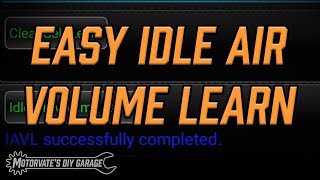
- After cleaning the throttle bodies, perform the "Accelerator Pedal Released Position Learning," "Throttle Valve Closed Position Learning," and "Idle Air Volume Learning" procedures. This is a critical step. 🎬 Watch this quick walkthrough for the Idle Air Volume Learning procedure. It can be done manually with a series of key turns and pedal presses, or more easily with a capable scan tool.
- Clear the codes and drive the vehicle. If the code returns, swap the MAF sensors between Bank 1 and Bank 2. Clear the codes and drive again. If the code changes to P010B, the MAF sensor you moved is faulty and needs replacement.
- If the code remains P0101 after the swap, the issue is not the sensor. Perform a smoke test to find a potential vacuum leak that was missed visually.
- If no leaks are found and all components are clean and functioning, contact an Infiniti dealership to check if your vehicle needs an ECM software update as per TSB ITB13-054D. This is a likely cause if no driveability issues are present.
Parts You'll Likely Need
- Mass Airflow Sensor Cleaner — This is the first and most crucial step for fixing a P0101 code caused by a dirty sensor element.
Trusted brands: CRC, Liqui Moly
Aftermarket price range: $10-$15 - Throttle Body Cleaner — Dirty throttle bodies are a very common cause of this code on the VQ37VHR engine.
Trusted brands: CRC, Berryman
Aftermarket price range: $10-$20 - Mass Airflow Sensor
(OEM #22680-7S000)
Related Codes That Often Appear With This One
- P010B — P010B is the same MAF sensor range/performance code but for Bank 2 (driver's side). Since the VQ37VHR has two of everything, it's common for issues like dirty throttle bodies, an outdated ECM calibration, or aftermarket intakes to affect both banks simultaneously, causing both codes to appear.
Technical Service Bulletins (TSBs) & Recalls
- ITB13054D
- ITB19-027
- ITB23-001
- ITB19-027a
- P9329_P9344_P934
- ITB17-017a
- ITB17-017
Platform-Specific Known Issues
- Owner Experience: TSB Reprogram and Cleaning Still Didn't Fix It: A user on Reddit with a 2013 G37x (same platform) reported getting P0101/P010B. A dealer performed the TSB reprogram and cleaned the throttle bodies, which fixed the issue for two weeks before the codes returned. This highlights that while the TSB is a key step, underlying issues like a persistent vacuum leak or failing sensor can sometimes cause a recurrence.
- Owner Experience: Cleaning Throttle Bodies is the Definitive Fix: On a popular Nissan 370Z forum, a user suffering from a persistent P0101 and limp mode, after having already replaced the MAF sensor twice with no success, finally resolved the issue by cleaning the throttle bodies and performing the reset procedures. This is a common story, confirming that throttle body hygiene is more often the cause than a bad MAF sensor.
- DIY Success Story: Throttle Body and MAF Cleaning: A user on MyG37.com detailed their process of cleaning the throttle bodies and MAF sensors to resolve a rough start-up issue. They noted significant 'charcoal/tar' buildup inside the throttle bodies. After cleaning and an ECU reset, they reported smoother running and gear changes, demonstrating the effectiveness of this DIY job.
Mechanic-Grade Diagnostic Values
- Mass Airflow (MAF) Rate at Idle — expected: 4.0 - 6.0 g/s (grams per second) for a fully warm 3.7L VQ37VHR engine.. Failure: Readings significantly lower or higher than this range at a steady idle suggest a sensor or vacuum leak issue.
- Mass Airflow (MAF) Rate at 2500 RPM (no load) — expected: 15 - 25 g/s (grams per second). Failure: A non-linear or delayed response, or readings outside this range, indicate a failing MAF sensor.
- MAF Sensor Power Supply Voltage — expected: Battery Voltage (approx. 12.0-12.6V). Failure: No voltage indicates a blown fuse or an open circuit in the power supply wire.
Hidden / Shadow Codes Worth Checking
- Permanent DTC (P-DTC): This is not a separate code, but a status for the P0101 code. A P-DTC is stored in a separate, non-volatile memory that cannot be erased by clearing codes with a standard scanner or disconnecting the battery. The ECM must first verify that the fault has been corrected by successfully completing a specific drive cycle. (see via Most OBD-II scanners will display a code as 'permanent' or 'P-DTC'. The TSB for this vehicle also specifically mentions permanent codes.)
Scan Tool Commands That Help
- Infiniti CONSULT or capable aftermarket scanner (e.g., Launch, Autel): Idle Air Volume Learning — This function is mandatory after cleaning or replacing the throttle bodies. It forces the ECM to relearn the new baseline for idle airflow. Failure to perform this will result in a high or hunting idle.
- Infiniti CONSULT or capable aftermarket scanner: Throttle Valve Closed Position Learning — Used in conjunction with the Idle Air Volume Learning, this teaches the ECM the physical closed position of the throttle plate. It should be performed anytime the throttle body is cleaned or replaced.
- Any OBD-II Scanner with Live Data: MAF B1 (g/s) and MAF B2 (g/s) Data Display — To diagnose a P0101, a technician should monitor the live data from both MAF sensors simultaneously. The readings should be very close to each other at all RPMs. If MAF B1 (Bank 1) reads erratically or significantly different from MAF B2 (Bank 2), it points towards a fault on Bank 1.
Wiring & Ground Locations
- ECM (Engine Control Module) — Located under the right (passenger) side of the dashboard.. The ECM receives the signal from the MAF sensor. In rare cases of persistent issues, the ECM connector pins or the ECM itself could be the source of the fault.
- Ground Points E9, E15 — Located at the left rear of the engine compartment.. These are primary ground points for the engine control system. A corroded or loose ground here can cause erratic sensor readings, including from the MAF sensor.
- Ground Point B7 — Located behind the left (driver's side) kick panel.. This is an interior body ground point. While less likely to cause this specific engine code, poor grounds can cause a variety of unpredictable electronic issues.
- MAF Sensor Connector — On the intake tube just after the air filter box on each side of the engine.. The connector itself or its wiring is a common failure point. It should be checked for corrosion, bent pins, or damaged wires. The connector has 6 pins.
Real Owner Repair Stories
- Reddit user in r/G37 (2015 Infiniti Q60S) — Permanent P0101 code that would not clear with a scanner.
❌ Tried (didn't work) Fixing a vacuum leak found with a smoke test., Cleaning both throttle bodies., Cleaning both MAF sensors., Performing all relearn procedures., Clearing the code with a standard OBD-II scanner.
✅ What actually fixed it The code was a 'Permanent DTC'. The only way to clear it was for the ECU to verify the fix itself by completing a very specific, multi-stage drive cycle (Driving Pattern B and D from the service manual), after which the permanent code cleared on its own. - MyG37 forum user (2013 G37x (VQ37VHR engine)) — P0101 code and vehicle entered 'limp mode' with loss of power.
❌ Tried (didn't work) Cleaning MAF sensors., Cleaning throttle bodies., Checking for vacuum leaks.
✅ What actually fixed it The issue started immediately after installing aftermarket test pipes (which replace the catalytic converters). The change in exhaust flow and backpressure was drastic enough to cause the MAF readings to be out of the expected range. The fix requires an ECU tune to recalibrate the engine parameters for the new hardware.
OEM Part Supersession History
22680-7S000→22680-7S00A, then 22680-7S00B— Standard part revision and improvement by the manufacturer.
Heads up: While all versions should be compatible, it is always best to use the latest revision (22680-7S00B). Multiple sources strongly warn against using non-OEM/aftermarket MAF sensors, as they frequently cause persistent codes or are dead on arrival.
Model Year Variations Within This Range
- 2014-2015: There are no significant mechanical or electronic differences between the 2014 and 2015 Q60 models. They are both rebadged versions of the G37 coupe and share the same VQ37VHR engine and control systems.
Helpful Videos
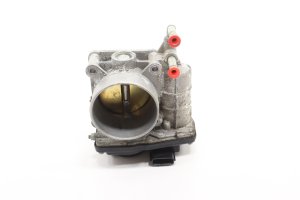
Used OEM Parts in Stock


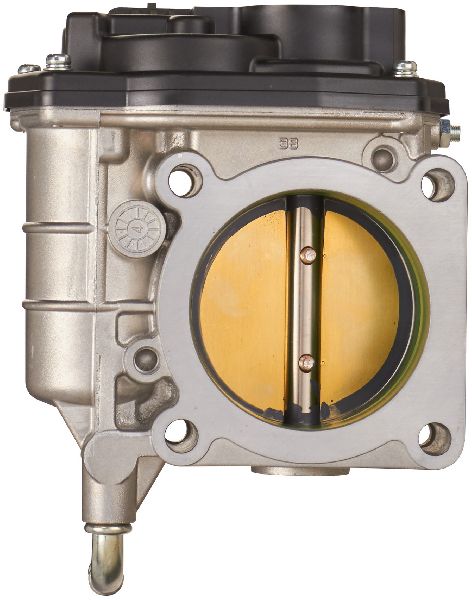
New Aftermarket Parts Available



The information in this article is provided for general reference and educational purposes only. Vehicle specifications, procedures, and part compatibility can vary by production date, trim level, and region. Always consult your vehicle's factory service manual and verify part numbers before purchasing or performing repairs. Safety-critical components such as airbags, seat belts, and braking systems should be installed by a qualified professional.
- Infiniti Q60:
- 🎬 Helpful Videos
- 🛍️ Shop This Part
- What's Unique About the 2014-2015 Infiniti Q60
- Diagnostic Flowchart
- Symptoms You May Notice
- Most Likely Causes
- Rare But Worth Checking
- Diagnosis Steps
- Parts You'll Likely Need
- Related Codes That Often Appear With This One
- Technical Service Bulletins (TSBs) & Recalls
- Platform-Specific Known Issues
- Mechanic-Grade Diagnostic Values
- Hidden / Shadow Codes Worth Checking
- Scan Tool Commands That Help
- Wiring & Ground Locations
- Real Owner Repair Stories
- OEM Part Supersession History
- Model Year Variations Within This Range
- 🎟️ Get 5% Off