

P0100 on 2015-2016 Volkswagen Golf: MAF Circuit Malfunction Causes and Fixes
For a 2015-2016 VW Golf (Mk7), code P0100 almost always points to a faulty Mass Airflow (MAF) sensor or a break in the wiring harness near the sensor's connector. Inspecting the wiring for breaks, particularly the brown ground wire, before replacing the sensor is critical. A new OEM-quality sensor costs between $150-$250.
- P0100 on a 2015-2016 Golf indicates an electrical circuit failure related to the Mass Airflow (MAF) sensor.
- Before buying any parts, carefully inspect the wiring harness near the MAF sensor connector for broken wires, as this is a very common failure point on VWs.
- If the wiring is good, try cleaning the sensor with dedicated MAF cleaner as a low-cost next step.
- If the sensor must be replaced, use a high-quality OEM brand like Bosch to avoid performance issues with poorly calibrated aftermarket parts.
What's Unique About the 2015-2016 Volkswagen GOLF
The 2015-2016 Golf (Mk7 generation) with the EA888 engine is sensitive to airflow metrics. While the MAF sensor itself can fail, Volkswagens of this era are notorious for having issues with the wiring harness leading to the sensor. Wires can become brittle and break internally from heat and vibration, especially at the sharp 90-degree bend the harness often takes near the connector. The brown ground wire is a frequently cited point of failure in owner forums. A careful inspection of this harness area is a crucial first step. The provided NHTSA technical service bulletins confirm that P0100 is a recognized issue on these models, often appearing alongside the related P0101 performance code.
🎬 Watch: Troubleshooting P0101 codes on a VW Golf Mk7.Diagnostic Flowchart
Tap your situation to follow the diagnostic path that matches what you're seeing on this vehicle.
Symptoms You May Notice
- Check Engine Light is on
- Rough or erratic idle.
- Engine hesitation or surging during acceleration.
- Reduced engine power and poor performance (limp mode).
- Decreased fuel economy.
- Engine stalling, especially shortly after starting or at low speeds.
- Black smoke from the exhaust if the engine runs too rich.
- Difficulty starting the engine.
- Replacing the MAF sensor without first checking the wiring harness for breaks. Many owners replace a perfectly good sensor when the actual problem is a simple broken wire near the connector.
Most Likely Causes
- MAF Sensor Wiring or Connector Issue 🔴 High Probability VWs are known for wiring issues where the harness bends sharply near the MAF connector. Wires, especially the brown ground wire, can break internally from engine vibration and heat cycles. This is the most common culprit for a P0100 on this platform.
How to confirm: Carefully peel back the protective loom/tape from the harness for 2-3 inches from the connector. Gently tug on each individual wire. A broken wire will stretch or snap. Forum users report the brown (ground) and yellow (voltage) wires are most susceptible. Use a multimeter to check for 12V power, ground continuity, and a 5V reference signal at the connector pins with the key on, engine off.
Typical fix: Repair the broken wire by soldering in a new section of 18-20 gauge wire and sealing it with adhesive-lined heat shrink tubing. If the connector is corroded or damaged, replace it with a new pigtail harness (Part # 1J0973705). When repairing, try to route the harness with a gentler curve to prevent repeat failure.
Est. part cost: $15-$40 - Faulty Mass Airflow (MAF) Sensor 🔴 High Probability MAF sensors are a common failure point on many modern vehicles, including VWs, due to contamination or simple electronic failure over time. However, this should be suspected only after wiring is confirmed to be intact.
How to confirm: After confirming wiring is intact, monitor live MAF data (g/s) with a scan tool. The reading should be around 2-4 g/s at idle for a warm engine and increase smoothly with engine RPM. If the reading is zero, stuck, or erratic, the sensor is likely bad. The 'unplug test' can also be used: if unplugging the sensor makes the engine run better, the sensor was providing bad data.
Typical fix: Replace the MAF sensor. It is highly recommended to use an OEM (Bosch) or high-quality equivalent part, as cheap aftermarket sensors are often poorly calibrated and can cause persistent issues. The correct Bosch part number for the EA888 Gen 3 engine is often 06K906461.
Est. part cost: $150-$250 - Dirty MAF Sensor 🟡 Medium Probability Oil vapors from the PCV system or fine dust that gets past the air filter can coat the sensor's delicate hot wire, insulating it and causing incorrect readings.
How to confirm: Visually inspect the sensor element. If it appears dirty, oily, or has debris on it, cleaning is a worthwhile step.
Typical fix: Remove the sensor and clean it ONLY with a dedicated MAF sensor cleaner spray. Do not touch the sensor wires. Allow it to dry completely before reinstalling.
Est. part cost: $10-$15 - Vacuum Leak ⚪ Low Probability Cracks in plastic or rubber intake components can allow unmetered air to enter the engine after the MAF sensor, confusing the ECM.
How to confirm: Visually inspect all intake hoses and vacuum lines for cracks or loose connections, especially the large intake boot between the MAF and the throttle body. A smoke test is the most effective way to find small leaks.
Typical fix: Replace the cracked or leaking hose/gasket.
Est. part cost: $20-$100 - Clogged Engine Air Filter ⚪ Low Probability
How to confirm: Inspect the engine air filter. If it is visibly dirty and clogged, it can restrict airflow enough to cause a fault.
Typical fix: Replace the engine air filter.
Est. part cost: $20-$40
Rare But Worth Checking
- Blown Fuse: The MAF sensor circuit is protected by a fuse in the engine bay fuse box. While not common, a blown fuse will cut power and immediately trigger a P0100 code. This can also affect the OBD-II port's ability to communicate.
- Faulty Powertrain Control Module (PCM): This is extremely rare, but if the sensor, wiring, and fuse are all confirmed to be good, the PCM itself could have a faulty driver for the MAF circuit. This should be the last consideration after all other possibilities are exhausted.
Diagnosis Steps
- Read the fault codes with an OBD-II scanner to confirm P0100 is present and note any other codes.
- Inspect the engine air filter and replace it if it's dirty.
- Visually inspect the MAF sensor's electrical connector for corrosion or damage.
- Carefully inspect the wiring harness leading to the MAF sensor. Peel back the protective loom 2-3 inches from the connector and gently pull each individual wire to check for hidden breaks, paying close attention to the brown ground wire.
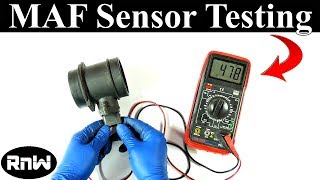
- If wiring looks good, use a multimeter to verify power (12V), ground (continuity to chassis), and reference voltage (5V) at the connector with the key on, engine off.
- If wiring and power are confirmed good, remove the MAF sensor and inspect it for contamination. If dirty, clean it with dedicated MAF sensor cleaner and re-test.
- Use a scan tool to monitor live MAF sensor data (in grams per second). The reading should be low at idle (2-7 g/s) and increase smoothly as you raise the engine RPM. If it's zero, stuck, or erratic, the sensor is likely faulty.
- If all other steps fail to identify the issue, replace the MAF sensor with a high-quality OEM part (e.g., Bosch).
Parts You'll Likely Need
- Mass Airflow (MAF) Sensor
(OEM #06K906461)— This is the most common part to fail and cause a P0100 code, after wiring issues have been ruled out.
Trusted brands: Bosch, Hitachi
OEM price range: $180-$250
Aftermarket price range: $70-$150 - MAF Sensor Connector Pigtail
(OEM #1J0973705)— Used to repair a damaged connector or as an easier alternative to soldering individual broken wires near the connector.
Trusted brands: Genuine Volkswagen, Various aftermarket
OEM price range: $25-$40
Aftermarket price range: $15-$25
Related Codes That Often Appear With This One
- P0101 — P0101 indicates a 'Range/Performance' issue with the MAF sensor. P0100 is a circuit fault, while P0101 is a logic fault. They often appear together as the underlying electrical issue (like a broken wire) can cause performance problems. The VW TSBs explicitly mention 'MIL-ON P0101 AND OR P0100'.
- P0171 — This code means 'System Too Lean'. If the MAF sensor is failing and under-reporting the amount of air entering the engine, the ECM will inject too little fuel, causing a lean condition.
- P0172 — This code means 'System Too Rich'. If the MAF sensor is over-reporting airflow, the ECM will inject too much fuel, causing a rich condition.
Technical Service Bulletins (TSBs) & Recalls
- VIN-4-A-PIN AUGU (2016 FUEL SYSTEM, GASOLINE, dated 2016-08-30): Acknowledges MIL-ON for P0100 and P0101 on 2016 Golf models as part of a general list of potential faults to be analyzed by technicians. It does not provide a specific repair procedure.
Platform-Specific Known Issues
- Common Wire Breakage at Harness Bend: Numerous owners on forums like golfmkv.com and vwvortex.com report finding a broken wire inside the MAF sensor harness, typically right at the sharp bend near the connector. One user on golfmkv.com documented finding a break in the brown (ground) and yellow (voltage) wires, which resolved the P0100 code after soldering. Another user confirmed a break in the black wire on their 3-pin connector after checking continuity. This is considered the primary suspect for P0100 on this platform.
Mechanic-Grade Diagnostic Values
- MAF Sensor Live Data (g/s) at warm idle — expected: 2-4 g/s. Failure: Reading is zero, stuck, or does not increase smoothly with RPM.
- MAF Connector Ground Pin Voltage Test (KOEO) — expected: 10-12 Volts. Failure: Voltage is significantly lower or zero, indicating an open in the ground circuit.
- MAF Connector 5V Reference Pin Voltage Test (KOEO) — expected: 4.5-5 Volts. Failure: Voltage is significantly lower or zero, indicating a problem with the ECM or the wiring from it.
- MAF Connector 12V Power Pin Voltage Test (KOEO) — expected: 10-12 Volts (Battery Voltage). Failure: Voltage is significantly lower or zero, indicating a blown fuse or an open in the power wire.
Scan Tool Commands That Help
- VCDS (VAG-COM): Advanced Measuring Blocks — For modern VWs on the MQB platform, classic Measuring Blocks are not supported. Use Advanced Measuring Blocks to view live data for Mass Air Flow, boost pressure, and fuel pressure to diagnose sensor performance.
- VCDS (VAG-COM) or equivalent: Measuring Block Group 032 (Fuel Trims) — To analyze long-term fuel trims. Block 1 shows additive trim (idle) and Block 2 shows multiplicative trim (above idle). Opposing, large values (e.g., -18% at idle, +24% at load) can strongly indicate a faulty MAF sensor, whereas high positive values only at idle often point to a vacuum leak.
Wiring & Ground Locations
- MAF Connector Ground Wire — Typically a brown wire in the MAF sensor harness.. This wire provides the ground for the sensor. It is a known failure point, often breaking internally near the connector, which causes a P0100 circuit code.
- Engine Bay Main Earth Point — On the bulkhead, behind/above the battery. It is a connection point for multiple brown ground wires.. A corroded or loose main ground point can cause various electrical issues, including an unstable ground for the MAF sensor circuit, leading to erratic readings or a P0100 code.
- Ground Point 15 — On the cylinder head.. This is a primary engine ground point. Ensuring it is clean and tight is crucial for the proper operation of all engine sensors, including the MAF.
- Ground Point 652 — Transmission/engine ground connection.. This serves as the main ground strap between the engine/transmission assembly and the vehicle body. A faulty connection here can lead to widespread sensor and starting issues.
Real Owner Repair Stories
- Things I'm Doing blog (VW GTI (Mk5, demonstrates long-standing issue)) — Engine bucking/surging at low RPM, intermittent at first, then Check Engine Light with P0100.
❌ Tried (didn't work) Was about to clean the MAF sensor but checked wiring first based on forum advice.
✅ What actually fixed it The owner peeled back the wiring loom near the MAF connector and found a break in the brown (ground) and yellow (DC voltage) wires right at the sharp 90-degree bend. Soldering the wires and re-routing the harness with a gentler curve fixed the problem.
Helpful Videos

We Have This Part in Stock


The information in this article is provided for general reference and educational purposes only. Vehicle specifications, procedures, and part compatibility can vary by production date, trim level, and region. Always consult your vehicle's factory service manual and verify part numbers before purchasing or performing repairs. Safety-critical components such as airbags, seat belts, and braking systems should be installed by a qualified professional.
- Volkswagen GOLF:
- 🎬 Helpful Videos
- 🛍️ Shop This Part
- What's Unique About the 2015-2016 Volkswagen GOLF
- Diagnostic Flowchart
- Symptoms You May Notice
- Most Likely Causes
- Rare But Worth Checking
- Diagnosis Steps
- Parts You'll Likely Need
- Related Codes That Often Appear With This One
- Technical Service Bulletins (TSBs) & Recalls
- Platform-Specific Known Issues
- Mechanic-Grade Diagnostic Values
- Scan Tool Commands That Help
- Wiring & Ground Locations
- Real Owner Repair Stories
- 🎟️ Get 5% Off