

P0100 on 2017-2018 Jaguar F-PACE: MAF Circuit Causes and Fixes
On the 2.0L petrol engine, this code is most likely caused by an air leak from a poorly fitted intake elbow, not a bad sensor. For other engines, suspect a dirty or faulty Mass Airflow (MAF) sensor. A smoke test is key for diagnosis on the 2.0L petrol model.
- For 2017-2018 F-PACE models with the 2.0L petrol engine, P0100 is very likely caused by an air leak at the intake elbow, per Jaguar TSB SSM73671.
- Before replacing any parts, perform a smoke test on the intake system to rule out air leaks.
- For all engines, cleaning the MAF sensor with a dedicated cleaner is a cheap and effective first step.
- This code is often accompanied by codes for the IAT sensor (P0111), a rich condition (P2178), and turbo underboost (P0299), which strongly points to an unmetered air leak.
- Do not immediately assume the MAF sensor is bad; a mechanical fault (air leak) is a documented cause for this electrical code on this platform.
What's Unique About the 2017-2018 Jaguar F-PACE
For the 2.0L Ingenium petrol engine in the F-PACE, this code has a well-documented cause that is not the sensor itself. A Jaguar TSB points directly to an incorrectly fitted air intake elbow below the throttle body, which creates an unmetered air leak. This leak confuses the sensor and the engine computer, causing it to log a signal frequency error. This makes a physical inspection and smoke test of the intake system more important than immediately replacing the sensor on these models. While other engines can suffer from this, it is a manufacturing/service-related issue on the 2.0L petrol.
Diagnostic Flowchart
Tap your situation to follow the diagnostic path that matches what you're seeing on this vehicle.
Symptoms You May Notice
- Check Engine Light (Malfunction Indicator Lamp or MIL) is on
- "Restricted Performance" message on the instrument cluster
- Lack of engine power and poor acceleration
- Engine running rough or stalling
- Engine hesitation or jerking during acceleration
- Decreased fuel economy
- Black smoke from the exhaust if running rich
- Hissing sound from the engine bay due to a vacuum leak
- Replacing the MAF sensor on a 2.0L petrol model without first checking for the air leak described in TSB SSM73671. The new sensor will not fix a problem caused by an unmetered air leak.
Most Likely Causes
- Incorrectly Fitted Air Intake Elbow (2.0L Petrol Engine) 🔴 High Probability A known issue documented by Jaguar in TSB SSM73671 for the Ingenium I4 2.0L Petrol engine. The elbow below the throttle body can be misaligned after service, causing a significant unmetered air leak.
How to confirm: Perform a visual inspection of the air intake system, especially the elbow connection to the throttle body. Use a diagnostic smoke tester to check the entire intake path for leaks, as this is the method recommended by Jaguar. 🎬 Watch: How a small air leak triggers MAF sensor codes
Typical fix: Correctly refit the air intake elbow. Ensure the clamp is secure and the elbow is fully seated. Replace any damaged clamps or seals.
Est. part cost: $0 - $50 - Dirty or Contaminated MAF Sensor 🟡 Medium Probability Oil from aftermarket air filters (e.g., K&N) or fine dust bypassing a worn standard filter can coat the sensor's delicate wire, insulating it and causing incorrect readings. This is a common first-step fix for many owners.
How to confirm: Remove the sensor and visually inspect the small wires or film inside. If they appear dirty or oily, cleaning is warranted.
Typical fix: Clean the sensor element using only a dedicated MAF sensor cleaning spray. Do not touch the element or use other chemicals like brake cleaner. Allow it to dry completely before reinstalling.
Est. part cost: $10 - $20 - Faulty Mass Airflow (MAF) Sensor 🟡 Medium Probability
How to confirm: After confirming no air leaks and cleaning the sensor, if the code returns, the sensor itself has likely failed. A diagnostic scanner can monitor the MAF sensor's output (in grams/second) to see if it responds correctly to changes in engine RPM. On V6 models with two sensors, you can swap them between banks; if the code follows the sensor (e.g., changes to P010B), the sensor is bad.
Typical fix: Replace the MAF sensor. On V6 models, ensure you are replacing sensor 'A' (Bank 1).
Est. part cost: $150 - $400 - Damaged Wiring or Poor Connection ⚪ Low Probability
How to confirm: Visually inspect the MAF sensor's electrical connector and wiring harness for any signs of corrosion, bent pins, or frayed wires. Wiggle the connector with the engine running to see if it affects the idle. Use a multimeter to check for proper voltage (5V reference and 12V power) and ground at the connector.
Typical fix: Repair the damaged wiring or clean/replace the connector pigtail.
Est. part cost: $20 - $100
Rare But Worth Checking
- Clogged Air Filter: A severely clogged air filter can restrict airflow to the point that the MAF sensor's readings are considered out of range by the PCM. Always check the filter as a basic maintenance step.
- Cracked Intake Manifold or Other Vacuum Leaks: While the TSB points to the intake elbow, other vacuum leaks can cause this code. The plastic intake manifolds on Ingenium engines are known to crack. A smoke test is essential to rule these out.
- Restricted Exhaust System: A clogged catalytic converter or diesel particulate filter (DPF) can prevent air from flowing properly through the engine, causing the MAF sensor readings to be abnormally low and triggering a P0100 code. This will usually be accompanied by other exhaust-related codes.
- Faulty Powertrain Control Module (PCM): This is extremely rare and should only be considered after all other possibilities, including wiring, have been exhaustively checked.
Diagnosis Steps
- Read all diagnostic trouble codes (DTCs) with an OBD-II scanner. Note if other codes like P0111, P2178, P0299, P0171, or P0174 are present.
- If you have the 2.0L Ingenium petrol engine, immediately suspect the air leak from TSB SSM73671. Visually inspect the air intake elbow below the throttle body for proper fitment.
- Perform a smoke test on the intake system to check for any unmetered air leaks. Pay close attention to the intake elbow, manifold gaskets, and all vacuum hoses.
- Inspect the engine air filter and replace it if it is dirty or clogged.
- Carefully remove the MAF sensor and inspect the sensing element for dirt or oil contamination.
- If dirty, clean the sensor using only dedicated MAF sensor cleaner. Allow it to dry completely before reinstalling.
- Inspect the MAF sensor's electrical connector for loose pins, corrosion, or damage. Check the wiring harness for any visible damage.
- If no leaks are found and cleaning does not resolve the issue, monitor the MAF sensor data with a scan tool. The reading (in g/s) should increase smoothly with engine RPM. Compare to known-good values if possible.
- For V6 engines, swap the Bank 1 and Bank 2 MAF sensors. Clear codes and drive. If the code changes to P010B (MAF 'B' Circuit), the sensor you moved is faulty.
- If the sensor data is erratic, unresponsive, or flat, the sensor is likely faulty and should be replaced.
- After any repair, clear the DTCs and perform a test drive to confirm the fix.
Parts You'll Likely Need
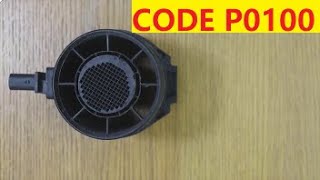
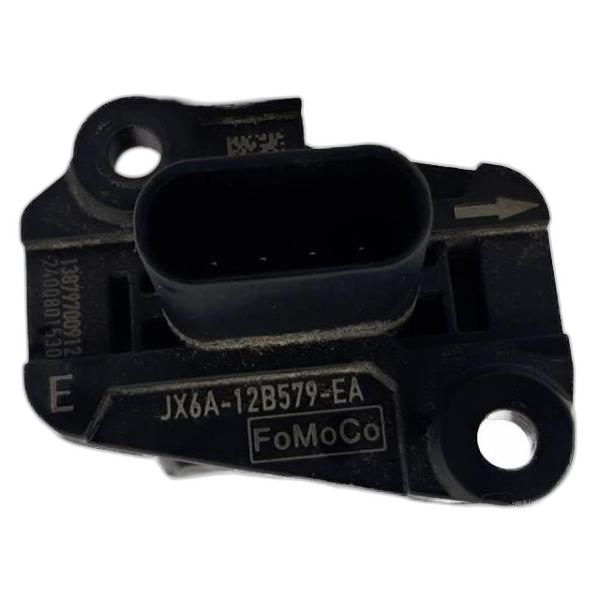
- Mass Airflow Sensor
(OEM #T2H7707 (for 2.0L Gas/Diesel), C2D2062 (for 3.0L V6))— If cleaning the sensor and checking for air leaks doesn't solve the problem, the sensor itself has likely failed electronically.
Trusted brands: Bosch, Denso, Genuine Jaguar
OEM price range: $250-$400
Aftermarket price range: $150-$250 - Mass Airflow Sensor Cleaner — This is the first and most cost-effective step. A dirty sensor is a very common cause for this code across all engines.
Trusted brands: CRC, Liqui Moly, WD-40 Specialist
OEM price range: $10-$20
Aftermarket price range: $10-$20
Related Codes That Often Appear With This One
- P0111 — Intake Air Temperature (IAT) Sensor performance issue. The IAT is often integrated into the MAF sensor housing. TSB SSM73671 specifically lists this code as appearing with P0100 due to the air leak.
- P2178 — System Too Rich Off Idle. An unmetered air leak can confuse the PCM's fuel calculations, leading to this code. It is also mentioned in TSB SSM73671.
- P0299 — Turbocharger/Supercharger Underboost. A significant air leak in the intake tract after the turbo will cause a loss of boost pressure, triggering this code alongside the MAF code. Also listed in TSB SSM73671.
- P0171 / P0174 — System Too Lean. If the MAF sensor is under-reporting airflow due to being faulty or if there's a vacuum leak, the engine will run lean, triggering these codes.
Technical Service Bulletins (TSBs) & Recalls
- SSM73671: Notes that on the 2.0L Ingenium Petrol engine, P0100-38 can be caused by an incorrectly fitted air intake elbow leading to an air leak. It also lists associated codes P0111, P0113, P2178, and P0299.
Platform-Specific Known Issues
- TSB SSM73671 documents an issue on the 2.0L Ingenium petrol engine where an incorrectly fitted air intake elbow causes an air leak, triggering P0100 and other codes. This is a primary diagnostic path for this specific engine.
Mechanic-Grade Diagnostic Values
- MAF Sensor Live Data (g/s) at Idle (Warm Engine) — expected: Approximately equal to the engine displacement in liters. For the 2.0L engine, expect ~2.0 g/s. For the 3.0L V6, expect ~3.0 g/s.. Failure: Readings are erratic, stuck at a specific value, or do not increase smoothly with RPM.
- MAF Sensor Live Data (g/s) at 2500 RPM — expected: Should rise to between 15 to 25 g/s, depending on engine size and load.. Failure: The reading rises too slowly (indicating a dirty sensor or air leak) or too quickly (indicating a sensor out of calibration).
- Ground Circuit Voltage Drop — expected: Less than 0.5V (500mV) when cranking the engine.. Failure: A reading significantly higher than 0.5V indicates a poor ground connection, which can cause incorrect sensor readings and various electrical issues.
Hidden / Shadow Codes Worth Checking
- P0100-38: Mass or Volume Air Flow Sensor "A" Circuit signal frequency incorrect. This is a Jaguar-specific sub-code that points to an electrical signal problem (like a wiring fault or a significant air leak causing implausible frequency changes) rather than a general circuit failure. (see via Jaguar-specific diagnostic tools like SDD or Pathfinder, though some high-end generic scanners may show it.)
Wiring & Ground Locations
- Engine Ground Strap — On some Jaguar models, a primary engine grounding strap is located directly under the starter on the right side lower frame of the car, connecting to the transmission.. A poor engine ground can cause a variety of electrical issues, including incorrect sensor readings. Verifying ground integrity by measuring voltage drop is a key step when electrical faults are suspected.
- Engine Bay Ground Studs — Multiple ground studs are located throughout the engine bay, often on the inner fenders/wings and firewall. Specific locations for the ECM grounds can be found in the vehicle's electrical guide.. The MAF sensor circuit relies on a clean ground reference. Corrosion or looseness at these points can introduce noise or voltage offsets into the MAF signal, triggering a P0100 code.
- MAF Sensor Connector — The electrical connector directly on the MAF sensor housing, located in the intake tract after the air filter box.. This is the most common point of failure for wiring issues. Pins can become corroded, bent, or wires can fray, leading to an intermittent or complete loss of signal from the MAF sensor.
Real Owner Repair Stories
- Jaguar F-Pace Club forum member (2017 F-Pace Portfolio, 89k miles) — Car spluttered to a stop.
❌ Tried (didn't work) Prior repairs included timing chain replacement and crank pulley/intake hose replacement.
✅ What actually fixed it The root cause was diagnosed as a failed turbo where the retaining nut reportedly came off, leading to catastrophic engine failure. This is an extreme edge case but shows that a severe mechanical failure can manifest with various performance symptoms and codes before total failure.
OEM Part Supersession History
T2H7707→T2R26101 (for some 2.0L applications)— Part update or consolidation by the manufacturer.
Heads up: Part number T2H7707 is listed for 2.0L Diesel and some 3.0L applications. Part T2R26101 is listed for 2.0L Ingenium Petrol from 2017 onwards. It is critical to verify the correct part number by VIN, as using the wrong sensor can cause persistent codes and performance issues.
Helpful Videos
We Have This Part in Stock



The information in this article is provided for general reference and educational purposes only. Vehicle specifications, procedures, and part compatibility can vary by production date, trim level, and region. Always consult your vehicle's factory service manual and verify part numbers before purchasing or performing repairs. Safety-critical components such as airbags, seat belts, and braking systems should be installed by a qualified professional.
- Jaguar F-PACE:
- 🎬 Helpful Videos
- 🛍️ Shop This Part
- What's Unique About the 2017-2018 Jaguar F-PACE
- Diagnostic Flowchart
- Symptoms You May Notice
- Most Likely Causes
- Rare But Worth Checking
- Diagnosis Steps
- Parts You'll Likely Need
- Related Codes That Often Appear With This One
- Technical Service Bulletins (TSBs) & Recalls
- Platform-Specific Known Issues
- Mechanic-Grade Diagnostic Values
- Hidden / Shadow Codes Worth Checking
- Wiring & Ground Locations
- Real Owner Repair Stories
- OEM Part Supersession History
- 🎟️ Get 5% Off