

OBD-II Code P0097: Intake Air Temperature Sensor 2 Circuit Low
What P0097 means, why it triggers, and how to fix it
- P0097 triggers when the engine computer detects a voltage below 0.2V from IAT Sensor 2, interpreting it as an impossibly high air temperature over 250°F.
- Unplug the sensor while watching live scanner data; if the temperature drops to -40°F, the sensor is internally shorted and requires replacement.
- Expect a 10-20% drop in fuel economy and potential catalytic converter damage costing over $1,200 if you ignore this code for more than a few months.
- Check for Technical Service Bulletins (TSBs) before replacing parts, as 2017-2019 GM trucks have a known wiring harness short that causes this specific code.
What Does P0097 Mean?

P0097 means the Powertrain Control Module (PCM) receives a low voltage signal from Intake Air Temperature (IAT) Sensor 2. This indicates a short circuit, which the computer interprets as extremely high air temperature (over 250°F). This sensor measures the heat of the air entering the engine after the turbocharger or supercharger, which is critical for calculating the correct air-to-fuel mixture and ignition timing.
Technical definition: Intake Air Temperature Sensor 2 Circuit Low (Bank 1). The PCM sets this code when the voltage signal from IAT Sensor 2 falls below the specified range, typically under 0.2 volts for several consecutive seconds. On newer vehicles like the 2023+ Honda Accord, this threshold is as low as 0.08 volts.
Can I Drive With P0097?
Yes, But With Caution. You can drive with this code, but fix it within a few weeks. Ignoring it causes poor engine performance, reduced fuel economy, and failed emissions tests. A persistent rich fuel condition overheats and damages the catalytic converter, a repair costing $800 to $2,500.
Common Causes

- Faulty Intake Air Temperature (IAT) Sensor 2 (Very Common) — The sensor shorts out internally due to age or heat, sending a continuous low voltage signal to the PCM.
- Wiring or Connector Issues (Common) — The wiring harness chafes, frays, or shorts to ground against other components. Connectors corrode, loosen, or fill with oil and coolant, disrupting the signal.
- Blown Fuse (Less Common) — A blown fuse cuts power to the sensor circuit, triggering this code alongside other sensor faults. For example, GM vehicles frequently blow fuse #43 due to a known wiring short.
- Dirty or Contaminated Sensor (Less Common) — Oil or debris from the intake system coats the sensor element, insulating it and skewing temperature readings.
- Failing Battery or Alternator (Rare) — A weak battery or failing alternator causes momentary dips in the 5-volt reference signal, temporarily pulling the IAT signal low enough to trigger the code.
- Powertrain Control Module (PCM) Malfunction (Very Rare) — The PCM fails and incorrectly processes the IAT sensor signal. Suspect this only after ruling out all other wiring and sensor causes.
Symptoms
- Check Engine Light is On — This is the first and sometimes only symptom a driver notices.
- Poor Engine Performance & Running Rich — The engine runs rich, wasting fuel and causing rough idling, hesitation, stalling, or black smoke from the exhaust. 🎬 Watch: A breakdown of P0097 symptoms, causes, and solutions
- Hard Starting (Cold Weather) — The engine struggles to start in cold weather because the PCM fails to provide the rich fuel mixture required for a cold engine.
- Engine Pinging or Knocking — An incorrect air-fuel mixture leads to detonation under load, sounding like a metallic pinging.
- Failed Emissions Test — The improper air-fuel ratio increases harmful emissions like NOx, causing an automatic emissions test failure.
Diagnostic Flowchart

Tap your situation to follow the diagnostic path that matches what you're seeing on this code.
Common Fixes & Costs

- Replace the IAT Sensor 2 — Parts: $20-$100, Labor: $50-$150, ~0.8 hr book time (DIY)
- Repair Damaged Wiring or Connector — Parts: $10-$50, Labor: $100-$400, ~2 hr book time (Intermediate)
- Clean the IAT Sensor 2 and Connector — Parts: $5-$15, Labor: $0-$30, ~0.2 hr book time (DIY)
- Replace a Blown Fuse — Parts: $1-$5, Labor: $0-$50, ~0.1 hr book time (DIY)
- Replace the Powertrain Control Module (PCM) — Parts: $600-$900, Labor: $150-$250, ~1.5 hr book time (Professional)
Used vs. New Parts: Buying Guide
When a used part is worth it: Buying a used IAT sensor rarely makes sense. The cost savings are minimal compared to the risk of receiving a faulty part.
Donor-vehicle mileage cap: roughly under 50000 miles for the part to have meaningful remaining life.
Donor quality checklist:
- Match the part number exactly.
- Visually inspect the connector for corrosion.
- Test the resistance of the used sensor at room temperature before installation.
Decision logic:
- If The new part costs less than $100 → Always buy new. The warranty and peace of mind are worth the price difference.
- If The vehicle is very old and budget is the absolute top priority → A used part is viable, but accept the risk of premature failure.
- If The part is integrated into an expensive intake manifold assembly → A used assembly is acceptable, but install a new sensor into it if possible.
Warranty tradeoff: Used sensors carry a 30-day warranty at best. New aftermarket sensors carry a 1-year to lifetime warranty.
Worst-case if a used part fails: $100-$200 if a used part fails, primarily due to repeated diagnostic and labor charges.
What Happens If You Wait — Timeline
- 0-2 weeks: Code P0097 sets and the Check Engine Light turns on. The PCM defaults to a 'hot air' fuel map. No major symptoms are noticeable. (MPG impact: 0-5%% · Added cost: $0)
- 2 weeks - 3 months: Fuel economy drops. Hesitation on acceleration, rough idle, and hard starting in cold weather become apparent. (MPG impact: 5-15%% · Added cost: $30-$100 in wasted fuel.)
- 3-8 months: The persistent rich fuel mixture overwhelms the catalytic converter, causing it to overheat. Black smoke may appear under acceleration. (MPG impact: 10-20%% · Added cost: $500-$1500 (catalytic converter damage risk is high).)
- 8+ months: Complete catalytic converter failure occurs, causing exhaust blockage, severe power loss, and frequent stalling. Downstream oxygen sensors may also fail. (MPG impact: 15-25%+% · Added cost: $1200-$3000+ (catalytic converter and O2 sensor replacement).)
Cost of Not Fixing It
- 0-1 month: Reduced fuel economy by 5-10% and noticeable engine hesitation. Guaranteed emissions test failure. (Added cost: $20-$50 in wasted fuel.)
- 1-6 months: The persistent rich fuel condition overheats the catalytic converter, melting the internal substrate. (Added cost: $1200-$2800 for catalytic converter replacement.)
- 6+ months: Fouled spark plugs, damaged oxygen sensors, and internal engine wear from fuel washing cylinder walls. (Added cost: $300-$800+ in addition to catalytic converter replacement.)
Diagnosis Steps
- Scan for Codes & Review Live Data
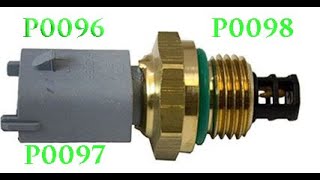
Use an OBD-II scanner to confirm P0097 and check for related codes (e.g., P0096, P0098, P0112). View live data for IAT Sensor 2. If it shows an impossibly high temperature (e.g., 250°F+) on a cold engine, you have a circuit low issue.
Tools: OBD-II Scanner (Beginner) - Unplug the Sensor Test
Turn the key 'On' (engine off). While monitoring live data, unplug the IAT Sensor 2 connector. If the temperature drops to -40°F and a P0098 code appears, the wiring is good and the sensor is internally shorted. If the reading stays high, the signal wire is shorted to ground in the harness.
Tools: OBD-II Scanner (Intermediate) - Visually Inspect the Sensor and Wiring
Locate IAT Sensor 2 (usually on the intake manifold or tube after the intercooler). Inspect the connector and wiring for melting, corrosion, or chafing against metal brackets.
Tools: Flashlight (Beginner) - Perform a 'Wiggle Test'
With the engine running and the scanner displaying live data, gently wiggle the connector and wiring harness. Wild temperature fluctuations indicate a loose connection or broken wire.
Tools: OBD-II Scanner (Beginner) - Test the Sensor Circuit Voltage
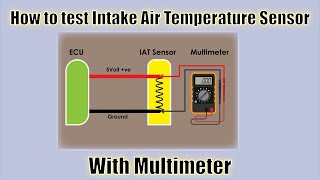
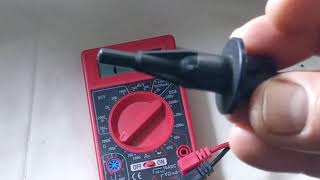
With the sensor unplugged and key on, use a multimeter to check for a 5-volt reference signal. A reading below 0.5V on the signal wire confirms a short to ground in the harness.
Tools: Digital Multimeter (Intermediate) - Test the Sensor's Resistance
Remove the sensor. Set a multimeter to Ohms. At room temperature (70°F), a good sensor reads between 2,000 and 2,500 Ohms. If resistance is near zero, the sensor is shorted and must be replaced.
Tools: Digital Multimeter (Advanced) - Test the Ground Circuit
Perform a voltage drop test. Connect the black multimeter lead to the sensor's ground pin and the red lead to the negative battery terminal. With the key on, the reading must be under 100 millivolts (0.1V). Higher readings confirm a bad ground connection.
Tools: Digital Multimeter (Advanced) - Analyze Live Data PID Values (Advanced)
Monitor the IAT Sensor 2 voltage PID directly. Normal voltage varies from 4.5V (cold) down to 0.5V (hot). P0097 triggers when this voltage stays persistently below 0.2V.
Tools: Advanced OBD-II Scanner (Advanced)
When This Code Triggers (Freeze-Frame Conditions)
- Engine Coolant Temp: 180-200°F (82-93°C) (Sets when the engine is fully warmed up and the PCM expects a plausible temperature reading.)
- RPM: 1500-2500 (Logged during steady-state cruise conditions when sensor values are expected to be stable.)
- Engine Load: 30-60% (Occurs under moderate engine load, not typically during heavy acceleration or idle.)
- Vehicle Speed: 35-55 mph (56-88 kph) (Triggers during city or highway driving as part of routine OBD-II sensor checks.)
Related Codes
- P0096 — Indicates an erratic signal (Range/Performance), whereas P0097 is a hard electrical fault where voltage is stuck low.
- P0098 — The exact opposite of P0097 (Circuit High/Open Circuit). If unplugging the sensor changes P0097 to P0098, the sensor is the problem.
- P0112 — The identical 'Circuit Low' fault but for IAT Sensor 1 (pre-turbo). Seeing both codes together strongly suggests a shared wiring problem or PCM fault.
- P2199 — Indicates readings from IAT1 and IAT2 don't correlate. A P0097 fault causes P2199 to set; fix P0097 first.
Climate & Environmental Factors
- Cold Weather: Cold temperatures exacerbate hard-starting symptoms. The PCM expects a high-voltage signal in the cold to enrich the fuel mixture; a low-voltage signal starves the engine of fuel during cold starts.
- High Humidity / Moisture: Humid climates and deep puddles accelerate corrosion on the IAT sensor's connector pins, leading to poor connections and circuit low faults.
- Road Salt / Corrosive Environments: Winter road salt degrades wiring harnesses and connector integrity, increasing the likelihood of shorts to ground.
How to Talk to a Mechanic About This Code
Say this: "I have a P0097 code for the Intake Air Temperature Sensor 2 circuit. I'd like to schedule a diagnostic to determine if the fault is the sensor itself, the wiring, or the connector. Please test the circuit and check for any TSBs before recommending a replacement part."
This signals you understand the common failure points. It directs the mechanic to perform a proper diagnosis rather than blindly replacing parts.
Avoid saying:
- 'My check engine light is on, can you just fix it?' (Invites unnecessary up-sells)
- 'I think I need a new IAT sensor.' (Don't diagnose for the mechanic)
- 'Just do whatever you think is best.' (Gives up control over the repair process)
Questions to ask before authorizing the repair:
- What were the results of the circuit voltage and resistance tests?
- Did you perform the 'unplug test' and what was the result?
- Did you find visible damage to the wiring harness or corrosion in the connector?
- What is the warranty on the recommended parts and labor?
Where to Take It: Dealer vs Independent vs Chain
- Dealer:
Recommended only if the vehicle is under warranty or has a known TSB. Otherwise, it is not cost-effective.
Best for: Vehicles under a bumper-to-bumper warranty., Complex cases involving known manufacturer TSBs (like GM trucks)., If the diagnosis points to a PCM failure requiring programming.
Downsides: Highest labor rates., May recommend replacing an entire assembly when only a small component failed. (Typical cost: +50% vs. baseline) - Independent Shop:
Best fit. P0097 is a routine diagnostic job that any competent independent mechanic handles efficiently.
Best for: Out-of-warranty vehicles., Cost-conscious owners wanting a proper diagnosis., Standard electrical diagnosis and repair.
Downsides: Diagnostic skill varies. Vet shops by checking for ASE certifications. (Typical cost: +0% vs. baseline) - Chain Shop:
Use with caution. Acceptable if you are certain the sensor is the only issue. AVOID for initial diagnosis.
Best for: Simple, confirmed part replacements where you diagnosed the issue yourself.
Downsides: Technicians may lack experience for proper electrical diagnosis., High pressure to upsell services. (Typical cost: -10% vs. baseline)
When to Walk Away From the Repair
If the total estimated repair cost exceeds 50% of your car's current private-party value, consider selling or trading it in.
- Car worth $5000, fix is $400: Fix it. This is a minor repair cost compared to the vehicle's value.
- Car worth $3500, fix is $2200: Walk away. The repair cost, likely for a damaged catalytic converter, is well over 50% of the car's value.
- Car worth $15000, fix is $350: Fix it. The repair cost is negligible.
What Scan Tool You Need for This Code
Minimum: An OBD-II reader that displays live sensor data and freeze-frame data.
A simple code reader cannot show live temperature data from IAT Sensor 2, which is required to perform the 'unplug test'.
Budget: BlueDriver Pro or Topdon TopScan (~$70) — Connects to your smartphone to provide live data streaming and freeze-frame data. Sufficient for a confident DIY diagnosis.
Mid-range: Foxwell NT510 Elite or Innova 5610 (~$150) — Offers manufacturer-specific diagnostics and bidirectional controls. Great for advanced DIY work.
Professional: Autel MaxiCOM MK808 series (~$500) — Provides full bidirectional control and OE-level capabilities. Overkill for P0097, but a worthy investment for serious mechanics.
Rent vs buy: If this is a one-time fix, auto parts stores loan scanners for free. Buy a scanner only if you diagnose issues more than once a year.
How to Clear the Code After You Fix It
- Use an OBD-II scan tool to clear the P0097 code from the PCM's memory.
- Perform a complete OBD-II drive cycle to allow readiness monitors to run.
- Rescan the vehicle to ensure the code has not returned.
Drive cycle (~30 minutes): A generic drive cycle includes a cold start, 3 minutes of idling, 10 minutes of steady highway driving at 55 mph, and 15 minutes of mixed stop-and-go city driving.
Readiness monitors affected: Catalyst Monitor, Evaporative System (EVAP) Monitor, Oxygen (O2) Sensor Monitor
Before emissions retest: drive at least 100 miles to fully set monitors.
Watch out for:
- Disconnecting the battery clears the code but resets all monitors to 'Not Ready', guaranteeing an emissions failure.
- The code returns immediately if the underlying electrical short has not been repaired.
Will This Fail Emissions / State Inspection?
Yes — this code typically fails an OBD-II emissions inspection.
- California: An active P0097 code results in an automatic failure. All OBD readiness monitors must be 'Ready' to pass; clearing the code requires a complete drive cycle before retesting.
- New York: An illuminated Check Engine Light from a P0097 code is an automatic failure during the OBD-II scan.
- Texas: The vehicle will fail in the 17 counties requiring emissions testing. After repair, the vehicle passes with a maximum of one monitor set to 'Not Ready'.
Most Commonly Affected Vehicles

- Chevrolet/GMC Silverado, Sierra, Cruze, Sonic (2013-2019) — Silverado/Sierra models (2017-2019) are subject to TSB 18-NA-217 for a wiring short near the fuel composition sensor, which blows fuse #43.
- Ford F-150 EcoBoost, Focus, Ranger (2015-2023) — The IAT2 sensor is crucial for turbo performance. Wiring harnesses are highly susceptible to heat and off-road debris damage.
- Honda Accord, Fit, Civic (2015-2023) — On 2023+ Accords, the code sets if voltage drops below a highly sensitive 0.08V threshold.
- Volkswagen/Audi Golf, GTI, Jetta, A4 (2013-2020) — Appears alongside low boost pressure complaints. The entire intake manifold may require replacement if the sensor port is compromised.
- Dodge/Ram Ram 1500 EcoDiesel, Charger, Durango (2017-2023) — Frequently points to sensor failure or ECM-related harness degradation.
- BMW 3 Series, 5 Series, X3, X5 (2005-2016) — Commonly related to the sensor itself or wiring harness degradation over time.
- Nissan Altima, Sentra (2013-2019) — Typically points to a faulty sensor or a localized wiring issue.
- Jeep Wrangler, Gladiator, Grand Cherokee (2015-2023) — Exposure to dust, mud, and trail conditions causes premature failure of the sensor or harness.
Manufacturer-Specific Notes
- General Motors (Chevrolet, GMC): TSB 18-NA-217: For 2017-2019 Silverado/Sierra trucks, P0097 is caused by the IAT signal wire shorting to ground near the fuel composition sensor, often blowing fuse #43.
- Ford: On EcoBoost engines, the IAT2 sensor (T-MAP) is located after the intercooler. Harness damage from heat and off-road debris is exceptionally common.
- Volkswagen/Audi: This code often appears alongside low boost pressure issues. In severe cases, the entire intake manifold requires replacement if the sensor port leaks.
Real Owner Stories
2015 Chevy Cruze 1.4L Turbo at 110K miles
Check Engine Light came on with code P0097. Car had a rough idle and hesitation when accelerating.
What they tried:
- Unplugged the sensor with the key on; scanner reading changed from 280°F to -40°F, proving the wiring was intact.
Outcome: Replaced the IAT Sensor 2 (ACDelco 213-4578) for $35. The repair took 20 minutes. The code cleared and engine performance returned to normal.
Lesson: The 'unplug test' is the fastest way to isolate whether the problem is the sensor or the wiring harness, preventing unnecessary part replacements.
2018 Ford F-150 EcoBoost at 75K miles
P0097 code appeared intermittently after driving in heavy rain. Fuel economy dropped by 2 MPG.
What they tried:
- Replaced the IAT Sensor 2, but the code returned a week later.
- A shop performed a wiggle test and found a corroded pin inside the connector.
Outcome: The connector was cleaned and packed with dielectric grease. Total shop cost was $120. The code has not returned.
Lesson: Don't assume the sensor is bad. Always check the connector and wiring first, especially when symptoms correlate with moisture.
2017 GMC Sierra 5.3L at 95K miles
Truck threw codes P0097, P0102, and P2199 simultaneously, ran poorly, and failed emissions.
What they tried:
- Replaced both the IAT and MAF sensors, but codes returned immediately.
- Searched for the code combination and found GM TSB 18-NA-217.
Outcome: A mechanic located a shorted signal wire near the fuel composition sensor, repaired it, and rerouted the harness for $350. All codes cleared.
Lesson: When multiple sensor codes appear at once, suspect a shared wiring problem or a known TSB. Searching for specific code combinations saves hundreds of dollars.
How to Prevent This Code From Triggering
- Inspect Sensor Connectors During Maintenance (During oil changes or spark plug replacements) — Visually checking the connector for corrosion and spraying it with contact cleaner prevents connection-related faults.
- Apply Dielectric Grease to Connectors (When replacing a sensor or living in a wet climate) — Dielectric grease creates a barrier against moisture, preventing the corrosion that causes intermittent shorts.
- Secure Wiring Harnesses (After any engine repair) — Ensuring wiring is secured away from hot exhaust components or sharp edges prevents the chafing that leads to shorts to ground.
- Address Fluid Leaks Promptly (As soon as detected) — Leaking oil or coolant saturates wiring harnesses, degrading insulation and causing electrical shorts.
Frequently Asked Questions
What is the difference between IAT Sensor 1 and IAT Sensor 2?
IAT Sensor 1 is located before the turbocharger and measures ambient air temperature. IAT Sensor 2 is located after the intercooler and measures the heated, compressed air entering the engine.
What are common mistakes when diagnosing P0097?
The biggest mistake is replacing the sensor without testing the wiring. Always perform the 'unplug test' and check for manufacturer TSBs before buying parts.
Where is the IAT Sensor 2 located?
It is found after the compressor on forced-induction vehicles. Look on the intake manifold, the charge pipe before the throttle body, or the intercooler outlet.
How much does it cost to fix code P0097?
A shop diagnostic costs $50 to $155. Replacing a bad sensor totals $100 to $250 for parts and labor. Wiring repairs range from $150 to $400 depending on damage severity.
Can I fix P0097 myself?
Yes, replacing the sensor or cleaning the connector is highly DIY-friendly. However, diagnosing and repairing a wiring short requires advanced multimeter skills.
Will a P0097 code clear itself?
No. This is a hard electrical fault that requires physical repair. Once fixed, you must clear the code with an OBD-II scanner.
Is P0097 covered under warranty?
It is covered under a 3-year/36,000-mile bumper-to-bumper warranty. It is rarely covered under the 8-year federal emissions warranty. Check for specific TSBs on your model.
Key Takeaways
- P0097 triggers when the engine computer detects a voltage below 0.2V from IAT Sensor 2, interpreting it as an impossibly high air temperature over 250°F.
- Unplug the sensor while watching live scanner data; if the temperature drops to -40°F, the sensor is internally shorted and requires replacement.
- Expect a 10-20% drop in fuel economy and potential catalytic converter damage costing over $1,200 if you ignore this code for more than a few months.
- Check for Technical Service Bulletins (TSBs) before replacing parts, as 2017-2019 GM trucks have a known wiring harness short that causes this specific code.
Helpful Videos


The information in this article is provided for general reference and educational purposes only. Vehicle specifications, procedures, and part compatibility can vary by production date, trim level, and region. Always consult your vehicle's factory service manual and verify part numbers before purchasing or performing repairs. Safety-critical components such as airbags, seat belts, and braking systems should be installed by a qualified professional.
- 🎬 Helpful Videos
- What Does P0097 Mean?
- Can I Drive With P0097?
- Common Causes
- Symptoms
- Diagnostic Flowchart
- Common Fixes & Costs
- Used vs. New Parts: Buying Guide
- What Happens If You Wait — Timeline
- Cost of Not Fixing It
- Diagnosis Steps
- When This Code Triggers (Freeze-Frame Conditions)
- Related Codes
- Climate & Environmental Factors
- How to Talk to a Mechanic About This Code
- Where to Take It: Dealer vs Independent vs Chain
- When to Walk Away From the Repair
- What Scan Tool You Need for This Code
- How to Clear the Code After You Fix It
- Will This Fail Emissions / State Inspection?
- Most Commonly Affected Vehicles
- Manufacturer-Specific Notes
- Real Owner Stories
- 2015 Chevy Cruze 1.4L Turbo at 110K miles
- 2018 Ford F-150 EcoBoost at 75K miles
- 2017 GMC Sierra 5.3L at 95K miles
- How to Prevent This Code From Triggering
- Frequently Asked Questions
- What is the difference between IAT Sensor 1 and IAT Sensor 2?
- What are common mistakes when diagnosing P0097?
- Where is the IAT Sensor 2 located?
- How much does it cost to fix code P0097?
- Can I fix P0097 myself?
- Will a P0097 code clear itself?
- Is P0097 covered under warranty?
- Key Takeaways
- 🎟️ Get 5% Off