

P0088 on 2006-2013 Volkswagen Touareg: Fuel Pressure Too High Causes & Fixes
On a 2006-2013 VW Touareg, code P0088 almost always points to a faulty high-pressure fuel pump (HPFP), a bad fuel rail pressure sensor (G247), or an issue with the HPFP's timing, often due to a stretched timing chain on 3.6L models. For TDI engines, this code can signal a catastrophic HPFP failure requiring a full fuel system replacement. This is a serious code that requires prompt attention to avoid engine damage.
- P0088 on a Touareg is a serious code indicating dangerously high fuel pressure and should be addressed immediately.
- The most likely causes are a faulty high-pressure fuel pump (HPFP), an incorrect HPFP timing, or a bad fuel rail pressure sensor.
- Due to the complexity of the high-pressure fuel system and the need for special tools, diagnosis and repair are best left to a qualified professional.
- Ignoring this code can lead to stalling, poor performance, and potentially catastrophic engine damage, especially on TDI models if the HPFP fails and contaminates the fuel system.
What's Unique About the 2006-2013 Volkswagen TOUAREG

The Touareg models in this year range use direct injection fuel systems (FSI, TSI, and TDI), which operate with a very high-pressure fuel pump (HPFP) in addition to a standard in-tank pump. This high-pressure system is a known point of failure. Volkswagen has issued multiple Technical Service Bulletins (TSBs) related to P0088. 🎬 Watch: A professional diagnosis and repair for the P0088 code. TSB 01-20-05TT specifically points to the HPFP being out of time due to stretched timing chains on 3.6L engines. For TDI models, TSB TB231601 and V231506 detail the diagnostic process for HPFP failure, which can send metal particles throughout the entire fuel system, a severe and well-documented issue.
Diagnostic Flowchart

Tap your situation to follow the diagnostic path that matches what you're seeing on this vehicle.
Generation note: This range covers two Touareg generations: the first (7L, 2006-2010) and the second (7P, 2011-2013). Both generations utilize direct-injection engines (gasoline and diesel) with high-pressure fuel systems. While specific engine designs differ, the fundamental causes for P0088 (HPFP, pressure sensor, regulator, timing) are common across both generations. The stretched timing chain issue is noted particularly on 2006-2009 3.6L engines. The 3.0L TDI V6 in the 2009-2013 models uses the Bosch CP4 HPFP, which is known for a specific catastrophic failure mode not present in the gasoline engines.
Symptoms You May Notice
- Check Engine Light (MIL) is on
- Engine runs rough or misfires [TB231601]
- Engine cranks but will not start [TB231601, 15]
- Engine stalls unexpectedly
- Reduced engine power and sluggish acceleration (limp mode)
- Black smoke from the exhaust
- Decreased fuel economy
- Strong smell of raw fuel
- High-pitched whining noise from the engine
- Replacing the fuel injectors when they are not the root cause. While high pressure can damage injectors, they are rarely the cause of the P0088 code itself.
- Replacing the in-tank low-pressure fuel pump. This pump's failure typically causes low pressure (P0087), not high pressure.
Most Likely Causes

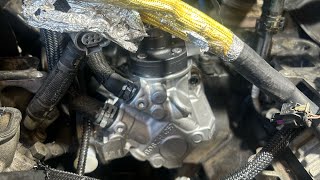
- High-Pressure Fuel Pump (HPFP) Failure or Timing Issue 🔴 High Probability As cited in VW's own TSBs, the HPFP can go out of time or fail mechanically, causing pressure regulation problems. On TDI models, the Bosch CP4 HPFP is known to disintegrate, sending metal shavings through the entire fuel system. On 3.6L gas engines, the pump timing is thrown off by stretched timing chains.
How to confirm: A technician will use a diagnostic scan tool (like VCDS) to check camshaft phase adjustments (MVB 208/209 or IDE00182/IDE00184); if they exceed 8 degrees, timing is off. For TDI models, a technician inspects the N290 Fuel Metering Valve on the HPFP for metallic particles, which confirms catastrophic failure.
Typical fix: If out of time due to chain stretch, the timing chains and tensioners must be replaced. If the pump has failed internally, it must be replaced. For TDI models, a catastrophic HPFP failure requires replacing the entire fuel system (pumps, lines, injectors, fuel rail, and cleaning the tank) to remove metal debris.
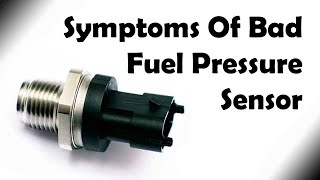
Est. part cost: $400-$1200 for the pump; up to $3000+ for a full TDI fuel system kit. - Faulty Fuel Rail Pressure Sensor (G247) 🟡 Medium Probability The sensor can fail and send an incorrect, high-voltage signal to the ECM, tricking it into thinking the pressure is too high even when it's normal. This is a common failure point on many modern direct-injection engines.
How to confirm: With the engine off (key on), a scan tool should show near-zero fuel rail pressure. If it shows a high reading, the sensor is likely faulty. Comparing the scan tool's live data to a mechanical pressure gauge can also confirm a bad sensor.
Typical fix: Replace the fuel rail pressure sensor.
Est. part cost: $50-$150 - Failed Fuel Pressure Regulator (N276) or Metering Valve (N290) 🟡 Medium Probability These regulators, with the N276 often on the fuel rail and the N290 on the HPFP, can get stuck or fail electronically, leading to uncontrolled pressure. TSBs for TDI models specifically mention checking the N290 valve.
How to confirm: Diagnosis involves using a scan tool to monitor regulator duty cycle and checking for proper power and ground at the valve's connector. Often, confirming this fault requires ruling out the sensor and HPFP timing first.
Typical fix: The N276 can sometimes be replaced separately, but the N290 is often integrated into the HPFP, requiring replacement of the entire pump assembly.
Est. part cost: $100-$250 for N276, or $400-$1200 as part of HPFP for N290.
Rare But Worth Checking
- Blocked Fuel Return Line: A restriction or kink in the fuel return line can prevent excess pressure from being bled off, causing it to build up in the rail.
- Wiring Issues: A short-to-power in the fuel pressure sensor's wiring harness can cause a constant high-voltage signal (e.g., 5 volts) to be sent to the ECM, mimicking a high-pressure condition. Rodent damage is a possible cause.
- Stretched Timing Chain (3.6L Engine): On 2006-2009 3.6L engines, a worn or stretched timing chain is a primary cause for the HPFP being out of sync, leading to P0088. VW TSB 01-20-05TT details this exact scenario, requiring chain replacement if camshaft adaptation exceeds 8 degrees.
Diagnosis Steps
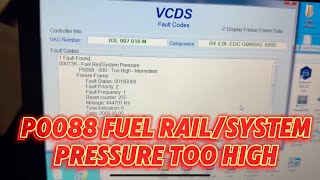
- Connect a VW-compatible scan tool (like VCDS) to read the fault codes and any associated freeze frame data.
- Observe live data for 'Fuel Rail Pressure (specified)' vs. 'Fuel Rail Pressure (actual)'. Note if the actual pressure is consistently and significantly higher than specified. At idle, pressures over 60 bar are suspect, and readings up to 125 bar strongly suggest a timing issue.
- With the engine off (key on), check the fuel rail pressure reading. It should be very low (ambient). If it reads high, the Fuel Rail Pressure Sensor (G247) is likely faulty.
- Inspect the wiring and connector for the G247 sensor for any signs of damage, corrosion, or shorts.
- For 3.6L engines, use VCDS to check camshaft adaptation. Check MVB 208/209 (KWP2000) or IDE00182/IDE00184 (UDS). If the value exceeds +/- 8 degrees, the timing chains are likely stretched and require replacement.
- For TDI models, follow TSB TB231601/V231506: carefully remove the N290 Fuel Metering Valve from the HPFP and inspect it and its bore for metallic particles. The presence of any metal shavings confirms HPFP failure and the need for a full fuel system replacement.
- If timing is correct and there are no metal particles, the fault likely lies within the HPFP's internal pressure regulator (N290) or the rail-mounted regulator (N276), warranting further testing or replacement.
Parts You'll Likely Need

- High-Pressure Fuel Pump (HPFP)
(OEM #03H127025C, 03H127025E (for 3.6L V6))— This is the most common mechanical failure point for P0088, either through internal failure (TDI) or a timing issue (3.6L), as documented in VW TSBs.
Trusted brands: Bosch, Hitachi
OEM price range: $700-$1200
Aftermarket price range: $400-$800 - Fuel Rail Pressure Sensor (G247)
(OEM #06J906051C (for 3.6L V6))— A common electrical failure that sends false high-pressure signals to the ECM, incorrectly triggering the P0088 code.
Trusted brands: Bosch, Standard Motor Products
OEM price range: $100-$200
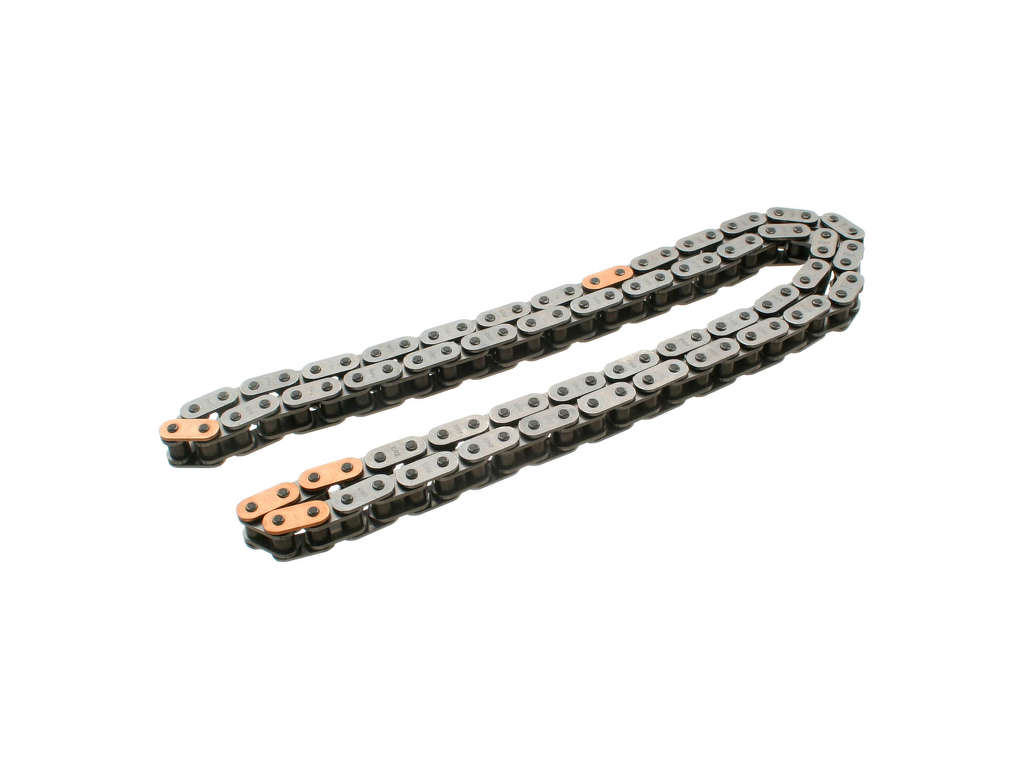
Aftermarket price range: $50-$150 - Timing Chain Kit — For 3.6L engines, stretched timing chains are a root cause of HPFP timing issues that set P0088, as per TSB 01-20-05TT.
Trusted brands: Iwis, Febi Bilstein
OEM price range: $600-$1000
Aftermarket price range: $300-$600
Related Codes That Often Appear With This One
- P0087 — Fuel Rail/System Pressure - Too Low. This code can appear with P0088 if the pressure is fluctuating wildly due to a failing regulator or a failing HPFP on a TDI engine. [TB231601, 24]
- P0191 — Fuel Rail Pressure Sensor 'A' Circuit Range/Performance. This indicates the sensor's signal is erratic or out of its expected range, which often accompanies a P0088. [TB231601, 24]
- P1025 — A VW-specific code for 'Fuel Pressure Regulation, Control Difference'. TSB 01-20-05TT links it directly with P0088 as part of the same fault condition caused by incorrect HPFP timing.
- P053F — Cold Start Fuel Pressure Performance. This can be set alongside P0088 when the HPFP is out of sync. [TT 01 20 05_4]
Technical Service Bulletins (TSBs) & Recalls
- TB231601: MIL on, No start, Running rough with DTCs P0087,P0088 or P0191 stored in ECM Fault memory (TDI Only).
- TT 01 20 05_4 / 01-20-05TT: DTCs P053F, P0087, P0088, P1025 may set due to the high pressure fuel pump being out of time (sync).
- TT011605_2045487: Enhanced diagnostic assistance for DTCs P0088 and P1025.
- V231506: Describes the diagnostic procedure to check for metallic particles in the fuel system when P0088 is present on TDI models.
Platform-Specific Known Issues
- TSB 01-20-05TT (supersedes TT 01 20 05_4) explicitly states that on 3.6L engines, DTC P0088 can be set because the high-pressure fuel pump is out of time. It advises checking camshaft adaptation values; if they exceed 8 degrees, the timing chains must be replaced.
- TSB TB231601 / V231506 (for TDI models) details the diagnostic procedure for P0087, P0088, and P0191. It instructs technicians to inspect the N290 Fuel Metering Valve on the HPFP for metal particles as a final step, which confirms catastrophic pump failure.
Mechanic-Grade Diagnostic Values
- Camshaft Phase Adjustment (3.6L Engine) — expected: Less than +/- 8 degrees at idle. Failure: A value of 8 degrees or more indicates stretched timing chains, causing the HPFP to be out of time.
- N276 Fuel Pressure Regulating Valve Resistance (TDI) — expected: Approximately 1 to 5 Ω. Failure: A reading outside this range suggests a faulty valve coil. Always verify with the specific repair manual for your engine.
- N290 Fuel Metering Valve Resistance (TDI) — expected: Approximately 0.8 to 5 Ω. Failure: A reading outside this range suggests a faulty valve coil. Always verify with the specific repair manual for your engine.
- N290 Fuel Metering Valve Fastener Torque (TDI) — expected: Pre-tighten to 2 Nm, then final torque to 6.5 – 7 Nm.. Failure: Incorrect torque can lead to fuel leaks or damage to the HPFP.
Scan Tool Commands That Help
- VCDS (VAG-COM): Engine -> Basic Settings -> Initial Fueling / Test Fuel System Pumps — After replacing a fuel filter, HPFP, or any component that introduces air into the fuel system on a TDI. This command runs the in-tank pump to purge air from the lines before starting the engine to prevent damage to the HPFP.
- VCDS (VAG-COM): Engine -> Adv. Meas. Values -> IDE00182 (Camshaft adjustment intake bank 1; phase position) & IDE00184 (Camshaft adjustment intake bank 2; phase position) — On 3.6L engines to diagnose stretched timing chains. These are the UDS controller equivalents of MVB 208/209. Check at idle; if the value exceeds +/- 8 degrees, the chains are likely stretched.
Wiring & Ground Locations
- G247 Fuel Pressure Sender Connector — On the high-pressure fuel rail, often under the intake manifold. It is a 3-pin connector.. The G247 sensor's signal is critical for pressure regulation. A wiring diagram shows it connects directly to the Engine Control Module (J623) at pins like T105a/49 (Signal), T105a/11 (Ground), and T105a/68 (5V Supply), depending on the specific engine/year. Damage to this harness can cause false P0088 codes.
- Engine Bay Ground Points — Multiple ground points exist. Key locations include on the long members near the headlamps (Points 12, 13, 640, 644), on the firewall/plenum chamber (Points 608, 645, 647), and directly on the engine block (Point 18).. A poor ground connection for the ECM or related sensors can introduce electrical noise and cause incorrect readings from the G247 sensor, potentially triggering a false P0088 code.
Real Owner Repair Stories
- The DIY Workshop on YouTube (Volkswagen Group vehicle with TDI Common Rail engine (demonstrated on a Passat, but principles apply to Touareg TDI)) — Check Engine Light with codes P0088, P0087, and P1065.
❌ Tried (didn't work) The video notes that the cause is often misdiagnosed as a bad HPFP or injectors.
✅ What actually fixed it The problem was resolved by replacing both the Fuel Rail Pressure Sensor (G247) and the Fuel Pressure Regulator Valve (N276) located on the fuel rail. The narrator suspected the G247 sensor was the primary culprit. - Ross-Tech Forums user (2015 VW Passat TDI (EA288 engine), 210k miles) — No symptoms or DTCs present, but preventative inspection was performed.
✅ What actually fixed it During a preventative inspection of the N290 Fuel Metering Valve on the HPFP, the owner found metal shavings on the screens, indicating the beginning of a catastrophic HPFP failure even without any fault codes. This highlights the importance of physical inspection on high-mileage TDI engines.
OEM Part Supersession History
03H127025C→03H127025E, 03H127025S— Part revision and updates by the manufacturer for the 3.6L V6 HPFP.
Heads up: While multiple revisions exist, they are generally interchangeable for the specified 3.6L engines. Always confirm fitment with VIN.06D906051A, 06D906051C, 06H906051A→06J906051C— This is the latest revision of the G247 fuel rail pressure sensor, addressing reliability issues found in earlier versions.
Heads up: 06J906051C is the recommended replacement for a wide range of VW/Audi direct injection engines to ensure reliability.
Model Year Variations Within This Range
- 2009-2013 (TDI Models): Touareg models from 2009 onwards with the 3.0L TDI engine use the Bosch CP4 high-pressure fuel pump. This pump is known for a catastrophic failure mode where it disintegrates internally, which is the primary cause of severe P0088/P0087 issues on these specific models. Earlier diesel engines used different pump designs.
- 2006-2010 (7L) vs 2011-2013 (7P): The electrical architecture, including CAN bus systems and control unit locations, differs between the first generation (7L) and second generation (7P). While the P0088 fault points to the same components, wiring diagrams and specific ground locations are not identical. For example, the Onboard Power Supply Control Unit (J519) location and function were updated in the 7P.
Helpful Videos

Used OEM Parts in Stock


New Aftermarket Parts Available



The information in this article is provided for general reference and educational purposes only. Vehicle specifications, procedures, and part compatibility can vary by production date, trim level, and region. Always consult your vehicle's factory service manual and verify part numbers before purchasing or performing repairs. Safety-critical components such as airbags, seat belts, and braking systems should be installed by a qualified professional.
- Volkswagen TOUAREG:
- 🎬 Helpful Videos
- 🛍️ Shop This Part
- What's Unique About the 2006-2013 Volkswagen TOUAREG
- Diagnostic Flowchart
- Symptoms You May Notice
- Most Likely Causes
- Rare But Worth Checking
- Diagnosis Steps
- Parts You'll Likely Need
- Related Codes That Often Appear With This One
- Technical Service Bulletins (TSBs) & Recalls
- Platform-Specific Known Issues
- Mechanic-Grade Diagnostic Values
- Scan Tool Commands That Help
- Wiring & Ground Locations
- Real Owner Repair Stories
- OEM Part Supersession History
- Model Year Variations Within This Range
- 🎟️ Get 5% Off