

P0088 on 2019-2022 Hyundai Veloster N: Fuel Pressure Too High Causes and Fixes
On a 2019-2022 Veloster N, code P0088 almost always means the High-Pressure Fuel Pump (HPFP) is failing. This is a well-documented issue covered by a Hyundai recall (Recall 262) and an extended warranty (15 years/150,000 miles), so the repair should be performed by a dealer at no cost. Do not drive the vehicle, as a sudden loss of power is a significant safety risk.
- P0088 on a Veloster N is a serious code indicating dangerously high fuel pressure, almost always caused by a faulty High-Pressure Fuel Pump (HPFP).
- DO NOT attempt to pay for this repair yourself. Contact a Hyundai dealer immediately, as this issue is covered by Safety Recall 262 and a 15-year/150,000-mile extended warranty.
- Symptoms include a check engine light, rough idle, hard starts, and a sudden loss of power or 'limp mode'.
- Continued driving is not recommended and is a safety risk, as the vehicle could stall or lose power unexpectedly.
What's Unique About the 2019-2022 Hyundai VELOSTER N
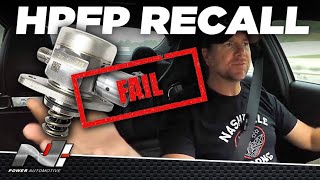
The 2019-2022 Veloster N, along with its platform mates the Elantra N and Kona N, is known for premature High-Pressure Fuel Pump (HPFP) failures. The issue stems from the HPFP supplied by Motonic Corporation. Specifically, the Fuel Control Valve (FCV) plunger within the pump can wear prematurely, allowing excess fuel to enter. This creates a rich air/fuel mixture, which triggers the P0088 code and can lead to a sudden loss of motive power at low speeds. The problem is so widespread that Hyundai issued Safety Recall 262 and TSB 24-01-075H-1 🎬 Watch: A quick update on the Elantra N HPFP recall to address it.
Diagnostic Flowchart
Tap your situation to follow the diagnostic path that matches what you're seeing on this vehicle.
Symptoms You May Notice
- Check Engine Light is on (though limp mode can sometimes occur before the light illuminates)
- Reduction or loss of engine power, especially at low speeds
- Engine enters 'limp mode', sometimes limiting RPMs to 3,000-5,000 RPM
- Hesitation or sputtering during acceleration
- Rough or unstable idle
- Hard starting or engine taking longer to turn over
- Engine misfires
- Black smoke from the exhaust
- Reduced or absent exhaust 'pops and bangs'
- Replacing the in-tank (low-pressure) fuel pump. The P0088 code specifically points to an issue in the high-pressure side of the fuel system, which on the Veloster N is almost always the engine-mounted HPFP.
- Replacing fuel injectors. While injectors can cause other fuel-related codes, the over-pressure condition of P0088 is caused by the pump failing to regulate itself. The recall procedure only calls for pump replacement if P0088 is present.
- Blaming 'bad fuel'. Some owners have been incorrectly told by dealers that bad fuel caused the issue, but P0088 is a widely acknowledged component failure covered by warranty.
Most Likely Causes
- Failing High-Pressure Fuel Pump (HPFP) 🔴 High Probability A known defect involving the Fuel Control Valve (FCV) plunger inside the pump causes premature wear, allowing excess fuel into the system. This is documented in Hyundai Safety Recall 262 and TSB 24-01-075H-1.
How to confirm: A Hyundai dealer will use a GDS scan tool to confirm if DTC P0088 (or P008800) is present in the ECM's history. The presence of this code is the primary criterion for replacing the pump under the recall.
Typical fix: Replace the High-Pressure Fuel Pump and high-pressure pipe. This repair is covered under Hyundai's extended warranty (15 years/150,000 miles) and Recall 262. The dealer will also perform a mandatory ECU software update as part of the recall service, which adjusts parameters that can trigger limp mode.
Est. part cost: $0 (if covered by warranty/recall)
Rare But Worth Checking
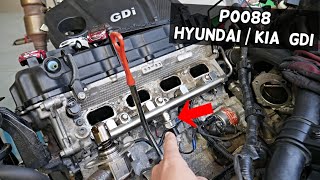
- Faulty Fuel Rail Pressure Sensor: While far less common than HPFP failure on this platform, a faulty sensor can send incorrect high-pressure readings to the ECU, triggering the P0088 code. Diagnosis involves comparing the sensor's voltage output on a scan tool to a mechanical pressure gauge reading. 🎬 See how to diagnose P0088 on Hyundai GDI engines If the scan tool shows high pressure but the mechanical gauge shows normal pressure, the sensor is likely faulty.
- Blocked or Restricted Fuel Return Line: A kink or blockage in the fuel return line can prevent excess fuel from returning to the tank, causing pressure to build up in the rail. This is a general mechanical issue that should be inspected if a new HPFP and sensor do not solve the problem.
Diagnosis Steps
- Contact a Hyundai dealership and provide your vehicle's VIN. Inquire about Safety Recall 262 and the warranty extension for the High-Pressure Fuel Pump (related to TSB 25-FL-002H).
- Schedule a service appointment. The dealership will follow the procedure outlined in TSB 24-01-075H-1.
- A technician will first perform a mandatory Engine Control Module (ECM) software update on all affected vehicles, regardless of symptoms. This is GDS Event #1141 for the Veloster N.
- The technician will then use a GDS scan tool to check for a stored DTC P0088 or P008800.
- If the code is present, the technician will replace the High-Pressure Fuel Pump and high-pressure pipe at no cost using the specified recall parts kit.
- If the code is not present, only the software update will be performed. The pump will not be replaced.
- For academic diagnosis, one would use a scan tool to monitor 'Fuel Rail Pressure'. On a vehicle with P0088, the actual pressure will be significantly higher 🎬 Watch: Real-world scan tool data for a P0088 over-pressure fault than the desired pressure, confirming the over-pressure condition. A Hyundai TSB notes the GDI high-pressure system can operate up to 3,626 PSI. One owner with code P0088 reported seeing ~5044 PSI on their scan tool.
Parts You'll Likely Need
- High-Pressure Fuel Pump Kit (Recall Part)
(OEM #35399-2G333QQH)— This is the complete kit specified by Hyundai for the recall repair. It contains the updated HPFP, bolts, and high-pressure pipe required to fix the root cause of P0088.
Trusted brands: Hyundai (OEM)
OEM price range: $500-$700
Aftermarket price range: Not Recommended - High-Pressure Fuel Pump (Contained in Kit)
(OEM #35320-2GHA1)— This is the updated pump component within the recall kit. The original failing part number was 35320-2GTA0.
Trusted brands: Hyundai (OEM)
OEM price range: $560-$710
Aftermarket price range: Not Recommended
Related Codes That Often Appear With This One
- P0172 — The failing HPFP allows excess, un-commanded fuel into the system, creating a rich air/fuel mixture that the oxygen sensors detect.
- P0300-P0304 — An incorrect and overly rich air/fuel mixture can lead to incomplete combustion, causing misfires in one or more cylinders.
Technical Service Bulletins (TSBs) & Recalls
- 24-01-075H-1: Outlines the service procedure for Recall 262, which involves updating the ECM software and inspecting for P0088. If the code is present, the HPFP is replaced. It lists the specific part numbers for the recall kit.
- 25-FL-002H: Officially describes the warranty extension for the High-Pressure Fuel Pump (HPFP) to 15 years or 150,000 miles for failures causing DTC P0088.
Platform-Specific Known Issues
- Recall 262 / TSB 24-01-075H-1: Hyundai has issued a safety recall for this exact issue. The remedy involves a mandatory ECM software update and, if DTC P0088 is found, replacement of the HPFP and high-pressure pipe.
- Warranty Extension (TSB 25-FL-002H): Per TSB #25-FL-002H, Hyundai extended the warranty coverage for the High-Pressure Fuel Pump to 15 years or 150,000 miles from the date of original retail delivery for failures that cause DTC P0088.
- Community Experience: Owners on forums like Reddit and n-cars.net widely report this failure, with symptoms appearing anywhere from 13,000 to 76,000 miles. The consensus is to take the vehicle to a dealer for the warranty/recall repair immediately.
Mechanic-Grade Diagnostic Values
- High-Pressure Fuel System (Normal Operation) — expected: 290 - 3,626 PSI. Failure: A reading significantly above 3,626 PSI. One owner with P0088 reported seeing ~5044 PSI on a scan tool.
- Fuel Rail Pressure Sensor (RPS) Voltage at Idle — expected: Below 1.7 V. Failure: Voltage significantly higher than expected at a given pressure.
- Fuel Rail Pressure Sensor (RPS) Voltage at Full Load — expected: Approx. 4.5 V (at ~1,600 bar / 23,200 PSI on a diesel, GDI will be lower). Failure: Voltage that does not correlate with pressure or is stuck high.
- High Pressure Fuel Pipe Installation Nut Torque — expected: 26.5 ~ 32.4 N.m (19.5 ~ 23.9 lb-ft). Failure: Improper torque can lead to fuel leaks.
- High Pressure Fuel Pump Installation Bolt Torque — expected: 12.8 ~ 14.7 N.m (9.4 ~ 10.9 lb-ft). Failure: Improper torque can damage the pump or cylinder head mounting surface.
Hidden / Shadow Codes Worth Checking
- P008800: This is the more specific version of the P0088 code that appears on the Hyundai GDS (Global Diagnostic System) dealer scan tool. Its presence is the primary trigger for HPFP replacement under recall. (see via Hyundai GDS Scan Tool.)
Scan Tool Commands That Help
- Hyundai GDS: GDS Event #1141: JSN THETA2 2.0T-GDI HIGH-PRESSURE FUEL PUMP ECM IMPROVEMENT FOR LIMP-HOME CONDITION UPDATE (P0088) — This is a mandatory software update performed on all affected vehicles as part of Recall 262. It adjusts the parameters that can trigger limp-home mode and must be performed regardless of whether the HPFP is replaced.
- Hyundai GDS: DTC Deletion — After releasing fuel pressure by removing the fuel pump fuse, a DTC may be set. This function is used to clear the code after the repair is complete.
Wiring & Ground Locations
- Fuel Rail Pressure Sensor Connector — Located on the end of the fuel rail, under the engine cover.. A poor connection or damaged wiring at this connector can cause incorrect pressure readings, potentially triggering a P0088 code, though this is rare on this platform compared to HPFP failure.
- High Pressure Fuel Pump Connector — On the High-Pressure Fuel Pump, which is mounted to the cylinder head and driven by the camshaft.. This connector provides power to the internal Fuel Control Valve (FCV). A bad connection could theoretically cause control issues, but the known failure mode is mechanical wear inside the pump.
Real Owner Repair Stories
- n-cars.net user 'Daleos' (Hyundai i30N (platform mate with same engine)) — In 1st or 2nd gear, when revving over 5000 RPM, the car would lose all power and not accelerate over 5000 RPM until the engine was turned off and on. Eventually, the check engine light came on.
✅ What actually fixed it The user self-scanned the code and found P0088. The community advised taking it to the dealer for diagnosis and repair under warranty, as it is a known issue with the HPFP or related sensors. - Reddit user '1kingtorulethem' (2019 Veloster N PP, 62,000 miles) — Car threw code P0088, scan tool showed fuel pressure at ~5044 psi during acceleration, causing misfires and making the car undrivable.
❌ Tried (didn't work) The dealer initially quoted a $2500 repair to replace the HPFP, high-pressure pipe, delivery pipe, and injectors.
✅ What actually fixed it The user contacted Hyundai customer service, who were working to get the repair covered under warranty/goodwill since it was just out of the 60,000-mile powertrain warranty, confirming the known HPFP issue.
OEM Part Supersession History
35320-2GTA0→35320-2GHA1 (as part of kit 35399-2G333QQH)— The original pump (35320-2GTA0) contained a Fuel Control Valve (FCV) plunger prone to premature wear. The updated part (35320-2GHA1) is the remedy component.
Heads up: The original part 35320-2GTA0 was also used on other Hyundai/Kia 2.0T models like the Sonata. Using a non-recall replacement part may lead to a repeat failure.
Model Year Variations Within This Range
- 2022: For the 2022 model year, Hyundai introduced an optional 8-speed dual-clutch automatic transmission (DCT). The 2019-2021 models were exclusively 6-speed manual. However, the P0088 HPFP failure and associated recall apply to all model years from 2019-2022, regardless of transmission type.
Helpful Videos
Used OEM Parts in Stock
New Aftermarket Parts Available


The information in this article is provided for general reference and educational purposes only. Vehicle specifications, procedures, and part compatibility can vary by production date, trim level, and region. Always consult your vehicle's factory service manual and verify part numbers before purchasing or performing repairs. Safety-critical components such as airbags, seat belts, and braking systems should be installed by a qualified professional.
- Hyundai VELOSTER N:
- 🎬 Helpful Videos
- 🛍️ Shop This Part
- What's Unique About the 2019-2022 Hyundai VELOSTER N
- Diagnostic Flowchart
- Symptoms You May Notice
- Most Likely Causes
- Rare But Worth Checking
- Diagnosis Steps
- Parts You'll Likely Need
- Related Codes That Often Appear With This One
- Technical Service Bulletins (TSBs) & Recalls
- Platform-Specific Known Issues
- Mechanic-Grade Diagnostic Values
- Hidden / Shadow Codes Worth Checking
- Scan Tool Commands That Help
- Wiring & Ground Locations
- Real Owner Repair Stories
- OEM Part Supersession History
- Model Year Variations Within This Range
- 🎟️ Get 5% Off