

P0088 on 2018-2019 Chevrolet Silverado 1500: Fuel Pressure Too High Causes & Fixes
P0088 on your Silverado means the fuel pressure is too high. This is most often caused by a failing high-pressure fuel pump (HPFP) or a faulty fuel rail pressure sensor. A bad sensor is a cheaper fix, but a failed HPFP is a common issue on these direct-injection engines, and a key sign is the smell of gasoline in the engine oil.
- P0088 indicates dangerously high fuel pressure in your Silverado's direct-injection engine.
- The most common culprits are a faulty fuel rail pressure sensor or a failing high-pressure fuel pump (HPFP).
- Always check your engine oil for the smell of gasoline. If present, the HPFP has likely failed and is leaking fuel into the crankcase, requiring immediate attention.
- Before replacing the expensive HPFP, verify the fuel rail pressure sensor is reading accurately. A faulty sensor can mimic a pump failure.
- Due to the extreme pressures and fire risk, diagnosis and repair of the high-pressure fuel system are best left to a professional.
What's Unique About the 2018-2019 Chevrolet SILVERADO 1500
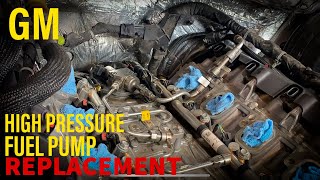
The 2018-2019 Silverado 1500 models use Gasoline Direct Injection (GDI) engines (like the 5.3L L83/L84 and 6.2L L86/L87), which feature a complex dual-pump fuel system. Unlike older port-injected engines, these trucks have both a low-pressure pump in the tank and a camshaft-driven high-pressure fuel pump (HPFP) on the engine. This high-pressure system, which can operate at over 2,000 PSI, introduces unique failure points like the HPFP and its specific sensors, which are the primary suspects for a P0088 code. 🎬 Watch: Overview of common causes and fixes for P0088 GM has also issued service bulletins pointing to issues like fuel system contamination (PIP5151F) and even swapped electrical connectors after a repair (PIP5119) as potential causes.
Diagnostic Flowchart
Tap your situation to follow the diagnostic path that matches what you're seeing on this vehicle.
Generation note: Yes, this range covers two distinct generations. The 2018 model is the final year of the 3rd generation (K2XX platform). The 2019 model year introduced the all-new 4th generation (T1XX platform). While both generations use direct-injection V8 engines (e.g., 5.3L, 6.2L), there are differences in engine management and wiring. However, the fundamental causes for P0088, related to the high-pressure fuel system, are largely consistent between them as they share the same core GDI architecture.
Symptoms You May Notice
- Check Engine Light is on
- Engine running rough or misfiring
- Hard starting or no-start conditions [PIP5151F]
- Reduced engine power ('limp mode')
- Poor acceleration and hesitation
- Black smoke from the exhaust
- Decreased fuel economy
- Strong smell of fuel, potentially from the exhaust or in the engine oil
- Replacing the in-tank (low-pressure) fuel pump when the issue is with the high-pressure pump or sensor.
- Replacing the high-pressure fuel pump without first verifying the fuel rail pressure sensor's accuracy with a mechanical gauge or by checking the KOEO reading on a scan tool.
Most Likely Causes
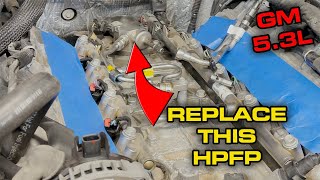
- Failing High-Pressure Fuel Pump (HPFP) 🔴 High Probability The mechanical HPFP is a known failure point on GM's direct injection engines. It is driven by the camshaft and can fail internally, causing it to produce excessive pressure or leak fuel into the crankcase.
How to confirm: A critical check is to smell the engine oil on the dipstick for gasoline. A fuel smell strongly indicates the HPFP has failed and is leaking fuel into the crankcase. A technician can also monitor desired vs. actual fuel rail pressure with a scan tool; if actual pressure is significantly higher than desired, the pump is a likely culprit.
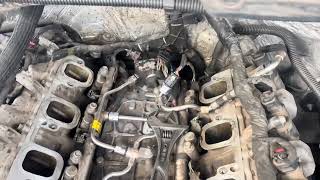
Typical fix: Replace the high-pressure fuel pump and the one-time-use high-pressure fuel line connected to it. An oil change 🎬 Watch: Complete guide to replacing the high-pressure fuel pump is mandatory if fuel has contaminated the oil.
Est. part cost: $350-$700 - Faulty Fuel Rail Pressure Sensor 🔴 High Probability The sensor provides the pressure reading to the ECM. It can fail by sending an inaccurately high voltage signal, tricking the ECM into thinking the pressure is too high when it's actually normal.
How to confirm: Use a scan tool to monitor the fuel rail pressure reading with the Key On, Engine Off (KOEO). If it shows a high pressure reading when the engine isn't running (it should be near zero), the sensor is likely bad. A reading stuck at a default max value, like 4,626 PSI, points to a shorted sensor or circuit. The definitive test is to compare the scan tool's reading to a mechanical fuel pressure gauge. If the readings don't match, the sensor is faulty.
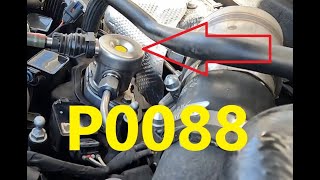
Typical fix: Replace the fuel rail pressure sensor. On Gen V engines, it is located at the back of the driver's side fuel rail, often requiring removal of other 🎬 See this service call for fuel rail pressure sensor repair components for access.
Est. part cost: $50-$150 - Fuel System Contamination 🟡 Medium Probability GM Technical Service Bulletins #PIP5151F and #16-NA-102 specifically mention that debris or water in the fuel system can cause components like the HPFP or injectors to malfunction, leading to P0088.
How to confirm: A fuel sample should be taken and inspected for debris, water, or other contaminants. In some cases, metal shavings in the fuel filter can indicate a disintegrating fuel pump.
Typical fix: If contamination is found, the TSB recommends cleaning the entire fuel system, which may include replacing the fuel tank, fuel lines, pumps, and injectors to prevent repeat failures. [PIP5151F]
Est. part cost: $500-$2000+ - Swapped Electrical Connectors ⚪ Low Probability TSB #PIP5119 notes that after an engine or fuel system repair, it's possible for the Fuel Rail Pressure 1 and 2 connectors to be swapped, which will cause P0088 to set. This is a human-error issue.
How to confirm: Visually inspect the wiring connectors at the fuel rails, especially if the code appeared immediately after a repair was performed.
Typical fix: Correctly connect the fuel rail pressure sensor connectors.
Est. part cost: $0
Rare But Worth Checking
- Wiring Harness Issue: A short-to-voltage in the fuel rail pressure sensor's wiring harness can cause a false high reading. TSB #21-NA-149 also points to potential harness chafing issues on the ECM/TCM bracket on 2019+ models, which can cause various electrical faults, including erratic sensor readings.
- Blocked Fuel Return Line: Though less common on modern returnless systems, a restriction in any pressure relief or return path could theoretically cause pressure to build.
- Faulty Fuel Pump Driver Module (FPCM): The FPCM, located on a frame crossmember near the spare tire, controls the in-tank low-pressure pump. A failure in the module or its wiring could cause the low-pressure pump to run at maximum duty cycle, potentially overwhelming the high-pressure system and contributing to a P0088 code.
Diagnosis Steps
- Connect an OBD-II scanner to confirm P0088 and check for any other related codes like P0087, P0191, P0172, or P0175.
- Use the scanner's live data function to monitor 'Desired Fuel Rail Pressure' vs. 'Actual Fuel Rail Pressure'. Note if the actual pressure is consistently and significantly higher than desired.
- CRITICAL: Check the engine oil for a gasoline smell. If fuel is present, the high-pressure fuel pump (HPFP) has most likely failed internally. Stop diagnosis and replace the HPFP and change the oil.
- If no fuel is in the oil, test the fuel rail pressure sensor. With the Key On, Engine Off (KOEO), the pressure should read near zero (<100 PSI). If it reads high or is stuck at a max value (e.g., 4,626 PSI), the sensor or its wiring is faulty.
- If possible, connect a mechanical pressure gauge to the high-pressure system (PROFESSIONAL-ONLY STEP) to verify the actual pressure. If the mechanical gauge shows normal pressure while the scanner shows high pressure, the sensor is bad.
- Inspect the wiring harness for the fuel rail pressure sensor for any signs of damage, chafing, or corrosion, particularly where it runs over the engine or near the ECM bracket on 2019+ models per TSB #21-NA-149.
- If recent repairs were made, verify that the fuel rail sensor connectors are not swapped, per TSB #PIP5119.
- If the sensor is confirmed good and actual pressure is verified to be high, the high-pressure fuel pump is the most likely cause.
Parts You'll Likely Need
- High-Pressure Fuel Pump (HPFP)
(OEM #12677329, 12688607, 12625817)— This is the most common mechanical failure that causes excessively high fuel pressure on these direct-injection engines. Part numbers can supersede; always verify with VIN.
Trusted brands: ACDelco (OEM), Delphi, Bosch - Fuel Rail Pressure Sensor
(OEM #12673824, 12623130)— This sensor provides the pressure reading to the ECM and is a common failure point, sending false high readings. Part numbers can vary, so always verify with VIN.
Trusted brands: ACDelco (OEM), Bosch
Related Codes That Often Appear With This One
- P0087 — Fuel Rail/System Pressure - Too Low. This can appear with P0088 if a component like the fuel pressure regulator or sensor is failing erratically, causing wild pressure swings. [6, PIP5151F]
- P0191 — Fuel Rail Pressure Sensor Circuit Range/Performance. This code often accompanies P0088 as it directly points to a problem with the sensor's signal, which could be the cause of the P0088 or a result of the extreme pressure readings. [35, PIP5151F]
- P128E — A GM-specific code related to fuel rail pressure performance. TSBs list it alongside P0087 and P0088, indicating a shared root cause. [PIP5151F, PIP4949E]
- P0172 / P0175 — System Too Rich (Bank 1 / Bank 2). These codes are a direct consequence of P0088, as the excessively high fuel pressure forces too much fuel into the cylinders, creating a rich condition.
Technical Service Bulletins (TSBs) & Recalls
- PIP5151F: Hard start, no start, rough running, or low fuel pressure with codes P0087, P0088, P0191, P128E, often due to fuel contamination.
- PIP5119: Codes P0088 and P128E may set after a repair if the Fuel Rail Pressure 1 and 2 connectors are swapped.
- 16-NA-102: Procedure for inspecting and replacing fuel components due to contamination causing hard/no start and codes P0087, P0088, P0191, or P128E.
- 21-NA-149: Details potential for engine wire harness chafing on the ECM/TCM bracket or other sharp edges on 2019+ models, causing a wide variety of DTCs including sensor faults.
Platform-Specific Known Issues
- 2019+ T1XX Platform Wiring Harness Chafing: For 2019 models on the new T1XX platform, TSB 21-NA-149 is particularly relevant. It describes how the engine wiring harness may not have been properly secured during assembly, allowing it to rub against sharp edges on the ECM/TCM bracket or shock tower. This can cause a short in the fuel rail pressure sensor circuit, leading to a false P0088 code.
Mechanic-Grade Diagnostic Values
- Low-Pressure Fuel System (In-tank pump) — expected: 55-62 PSI. Failure: Pressure significantly above 62 PSI could indicate a problem with the low-side regulation, potentially over-pressurizing the HPFP.
- High-Pressure Fuel System at Idle (GDI Engines) — expected: 500 - 1000 PSI. Failure: Pressure that is stuck high, unresponsive, or significantly exceeds the commanded pressure on a scan tool.
- Fuel Rail Pressure Sensor Voltage (Signal Wire) — expected: 0.5V to 4.5V, varying with pressure.. Failure: A reading of 5V or higher often indicates a short to power in the wiring or a bad ground connection for the sensor.
- Fuel Rail Pressure Sensor Reading (Key On, Engine Off) — expected: Close to 0 PSI or atmospheric pressure.. Failure: A significantly elevated pressure reading (e.g., >100 PSI) with the engine off strongly suggests a faulty sensor.
- Fuel Rail Pressure Sensor Reading (Shorted Circuit) — expected: Scan tool may display a default maximum value, such as 4,626 PSI.. Failure: Seeing the maximum possible pressure reading with the engine off is a definitive sign of a shorted sensor or wiring.
Scan Tool Commands That Help
- GDS2 (GM Techline): Fuel Pressure Control — To manually command changes in fuel pressure to test the response of the high-pressure fuel pump (HPFP) and fuel rail pressure sensor. This helps isolate a non-responsive or faulty component.
- GDS2 (GM Techline): Fuel Pump Enable/Disable — To safely disable the low-pressure fuel pump when servicing the high-pressure side of the fuel system or checking for leaks without the system being pressurized.
- GDS2 (GM Techline): Fuel System Depressurize — Used to safely relieve fuel pressure before servicing components. It can also be used to test a suspected faulty fuel pressure sensor; if the pressure reading on the scan tool doesn't drop to zero as the engine stalls, the sensor is likely bad.
Wiring & Ground Locations
- Fuel Pump Control Module (FPCM) — Located on a frame crossmember, typically near the spare tire. The spare tire may need to be lowered for access.. The FPCM controls the in-tank low-pressure pump. A failure here could theoretically cause the pump to run at full duty cycle, delivering excessive volume to the HPFP and contributing to a high-pressure condition.
- G103 / G107 (Engine Grounds) — On the front or rear of the passenger side cylinder head, just below the valve cover. Exact location varies by engine and year. A common location is a stud on the rear of the cylinder head.. These are primary engine and ECM grounds. A poor or corroded connection at these points can cause erratic sensor readings, including false high readings from the fuel rail pressure sensor, tricking the ECM into setting a P0088.
- Fuel Pump Frame Ground — On the driver's side frame rail.. This is the primary ground for the in-tank fuel pump. While a bad ground here more commonly causes low pressure (P0087), intermittent or poor connections could contribute to erratic FPCM behavior.
Real Owner Repair Stories
- Video by 'The Auto Electrician' (GM Truck with GDI (similar design to Silverado)) — Crank no-start, fuel pressure sensor codes P0192 & P127C.
❌ Tried (didn't work) Initial diagnosis pointed towards a bad sensor or wiring.
✅ What actually fixed it The technician found two physically identical main harness connectors on top of the engine were swapped. This sent incorrect voltage to the fuel rail pressure sensor. Correcting the connectors resolved the issue. This is consistent with GM TSB #PIP5119. - YouTube user GrumpsBowtieGarage (2019 Chevrolet Silverado 5.3L) — Check Engine Light on, specific code not mentioned but implied fuel system issue.
✅ What actually fixed it The Fuel Pump Control Module (FPCM) was replaced. After disconnecting the battery and replacing the module, the Check Engine Light did not return after several starts.
OEM Part Supersession History
12677329→12691016, among others (e.g., 12622475, 12633594, 12641740, 12669005).— Standard part evolution for design improvements, reliability, or manufacturing changes.
Heads up: The part number 12677329 is a widely recognized HPFP for various GM GDI engines, but it has been superseded multiple times. Always verify the latest correct part number with a VIN at a GM dealer to ensure compatibility.
Model Year Variations Within This Range
- Pre-2017 vs. Post-2017 (Approximate): Early Gen V engines (approx. 2014-2016) sometimes used a four-wire fuel rail pressure sensor that measured both pressure and temperature. Later models transitioned to a three-wire sensor that only measures pressure. The sensor's internal function also changed from analog to a serial data signal on some applications, meaning voltage cannot be tested with a simple multimeter.
Helpful Videos
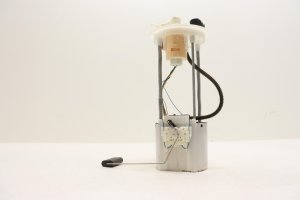
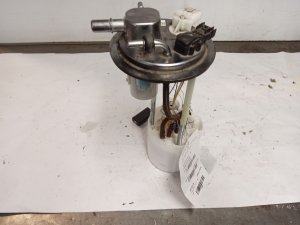
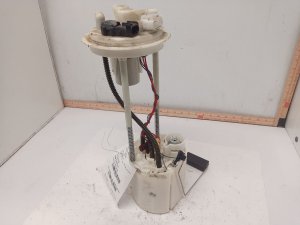
Used OEM Parts in Stock


New Aftermarket Parts Available
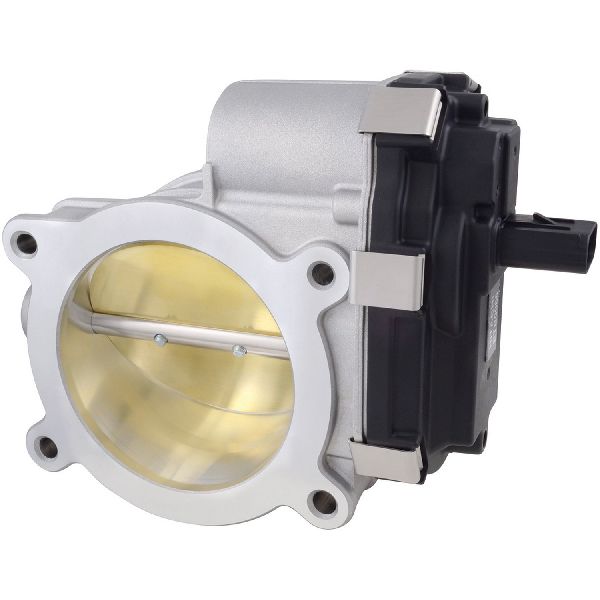


The information in this article is provided for general reference and educational purposes only. Vehicle specifications, procedures, and part compatibility can vary by production date, trim level, and region. Always consult your vehicle's factory service manual and verify part numbers before purchasing or performing repairs. Safety-critical components such as airbags, seat belts, and braking systems should be installed by a qualified professional.
- Chevrolet SILVERADO 1500:
- 🎬 Helpful Videos
- 🛍️ Shop This Part
- What's Unique About the 2018-2019 Chevrolet SILVERADO 1500
- Diagnostic Flowchart
- Symptoms You May Notice
- Most Likely Causes
- Rare But Worth Checking
- Diagnosis Steps
- Parts You'll Likely Need
- Related Codes That Often Appear With This One
- Technical Service Bulletins (TSBs) & Recalls
- Platform-Specific Known Issues
- Mechanic-Grade Diagnostic Values
- Scan Tool Commands That Help
- Wiring & Ground Locations
- Real Owner Repair Stories
- OEM Part Supersession History
- Model Year Variations Within This Range
- 🎟️ Get 5% Off