

P0088 on 2010-2014 Chevrolet Express: Fuel Pressure Too High Causes & Fixes
P0088 on a 2010-2014 Chevy Express means the fuel rail pressure is dangerously high. This is often caused by a faulty high-pressure fuel pump (especially the CP4.2 pump on 6.6L Duramax engines), a bad fuel rail pressure sensor, or fuel contamination. On Duramax vans, this code is a critical warning sign of potential high-pressure fuel pump failure, which can distribute metal debris throughout the fuel system.
- P0088 indicates a serious over-pressure condition in the fuel system that should be addressed immediately.
- Do not drive the vehicle, as high fuel pressure creates a fire risk and can damage the engine.
- For the 2010-2014 Express, a key diagnostic step recommended by GM is to check for fuel system contamination, in addition to testing the high-pressure pump and rail sensor.
- Diagnosis requires specialized tools like a scan tool with live data and a mechanical fuel pressure gauge. This is not a simple DIY fix and professional service is strongly recommended.
What's Unique About the 2010-2014 Chevrolet EXPRESS
For this generation of Chevrolet Express vans, the cause of P0088 is highly dependent on the engine. For vans with the 6.6L Duramax LGH/LML diesel engine, the code is a notorious indicator of issues with the Bosch CP4.2 high-pressure fuel pump. This pump is known for a failure mode where it can self-destruct, sending metallic debris throughout the entire high-pressure fuel system. Manufacturer technical service bulletins (TSBs) specifically instruct technicians to inspect the fuel pressure regulators for magnetic metal debris as the first step in diagnosing P0088, confirming this known failure pattern. For gasoline engines like the 6.0L V8, the issue is less severe and more typically related to a faulty in-tank fuel pump/regulator assembly or a failed sensor. Another unique issue on the Duramax is the possibility of the two fuel pressure regulator electrical connectors being swapped after an engine repair, which can cause P0088 immediately.
Diagnostic Flowchart
Tap your situation to follow the diagnostic path that matches what you're seeing on this vehicle.
Symptoms You May Notice
- Check Engine Light is on
- Engine runs rough, has a noticeable 'fuel knock', or idles erratically [TSB #PIP5151F, 9]
- Reduced engine power or vehicle entering 'limp mode'
- Hard starting or no-start condition [TSB #PIP4949E, TSB #16-NA-102]
- Black smoke from the exhaust
- Strong smell of raw fuel
- Poor fuel economy
- Replacing the fuel injectors without confirming they are the cause. While high pressure can damage injectors, they are not typically the root cause of the P0088 code itself.
- Replacing the in-tank low-pressure fuel pump (on diesel models) when the issue is with the engine-mounted high-pressure pump or its regulator.
- Replacing the high-pressure fuel pump on a Duramax without checking for and cleaning out metal contamination from the rest of the system, leading to a repeat failure of the new pump.
Most Likely Causes
- Faulty High-Pressure Fuel Pump (CP4.2) or Fuel Pressure Regulator (FPR) 🔴 High Probability On 6.6L Duramax engines, the Bosch CP4.2 pump is a known failure point. The internal pressure regulator (FPR 1) can stick or the pump itself can fail, sending metal shavings through the system. TSBs PIP4949E and 16-NA-102 directly address this, guiding technicians to check the FPR for magnetic debris.
How to confirm: A technician will use a scan tool to monitor desired versus actual fuel rail pressure. On Duramax engines, if actual pressure spikes over 29,000 PSI or exceeds desired pressure by over 2,900 PSI, the pump/regulator is suspect. A characteristic 'shark fin' pattern on a graph of the fuel pressure at idle is a strong indicator of a failing regulator. The definitive check is to remove Fuel Pressure Regulator 1 from the high-pressure pump and inspect its screen for metallic particles.
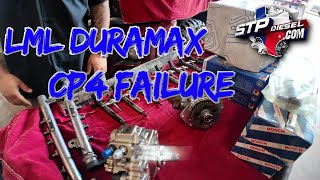
Typical fix: If no metal is found, only the fuel pressure regulator may be replaced. 🎬 See how to swap the Duramax fuel pressure regulator If magnetic debris is present, a full fuel system replacement is required. This includes the high-pressure pump, fuel rails, all high-pressure lines, and injectors, plus cleaning the fuel tank and low-pressure lines to prevent re-contamination. This is an extremely expensive repair. 🎬 Watch: Full CP4 failure fuel system replacement walkthrough
Est. part cost: $150-$400 (Regulator only), $2000-$4000+ (Full fuel system kit) - Faulty Fuel Rail Pressure (FRP) Sensor 🟡 Medium Probability The FRP sensor can fail and send an incorrect, high-voltage signal to the ECM, tricking it into thinking the pressure is too high even when it's normal. Corrosion at the sensor connector is also a known issue on GM trucks.
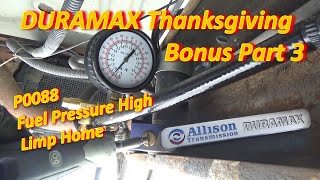
How to confirm: Compare the live data from the FRP sensor on a scan tool with a reading from a mechanical fuel pressure gauge (if a port is available). 🎬 Watch: General diagnosis and repair for the P0088 code If the scan tool shows high pressure but the mechanical gauge shows normal pressure, the sensor is likely bad. Unplugging the sensor should cause the code to change from P0192 (low voltage) to P0193 (high voltage), indicating the wiring is likely intact. Also, inspect the sensor's electrical connector for corrosion or damage.
Typical fix: Replacement of the fuel rail pressure sensor.
Est. part cost: $50-$160 - Fuel System Contamination 🟡 Medium Probability Multiple GM TSBs (#16-NA-102, #PIP5151F) for the Express van chassis state that debris in the fuel system can cause P0088. TSB PIP5151F specifically shows examples of contamination from water (causing rust), Diesel Exhaust Fluid (DEF), and other fluids that can damage fuel system components.
How to confirm: A visual inspection of the fuel tank, fuel filter, and fuel lines is required. A fuel sample should be taken and checked for water, discoloration, or separation. On Duramax models, inspection of the Fuel Pressure Regulator 2 (on the rail) can also reveal contamination.
Typical fix: If contamination is found, the entire fuel system must be cleaned, including the tank and lines. The fuel filter must be replaced. Depending on the contaminant, components like the high-pressure pump and injectors may be permanently damaged and require replacement.
Est. part cost: $50-$1000+ - Restricted Fuel Return Line ⚪ Low Probability A kinked, bent, or internally clogged fuel return line can prevent excess fuel from returning to the tank, causing pressure to build up in the rail.
How to confirm: Visually inspect the entire length of the fuel return line from the engine back to the fuel tank for any signs of physical damage or kinking.
Typical fix: Repair or replace the damaged section of the fuel line.
Est. part cost: $20-$200
Rare But Worth Checking
- Wiring Issues: A short in the wiring harness for the fuel rail pressure sensor can cause a constant high-voltage signal (5V) to be sent to the ECM, mimicking a high-pressure condition. Rodent damage is a possible cause. On Duramax models, TSB PIP5119 notes that the electrical connectors for the two fuel pressure regulators can be accidentally swapped during repairs, causing P0088.
- Aftermarket Lift Pump Issues: For Duramax engines modified with an aftermarket lift pump, if the pressure from the lift pump is set too high, it can over-feed the high-pressure pump and cause P0088 during specific conditions like coasting downhill.
- Faulty Powertrain Control Module (PCM): This is extremely rare, but a software glitch or internal failure in the PCM could lead to a false P0088 code. This should only be considered after all other possibilities have been exhausted.
Diagnosis Steps
- Connect an OBD-II scanner to confirm the P0088 code and check for any other related codes (e.g., P0087, P0191, P128E).
- View live data on the scanner, focusing on 'Desired Fuel Rail Pressure' and 'Actual Fuel Rail Pressure'. Note if the actual pressure is significantly higher than desired, especially during idle or deceleration. On a Duramax, a deviation over 2900 PSI is a key indicator.
- Perform a thorough visual inspection of the fuel rail, high-pressure pump, and all fuel lines for any signs of leaks, damage, or kinks.
- Inspect the wiring harness and connector for the Fuel Rail Pressure (FRP) sensor for damage, corrosion, or loose connections. Check for 5V reference, ground, and signal wire integrity.
- For Duramax engines, follow TSB #16-NA-102 / #PIP4949E: Carefully remove Fuel Pressure Regulator 1 (on the CP4 pump) and inspect the screen for magnetic metal debris. This is the most critical step to identify a failing high-pressure pump.
- If metal debris is found in step 5, the entire high-pressure fuel system is compromised and requires replacement and cleaning per the TSB. Do not proceed further with individual component testing.
- If no metal is found, take a fuel sample and inspect for contamination. If the fuel is clean, further testing of the Fuel Pressure Regulator and FRP sensor is required.
Parts You'll Likely Need
- High-Pressure Fuel Pump
(OEM #Bosch 0445010197 (Common OEM equivalent for LML/LGH CP4.2))— This is the primary cause on 6.6L Duramax engines. The internal pressure regulator fails or the pump self-destructs, causing over-pressurization and system contamination.
Trusted brands: Bosch, ACDelco (often a re-boxed Bosch)
OEM price range: $800-$1200
Aftermarket price range: $700-$1000 - Fuel Rail Pressure Sensor
(OEM #12686809 (Duramax), 12651990 or 13516496 (Gas V8, varies by year/model))— A faulty sensor can send incorrect high-pressure readings to the computer, triggering the code even if the pressure is normal.
Trusted brands: ACDelco, Bosch, Delphi
OEM price range: $80-$160
Aftermarket price range: $40-$90 - Fuel System Contamination Kit (Duramax) — If the CP4 pump fails and sends metal through the system, a complete kit including pump, injectors, rails, and lines is required for a proper repair to avoid repeat failure.
Trusted brands: GM Genuine, Bosch
OEM price range: $3000-$4000
Aftermarket price range: $2500-$3500 - Fuel Filter — TSBs indicate system contamination is a major issue. Replacing the filter is a mandatory step if any debris is found or if the system is flushed. [TSB #16-NA-102, 31]
Trusted brands: ACDelco, Wix, Racor
OEM price range: $30-$60
Aftermarket price range: $15-$40
Related Codes That Often Appear With This One
- P0087 — Fuel Rail/System Pressure - Too Low. This code may appear with P0088 if the pressure regulator is failing erratically, or if contamination is causing intermittent blockages. Both codes are listed together in multiple TSBs. [TSB #PIP4949E, TSB #16-NA-102]
- P0191 — Fuel Rail Pressure Sensor Circuit Range/Performance. This code often appears alongside P0088, as it indicates a problem with the sensor's signal, which could be the cause of the P0088 or a result of the extreme pressure readings. [TSB #PIP4949E]
- P128E — Fuel Rail Pressure Performance. This is another GM-specific code that is frequently logged with P0087/P0088 on Duramax engines when there is a fuel pressure deviation, as noted in TSBs PIP4949E and 16-NA-102.
Technical Service Bulletins (TSBs) & Recalls
- PIP4949E: Provides diagnostic guidance for hard start/no start conditions with DTCs P0087, P0088, P0191 or P128E.
- 16-NA-102: Outlines a procedure to inspect and replace fuel components to fix issues caused by fuel system contamination, which sets codes including P0088.
- PIP5151F: Advises that the complete fuel system needs cleaning if contamination is found while diagnosing rough running and fuel pressure codes like P0088.
Platform-Specific Known Issues
- GM has issued multiple Technical Service Bulletins (TSBs) related to P0088 on this platform, especially for the 6.6L Duramax engine.
- TSB #PIP4949E / #16-NA-102: These are the most critical bulletins. They describe a procedure for diagnosing hard/no-start conditions with P0088 by inspecting Fuel Pressure Regulator 1 for magnetic metal debris, which indicates a catastrophic failure of the high-pressure fuel pump requiring a full system replacement.
- TSB #PIP5151F: This bulletin helps technicians identify various types of fuel contamination (water, rust, DEF, other automotive fluids) that can cause P0088 and other fuel system DTCs. It emphasizes that damage from contamination is not a warranty repair.
- TSB #PIP5119: Specific to the 6.6L Duramax, this bulletin warns that the electrical connectors for the two fuel pressure regulators can be swapped during engine service, leading to a rough run condition and P0088 with extremely high (29,000 PSI) fuel pressure at idle.
Mechanic-Grade Diagnostic Values
- Fuel Rail Pressure (FRP) Sensor Signal Voltage — expected: 0.5V to 4.5V. Voltage increases as pressure increases.. Failure: A constant 5V signal indicates a short to power or a bad ground, which can trick the ECM into seeing maximum pressure.
- Low-Pressure Fuel System (Lift Pump) Vacuum — expected: The high-pressure pump should be able to pull at least 12 inches of Hg vacuum when cranking.. Failure: Less than 12 inches of Hg may indicate a weak lift pump or a leak in the low-pressure side, though this typically causes low pressure (P0087), not high.
- Fuel Pressure Regulator 1 (on CP4 pump) Commanded Duty Cycle — expected: Varies with demand. At idle, it may be around 35-40%.. Failure: A 'shark tooth' pattern on a live data graph of fuel pressure vs. time at a steady idle is a classic sign of a failing regulator.
Scan Tool Commands That Help
- GDS2 / Tech2: Fuel Pressure Control — To manually command the fuel pressure regulator to a specific duty cycle (e.g., 25%, 50%, 75%) and observe if the actual fuel rail pressure responds accordingly. This helps isolate a faulty regulator from a sensor or wiring issue.
- GDS2 / Tech2: Fuel System Data Stream Graphing — Graphing 'Desired Fuel Rail Pressure' vs. 'Actual Fuel Rail Pressure' is critical. A large, sudden deviation where the actual pressure spikes far above the desired pressure, especially on deceleration, points directly to a regulator or pump issue.
Wiring & Ground Locations
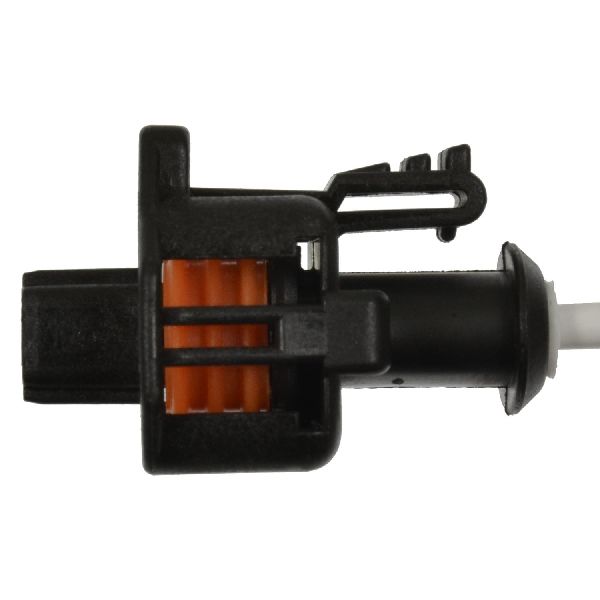
- Fuel Rail Pressure (FRP) Sensor — On the Duramax LGH/LML, it is installed on the front of the left (driver's side) fuel rail.. This sensor provides the primary data for the P0088 code. Damage to its wiring or connector can cause a false high-pressure reading.
- Fuel Pressure Regulator 1 (FPR1 / MPROP) — On the Duramax LGH/LML, it is located on the top/rear of the CP4.2 high-pressure fuel pump, in the engine valley.. This is the primary actuator for controlling fuel pressure. A stuck or contaminated FPR1 is a leading cause of P0088. TSB #16-NA-102 requires inspecting this part for metal debris.
- Fuel Pressure Regulator 2 (on rail) — On the Duramax LGH/LML, it is located on the left-hand (driver's side) fuel rail.. This regulator works with FPR1 to control rail pressure. While less common to fail than FPR1, it can also be a point of inspection for contamination.
- ECM Connector J1/X1 Pin 34 — At the Engine Control Module (ECM).. This is the 5V reference circuit for the fuel pressure sensor. A short to power on this circuit could cause a false high reading.
Real Owner Repair Stories
- YouTube channel 'Pine Hollow Auto Diagnostics' (Duramax truck with an aftermarket PPE lift pump) — P0088 code setting specifically when coasting downhill off-throttle.
❌ Tried (didn't work) Initial diagnosis was difficult as the code only set under very specific conditions.
✅ What actually fixed it The aftermarket lift pump's pressure was set too high (around 14 PSI). During deceleration, when the injectors shut off, the high-pressure pump had nowhere to send the excess fuel being supplied by the lift pump, causing a pressure spike in the rail that exceeded the desired pressure by more than 2900 PSI. Adjusting the lift pump pressure down to about 5 PSI resolved the issue completely. - Reddit user in r/Duramax (LMM Duramax) — P0088 code, rough running, limp mode after replacing fuel lines and sending unit.
❌ Tried (didn't work) Replacing the fuel filter after finding rusty metal bits inside did not clear the code initially.
✅ What actually fixed it After finding contamination, the user added injector cleaner to the fuel and let the engine idle for approximately 30 minutes. The engine sputtered, and then the fuel pressure dropped to normal, clearing the code. This suggests a piece of debris was temporarily stuck in the fuel pressure regulator and was eventually flushed out.
OEM Part Supersession History
Multiple→Bosch 0 281 006 313— This is a common OE and aftermarket replacement part number for the Fuel Rail Pressure Sensor on LGH/LML engines.
Model Year Variations Within This Range
- 2011-2014: The LML engine was introduced in 2011 alongside the LGH, primarily for vehicles sold in North America requiring stricter emissions (using Diesel Exhaust Fluid - DEF). The LGH engine continued in van applications. While both use the CP4.2 pump, contamination of the fuel system with DEF is a possibility on LML-equipped vehicles (though less common on Express vans which primarily used the LGH) and can cause severe fuel system damage leading to P0088.
Helpful Videos
Used OEM Parts in Stock

New Aftermarket Parts Available


The information in this article is provided for general reference and educational purposes only. Vehicle specifications, procedures, and part compatibility can vary by production date, trim level, and region. Always consult your vehicle's factory service manual and verify part numbers before purchasing or performing repairs. Safety-critical components such as airbags, seat belts, and braking systems should be installed by a qualified professional.
- Chevrolet EXPRESS:
- 🎬 Helpful Videos
- 🛍️ Shop This Part
- What's Unique About the 2010-2014 Chevrolet EXPRESS
- Diagnostic Flowchart
- Symptoms You May Notice
- Most Likely Causes
- Rare But Worth Checking
- Diagnosis Steps
- Parts You'll Likely Need
- Related Codes That Often Appear With This One
- Technical Service Bulletins (TSBs) & Recalls
- Platform-Specific Known Issues
- Mechanic-Grade Diagnostic Values
- Scan Tool Commands That Help
- Wiring & Ground Locations
- Real Owner Repair Stories
- OEM Part Supersession History
- Model Year Variations Within This Range
- 🎟️ Get 5% Off