

P0087 on 2012-2019 Volkswagen Passat: Low Fuel Pressure Causes & Fixes
On a 2012-2019 VW Passat with a direct injection engine (TSI or TDI), P0087 most often points to a failing High-Pressure Fuel Pump (HPFP) or its associated components like the cam follower. For TDI models, this can indicate a catastrophic failure of the CP4 HPFP. Expect a repair cost of $400-$1500+, depending on the specific cause and whether you choose OEM or aftermarket parts. A full fuel system replacement on a TDI can exceed $5,000.
- P0087 on a 2012-2019 Passat indicates dangerously low fuel pressure, usually in the high-pressure side of the system.
- The most common culprit is a failing High-Pressure Fuel Pump (HPFP), a known issue for these engines.
- Diagnosis should always begin by checking the low-pressure fuel pump's output before condemning the more expensive HPFP.
- A specific VW TSB mentions the HPFP can be 'out of time', a unique diagnostic angle that should be considered by a professional.
- Do not ignore this code; it can lead to stalling, poor performance, and leave you stranded.
What's Unique About the 2012-2019 Volkswagen PASSAT

The 2012-2019 Passat (NMS generation in North America) relies heavily on direct injection for both its gasoline (TSI) and diesel (TDI) engines. These systems are prone to specific failures that cause P0087. A critical issue, identified in a VW Technical Service Bulletin (TSB), is that the high-pressure fuel pump (HPFP) can go 'out of time' or 'out of sync', directly triggering this code. Furthermore, real-world owner complaints frequently cite premature failure of the HPFP itself as the root cause. For TDI models specifically, the Bosch CP4 HPFP is notorious for failing and disintegrating, sending metal shavings throughout the entire fuel system, leading to an extremely expensive repair. For TSI engines, wear on the camshaft follower that drives the HPFP is a very common failure point leading to P0087.
Diagnostic Flowchart

Tap your situation to follow the diagnostic path that matches what you're seeing on this vehicle.
Generation note: The 2012-2019 Volkswagen Passat in North America is primarily the NMS (New Midsize Sedan) generation. While the chassis is consistent, the engine options (1.8T TSI, 2.0T TSI, 3.6L VR6, 2.5L 5-cyl, 2.0L TDI) have different fuel systems. This guide focuses primarily on the direct injection TSI (EA888) and TDI (EA288) engines, as they are most commonly affected by P0087. The failure modes differ significantly between them, with cam follower wear being a key issue for TSI engines and CP4 pump failure being a major concern for the TDI models. The EA888 engine itself has generations (Gen1, Gen2, Gen3) within this vehicle's year range, with changes to fuel system components and engine blocks.
Symptoms You May Notice

- Significant loss of engine power (limp mode)
- Check Engine Light and/or EPC light illuminated
- Flashing glow plug light (on TDI models)
- Engine hesitation or stumbling during acceleration
- Rough idle
- Difficulty starting the engine, or engine cranks but won't start
- Engine stalling, sometimes randomly and without warning
- Strong smell of fuel from the exhaust, indicating a rich condition from a leaking injector
- Replacing the fuel rail pressure sensor when the pump is the actual problem.
- Replacing the in-tank fuel pump (LPFP) without first testing its pressure output, when the issue is actually the HPFP or cam follower.
- On TSI engines, replacing only the HPFP without inspecting the cam follower and camshaft lobe, leading to a repeat failure of the new pump.
- On TDI engines, replacing just the HPFP without inspecting for and cleaning out metal contamination, leading to a catastrophic failure of the new components.
Most Likely Causes

- High-Pressure Fuel Pump (HPFP) Failure 🔴 High Probability The HPFP is a known failure point on many VW direct injection engines. For TSI engines, internal components can break or wear out. For TDI engines, the Bosch CP4 HPFP is infamous for self-destructing, contaminating the entire fuel system with metal particles. Owner complaints for the Passat specifically mention the HPFP failing and causing a P0087 code.
How to confirm: A technician will use a scan tool (like VCDS) to monitor requested vs. actual fuel rail pressure under load. A significant deviation where actual pressure cannot meet the requested pressure points to a weak HPFP. For TDI models, inspection of the fuel filter and fuel metering valve (N290) for metallic debris is a critical diagnostic step.
Typical fix: Replacement of the high-pressure fuel pump. For TSI, the cam follower should always be replaced at the same time. For TDI, if metal debris is found, the entire fuel system (tank, lines, pumps, injectors, rail) must be replaced.
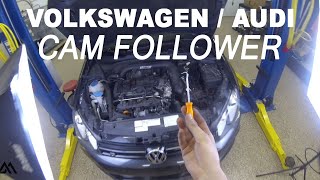
Est. part cost: $250-$700 for the pump; $5000+ for a full TDI fuel system replacement. - Worn Camshaft Lobe or Cam Follower (TSI Engines) 🔴 High Probability The HPFP on TSI engines is driven by a lobe on the camshaft via a small, flat-faced 'cam follower'. This follower is a wear item and can wear through completely, destroying both the pump's plunger and the camshaft lobe. This was a major issue on earlier EA113 and early EA888 engines but remains a common failure point across the generations.
How to confirm: Physical inspection is required. The HPFP must be removed to access and inspect the cam follower and the camshaft lobe for wear or damage. Many owners and mechanics recommend checking it as a preventative measure.
Typical fix: Replacement of the cam follower. If the camshaft lobe is also damaged, the intake camshaft must also be replaced, which is a much larger job. The HPFP is often replaced as a precaution if the follower has failed catastrophically.
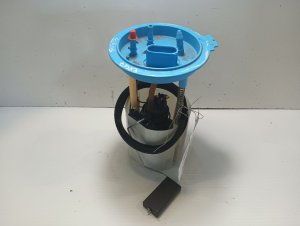
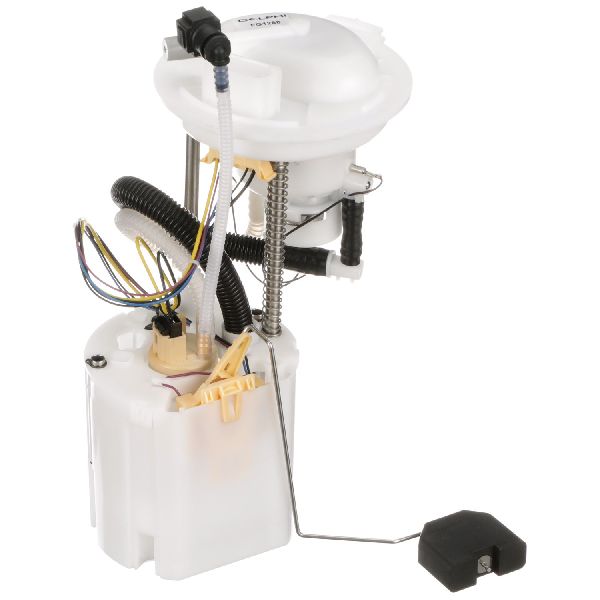
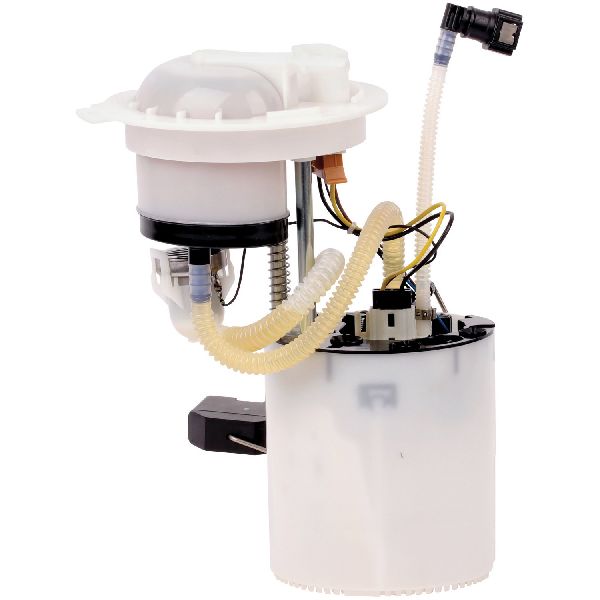
Est. part cost: $40-$80 for the follower; $400-$1000+ if the camshaft also needs replacement. - Failing In-Tank Low-Pressure Fuel Pump (LPFP) or Control Module 🟡 Medium Probability The HPFP cannot generate high pressure if it isn't being supplied with adequate low-pressure fuel from the tank. A weak LPFP or a faulty Fuel Pump Control Module (J538) will starve the HPFP. These modules can fail from overheating or corrosion, leading to intermittent or total loss of low-pressure supply.
How to confirm: Test the low-pressure fuel system pressure at the HPFP inlet. It should meet the manufacturer's specification (typically 4-7 Bar or ~58-101 PSI). A technician can also use diagnostic software like VCDS to command the LPFP to run and verify its operation and power supply from the control module.
Typical fix: Replacement of the in-tank fuel pump assembly or the fuel pump control module.
Est. part cost: $150-$400 for the pump; $50-$150 for the control module. - Clogged Fuel Filter ⚪ Low Probability This is a standard maintenance item. If neglected, it can restrict fuel flow to the HPFP, causing low pressure. On TDI models, this is the first place to check for metal shavings from a failing HPFP.
How to confirm: If the fuel filter hasn't been replaced per the maintenance schedule (typically every 20,000 miles for TDI, longer for TSI), it's a prime suspect. Low-side pressure tests can also indicate a restriction. Cut open the old filter to inspect for debris.
Typical fix: Replacement of the fuel filter.
Est. part cost: $30-$80 - Faulty Fuel Rail Pressure Sensor (G247) ⚪ Low Probability The sensor can fail and send incorrect low-pressure readings to the ECM, triggering the code even if the pressure is normal.
How to confirm: Compare the sensor's reading on a scan tool to a reading from a mechanical pressure gauge. If the readings differ significantly, the sensor is likely faulty. Another test is to observe the pressure reading with the key on, engine off; it should show a plausible static pressure, not zero or an impossibly high number.
Typical fix: Replacement of the fuel rail pressure sensor.
Est. part cost: $50-$150 - High-Pressure Fuel Pump (HPFP) Out of Time/Sync ⚪ Low Probability A Volkswagen TSB (#TT 01 20 05_4) explicitly states that DTC P0087 can be set if the HPFP is out of time. This can happen due to issues with the camshaft or timing chain system that drives the pump.
How to confirm: This requires checking the engine's timing and the alignment of the HPFP drive mechanism, a job for an experienced technician. VCDS can be used to check camshaft adaptation values, which should not exceed +/- 8.0 degrees.
Typical fix: Correcting the engine timing and/or replacing the HPFP and its follower.
Est. part cost: $50-$700
Rare But Worth Checking
- Leaking Fuel Injector(s): A fuel injector stuck open will cause a constant drop in rail pressure. This is often accompanied by misfire codes for a specific cylinder, a strong smell of fuel, and sometimes gasoline washing into the oil.
- Faulty Fuel Pressure Regulator Valve (N276): This valve is typically integrated into the HPFP itself. If it malfunctions, it can fail to regulate pressure correctly. Sometimes this throws its own codes, but it can also contribute to a P0087.
Diagnosis Steps
- Check for any other stored DTCs that could provide more context, such as misfire codes or fuel regulator codes.
- Using a capable OBD-II scanner (like VCDS), monitor both specified and actual fuel rail pressure (high pressure) and low-pressure system pressure. Observe values at idle, during a brief rev, and under load while driving.
- Visually inspect the fuel system for any obvious leaks, especially around the HPFP and fuel rail.
- For TDI engines, remove the fuel filter and empty its contents into a clean container. Inspect for any metallic glitter, which indicates HPFP failure.
- Connect a mechanical gauge to the low-pressure fuel line to verify the in-tank pump is supplying adequate pressure to the HPFP.
- For TSI engines, if low-side pressure is good but high-side pressure is low, remove the HPFP to physically inspect the cam follower and the camshaft lobe for wear. This is a critical and common failure point.
- If the HPFP is suspected, a technician may need to check its timing relative to the camshaft, as mentioned in TSB #TT 01 20 05_4.
- If pressure seems fine but the code persists, test the fuel rail pressure sensor (G247) by comparing its readings to a known-good mechanical gauge.
Parts You'll Likely Need
- High-Pressure Fuel Pump (HPFP)
(OEM #06L127025R (or supersessions like 06L127025T) for many 2.0T/1.8T TSI engines.)— This is the most frequently cited cause of P0087 in owner complaints and diagnostic forums for this vehicle.
Trusted brands: Bosch, Hitachi
OEM price range: $400-$700
Aftermarket price range: $250-$500 - HPFP Cam Follower (TSI Only)
(OEM #06D109309C or 06L109309)— A critical wear item on TSI engines that directly causes HPFP failure and P0087 when it wears out. It should be replaced whenever the HPFP is serviced.
Trusted brands: INA, VW Genuine
OEM price range: $40-$80
Aftermarket price range: $25-$50 - In-Tank Low-Pressure Fuel Pump (LPFP) — If the HPFP is starved of fuel, it cannot produce the required pressure. A failing LPFP is a common cause.
Trusted brands: VDO, Bosch
OEM price range: $250-$400
Aftermarket price range: $150-$250 - Fuel Rail Pressure Sensor (G247)
(OEM #06J906051D (or supersessions like 06J906051F, 06K906051).)— Can fail and provide incorrect readings to the ECM, falsely triggering the code.
Trusted brands: Bosch
OEM price range: $100-$180
Aftermarket price range: $50-$100 - Fuel Pump Control Module
(OEM #1K0906093G (or supersessions))— This module controls the in-tank (low pressure) fuel pump. Its failure can mimic a failed LPFP, causing fuel starvation to the HPFP.
Trusted brands: VW Genuine
OEM price range: $100-$200
Aftermarket price range: $50-$120
Related Codes That Often Appear With This One
- P0088 — P0088 is "Fuel Rail/System Pressure - Too High". It can appear with P0087 if the fuel pressure regulation is erratic, as noted in TSB #TT 01 20 05_4.
- P053F — "Fuel Pressure Regulator Performance". This code is frequently cited alongside P0087 in VW TSBs, indicating a problem with the control of the high-pressure pump.
- P0300-P0304 — These are random and specific cylinder misfire codes. Insufficient fuel pressure can lead to a lean condition, causing the engine to misfire.
- P2293 — "Fuel Pressure Regulator 2 Performance". This code is very common on earlier TSI engines alongside P0087 and often points directly to a worn cam follower and damaged HPFP.
Technical Service Bulletins (TSBs) & Recalls
- TT 01 20 05_4
- VIN4APIN20211116
- TB231601
- 2027458 / 01-11-19
Platform-Specific Known Issues
- A known issue documented in TSB #TT 01 20 05_4 is the high-pressure fuel pump being out of time, which can set P0087, P0088, and P053F.
- Owner complaints confirm that HPFP failure is a common cause for P0087 on the 2013 Passat.
- For TDI models, the Bosch CP4 HPFP is known to fail catastrophically, sending metal debris through the fuel system. This is a well-documented issue across many VW/Audi TDI vehicles from this era.
- For TSI engines (1.8T/2.0T), wear of the HPFP cam follower is a very common cause of P0087 and should be one of the first components inspected.
Mechanic-Grade Diagnostic Values

- Low-Pressure Fuel Pump (LPFP) output pressure — expected: 4.0 to 7.0 Bar (~58 to 101 PSI), depending on ECM request.. Failure: Pressure significantly below 4.0 Bar (58 PSI) indicates a weak in-tank pump, clogged filter, or faulty control module.
- High-Pressure Fuel Rail (G247 Sensor) at idle — expected: Approximately 50 Bar (~725 PSI) for TSI engines.. Failure: Actual pressure significantly lower than specified pressure (e.g., 25 Bar when 50 is requested) points to a failing HPFP, worn cam follower, or leak.
- High-Pressure Fuel Rail (TDI) under load — expected: Can exceed 1,800 Bar (~26,000 PSI).. Failure: Failure to reach requested pressure at higher RPMs, often capping out at a much lower value (e.g., 770 Bar), indicates a fuel delivery problem.
- Fuel Pressure Regulator Valve (N276) resistance — expected: ~1 to 5 Ω.. Failure: Readings outside this range may indicate a faulty regulator valve on the HPFP.
- G247 Sensor Connector Voltage (TDI, connector disconnected, ignition on) — expected: Pin 1 to Ground: ~5V, Pin 2 to Ground: ~5V, Pin 3: Signal return.. Failure: Absence of 5V reference voltage points to a wiring or ECM issue, not a sensor failure.
Hidden / Shadow Codes Worth Checking
- P119A / 004506: Fuel Pressure Sensor (G247): Malfunction. (see via This code can appear on VCDS or other advanced scanners when the G247 sensor itself is faulty or if an incompatible revision of the sensor is installed for the vehicle's specific ECM software.)
Scan Tool Commands That Help
- VCDS (or equivalent VAG-specific tool): Engine (01) -> Basic Settings -> Fuel Supply Pump Activation — This command forces the in-tank low-pressure fuel pump (LPFP) to run, allowing a technician to test for voltage at the pump connector or listen for its operation without the engine running. It's a key step in isolating a failed LPFP from its control module or wiring.
- VCDS: Engine (01) -> Measuring Blocks (08) -> Group 106 (CAN) or Adv. Measuring Values (UDS) — Used to monitor 'Fuel Rail Pressure (actual)' vs. 'Fuel Rail Pressure (specified)'. This is the primary method for diagnosing a weak HPFP. A large deviation between actual and specified pressure under load is a classic symptom of a failing pump or worn follower.
- VCDS: Engine (01) -> Basic Settings -> Group 035 (TDI) — On TDI models, after replacing fuel system components (like injectors or HPFP), this basic setting must be run multiple times to prime and bleed air from the new parts before starting the engine.
Wiring & Ground Locations
- J538 - Fuel Pump Control Module — On many Passat models, the J538 module is located under the rear passenger-side seat, often integrated into the access cover for the in-tank fuel pump. On some older or different models, it can be near the fuel tank under the vehicle.. A failure of this module will cut power to the low-pressure fuel pump, starving the high-pressure pump and directly causing a P0087 code. The module can overheat and melt, or suffer from corroded connectors.
- G247 - Fuel Rail Pressure Sensor Wiring — The G247 sensor is screwed into the high-pressure fuel rail. Its 3-pin connector (T3bg) wiring runs back to the main Engine Control Module (ECM) connector (T60a). For example, Pin 1 (br/bl) might go to T60a/57, Pin 2 (li/gn) to T60a/55, and Pin 3 (sw/gr) to T60a/43.. Damage or high resistance in the wiring between the G247 sensor and the ECM can cause incorrect pressure readings, leading to a false P0087 code. A specified maximum resistance for this circuit is 1.5 ohms.
- Fuel Pump Relay — On a Passat B6, the fuel pump relay is often located in the 'Fascia 3' fuse box under the steering wheel, at position #5. For a B7, the locations can vary but are detailed in service manuals accessible via diagnostic tools.. While less common than a module failure, a faulty relay can also prevent the low-pressure pump from activating, leading to a no-start and P0087.
Real Owner Repair Stories
- GOLFMKV.com forum user (VW GTI (with similar TSI engine)) — P0087 code present. At idle, actual rail pressure was ~25 bar while specified was 50 bar.
❌ Tried (didn't work) Replaced the High-Pressure Fuel Pump (HPFP) with an aftermarket upgraded version., Replaced the G247 fuel rail pressure sensor with a newer revision (06J906051D).
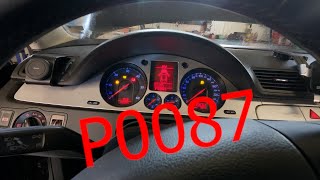
✅ What actually fixed it The newer revision 'D' sensor was incompatible with the car's older ECU, causing an additional P119A fault code. The user planned to revert to the original 'B' revision sensor or the original HPFP to resolve the issue, indicating the problem was likely an incompatible part rather than a mechanical failure. - YouTube video by BodyCamSebastian (2008 VW Passat 2.0 TDI) — P0087 code, random engine shutdowns, difficulty restarting. VCDS showed requested rail pressure at 248 bar but actual pressure was zero.
❌ Tried (didn't work) Initial diagnosis pointed towards the high-pressure system, but further testing was needed.
✅ What actually fixed it Using VCDS to activate the in-tank fuel pump produced no response. Power was confirmed at the connector, but applying 12V directly to the pump also did nothing. The in-tank low-pressure fuel pump had failed completely. Replacing the in-tank pump and priming the system with VCDS resolved the P0087 code and starting issues.
OEM Part Supersession History
06J 906 051 B (For G247 Sensor)→06J 906 051 D— Part revision and update by manufacturer.
Heads up: The 'B' (often black connector) and 'D' (often orange connector) sensors are NOT always interchangeable. Installing a 'D' sensor on a vehicle originally equipped with a 'B' sensor can cause a P119A fault code alongside P0087 due to incompatibility with the ECM software. Always verify the correct part number for the specific vehicle VIN.06L127025K / 06L127025M (For HPFP)→06L127025Q / 06L127025R / etc.— Internal design improvements to increase reliability and address wear issues.
Heads up: While most HPFP revisions for the EA888 are forward-compatible, it is critical to also replace the cam follower (e.g., 06L109311) to ensure longevity of the new pump.
Model Year Variations Within This Range
- 2012-2016 vs 2016-2019: The EA888 engine evolved from Gen2 to Gen3 around 2012-2015. Later Passat models (approx. 2016+) are more likely to have the Gen3 or Gen3B engine. Gen3 engines feature significant changes, including a cylinder head with an integrated exhaust manifold and, on some low-power versions (Gen3B), a Miller combustion cycle for efficiency. These changes affect components like pistons, injectors, and the HPFP drive system (Gen3 uses a 4-lobe cam for the HPFP vs. a single lobe on earlier engines), which can alter diagnostic approaches.
Helpful Videos
Used OEM Parts in Stock

New Aftermarket Parts Available


The information in this article is provided for general reference and educational purposes only. Vehicle specifications, procedures, and part compatibility can vary by production date, trim level, and region. Always consult your vehicle's factory service manual and verify part numbers before purchasing or performing repairs. Safety-critical components such as airbags, seat belts, and braking systems should be installed by a qualified professional.
- Volkswagen PASSAT:
- 🎬 Helpful Videos
- 🛍️ Shop This Part
- What's Unique About the 2012-2019 Volkswagen PASSAT
- Diagnostic Flowchart
- Symptoms You May Notice
- Most Likely Causes
- Rare But Worth Checking
- Diagnosis Steps
- Parts You'll Likely Need
- Related Codes That Often Appear With This One
- Technical Service Bulletins (TSBs) & Recalls
- Platform-Specific Known Issues
- Mechanic-Grade Diagnostic Values
- Hidden / Shadow Codes Worth Checking
- Scan Tool Commands That Help
- Wiring & Ground Locations
- Real Owner Repair Stories
- OEM Part Supersession History
- Model Year Variations Within This Range
- 🎟️ Get 5% Off