

P0087 on 2018-2020 Toyota Tundra: Fuel Pressure Too Low Causes & Fixes
On a 2018-2020 Tundra, code P0087 almost always points to a failing in-tank fuel pump. A massive safety recall was issued for these pumps because the impeller can degrade and cause the pump to stop working. Before paying for repairs, check if your truck's VIN is covered under the recall (NHTSA 20V012000, Toyota 20TA02). If not, expect a repair cost of $1,500-$2,700 at a shop, as the fuel tank must be removed.
- For a 2018-2020 Tundra, P0087 is most likely caused by a failing fuel pump, which was subject to a major safety recall.
- Before any repair, check if your truck's VIN is covered by Toyota recall 20TA02/20TB02. If so, the repair should be free at a dealership.
- Do not drive the vehicle. The risk of the engine stalling in traffic is high and poses a serious safety hazard.
- This is not a simple DIY fix. The fuel tank must be removed to replace the in-tank fuel pump assembly.
- Look for accompanying codes P0171 (Lean Bank 1) and P0174 (Lean Bank 2), as they strongly support the diagnosis of low fuel pressure.
What's Unique About the 2018-2020 Toyota TUNDRA
The story of P0087 on the 2018-2020 Tundra is dominated by a single, widespread issue: a defective low-pressure fuel pump. Toyota issued a major safety recall (NHTSA Campaign 20V012000, expanded multiple times) for millions of vehicles, including these Tundras, because the Denso-made fuel pumps could fail unexpectedly. The failure is caused by an impeller that can absorb fuel, deform, and stop pumping, causing the engine to stall while driving. This known issue makes a failing fuel pump the number one suspect by a wide margin, far more so than on other vehicles where causes might be more varied.
Diagnostic Flowchart
Tap your situation to follow the diagnostic path that matches what you're seeing on this vehicle.
Symptoms You May Notice
- Check Engine Light illuminated
- Engine stalling, sometimes while driving at speed
- Reduced engine power and poor acceleration (limp mode)
- Engine hesitation or stumbling under load
- Hard starting or extended cranking, especially after sitting overnight
- Engine will not start (crank-no-start)
- Rough idle
- Stalling or hesitation at high altitudes and high ambient temperatures (above 85°F/30°C)
- Replacing only the fuel pressure sensor without first verifying actual fuel pressure with a mechanical gauge.
- Replacing fuel injectors when the primary cause is the low-pressure supply from the tank.
- A shop replacing a fuel pump but failing to diagnose a faulty Fuel Pump Control Module that was the actual root cause, or which was damaged by the initial pump failure.
Most Likely Causes
- Failing In-Tank Fuel Pump 🔴 High Probability A widespread safety recall (NHTSA 20V012000, Toyota 20TA02/20TB02) was issued for defective Denso fuel pumps on 2018-2020 Tundras that are known to fail prematurely. The impeller can degrade and stop functioning.
How to confirm: First, check if your vehicle's VIN is part of the recall on Toyota's or NHTSA's website. If not, a technician must perform a fuel pressure test. Monitoring live data with a scan tool will show actual fuel pressure failing to meet commanded pressure, especially under load. A healthy system should idle around 38-44 PSI. A failing pump may show significantly lower pressure.
Typical fix: Replace the entire in-tank fuel pump module assembly. If the vehicle is under recall, this is performed by a Toyota dealer free of charge.
Est. part cost: $350-$550 - Clogged Fuel Filter/Sock 🔴 High Probability The fuel filter is an integrated part of the fuel pump assembly and is considered a 'lifetime' filter. It is not serviced separately. If it becomes clogged, it restricts fuel flow and causes the same symptoms as a failed pump. This is diagnosed and repaired with the pump itself.
How to confirm: This is diagnosed concurrently with the fuel pump. If a fuel pressure test shows low pressure, the entire assembly (pump and integrated filter) is the suspected cause and is replaced as a unit.
Typical fix: The filter is replaced as part of the complete fuel pump assembly. It is not available as a separate part from the OEM.
Est. part cost: $350-$550 - Faulty Fuel Pump Control Module 🟡 Medium Probability Forum discussions mention this module as a failure point that can mimic a bad fuel pump, causing a start-and-stall condition. In some cases, a failing aftermarket pump can repeatedly damage the control module. It controls the voltage and speed of the fuel pump. A technician can test the inputs and outputs of the module to see if it is commanding the pump correctly. A user on Tundras.com reported that wiggling the wiring harness to the module allowed the truck to start, pointing to a bad connection or damaged wiring as a possible culprit.
How to confirm: Using a multimeter, a technician can test the inputs and outputs of the module. With the key on, the module should receive ~12V power. The output voltage to the pump is varied by the module to control pump speed. A scan tool like Techstream can also perform an active test to command the fuel pump to run at different speeds, verifying module function.
Typical fix: Replace the fuel pump control module. Ensure wiring and connectors are inspected for damage or corrosion.
Est. part cost: $200-$400
Rare But Worth Checking
- Faulty Fuel Pressure Sensor: The sensor itself can fail and send incorrect low-pressure readings to the ECM, triggering P0087 even if the mechanical parts are working correctly. This should be considered if a manual pressure gauge shows good pressure but the scan tool reads low.
- Leaking Fuel Injector: An injector that is stuck open can cause a drop in fuel rail pressure. This would likely be accompanied by specific cylinder misfire codes (P0301-P0308) and a strong smell of fuel.
Diagnosis Steps
- Check your vehicle's VIN on the NHTSA or Toyota website for open recalls, specifically the fuel pump recall (20TA02/20TB02). If active, contact a dealer for a free repair.
- Connect an OBD-II scanner to confirm code P0087 and look for related codes like P0171, P0174, or any P030x misfire codes.
- Use the scanner's live data function to monitor 'Commanded Fuel Rail Pressure' vs. 'Actual Fuel Rail Pressure'. A significant discrepancy where actual pressure is lower than commanded points to a problem.
- If possible, connect a mechanical fuel pressure gauge to the fuel system to verify the readings from the electronic sensor. This is the definitive test to confirm low pressure. Note that many Toyotas do not have a convenient test port, requiring an in-line adapter.
- If fuel pressure is confirmed to be low, the fuel pump assembly is the primary suspect. Inspect the wiring and connector to the Fuel Pump Control Module for any damage or corrosion, as reported by owners.
- If fuel pressure tests good but the code persists, investigate the fuel pressure sensor and its circuit.
- If the pump and sensor are good, test the Fuel Pump Control Module for proper operation using a scan tool's active test function or by checking voltage inputs/outputs.
Parts You'll Likely Need
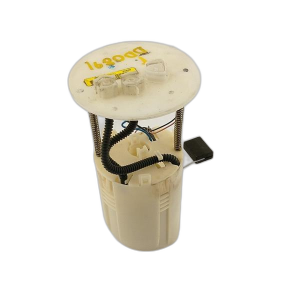
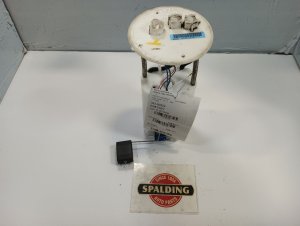
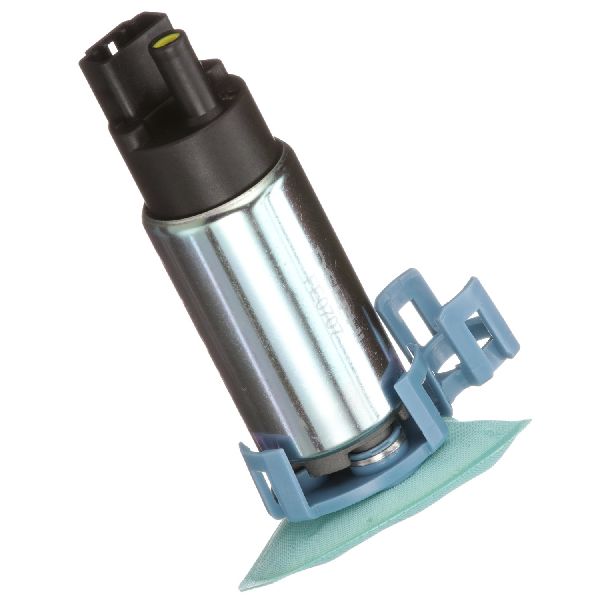
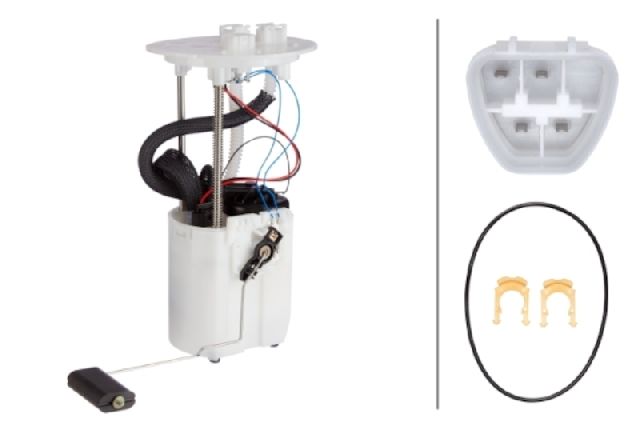
- Fuel Pump and Hanger Assembly
(OEM #77020-0C160 (For 38-gallon tank, non-Flex Fuel) or 77020-0C170 (For 38-gallon tank, with Flex Fuel). Note: Part numbers vary by tank size and fuel type. Always verify with VIN.)— This is the most common failure item for code P0087 on this vehicle, due to a widespread recall. The assembly includes the pump motor, fuel level sender, and the integrated, non-serviceable fuel filter.
Trusted brands: Toyota (OEM), Denso
OEM price range: $450-$550
Aftermarket price range: $250-$400
Related Codes That Often Appear With This One
- P0171 / P0174 — These "System Too Lean" codes are common because low fuel pressure starves the engine of fuel, creating a lean air-fuel mixture. Toyota TSB #TSB000923 explicitly links these codes together as symptoms of a fuel delivery problem.
- P0300 - P0308 — These are misfire codes. Insufficient fuel pressure can prevent proper combustion in one or more cylinders, leading to misfires.
Technical Service Bulletins (TSBs) & Recalls
- TSB000923: Notes that a MIL ON condition with P0087, often accompanied by P0171/P0174 (System Too Lean), indicates a fuel delivery problem that may require diagnosis of fuel pressure.
- T-SB-0035-20: Addresses some Toyota vehicles exhibiting P0087 when operated at high altitude and high temperatures, recommending an ECM logic update and potentially a new fuel suction tube assembly.
Platform-Specific Known Issues
- A major safety recall (NHTSA Campaign: 20V012000, Toyota Recall: 20TA02 / 20TB02) was issued for the low-pressure fuel pump. The pump, made by Denso, can fail because the impeller may degrade, causing the engine to stall, which is a direct cause of code P0087.
- A separate TSB (T-SB-0035-20) addresses P0087 occurring specifically at high altitudes (above 3,300 ft) and high temperatures (above 85°F), which may require an ECM update and/or an improved fuel suction tube assembly.
Mechanic-Grade Diagnostic Values
- Low-Pressure Fuel System Pressure at Idle — expected: 38 - 44 psi. Failure: Pressure significantly below 38 psi.
- Residual Fuel System Pressure (5 minutes after engine off) — expected: 21 psi or higher. Failure: Pressure significantly below 21 psi, indicating a leak in the system or a faulty check valve in the pump.
- Fuel Pump Control Module Voltage (to pump) — expected: Variable voltage; one user measured ~9.5V at key-on, which is modulated by the FPCM. Techstream can command different duty cycles (e.g., 25% or 80%) which result in different voltages (e.g., 4V or 12V).. Failure: No voltage or incorrect voltage being sent to the pump despite commands from the ECM.
- Mass Air Flow (MAF) Sensor Reading at Idle — expected: ~5-7 g/s for the 5.7L V8. Failure: Readings significantly outside this range could indicate other issues, though not a primary indicator for P0087.
Hidden / Shadow Codes Worth Checking
- P008700: This is an extended format of the P0087 code, often seen in Toyota's Techstream software. The extra digits do not typically add new diagnostic meaning for this specific code but confirm it as the primary fault. (see via Toyota Techstream diagnostic software.)
- P107A2A: Fuel Rail Pressure Sensor (Low) Signal Stuck in Range. This code can appear alongside P0087, specifically in high-altitude, high-temperature situations as per T-SB-0058-22. (see via Toyota Techstream diagnostic software.)
Scan Tool Commands That Help
- Toyota Techstream: Active Test: Control the Fuel Pump / Speed — Use this to command the fuel pump to turn on and run at different speeds (low, medium, high) to verify the functionality of the entire circuit, including the Fuel Pump Control Module and the pump itself, without having to drop the tank.
- Toyota Techstream: Active Test: Activate the Fuel Pressure Switching Valve — On Flex Fuel models, this test can be used to switch the fuel pressure between high and low settings to check the response of the system and monitor short-term fuel trims for changes.
- Toyota Techstream: Data List: Fuel Pump / Spd — Monitor this PID in the live data list to see the commanded state (ON/OFF) of the fuel pump as determined by the ECM. This helps differentiate between a command issue and a component failure.
Wiring & Ground Locations
- Fuel Pump Control Module — On the driver's side frame rail, near the rear of the cab and charcoal canister.. This module is the 'brain' for the fuel pump. Its location on the frame rail exposes it to the elements, making its connectors and wiring a potential point of failure due to corrosion or damage, which can mimic a dead fuel pump.
- Fuel Pump Connector — On top of the fuel tank, accessible by lowering the tank or sometimes by tilting the truck bed.. This is the final connection point before power enters the fuel pump assembly. Testing for voltage at the two large wires (power and ground) on this connector is a key diagnostic step to confirm if power is reaching the pump.
Real Owner Repair Stories
- Tundras.com forum user (2010 Toyota Tundra 5.7L) — Starts for a few seconds and then quits. Sometimes would run longer.
❌ Tried (didn't work) Replaced the in-tank fuel pump.
✅ What actually fixed it The user found power at the pump connector but discovered the ground wire (large red wire) was not being properly controlled by the Fuel Pump Control Module. They temporarily fixed it by manually grounding the red wire at the pump connector to the frame, which allowed the truck to run, proving the Fuel Pump Control Module was the actual point of failure.
Model Year Variations Within This Range
- 2020: For the 2020 model year, Toyota discontinued the 4.6L V8 engine, making the 5.7L V8 standard across all Tundra trims. This simplifies diagnosis as only one engine's fuel system specifications apply.
- 2019-2020: Unlike the 2018 models, the 2019 and 2020 Tundras did not come equipped with an external transmission cooler. While unrelated to the P0087 code, it is a notable mechanical difference within the specified vehicle range.
- 2020: The 2020 model year introduced Apple CarPlay and Android Auto compatibility with larger 7-inch or 8-inch touchscreens, as well as optional push-button start. These are technology changes and do not affect the P0087 fault.
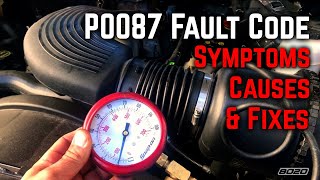
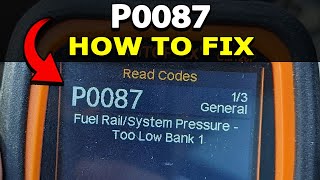
Helpful Videos

Used OEM Parts in Stock

New Aftermarket Parts Available


The information in this article is provided for general reference and educational purposes only. Vehicle specifications, procedures, and part compatibility can vary by production date, trim level, and region. Always consult your vehicle's factory service manual and verify part numbers before purchasing or performing repairs. Safety-critical components such as airbags, seat belts, and braking systems should be installed by a qualified professional.
- Toyota TUNDRA:
- 🎬 Helpful Videos
- 🛍️ Shop This Part
- What's Unique About the 2018-2020 Toyota TUNDRA
- Diagnostic Flowchart
- Symptoms You May Notice
- Most Likely Causes
- Rare But Worth Checking
- Diagnosis Steps
- Parts You'll Likely Need
- Related Codes That Often Appear With This One
- Technical Service Bulletins (TSBs) & Recalls
- Platform-Specific Known Issues
- Mechanic-Grade Diagnostic Values
- Hidden / Shadow Codes Worth Checking
- Scan Tool Commands That Help
- Wiring & Ground Locations
- Real Owner Repair Stories
- Model Year Variations Within This Range
- 🎟️ Get 5% Off