

P0087 on 2017-2024 Subaru Impreza: Low Fuel Rail Pressure Causes & Fixes
On 2017-2024 Subaru Imprezas, the P0087 code almost always points to a failing high-pressure fuel pump (HPFP). The original pump design was prone to failure, causing Subaru to issue a Technical Service Bulletin (TSB #09-123-24) for a redesigned pump to fix this exact issue. Expect a repair cost of $700-$1300 at a shop. The issue also affects the Subaru Crosstrek, which shares the same engine.
- P0087 on a 2017-2024 Impreza is most likely caused by a failed high-pressure fuel pump (HPFP).
- Subaru has acknowledged this issue and released a redesigned pump (TSB #09-123-24).
- The same issue is common on the Subaru Crosstrek and Forester.
- Repair is not recommended for DIYers due to the high pressures involved; professional service is strongly advised.
What's Unique About the 2017-2024 Subaru IMPREZA
The fifth and sixth-generation Subaru Impreza with the 2.0L FB20D direct-injection engine is known for this specific issue. The problem became so prevalent that Subaru released a Technical Service Bulletin (TSB #09-123-24) announcing a redesigned high-pressure fuel pump (HPFP). The bulletin states the new pump has an optimized internal discharge valve to prevent unstable fuel pressure caused by engine vibrations. This makes the HPFP the primary suspect by a wide margin, distinguishing it from other vehicles where causes might be more varied. This issue is also common on the 2018-2024 Subaru Crosstrek, which uses the same FB20D engine.
Diagnostic Flowchart
Tap your situation to follow the diagnostic path that matches what you're seeing on this vehicle.
Generation note: This range covers the end of the fifth generation (2017-2023) and the beginning of the sixth generation (2024+). Both generations use a 2.0L direct-injection engine (FB20D) and are covered by the relevant TSBs, indicating the high-pressure fuel pump issue can affect both.
Symptoms You May Notice
- Check Engine Light is on
- Engine hesitation or stumbling during acceleration
- Reduced engine power or sluggish performance
- Rough or unstable idle
- Engine stalling, especially under load or in traffic
- Difficulty starting the engine, or will crank but not start
- Decreased fuel economy
- Engine misfires and runs terribly after a hot-soak (sitting for 10-15 mins after a long drive)
- Replacing the in-tank low-pressure fuel pump when the actual fault lies with the engine-mounted high-pressure fuel pump.
- Replacing the fuel pressure sensor without first verifying that the pump can generate the required pressure.
- Assuming a clogged fuel filter is the cause, when the primary filter is a non-serviceable part of the in-tank pump assembly on this model.
Most Likely Causes
- Failing High-Pressure Fuel Pump (HPFP) 🔴 High Probability Subaru issued TSB #09-123-24 announcing a redesigned HPFP to specifically address DTC P0087. The bulletin states the original pump's internal discharge valve performance was not optimal, leading to unstable fuel pressure from engine vibrations.
How to confirm: A technician will use a scan tool to monitor desired vs. actual fuel rail pressure. If the actual pressure consistently fails to meet the desired pressure under load, and the low-pressure system is confirmed to be working, the HPFP is the culprit. A Subaru dealer can also check the part number on the installed pump to see if it is the old design.
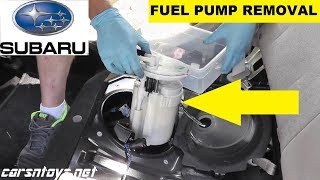
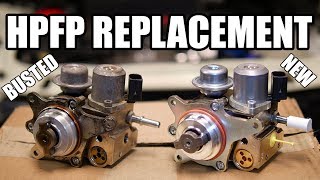
Typical fix: Replace the high-pressure fuel pump with the updated part (current P/N 16625AA200, superseding 16625AA190). It may also 🎬 Watch: How to replace a high pressure fuel pump be necessary to update the ECM software per TSB #09-120-24R.
Est. part cost: $450-$700 - Outdated Engine Control Module (ECM) Software 🟡 Medium Probability TSB #09-120-24R indicates that Subaru released updated software with "enhanced logic for the self-diagnosis program" and to "optimize stabilization of fuel pressure" for DTC P0087. This update may be required after replacing the pump or could, in some cases, resolve the issue on its own if the pressure drop is marginal.
How to confirm: A Subaru dealership or qualified shop can check the current software version against the latest available version using a VIN.
Typical fix: Reprogram the ECM with the latest software file.
Est. part cost: $0 (if under warranty) - $150 - Faulty Fuel Rail Pressure Sensor ⚪ Low Probability
How to confirm: Monitor the sensor's readings on a scan tool. If the readings are erratic, stuck at a certain value, or don't correlate with pressure changes when tested with a gauge, the sensor is likely faulty. A faulty sensor can cause the P0087 code even if the pump is healthy.
Typical fix: Replace the fuel rail pressure sensor.
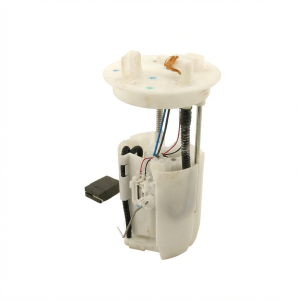
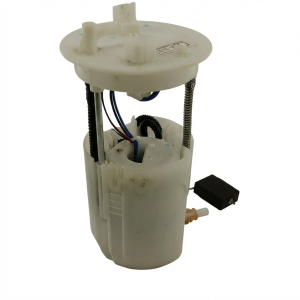
Est. part cost: $160-$255 - Problem with the Low-Pressure Fuel System ⚪ Low Probability While less common than the HPFP failure on this platform, a weak in-tank pump can starve the HPFP, causing the P0087 code.
How to confirm: Test the fuel pressure of the in-tank (low-pressure) pump to ensure it's delivering adequate volume and pressure to the HPFP. A reading below specification would indicate a problem with the in-tank pump or a clogged fuel filter sock.
Typical fix: Replace the in-tank low-pressure fuel pump assembly or the fuel filter.
Est. part cost: $150-$300
Rare But Worth Checking
- Leaking Fuel Injector: A fuel injector stuck open can cause a drop in rail pressure. This is less common than the HPFP failure but is a possibility. Subaru has issued TSBs for injector issues on these engines, though not directly tied to P0087.
- Damaged Cam Lobe: The HPFP is mechanically driven by a lobe on the camshaft. Extreme wear or damage to this lobe could prevent the pump from generating sufficient pressure, but this is a very rare and severe mechanical failure.
Diagnosis Steps
- Check for Technical Service Bulletins (TSBs) related to P0087 for your vehicle's VIN. Specifically, check for TSB #09-123-24 and #09-120-24R.
- Connect a professional scan tool to read and record any other fault codes.
- Use the scan tool to monitor live data for 'Desired Fuel Rail Pressure' and 'Actual Fuel Rail Pressure'.
- Observe the pressure readings at idle, during gentle acceleration, and under heavy load (e.g., wide-open throttle). Note any significant lag or inability for the actual pressure to meet the desired pressure.
- If pressure is low, first test the low-pressure fuel system. Connect a fuel pressure gauge to the low-pressure line to ensure the in-tank pump is supplying the correct pressure to the HPFP. This is a crucial first step before condemning the expensive HPFP.
- If the low-pressure system is healthy, the suspicion falls heavily on the high-pressure fuel pump.
- Inspect the area around the HPFP and fuel rail for any signs of fuel leaks. Check the engine oil for a fuel smell, which could indicate a leaking pump seal.
- If the HPFP is replaced, check if the ECM software update from TSB #09-120-24R is also required. Always order parts by VIN to ensure you receive the latest redesigned pump.
Parts You'll Likely Need
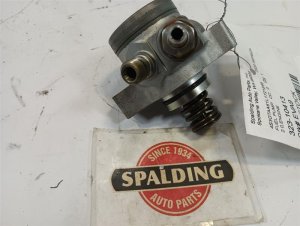
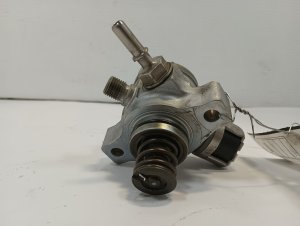
- High-Pressure Fuel Pump
(OEM #16625AA200 (Supersedes 16625AA190, 16625AA120))— This is the most common failure part for this code on this specific vehicle, as documented by Subaru's own Technical Service Bulletin #09-123-24. The part was redesigned to fix the issue.
Trusted brands: Subaru (Genuine)
OEM price range: $500-$700
Aftermarket price range: $350-$550
Related Codes That Often Appear With This One
- P0300-P0304 — Random or specific cylinder misfire codes can occur because low fuel pressure leads to a lean air-fuel mixture and incomplete combustion.
- P0171 — System Too Lean (Bank 1) can be triggered when the fuel system cannot supply enough fuel to match the air entering the engine.
Technical Service Bulletins (TSBs) & Recalls
- 09-123-24: Announces a design change to the high-pressure fuel pump to prevent DTC P0087. Specifies the new pump has an optimized internal discharge valve.
- 09-120-24R: Details an ECM software update with enhanced logic for self-diagnosis related to P0087 and to optimize fuel pressure stabilization.
Platform-Specific Known Issues
- Subaru has identified an issue with the original high-pressure fuel pump on these models, leading to the P0087 code. TSB #09-123-24 was issued to address this with a redesigned pump whose internal valve better handles engine vibrations.
- An ECM software update may be required to optimize the diagnostic logic for the fuel system, as noted in TSB #09-120-24R.
- An earlier recall for the 2017 Impreza (NHTSA Campaign Number: 17V197000) addressed stalling from premature fuel vaporization with winter-blend fuels, which also caused a loss of fuel pressure, though this was fixed with an ECU reprogram to adjust radiator fan timing.
Mechanic-Grade Diagnostic Values
- Low-Pressure Fuel Pump Pressure (at HPFP inlet) — expected: Approx. 50-65 PSI. Failure: Pressure significantly below 50 PSI indicates a failing in-tank pump or clogged filter, which will starve the HPFP.
- High-Pressure Fuel Rail Pressure (Scan Tool) — expected: Approx. 500-600 PSI at idle, up to 3000+ PSI under load.. Failure: If 'Actual Pressure' consistently lags behind or fails to reach 'Desired Pressure' during acceleration, it points to a weak HPFP.
- Fuel Rail Pressure Sensor Voltage (Signal Wire) — expected: Approx. 0.5V with key-on-engine-off (KOEO), ~1.3V at idle, and rising with pressure up to ~4.5V.. Failure: Voltage that is stuck at 0V, 5V, or does not change with engine RPM/load suggests a faulty sensor or wiring issue.
- Fuel Rail Pressure Sensor Wiring (at sensor connector, KOEO) — expected: One pin should have a 5V reference from the ECM, one pin should be a ground (continuity to chassis ground), and the third is the signal wire.. Failure: Absence of 5V reference or a bad ground indicates a wiring or ECM problem, not a sensor failure.
Hidden / Shadow Codes Worth Checking
- Stored/Pending Code: The P0087 code may first appear as a 'stored' or 'pending' code without illuminating the Check Engine Light. The ECM is waiting for the fault to recur on a subsequent self-test before making the code active and turning on the light. (see via A standard OBD-II scanner that can read pending/stored codes.)
Wiring & Ground Locations
- ECU/ECM Ground — Typically grounded to the top of the intake manifold via the harness.. A poor ECU ground can cause erratic sensor readings and incorrect calculations for fuel pressure, potentially leading to a false P0087 code. The ECU needs a stable reference ground to accurately interpret the fuel rail pressure sensor's signal.
- Main Engine Harness Ground — A primary ground point is typically located on the engine block itself, and another on the chassis near the battery.. The entire fuel system's electrical components, including the fuel pump control module and sensors, rely on these main grounds. A corroded or loose main ground can introduce resistance and cause a voltage drop, affecting fuel pump performance.
- High-Pressure Fuel Pump Connector — On the HPFP itself, mounted on the engine.. This connector provides power and control signals to the pump's internal fuel volume regulator. Unplugging it causes the pump to default to a low-pressure mode, which can be a diagnostic step. Checking for voltage and ground here is critical before replacing the pump.
Real Owner Repair Stories
- Reddit user u/jobjohnny, r/SubaruAscent (2019 Subaru Ascent (different model, but same P0087 hot-soak symptom)) — After driving for an hour in hot weather, car would not restart after being parked for 10-15 minutes. When it did start, it would misfire, sound awful, and stall. Code P0087 was stored.
❌ Tried (didn't work) Dealer could not replicate the issue with short drives., Dealer was hesitant to 'throw parts at it' without replicating the failure.
✅ What actually fixed it Another user in the thread reported the final fix for identical symptoms was replacing the low-pressure in-tank fuel pump, which was not properly supplying the high-pressure pump.
OEM Part Supersession History
16625AA120→16625AA190, then 16625AA200— Design change to optimize the internal discharge valve to prevent unstable fuel pressure caused by engine vibrations, specifically to address DTC P0087.
Heads up: The older part numbers are prone to the failure that triggers P0087. When replacing, it is critical to use the latest part number (16625AA200 or newer) to ensure the fix is permanent.
Model Year Variations Within This Range
- 2017-2024: The primary variation is not in the hardware design across these years, but in the installed part. Early models (e.g., 2017-2023) are more likely to have the original, failure-prone high-pressure fuel pump. Later models may have the redesigned pump from the factory, but the TSB still applies to the full range, indicating a long production run of the original part.
Helpful Videos

Used OEM Parts in Stock
New Aftermarket Parts Available


The information in this article is provided for general reference and educational purposes only. Vehicle specifications, procedures, and part compatibility can vary by production date, trim level, and region. Always consult your vehicle's factory service manual and verify part numbers before purchasing or performing repairs. Safety-critical components such as airbags, seat belts, and braking systems should be installed by a qualified professional.
- Subaru IMPREZA:
- 🎬 Helpful Videos
- 🛍️ Shop This Part
- What's Unique About the 2017-2024 Subaru IMPREZA
- Diagnostic Flowchart
- Symptoms You May Notice
- Most Likely Causes
- Rare But Worth Checking
- Diagnosis Steps
- Parts You'll Likely Need
- Related Codes That Often Appear With This One
- Technical Service Bulletins (TSBs) & Recalls
- Platform-Specific Known Issues
- Mechanic-Grade Diagnostic Values
- Hidden / Shadow Codes Worth Checking
- Wiring & Ground Locations
- Real Owner Repair Stories
- OEM Part Supersession History
- Model Year Variations Within This Range
- 🎟️ Get 5% Off