

P0087 on 2017-2019 Nissan Sentra: Fuel Pressure Low Causes & Fixes
On a 2017-2019 Sentra, code P0087 often points to a software glitch in the Engine Control Module (ECM). Before replacing any fuel system parts, check with a Nissan dealer about Technical Service Bulletin NTB19-045b, which calls for an ECM reprogram to fix a false code. This TSB is the most critical first step in diagnosis.
- For a 2017-2019 Nissan Sentra, P0087 is very often a software issue, not a hardware failure.
- Always check for the applicability of TSB NTB19-045b with a dealer before authorizing any part replacements.
- If a mechanical repair is needed after the TSB is ruled out, diagnosis should involve testing both the low-pressure and high-pressure fuel pumps.
- Driving with this code can be unsafe due to potential stalling and can cause further engine damage.
What's Unique About the 2017-2019 Nissan SENTRA

What makes the 2017-2019 Sentra unique regarding P0087 is a known software issue acknowledged by Nissan. The manufacturer issued Technical Service Bulletins (TSBs) stating that due to calibration errors, the ECM can improperly store a permanent P0087 trouble code even when no actual fuel pressure problem exists. This makes an ECM reprogram a critical first diagnostic step, potentially saving owners from unnecessarily replacing expensive fuel system components like the high-pressure fuel pump. The TSB explicitly states the reprogram is not a fix for an underlying mechanical issue, but an update to how the permanent code is stored and erased.
Diagnostic Flowchart
Tap your situation to follow the diagnostic path that matches what you're seeing on this vehicle.
Symptoms You May Notice
- Check Engine Light is on
- Engine hesitation or stumbling during acceleration.
- Rough idle.
- Difficulty starting the engine, or longer crank times.
- Loss of engine power.
- Vehicle may stall unexpectedly, sometimes after 20-30 minutes of driving.
- Reduced fuel economy. 🎬 Watch: Understanding the causes and fixes for the P0087 code.
- Replacing the high-pressure or low-pressure fuel pump without first checking for the ECM software update specified in TSB NTB19-045b. This can lead to unnecessary and expensive repairs, as forum users have experienced replacing hardware only for the code to return.
Most Likely Causes

- Engine Control Module (ECM) Software Calibration Error 🔴 High Probability Nissan issued TSBs #NTB19-045b, #P9328_P9343_P934, and #NTB19-045a specifically for this issue on 2017-2019 Sentras, indicating a known problem with the ECM software improperly storing a permanent DTC. This issue is not unique to the Sentra and affects other Nissan models from the same era.
How to confirm: A Nissan dealership can check your vehicle's VIN against the applicable TSBs. The code will often be stored as a 'permanent' DTC that cannot be cleared with a standard OBD-II scanner until the reprogram is performed.
Typical fix: Reprogramming the ECM with updated software provided by Nissan. The TSB specifies this should be done *after* diagnosing and repairing any actual mechanical faults.
Est. part cost: $0-$250 - Failing High-Pressure Fuel Pump (HPFP) 🟡 Medium Probability This is a common failure point in many direct-injection engines, including the 1.6L Turbo (MR16DDT) found in SR Turbo and NISMO trims. The pump is mechanically driven by the camshaft and can wear out.
How to confirm: After ruling out the TSB, a technician can monitor fuel rail pressure with a scan tool during acceleration. A significant drop below the commanded pressure under load points to a weak HPFP. A real-world owner story involved replacing the HPFP after a fuel filter replacement didn't solve the issue.
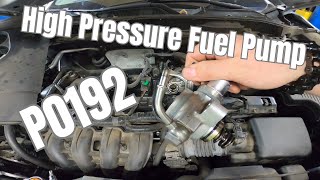
Typical fix: Replace the high-pressure fuel pump. 🎬 Watch: Step-by-step guide to high pressure fuel pump replacement.
Est. part cost: $300-$700 - Failing In-Tank (Low-Pressure) Fuel Pump 🟡 Medium Probability
How to confirm: A technician can test the low-pressure fuel system's pressure at idle using a fuel pressure gauge. If the pressure is below specification (e.g., below 45-55 PSI), the in-tank pump is likely the cause. You may also hear a whining noise from the fuel tank area.
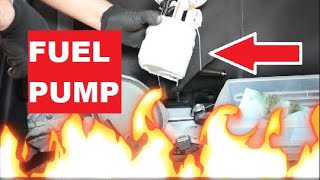
Typical fix: Replace the in-tank fuel pump module. 🎬 See this complete tutorial on Nissan Sentra fuel pump installation.
Est. part cost: $200-$450 - Clogged Fuel Filter ⚪ Low Probability The fuel filter is integrated into the in-tank fuel pump module and is not typically serviced separately. It can become clogged over time, especially with contaminated fuel, restricting fuel flow.
How to confirm: This is usually diagnosed by confirming low pressure from the in-tank pump, pointing to a restriction within the module. In some cases, owners try replacing the filter first as a cheaper initial step, but often the issue returns if the pump itself is weak.
Typical fix: Replace the entire in-tank fuel pump assembly.
Est. part cost: $200-$450
Rare But Worth Checking
- Faulty Fuel Rail Pressure Sensor: The sensor can fail and send incorrect low-pressure readings to the ECM. This can be checked by comparing the sensor's reading on a scan tool to a manual pressure gauge. A faulty sensor may give erratic readings, while a true pressure drop will be consistent.
- Leaking Fuel Injector: A fuel injector stuck open can cause a drop in rail pressure. This may also be accompanied by a rich running condition, fuel smell, or misfire codes (like P030x) for a specific cylinder.
- Damaged Fuel Lines: A kinked, pinched, or leaking fuel line between the tank and the engine can restrict flow or cause a pressure drop. A visual inspection for leaks is a good first step.
Diagnosis Steps
- First, contact a Nissan dealership or qualified shop with your VIN to determine if TSB #NTB19-045b applies to your vehicle. This is the most critical first step.
- If the TSB applies AND a mechanical fault has been ruled out, have the ECM reprogrammed as recommended by Nissan.
- If the code returns or the TSB does not apply, connect a diagnostic scan tool to monitor live data. Observe the 'Commanded Fuel Rail Pressure' and 'Actual Fuel Rail Pressure' readings at idle and under load.
- Test the low-pressure fuel system. Connect a manual fuel pressure gauge to check the pressure from the in-tank pump at idle. It should meet specifications (typically 45-55 PSI for the 1.8L engine).
- If low-pressure is adequate, test the high-pressure system (on 1.6L Turbo models). Monitor fuel pressure while accelerating. A significant drop below the commanded pressure indicates a problem with the HPFP, its drive (cam lobe), or its control solenoid.
- Inspect for fuel leaks. Visually check all fuel lines, the fuel rail, and around the injectors for any signs of wetness or fuel smell.
- Test the Fuel Rail Pressure Sensor. Compare the live data reading from the sensor with a reading from a manual gauge. If they differ significantly, the sensor or its wiring may be faulty.
Parts You'll Likely Need

- High-Pressure Fuel Pump
(OEM #16630-HY00A (replaces 16630-BV80A))— If a mechanical fault is confirmed (after ruling out the TSB), the HPFP is a likely culprit, especially on the 1.6L direct-injection engine.
Trusted brands: Hitachi, Bosch, Nissan Genuine
OEM price range: $500-$780
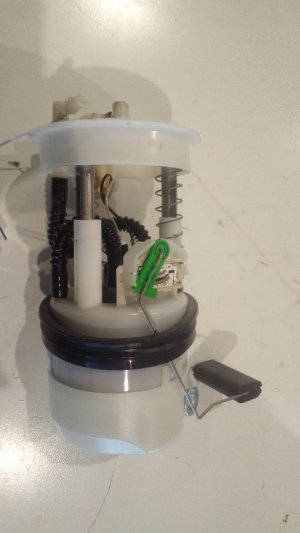
Aftermarket price range: $300-$500 - In-Tank Fuel Pump Assembly
(OEM #17040-3SG0F (for 1.8L, may supersede other numbers))— Provides the initial pressure for the fuel system. A weak low-pressure pump will starve the high-pressure pump, causing the P0087 code.
Trusted brands: Denso, Delphi, API, TYC
OEM price range: $350-$500
Aftermarket price range: $150-$350
Related Codes That Often Appear With This One
- P0101 — Mass Air Flow (MAF) Sensor Performance. This code is listed alongside P0087 in Nissan's TSBs (NTB19-045b, P9328_P9343_P934) as being potentially caused by the same ECM software glitch.
- P0448 — EVAP Vent Control Circuit Shorted. This is another code mentioned in the same Nissan TSBs as P0087, pointing to a common software-related cause.
- P2008 — Intake Manifold Runner Control Circuit Open. Also listed in the Nissan TSBs, suggesting it can be falsely triggered by the same ECM calibration error.
- P0300-P0306 — Cylinder Misfire. Low fuel pressure can cause a lean condition, leading to engine misfires.
Technical Service Bulletins (TSBs) & Recalls
- NTB19-045b: 'MIL ON WITH DTC P0087, P0101, P0448, OR P2008, VEHICLES REGISTERED OUTSIDE OF CALIFORNIA' - Recommends diagnosing any mechanical faults first, then reprogramming the ECM to update how permanent DTCs are stored and erased.
- P9328_P9343_P934: Mentions reprogramming the ECM due to calibration errors that may improperly store a permanent diagnostic trouble code for P0087.
- NTB19-045a: An earlier version of the bulletin addressing the same set of false DTCs, including P0087.
Platform-Specific Known Issues
- A primary issue for the 2017-2019 Sentra is an ECM calibration error that can falsely trigger and store a permanent P0087 code. This is documented in Nissan Technical Service Bulletins NTB19-045b, P9328_P9343_P934, and NTB19-045a.
- Owner frustration is common when shops replace fuel pumps without first performing the TSB reprogram, leading to the code returning and wasted money. One Reddit user described a scenario where the fuel filter was replaced, then the HPFP, and the problem still came back, highlighting the need for proper diagnosis.
Mechanic-Grade Diagnostic Values
- Low-Pressure Fuel Pump (In-tank) Pressure at Idle (1.8L MRA8DE) — expected: 45-55 PSI. Failure: Pressure below 45 PSI indicates a weak in-tank pump or clogged filter.
- High-Pressure Fuel Pump (HPFP) Pressure at Idle (1.6L MR16DDT) — expected: Approximately 500-600 PSI. Failure: Pressure significantly lower than commanded pressure on a scan tool, especially under load, points to a failing HPFP.
- Fuel Rail Pressure Sensor Voltage (Key On, Engine Off) — expected: Approximately 0.5 V. Failure: Voltage stuck at 0V, 5V, or not changing with pressure indicates a potential sensor or wiring fault.
- Fuel Rail Pressure Sensor Voltage (Under Snap Acceleration) — expected: Rises towards 4.5 V. Failure: Voltage does not increase significantly when the throttle is snapped, indicating a lack of pressure response from the sensor.
Hidden / Shadow Codes Worth Checking
- Permanent DTC (P-DTC): The P0087 code on these Sentras is often stored as a 'Permanent' code due to an ECM software flaw. A P-DTC cannot be cleared by a standard OBD-II scanner's 'clear codes' function or by disconnecting the battery. It will only clear itself after a certain number of successful drive cycles with no fault detected. (see via Most professional scan tools can differentiate between active DTCs and permanent DTCs. The key indicator is the inability to clear the code using standard methods.)
Scan Tool Commands That Help

- Nissan CONSULT or advanced bidirectional scanner: Fuel Pump Active Test — This function allows the technician to command the in-tank fuel pump to run without the engine being on. It is used to verify the pump operates and to build pressure for checking the low-pressure side for leaks or testing with a manual gauge.
- Nissan CONSULT or advanced bidirectional scanner: Work Support > Clear Permanent DTC — After performing the ECM reprogram as per TSB NTB19-045b, this specific function may be required to erase the falsely stored permanent P0087 code. Standard code clearing will not work.
Wiring & Ground Locations
- In-Tank Fuel Pump Access Cover — Under the rear passenger seat cushion. The cushion must be lifted up to expose a metal or plastic cover on the vehicle floor.. This is the primary access point for testing or replacing the low-pressure in-tank fuel pump assembly, a common cause for P0087.
- ECM Ground (E15) — On the 1.6L Turbo, a main ECM ground point (E15) is located on the lower left side of the engine.. A poor ECM ground can cause a variety of incorrect sensor readings and false trouble codes, including those related to fuel pressure. Verifying this ground is clean and tight is a crucial electrical diagnostic step.
- Fuel Pump Connector — On top of the in-tank fuel pump assembly, under the access cover.. This connector provides power to the low-pressure pump. It should be inspected for corrosion or damage. It can be disconnected to relieve fuel pressure before servicing the fuel line.
OEM Part Supersession History
17040-3SG0D→17040-3SG0E, 17040-3SG0F— Standard part revision and updates by the manufacturer.
Heads up: While later part numbers generally supersede earlier ones, it is critical to verify the correct part number for your specific vehicle's VIN, as there can be subtle differences in fittings or sensors between revisions.
Model Year Variations Within This Range
- 2017-2019: The fuel system is fundamentally different between the standard 1.8L (MRA8DE) engine and the 1.6L Turbo (MR16DDT) engine found in SR Turbo and NISMO trims. The 1.8L uses a standard multi-point fuel injection system with only an in-tank low-pressure pump. The 1.6L Turbo uses a Gasoline Direct Injection (GDI) system, which adds a camshaft-driven High-Pressure Fuel Pump (HPFP) and a fuel rail pressure sensor, making its diagnosis for P0087 more complex.
Helpful Videos


Used OEM Parts in Stock

New Aftermarket Parts Available

The information in this article is provided for general reference and educational purposes only. Vehicle specifications, procedures, and part compatibility can vary by production date, trim level, and region. Always consult your vehicle's factory service manual and verify part numbers before purchasing or performing repairs. Safety-critical components such as airbags, seat belts, and braking systems should be installed by a qualified professional.
- Nissan SENTRA:
- 🎬 Helpful Videos
- 🛍️ Shop This Part
- What's Unique About the 2017-2019 Nissan SENTRA
- Diagnostic Flowchart
- Symptoms You May Notice
- Most Likely Causes
- Rare But Worth Checking
- Diagnosis Steps
- Parts You'll Likely Need
- Related Codes That Often Appear With This One
- Technical Service Bulletins (TSBs) & Recalls
- Platform-Specific Known Issues
- Mechanic-Grade Diagnostic Values
- Hidden / Shadow Codes Worth Checking
- Scan Tool Commands That Help
- Wiring & Ground Locations
- OEM Part Supersession History
- Model Year Variations Within This Range
- 🎟️ Get 5% Off