

P0087 on 2015-2017 Nissan JUKE: Fuel Pressure Low Causes and Fixes
For a 2015-2017 Nissan Juke, code P0087 is very often caused by an ECM software error, not a bad part. A simple dealer reprogram, as outlined in Nissan Technical Service Bulletins, is the most likely fix. If that doesn't work, the high-pressure fuel pump is the next most common culprit, which is a known failure point on this engine.
- First, check for a software update. The most likely cause for P0087 on a 2015-2017 Juke is a known software glitch that requires an ECM reprogram at a dealership.
- Do not replace any parts until you have ruled out the software issue, as you could waste hundreds of dollars.
- If the software is fine, the high-pressure fuel pump (HPFP) is the next most likely component to have failed.
- Symptoms like stalling, hesitation, and loss of power are common and indicate the vehicle should be serviced soon to prevent being stranded.
- This is not a simple DIY fix. Both the software update and high-pressure fuel system work require professional tools and expertise.
What's Unique About the 2015-2017 Nissan JUKE

What's unique about the 2015-2017 Juke is that Nissan has officially acknowledged that the P0087 code can be triggered by a software glitch. Due to "calibration errors," the Engine Control Module (ECM) can improperly store this as a permanent trouble code even when there is no actual fuel pressure problem. Before you or your mechanic replace any expensive parts, the first step should always be to check if the vehicle's ECM software has been updated according to Nissan's service bulletins NTB19-045b and P9328_P9343_P934. It's critical to note that the TSB states the reprogram itself is not a 'repair' for the DTC, but an update to how the code is stored and erased; the underlying issue must still be diagnosed and fixed first.
Diagnostic Flowchart

Tap your situation to follow the diagnostic path that matches what you're seeing on this vehicle.
Symptoms You May Notice
- Check Engine Light is on
- Engine hesitation or stumbling during acceleration
- Noticeable loss of power, especially when going uphill or under load
- Engine stalls, sometimes intermittently or when warm
- Rough or uneven idle
- Difficulty starting the engine (long crank time)
- Reduced fuel economy
- Strong smell of gasoline in or around the car
- Replacing the high-pressure fuel pump before checking for the ECM software update. This is a costly and unnecessary repair if the root cause is the software glitch identified in Nissan's TSBs.
Most Likely Causes

- ECM Software Requires Update 🔴 High Probability Nissan issued multiple Technical Service Bulletins (TSBs) for this specific issue on this model year range, indicating a known calibration error in the ECM.
How to confirm: A Nissan dealership or a properly equipped independent shop can check the current ECM software version against the latest version specified in TSBs NTB19-045b or P9328_P9343_P934 using a CONSULT-III plus tool.
Typical fix: Reprogramming the Engine Control Module (ECM) with the updated software. 🎬 Watch: How to reset or reprogram your Nissan Juke computer. This is often done *after* a mechanical repair to prevent the code from being permanently stored incorrectly.
Est. part cost: $0 - Failing High-Pressure Fuel Pump (HPFP) 🟡 Medium Probability The HPFP is a known failure point on the 1.6L DIG engine, often causing intermittent stalling and hard starts once the engine is warm. It is mechanically driven by the camshaft.
How to confirm: After confirming the ECM software is up-to-date, a technician will monitor fuel rail pressure with a scan tool during cranking and under load. A pressure reading that fails to meet specifications points to the HPFP. A user on a Reddit forum confirmed this was the ultimate fix for their P0087 code.
Typical fix: Replace the high-pressure fuel pump.
Est. part cost: $400-$1400 - Faulty Fuel Rail Pressure Sensor ⚪ Low Probability While less common than the HPFP, sensor failure can cause incorrect readings. There were recalls on earlier model Jukes for this sensor leaking, but not specifically for this year range causing P0087.
How to confirm: Compare the fuel pressure reading from the sensor (via a scan tool) to a reading from a mechanical fuel pressure gauge. If the readings differ significantly, the sensor is likely faulty. Alternatively, test the sensor for continuity with a multimeter; a lack of continuity indicates a faulty sensor.
Typical fix: Replace the fuel rail pressure sensor.
Est. part cost: $150-$330 - Failing Low-Pressure Fuel Pump (In-tank) ⚪ Low Probability
How to confirm: Test the fuel pressure on the low-pressure side of the system. If the pressure is below the specification of 4.0 to 7.0 bar (58-101 PSI) at idle, the in-tank pump is likely weak or failing.
Typical fix: Replace the in-tank fuel pump assembly.
Est. part cost: $200-$450
Rare But Worth Checking
- Clogged Fuel Filter or Restricted Fuel Line: The fuel filter is part of the in-tank pump assembly. While less common than pump failure, a blockage can starve the HPFP of fuel, causing low pressure.
- Worn Camshaft Lobe: The HPFP is driven by a lobe on the camshaft. In high-mileage vehicles or those with poor oil change history, this lobe can wear down, preventing the pump from generating sufficient pressure. This is rare and usually a last-resort diagnosis.
- Faulty Fuel Pressure Regulator: A YouTube video on a diesel Juke with P0087 demonstrated a fix by cleaning the fuel pressure regulator on the side of the high-pressure pump. The mechanic noted it's a common issue and that tiny metal fragments can cause it to stick. While a different engine, the principle of a contaminated regulator causing pressure issues is relevant.
Diagnosis Steps
- Connect an OBD-II scanner and confirm P0087 is present. 🎬 Watch this video for a clear explanation of the P0087 code. Note any other codes, especially P0101, P0448, P0090 or P2008.
- Contact a Nissan dealer to verify if TSBs NTB19-045b or P9328_P9343_P934 apply and if the ECM reprogram has been performed. This is the most critical first step. The TSB clarifies that the reprogram updates how a permanent DTC is stored and erased, and that the underlying mechanical fault must be diagnosed and repaired first.
- If the software is up-to-date, or after the reprogram is performed and the code returns, proceed with mechanical diagnosis.
- Connect a scan tool and monitor live data for Fuel Rail Pressure. Observe the pressure at idle, during a short drive, and under acceleration. Compare desired vs. actual pressure. At idle, high pressure should be around 500-600 PSI.
- Connect a mechanical fuel pressure gauge to the low-pressure line to test the output of the in-tank fuel pump. A healthy pump should show between 4.0 and 7.0 bar (58-101 PSI).
- If low-pressure is adequate but high-pressure is low, inspect the High-Pressure Fuel Pump (HPFP) and its electrical connector for damage or corrosion. The HPFP is a very common failure point.
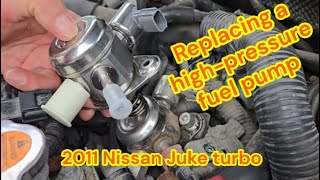
- If the HPFP is suspected, it should be professionally replaced. This involves removing the intake manifold. 🎬 See this walkthrough on how to replace the high-pressure fuel pump.
- If pressure readings seem erratic or incorrect, test the fuel rail pressure sensor by comparing its output to a mechanical gauge or by checking for continuity with a multimeter.
Parts You'll Likely Need
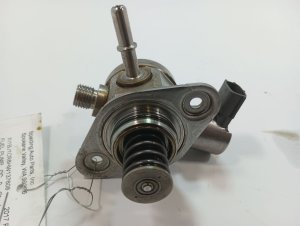
- High-Pressure Fuel Pump
(OEM #16630-3JY0A (latest), supersedes 16630-1KC0A, 16630-1KC0C, 16630-4BA0A)— This is the most common mechanical failure causing P0087 on the Juke's direct injection engine after the software issue is ruled out.
Trusted brands: Hitachi, Bosch, Nissan OE
OEM price range: $489 - $1400
Aftermarket price range: $80 - $700 - Fuel Rail Pressure Sensor — This sensor can fail and send incorrect low-pressure readings to the ECM, falsely triggering the code. It was also the subject of recalls on earlier models for fuel leaks. Note that the part is different for 2015+ models versus earlier Jukes.
Trusted brands: Bosch, Denso, Nissan OE
OEM price range: $250-$330
Aftermarket price range: $150-$220
Related Codes That Often Appear With This One
- P0101 — Mass Air Flow (MAF) Sensor Performance. This code is explicitly mentioned alongside P0087 in Nissan TSBs NTB19-045b and NTB19-045a as being potentially caused by the same ECM calibration error.
- P0448 — EVAP System Vent Control Circuit Shorted. Also mentioned in the same TSBs (NTB19-045b, P9328_P9343_P934) as being related to the ECM software issue.
- P2008 — Intake Manifold Runner Control Circuit Open. This is the fourth code listed in the TSBs (NTB19-045b, P9328_P9343_P934) that can be resolved with the ECM reprogram.
- P0090 — Fuel Pressure Regulator 1 Control Circuit. This code often appears with P0087 as it relates to the control of the high-pressure pump. A user on CarComplaints.com reported having both P0087 and P0090 on their 2012 Juke.
Technical Service Bulletins (TSBs) & Recalls
- NTB19-045b: MIL ON WITH DTC P0087, P0101, P0448, OR P2008
- P9328_P9343_P934: VOLUNTARY EMISSION RECALL CAMPAIGN; ECM REPROGRAM FOR P-DTC
- NTB19-045a: MIL ON WITH DTC P0087, P0101, P0448, OR P2008
Platform-Specific Known Issues
- Nissan Technical Service Bulletin NTB19-045b notes that a MIL can be ON with DTC P0087 due to an ECM calibration error, requiring a software update. It's crucial to understand this TSB states the mechanical issue must be fixed *before* the reprogram is applied.
- Nissan Technical Service Bulletin P9328_P9343_P934 explicitly states that due to calibration errors, the ECM may improperly store a permanent DTC for P0087, and the fix is to reprogram the ECM.
- A Reddit user with a 2017 Juke and code P0087 was advised that if no other codes are present, the high-pressure fuel pump is the most likely failure.
Mechanic-Grade Diagnostic Values
- Low-Pressure Fuel Pump (In-tank) Output — expected: 4.0 to 7.0 bar (58 to 101 PSI) at idle.. Failure: Pressure drops below 4.0 bar (58 PSI) at idle.
- High-Pressure Fuel Pump Output (Scan Tool Data) — expected: Approximately 500-600 PSI at idle, rising to 2,000-3,000 PSI under load.. Failure: Actual pressure is significantly lower than desired pressure, especially under load.
- Fuel Rail Pressure Sensor Continuity — expected: Continuity should be present across the sensor terminals.. Failure: No continuity (an open circuit) indicates a faulty sensor.
Scan Tool Commands That Help
- Professional Scan Tool (e.g., CONSULT): Bidirectional test of the ECM's fuel-pump driver circuit. — Use this after verifying wiring integrity. If the command fails, it points to an internal failure within the Engine Control Module (ECM), avoiding unnecessary replacement of the fuel pump.
Wiring & Ground Locations
- Fuel Rail Pressure Sensor Location — Under the intake manifold, on the fuel rail.. Physical access requires removing the intake manifold, which significantly increases labor time for diagnosis or replacement of the sensor.
Real Owner Repair Stories
- YouTube - DIY Daly (2016 Nissan Juke 1.5 DCI (Diesel Engine)) — Intermittent stalling, engine cutting out randomly, P0087 code logged.
❌ Tried (didn't work) Initial diagnosis was difficult due to the intermittent nature of the fault.
✅ What actually fixed it The mechanic removed the fuel pressure regulator from the side of the high-pressure pump, found it contaminated with tiny metal fragments and gelled fuel, cleaned it thoroughly with brake cleaner, and reinstalled it. The car ran without issue for 120 miles, confirming the fix. - Reddit - r/AskAMechanic (2011 Nissan Juke) — Check Engine Light with code indicating a high-pressure fuel pump failure.
❌ Tried (didn't work) A high-pressure fuel pump was replaced by the dealer.
✅ What actually fixed it The same issue recurred just 18 months after the dealer replaced the high-pressure fuel pump, requiring another replacement. This story highlights the high failure rate and potential for repeat failures of this component.
OEM Part Supersession History
16630-1KC0A, 16630-1KC0C, 16630-4BA0A→16630-3JY0A— Part revision by the manufacturer, likely for improved reliability.
Heads up: The latest part number (16630-3JY0A) is the recommended replacement for all previous versions for the specified vehicle range.
Model Year Variations Within This Range
- 2015-2017 vs 2011-2014: The Fuel Rail Pressure Sensor part number is different for 2015-2017 Juke models compared to the 2011-2014 models. Ordering the correct sensor for the specific model year is critical.
Helpful Videos


Used OEM Parts in Stock


New Aftermarket Parts Available


The information in this article is provided for general reference and educational purposes only. Vehicle specifications, procedures, and part compatibility can vary by production date, trim level, and region. Always consult your vehicle's factory service manual and verify part numbers before purchasing or performing repairs. Safety-critical components such as airbags, seat belts, and braking systems should be installed by a qualified professional.
- Nissan JUKE:
- 🎬 Helpful Videos
- 🛍️ Shop This Part
- What's Unique About the 2015-2017 Nissan JUKE
- Diagnostic Flowchart
- Symptoms You May Notice
- Most Likely Causes
- Rare But Worth Checking
- Diagnosis Steps
- Parts You'll Likely Need
- Related Codes That Often Appear With This One
- Technical Service Bulletins (TSBs) & Recalls
- Platform-Specific Known Issues
- Mechanic-Grade Diagnostic Values
- Scan Tool Commands That Help
- Wiring & Ground Locations
- Real Owner Repair Stories
- OEM Part Supersession History
- Model Year Variations Within This Range
- 🎟️ Get 5% Off