

P0087 on 2011-2013 Kia Sportage: Fuel Rail Pressure Too Low Causes and Fixes
On a 2011-2013 Kia Sportage with a GDI engine, P0087 is most often caused by either a faulty high-pressure fuel pump (HPFP) or an outdated software in the Engine Control Module (ECM). Before replacing parts, check with a Kia dealer for applicable software updates, as this is a known issue addressed by Kia's technical service bulletins. If the software is current, the HPFP is the next most likely culprit.
- Before buying any parts for a P0087 code on a 2011-2013 Kia Sportage, call a Kia dealer with your VIN to check if the SC114 software update has been performed.
- If the software is up to date, the most likely culprit is a failing high-pressure fuel pump (HPFP).
- Diagnosing this code effectively requires a scan tool that can read live data to compare desired versus actual fuel rail pressure.
- Symptoms like engine hesitation, stalling, and a long crank time are common with this code and indicate the problem should be fixed promptly to avoid further issues.
What's Unique About the 2011-2013 Kia SPORTAGE

For this generation of Kia Sportage with GDI engines, the P0087 code is uniquely tied to manufacturer-acknowledged issues. Kia released several Technical Service Bulletins (TSBs) indicating that the cause could be the ECM's software logic, not a mechanical failure. A specific Voluntary Service Campaign (SC114) was issued to update the ECM software to correct this problem, making a trip to the dealer for a software check a crucial first step before any parts are replaced. TSB FUE-026 also provides a detailed diagnostic path that often leads to replacing the HPFP if the software fix is not applicable or doesn't resolve the issue.
Diagnostic Flowchart
Tap your situation to follow the diagnostic path that matches what you're seeing on this vehicle.
Symptoms You May Notice
- Check Engine Light is on
- Engine hesitation or stumbling, especially under acceleration
- Noticeable loss of engine power or entering 'limp mode'
- Rough or unstable idle
- Difficulty starting the engine or extended cranking time.
- Engine stalling, sometimes intermittently, especially when hot.
- Gasoline smell in engine oil (critical symptom of an internal HPFP leak).
- Replacing the high-pressure fuel pump (HPFP) without first checking for required ECM software updates. This is a costly mistake, as the software update is a known fix.
- Replacing the in-tank (low-pressure) fuel pump when the fault is in the high-pressure system (HPFP or sensor).
- Replacing the HPFP without checking for the small roller tappet underneath it. If the tappet is missing, a new pump will not solve the problem.
Most Likely Causes


- Outdated Engine Control Module (ECM) Software 🔴 High Probability Kia issued multiple TSBs (including a Voluntary Service Campaign SC114) specifically to address P0087 with a software update on these models. The update improves the durability and operation of the fuel control valve logic.
How to confirm: Contact a Kia dealership with your vehicle's VIN. They can check if TSB SC114R1 or a similar campaign is open for your vehicle or if the update has already been performed.
Typical fix: The dealership will reflash or update the ECM software. This is not a DIY repair.
Est. part cost: $0-$200 - Failing High-Pressure Fuel Pump (HPFP) 🔴 High Probability The HPFP is a mechanical component that is under constant stress in a GDI system and is a common failure point as the vehicle ages. TSB FUE-026 specifically calls out replacing the HPFP to resolve P0087 if other diagnostics pass. An internal leak in the pump can also cause gasoline to mix with the engine oil, which is a severe issue.
How to confirm: Use a capable OBD-II scan tool to monitor 'Fuel Rail Pressure' and 'Desired Fuel Rail Pressure' live data. Under hard acceleration, the actual pressure should closely track the desired pressure. If the actual pressure drops significantly while the desired pressure stays high, the pump is likely weak. Also, check the engine oil dipstick for a strong gasoline smell.
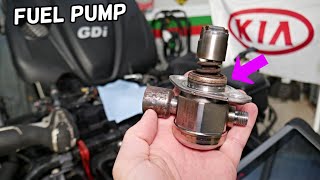
Typical fix: Replacement of the high-pressure fuel pump and its associated high-pressure fuel pipe, which is a one-time use part. 🎬 See how to replace the high-pressure fuel pump.
Est. part cost: $250-$750 - Faulty Fuel Rail Pressure Sensor 🟡 Medium Probability The sensor provides the pressure reading to the ECM. An incorrect reading can falsely trigger the P0087 code.
How to confirm: With the engine off, the fuel rail pressure reading on a scan tool should be very low (near 0 PSI). If it shows a high or erratic value, the sensor is suspect. Comparing its reading to a mechanical gauge (if possible) can also confirm a fault.
Typical fix: Replacement of the fuel rail pressure sensor. 🎬 Watch: How to diagnose a faulty fuel rail pressure sensor.
Est. part cost: $60-$150 - Weak In-Tank Low-Pressure Fuel Pump ⚪ Low Probability The HPFP is fed by the low-pressure pump in the fuel tank. If the low-pressure pump is weak, it can starve the HPFP, causing low pressure on the high side.
How to confirm: Test the low-pressure side fuel pressure at the engine bay with a fuel pressure gauge. It should meet the manufacturer's specification (typically 50-75 PSI).
Typical fix: Replacement of the in-tank fuel pump assembly.
Est. part cost: $150-$350
Rare But Worth Checking
- Clogged Fuel Filter: The fuel filter is often integrated into the in-tank fuel pump assembly. If it becomes severely clogged, it can restrict fuel flow to the HPFP.
- Missing HPFP Roller/Tappet: A small roller tappet (cam follower) sits between the camshaft and the HPFP. During a previous repair (like a valve cover gasket or HPFP replacement), this part can be misplaced or forgotten, leading to the pump not being actuated and an immediate P0087 code.
- Leaking Fuel Injector: A fuel injector stuck open can cause a drop in rail pressure, though this is less common and often accompanied by other codes like misfires (P0300-P0304).
- Heat Soak / Vapor Lock: In very hot ambient temperatures, some owners report stalling and P0087 after the car has been idling for an extended period. This may be due to heat affecting the HPFP or its control valve, causing a temporary fuel pressure drop. This is anecdotal but has been reported in forums.
Diagnosis Steps
- Check for TSBs: Contact a Kia dealership with your VIN to check for open service campaigns or TSBs related to P0087, specifically SC114. This should always be the first step.
- Scan for Codes: Use an OBD-II scanner to confirm P0087 is present and check for any other related codes (e.g., P0191, P0088, misfire codes). Address other codes first.
- Analyze Live Data: Use a scan tool that can display live data. Monitor 'Fuel Rail Pressure' and 'Desired Fuel Rail Pressure' PIDs.
- Idle Test: At idle, the actual and desired pressures should be very close, around 48-50 bar (approx. 700 PSI). If the actual pressure is significantly lower (e.g., 5 bar or ~72 PSI), it indicates a major fault.
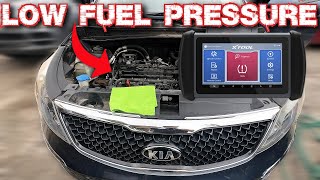
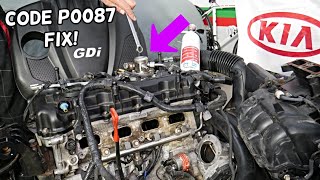
- Load Test: Safely perform a road test with hard acceleration. Watch the live data. If the actual fuel pressure drops significantly below the desired pressure under load, the HPFP is the primary suspect. 🎬 Watch: A complete P0087 diagnosis and repair walkthrough.
- Check for Gas in Oil: Pull the engine oil dipstick and smell it for gasoline. A strong fuel smell is a tell-tale sign of a failing HPFP with an internal leak and requires immediate attention.
- Low-Pressure System Test: If the high-pressure side seems inconclusive, test the pressure of the low-pressure in-tank pump. Connect a fuel pressure gauge to the low-pressure feed line. The pressure should be stable and within the 50-75 PSI range.
- Inspect HPFP Tappet: If the HPFP is being replaced, ALWAYS inspect the bore to ensure the roller tappet is present and installed correctly. If it's missing, the pump will not function.
Parts You'll Likely Need

- High-Pressure Fuel Pump (HPFP)
(OEM #35320-2G720)— This is the most common mechanical failure for P0087 on GDI engines after the software has been ruled out. It is responsible for creating the high pressure required for direct injection.
Trusted brands: Bosch, Delphi, Genuine Hyundai/Kia
OEM price range: $700-$1000
Aftermarket price range: $90-$400 - Fuel Rail Pressure Sensor
(OEM #35342-2E500)— This sensor reports the fuel pressure to the ECM. A faulty sensor can provide incorrect readings, leading to a false P0087 code.
Trusted brands: Duralast, Vemo, Standard Motor Products
OEM price range: $70-$110
Aftermarket price range: $40-$70 - HPFP Roller Tappet (Cam Follower)
(OEM #35325-2G700)— This small but critical part sits between the camshaft and the HPFP. It can be lost during repairs, and its absence will cause a complete lack of high fuel pressure and an immediate P0087 code.
Trusted brands: Genuine Hyundai/Kia
OEM price range: $20-$40
Aftermarket price range: $15-$25
Related Codes That Often Appear With This One
- P0088 (Fuel Rail/System Pressure - Too High): Can sometimes appear if the fuel pressure control solenoid on the HPFP is failing erratically.
- P0191 (Fuel Rail Pressure Sensor Circuit Range/Performance): Can indicate an issue with the sensor or its wiring, closely related to P0087.
Technical Service Bulletins (TSBs) & Recalls
- TSBSC114R1: Voluntary Service Campaign for an ECM software update related to DTC P0087.
- TSB-FUE026: Provides diagnosis and repair procedures for P0087, including the potential replacement of the high-pressure fuel pump.
- SC114DEALERP / SC114QA: Further documents related to the service campaign for the P0087 code on GDI engines.
Platform-Specific Known Issues
- ECM Software Update (SC114): A significant number of 2011-2013 Sportage models were subject to a voluntary service campaign to update the ECM software to fix false P0087 triggers. This is the most critical vehicle-specific issue to check first.
- TSB FUE-026: This technical service bulletin provides a diagnostic procedure specifically for P0087 on these vehicles, which may culminate in replacing the high-pressure fuel pump and associated delivery pipe. It explicitly states not to reuse the high-pressure fuel pipe.
Helpful Videos


Used OEM Parts in Stock


New Aftermarket Parts Available


The information in this article is provided for general reference and educational purposes only. Vehicle specifications, procedures, and part compatibility can vary by production date, trim level, and region. Always consult your vehicle's factory service manual and verify part numbers before purchasing or performing repairs. Safety-critical components such as airbags, seat belts, and braking systems should be installed by a qualified professional.
- Kia SPORTAGE:
- 🎬 Helpful Videos
- 🛍️ Shop This Part
- What's Unique About the 2011-2013 Kia SPORTAGE
- Diagnostic Flowchart
- Symptoms You May Notice
- Most Likely Causes
- Rare But Worth Checking
- Diagnosis Steps
- Parts You'll Likely Need
- Related Codes That Often Appear With This One
- Technical Service Bulletins (TSBs) & Recalls
- Platform-Specific Known Issues
- 🎟️ Get 5% Off