

P0087 on 2013-2020 Honda Accord: Fuel Rail Pressure Too Low Causes & Fixes
P0087 on a 2013-2020 Honda Accord indicates the fuel pressure is dangerously low, often causing stalling or hard starts. For 9th gen (2013-17), the most common cause is a failing high-pressure fuel pump (HPFP), a known issue confirmed by Honda TSB 14-071. For 10th gen (2018-20), a faulty low-pressure in-tank pump was the subject of a major recall causing the same code. This is a critical safety issue; expect repair costs of $700-$1800 for the HPFP.
- P0087 on a 2013-2020 Accord is a critical code that indicates a dangerous risk of stalling.
- The most likely cause, especially on 2013-2017 models, is a failed high-pressure fuel pump (HPFP).
- For 2019-2020 models, check for an open recall on the low-pressure fuel pump before performing other repairs.
- This is not a DIY-friendly repair due to the extreme pressures in the fuel system.
- Do not drive the vehicle. Have it towed to a qualified repair shop for diagnosis.
What's Unique About the 2013-2020 Honda ACCORD

The 2013-2020 Accord range spans two generations (9th and 10th), both utilizing direct-injected engines with a high-pressure fuel system susceptible to this fault. Honda issued TSB 14-071 specifically for 2013-2014 Accords, pointing to internal failures of the high-pressure fuel pump (HPFP) as the primary cause for P0087. 🎬 Watch: Diagnosing long cranks and stalling on 9th-gen Accords. Later, 10th-gen models with 1.5T and 2.0T engines were subject to massive safety recalls (like A21-036) for defective low-pressure fuel pump motors that swell and seize, also triggering P0087. This makes low fuel pressure a well-documented issue across this entire vehicle range, with different primary causes depending on the generation.
Diagnostic Flowchart

Tap your situation to follow the diagnostic path that matches what you're seeing on this vehicle.
Generation note: This range covers the 9th generation (2013-2017) and the 10th generation (2018-2020). Both generations use direct-injected engines (2.4L K24W1 & 3.5L J35Y in 9th gen; 1.5T L15B7 & 2.0T K20C4 in 10th gen) which have the high-pressure fuel system where this fault occurs. The high-pressure fuel pump (HPFP) is the most common failure on the 9th gen. The low-pressure in-tank fuel pump was recalled on many 10th gen models, both potentially causing a P0087 code.
Symptoms You May Notice

- Check Engine Light is on, often with other warning lights like traction control and power steering.
- Engine stalls while driving, potentially at highway speeds.
- Engine is hard to start or has a long crank time.
- Reduced engine power and sluggish acceleration (bogging).
- Vehicle enters 'limp mode,' limiting speed and RPMs to around 2500.
- Engine runs rough or misfires.
- An audible rattling or loud ticking noise from the high-pressure fuel pump area on the engine.
- Replacing the in-tank (low-pressure) fuel pump on a 9th Gen Accord when the actual fault lies with the engine-mounted high-pressure fuel pump (HPFP).
- Replacing the high-pressure fuel pump (HPFP) when the actual fault is a weak in-tank low-pressure pump that cannot supply it with enough fuel.
- Dealerships attempting to upsell a high-pressure fuel pump replacement on a 10th Gen Accord when only the low-pressure pump is covered under the recall, even though the recall part is the primary cause.
Most Likely Causes

- Failing High-Pressure Fuel Pump (HPFP) 🔴 High Probability Honda TSB 14-071 for 2013-2014 models directly states that an internal component of the HPFP is the known cause for P0087. Mechanic and owner reports confirm this is the most common failure point for 9th generation Accords (2013-2017).
How to confirm: A technician will use a scan tool to monitor desired vs. actual fuel rail pressure. If the actual pressure consistently fails to meet the target (e.g., drops from a target of 500-800 PSI to under 100 PSI), and the low-pressure system is confirmed to be supplying adequate pressure (around 55-60 PSI), the HPFP is the culprit. Also inspect the camshaft lobe and follower for wear when the pump is removed.
Typical fix: Replace the high-pressure fuel pump, its associated seals, and sometimes the camshaft follower (tappet). It is also recommended to replace the high-pressure fuel line.
Est. part cost: $400-$900 - Failing Low-Pressure Fuel Pump (In-tank) 🟡 Medium Probability Honda issued major safety recalls (e.g., A21-036, 21-027, 20V771000) for the in-tank fuel pump motor on 2018-2020 Accord models. A defective impeller was improperly molded, causing it to swell, deform, and seize the pump, leading to a P0087 code and stalling.
How to confirm: Check if the vehicle's VIN is part of the recall campaign on Honda's official recall site. A technician can also test the low-pressure fuel system's pressure at the feed line to the HPFP. If pressure is low, fluctuating, or drops quickly after shutoff, this pump is the issue.
Typical fix: Replace the in-tank fuel pump motor, often performed for free as part of the recall procedure at a Honda dealership.
Est. part cost: $150-$400 - Faulty Fuel Rail Pressure Sensor ⚪ Low Probability
How to confirm: Compare the pressure reading from the sensor (via a scan tool) to a reading from a mechanical fuel pressure gauge. If the readings differ significantly, the sensor is likely faulty. A failing sensor may also give erratic, jumpy readings instead of a consistent low reading.
Typical fix: Replace the fuel rail pressure sensor.
Est. part cost: $80-$150 - Clogged Fuel Filter or Restricted Fuel Line ⚪ Low Probability While not a design flaw, a clogged fuel filter can cause P0087 if neglected. The main filter is part of the in-tank pump assembly.
How to confirm: A fuel pressure and volume test can reveal a restriction. If pressure is good at the pump but low at the rail, a blockage is likely. One owner reported fixing P0087 by replacing a fuel filter that a shop had allegedly failed to change during service.
Typical fix: Replace the clogged fuel filter (typically part of the in-tank fuel pump module) or repair the damaged section of the fuel line.
Est. part cost: $30-$100
Rare But Worth Checking
- Leaking Fuel Injector(s): A fuel injector stuck open can bleed off pressure from the fuel rail, causing this code. This may also be accompanied by a rich running condition or misfire codes for a specific cylinder.
- Worn Camshaft Lobe/Follower: The HPFP is driven by a special lobe on the camshaft. The pump has a small bucket or 'follower' that rides on this lobe. If the lobe or follower wears down due to poor lubrication or a defect, the pump's plunger won't be fully actuated, resulting in low pressure. It is critical to inspect the lobe and follower whenever replacing the HPFP.
Diagnosis Steps
- Check for any applicable recalls or Technical Service Bulletins (TSBs) for your vehicle's VIN on the NHTSA or Honda recall websites.
- Connect an OBD-II scanner to verify the P0087 code and check for any other related codes.
- Use the scanner's live data function to monitor 'Desired Fuel Rail Pressure' and 'Actual Fuel Rail Pressure'. Observe the values at idle, under load, and during a test drive (if safe). Note if the actual pressure drops significantly below the desired pressure.
- If actual pressure is low, the next step is to isolate the problem. First, test the low-pressure fuel system. Connect a fuel pressure gauge to the low-pressure line feeding the HPFP. Pressure should be stable at around 57-64 PSI. If it's low or drops rapidly after engine shutoff, the in-tank pump, filter, or a line restriction is the issue.
- If the low-pressure side is strong and stable, the problem is in the high-pressure system. Inspect for external leaks at the HPFP, fuel lines, and injectors.
- If no leaks are found and the low-pressure system is healthy, the high-pressure fuel pump (HPFP) is the most likely cause.
- When replacing the HPFP, it is critical to inspect the camshaft lobe and the pump's follower/tappet for any signs of scoring, pitting, or wear. Replace if any damage is found.
Parts You'll Likely Need
- High-Pressure Fuel Pump
(OEM #16790-5A2-A01 (superseded by 16790-5LA-305 for 2.4L) or 16790-5PC-H02 (for 1.5T))— This is the most common failure point for P0087 on the 9th generation (2013-17) Accord, as documented in TSB 14-071.
Trusted brands: Honda (OEM), Bosch
OEM price range: $587-$940
Aftermarket price range: $400-$800 - Low-Pressure Fuel Pump Motor Kit
(OEM #06170-TVA-306)— This part was subject to a massive safety recall on 2019-2020 models for causing this exact code and stalling issues.
Trusted brands: Honda (OEM)
OEM price range: $150-$250
Aftermarket price range: $80-$150 - Fuel Rail Pressure Sensor
(OEM #37890-R40-A01 (example, verify by VIN))— A less common but possible cause. If the sensor fails, it can send incorrect low-pressure readings to the ECM.
Trusted brands: Honda (OEM), Denso
OEM price range: $100-$150
Aftermarket price range: $50-$90
Related Codes That Often Appear With This One
- P0299 — A P0299 (Turbocharger/Supercharger Underboost) code was reported alongside P0087 on a 2018 Accord. Insufficient fuel pressure can lead to poor engine performance, preventing the turbo from building the expected amount of boost.
- U0401 — A U0401 (Invalid Data Received From ECM/PCM) code was reported with P0087 on a Honda CR-V with the same fuel system. This indicates a communication failure that can be triggered by the primary engine fault.
Technical Service Bulletins (TSBs) & Recalls
- TSB 14-071 (Originally Oct 2014, revised Jan 2015): For 2013-2014 Accords, states the MIL is on with DTC P0087 and the cause is an internal component of the high pressure fuel pump.
- A21-036 (July 30, 2021): Safety Recall for 2019-20 Accord 1.5T. A seized low-pressure fuel pump motor can cause DTC P0087 and engine stalling.
- 21-027 (March 26, 2021): Safety Recall for 2019 Accord 2.0T for the same low-pressure fuel pump motor issue causing P0087.
- 20V-314 / 21V-215 (KGC, KGD): NHTSA campaign numbers for the massive low-pressure fuel pump recalls that include 2018-2020 Accords.
Platform-Specific Known Issues
- A service bulletin for the 2013-2014 Accord (TSB 14-071) with P0087 specifically states the cause is an internal component of the high pressure fuel pump.
Mechanic-Grade Diagnostic Values
- Low-Pressure Fuel System Pressure (at HPFP inlet) — expected: 57-64 PSI. Failure: Pressure is low, fluctuating, or drops rapidly after engine shutoff (e.g., loses half its pressure in under a minute).
- High-Pressure Fuel System Pressure (at fuel rail, via scan tool) — expected: 500-800 PSI at idle, up to 2,000-3,000 PSI under load.. Failure: Actual pressure consistently reads far below desired pressure, or drops to low-pressure system levels (e.g., ~60 PSI) causing a stall.
- Low-Pressure Fuel Pump Bleed-Down Rate — expected: Pressure should hold for about 5 minutes after engine shutoff.. Failure: Pressure drops rapidly, for example from 55 PSI to under 40 PSI in less than 30 seconds, indicating a bad regulator in the pump assembly.
Scan Tool Commands That Help
- Honda Diagnostic System (HDS): Record all onboard snapshots and freeze frame data. — This is the first step before clearing any codes, as it preserves the engine's state at the moment the fault was triggered, which is critical for diagnosis.
- Honda Diagnostic System (HDS): Direct Injection Fuel Pressure Test — This is a specific function to test the high-pressure fuel pump. A failed test is a strong indicator that the HPFP needs replacement.
- Honda Diagnostic System (HDS): VSA Sensor Neutral Position Memorization — This procedure must be performed after replacing the in-tank fuel pump motor as part of the recall repair, after clearing all DTCs.
Wiring & Ground Locations
- Low-Pressure Fuel Line Test Port — There is no factory-installed test port on the low-pressure side for 9th generation (2013-2017) models.. To accurately measure the low-pressure pump's output, a technician must install a T-adapter with a Schrader valve into the quick-disconnect joint in the fuel line, typically located on the firewall.
Real Owner Repair Stories
- hondacivicforums.com user 'n8phu' (2014 Honda Accord LX 2.4L) — P0087 code, car went into limp home mode.
❌ Tried (didn't work) Replaced the high-pressure fuel pump (HPFP) based on the TSB. The code returned after 10 minutes of driving.
✅ What actually fixed it The in-tank (low-pressure) fuel pump was weak and failing. Replacing the used in-tank pump assembly for $55 resolved the P0087 code permanently. - YouTube channel 'BCauto_' (2013-2017 Honda Accord 2.4L with 51,000 miles) — P0087, long crank (3-5 seconds), and stalling.
✅ What actually fixed it Replaced the high-pressure fuel pump (HPFP). The video notes this is a common history for these cars and the diagnosis was confirmed with a failed 'Direct Injection Fuel Pressure Test' on a scan tool. - YouTube channel 'CHECK ENGINE KSA' (2019 Honda Accord) — P0087, no start condition (engine cranks but does not start).
✅ What actually fixed it Replaced the in-tank (low-pressure) fuel pump. The car started immediately after replacement, confirming the fix for the no-start symptom associated with the code on this 10th gen model.
When the Usual Fixes Don't Work
- While the Technical Service Bulletin for 9th generation Accords points directly to the high-pressure fuel pump (HPFP), there are documented cases where this was a misdiagnosis. One owner of a 2014 Accord replaced the HPFP according to the TSB, only for the P0087 code to return. The actual root cause was a weak in-tank (low-pressure) fuel pump that could not supply the new HPFP with adequate volume. This highlights the importance of testing the low-pressure system (57-64 PSI) before defaulting to the HPFP replacement, even when a TSB exists.
OEM Part Supersession History
16790-5A2-A01→16790-5LA-305— Updated part for the High-Pressure Fuel Pump on 2.4L engines.
Model Year Variations Within This Range
- 2013-2017 (9th Gen): The primary cause for P0087 is overwhelmingly the high-pressure fuel pump (HPFP), as documented in TSBs and repair histories.
- 2018-2020 (10th Gen): The primary cause for P0087 is overwhelmingly the in-tank low-pressure fuel pump, which was subject to a major safety recall for a defective impeller that swells and seizes.
- 2016 vs 2017: There were no significant changes to the 2.4L powertrain or fuel system between these model years. A new 'Sport Special Edition' trim was added in 2017, but it was cosmetic.
- 2018 vs 2019: No significant changes were made to the standard 1.5T or optional 2.0T powertrains and fuel systems between these model years. The 2.0T engine became standard on the Touring trim for 2019.
Helpful Videos

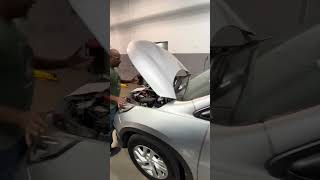
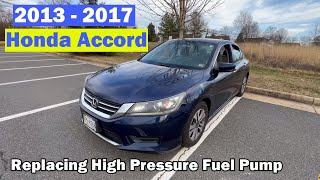
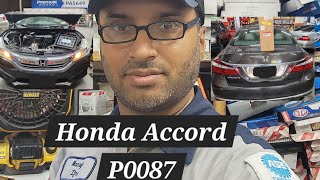
Used OEM Parts in Stock


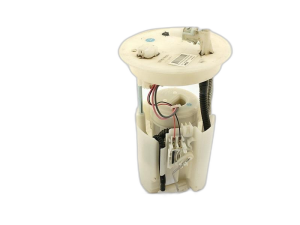
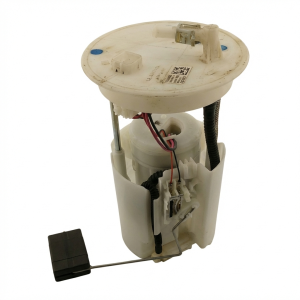
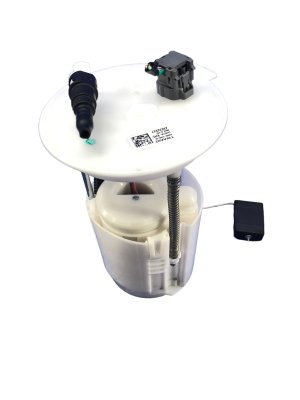
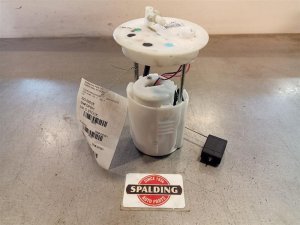
New Aftermarket Parts Available



The information in this article is provided for general reference and educational purposes only. Vehicle specifications, procedures, and part compatibility can vary by production date, trim level, and region. Always consult your vehicle's factory service manual and verify part numbers before purchasing or performing repairs. Safety-critical components such as airbags, seat belts, and braking systems should be installed by a qualified professional.
- Honda ACCORD:
- 🎬 Helpful Videos
- 🛍️ Shop This Part
- What's Unique About the 2013-2020 Honda ACCORD
- Diagnostic Flowchart
- Symptoms You May Notice
- Most Likely Causes
- Rare But Worth Checking
- Diagnosis Steps
- Parts You'll Likely Need
- Related Codes That Often Appear With This One
- Technical Service Bulletins (TSBs) & Recalls
- Platform-Specific Known Issues
- Mechanic-Grade Diagnostic Values
- Scan Tool Commands That Help
- Wiring & Ground Locations
- Real Owner Repair Stories
- When the Usual Fixes Don't Work
- OEM Part Supersession History
- Model Year Variations Within This Range
- 🎟️ Get 5% Off