

P0087 on 2015-2018 GMC Sierra Denali: Low Fuel Pressure Causes & Fixes
On a 2015-2018 Sierra Denali, P0087 most often points to a failing high-pressure fuel pump (HPFP) or a weak in-tank low-pressure fuel pump. Per a GM TSB, the in-tank pump is known to fail in cold weather, causing a no-start or stalling. A failing HPFP can also cause fuel to enter the crankcase, so checking the oil for a fuel smell is a critical diagnostic step. Expect to pay $400-$800 for a new HPFP and $300-$500 for an in-tank pump.
- P0087 on your Sierra Denali means the high-pressure fuel system is not providing enough fuel to the engine.
- The most common fixes are replacing the high-pressure fuel pump (HPFP) or the in-tank low-pressure fuel pump.
- A specific GM Technical Service Bulletin (#18NA103) warns that the in-tank pump can fail in temperatures below 20°F, causing this exact code and stalling.
- Do not continue to drive the vehicle, as the engine could stall at any time, posing a serious safety risk.
- This is not a simple DIY fix. Due to the high pressures and complexity, professional service is strongly recommended.
What's Unique About the 2015-2018 Gmc SIERRA DENALI
The 2015-2018 Sierra Denali's EcoTec3 engines use a sophisticated direct injection system with two fuel pumps: a low-pressure pump in the tank and a high-pressure fuel pump (HPFP) driven by the camshaft. This code specifically flags an issue on the high-pressure side. What's particularly unique to this platform is a known issue, documented in GM Technical Service Bulletin #18NA103, where the in-tank fuel pump can fail to perform correctly in very cold temperatures (below 20°F), directly causing a P0087 code along with stalling or no-start conditions. Furthermore, the camshaft-driven HPFP can fail in a way that allows gasoline to leak into the crankcase, contaminating the engine oil, a specific diagnostic clue for this platform.
Diagnostic Flowchart
Tap your situation to follow the diagnostic path that matches what you're seeing on this vehicle.
Symptoms You May Notice
- Check Engine Light (MIL) illuminated
- Loss of engine power or reduced acceleration
- Engine stalling, especially under load or when coming to a stop
- Hard starting or no-start condition.
- Rough running or idling.
- Engine misfires, potentially with codes P0300-P0308.
- Noticeable gasoline smell from the engine oil/dipstick
- Replacing the fuel rail pressure sensor when the actual problem is one of the fuel pumps.
- Replacing only the in-tank pump when the high-pressure pump has failed, or vice-versa.
- Failing to check for fuel-in-oil contamination after replacing a failed HPFP, leading to subsequent engine damage.
Most Likely Causes
- High-Pressure Fuel Pump (HPFP) Failure 🔴 High Probability The HPFP is a mechanical pump driven by the camshaft that is known to wear out over time on these direct injection engines. It is a common failure point leading to P0087. A failure of the internal seals can also cause fuel to leak into the crankcase.
How to confirm: Use a diagnostic scan tool to monitor desired vs. actual fuel rail pressure. If the actual pressure consistently fails to meet the desired pressure under load, and the low-pressure system is confirmed to be working, the HPFP is the likely culprit. A critical secondary check is to smell the engine oil for gasoline, which strongly indicates a failed HPFP.
Typical fix: Replacement of the high-pressure fuel pump and the one-time-use fuel line connecting it to the rail. This requires removing the intake manifold. An oil change is mandatory if fuel contamination is present.
Est. part cost: $400-$800 - In-Tank Low-Pressure Fuel Pump Failure 🟡 Medium Probability GM issued TSB #18NA103 specifically for this issue, noting the in-tank pump can fail in temperatures below 20°F (-6°C), causing P0087 and stalling or no-start symptoms. This pump's job is to feed the HPFP, so any weakness here starves the high-pressure side.
How to confirm: Check the low-pressure fuel system pressure using a scan tool (PID for 'Low Side Fuel Pressure') or a mechanical gauge at the service port. If the pressure is below specification (typically 50-65 PSI) or drops under load, the in-tank pump or FPDM is failing.
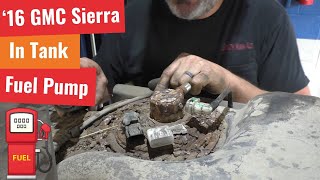
Typical fix: Replace the in-tank fuel pump module assembly. This requires dropping the fuel tank.
Est. part cost: $300-$500 - Faulty Fuel Rail Pressure Sensor ⚪ Low Probability
How to confirm: Monitor the fuel rail pressure sensor reading on a scan tool. If the reading is erratic, stuck at a low value, or doesn't change with engine RPM, the sensor may be faulty. Compare its reading to a mechanical gauge if possible, though this is difficult on the high-pressure side. A faulty sensor might also show a pressure reading with the engine off after the system has depressurized.
Typical fix: Replace the fuel rail pressure sensor located on the high-pressure fuel rail.
Est. part cost: $50-$150 - Failed Fuel Pump Driver Module (FPDM) ⚪ Low Probability This module, often located on the frame rail near the spare tire, controls the in-tank fuel pump. It is exposed to the elements and can fail due to corrosion or internal faults.
How to confirm: Diagnosis involves checking for power and ground at the module and verifying the command signal from the ECM and the output to the pump. A scan tool may show specific FPDM-related codes. If low-side pressure is zero, but the pump works when powered directly, the FPDM is a prime suspect.
Typical fix: Replace the Fuel Pump Driver Module.
Est. part cost: $75-$200
Rare But Worth Checking
- Clogged Fuel Filter: The fuel filter is integrated into the in-tank fuel pump module and is not typically serviced separately. A severely clogged filter would usually necessitate replacing the entire module.
- Fuel System Contamination: As mentioned in TSB #PIP5151B, contamination in the fuel can cause widespread issues. If contamination is found, the entire fuel system may need to be cleaned or replaced. TSB 16-NA-102 for Duramax models also details procedures for diagnosing and cleaning contamination, which are conceptually similar.
- Worn Camshaft Lobe or HPFP Follower: The high-pressure fuel pump is driven by a dedicated lobe on the camshaft, using a 'follower' or 'tappet'. Extreme wear on this lobe or follower can reduce the pump's stroke, preventing it from building adequate pressure. This is less common than pump failure itself but can occur on high-mileage engines. Diagnosis requires removing the HPFP and visually inspecting the follower and the cam lobe.
Diagnosis Steps
- Connect an OBD-II scanner and check for P0087 and any other stored codes.
- Using the scanner's live data function, monitor both 'Low Side Fuel Pressure' and 'Fuel Rail Pressure' (high side).
- Compare the 'Desired Fuel Rail Pressure' with the 'Actual Fuel Rail Pressure'. A large discrepancy where the actual is much lower than desired points to a problem.
- CRITICAL: Pull the engine oil dipstick and smell it for a strong gasoline odor. If fuel is present, the High-Pressure Fuel Pump (HPFP) has likely failed internally and is leaking into the crankcase. Do not run the engine further and plan to replace the HPFP and change the oil.
- Test the low-pressure system first. The pressure should be stable and within the manufacturer's specification (typically 50-65 PSI). If low-side pressure is weak, drops under acceleration, or is zero, suspect the in-tank fuel pump, its wiring, or the FPDM.
- If the low-pressure side is healthy but the high-pressure side cannot meet the commanded pressure, the issue is likely the high-pressure fuel pump (HPFP) or the high-pressure rail sensor.
- Inspect the HPFP area (at the back of the engine, under the intake manifold) for any visible fuel leaks.
- If the sensor readings are erratic or do not respond to changes in engine speed, test the sensor and its wiring.
- If the sensor is good, the low-pressure supply is good, and there is no fuel in the oil, the most likely remaining cause is a worn or failed high-pressure fuel pump.
Parts You'll Likely Need
- High-Pressure Fuel Pump
(OEM #12677329, 12688607 (supercedes 12625817, 12641740))— This is the most common component to fail and directly cause low pressure in the fuel rail on these GDI engines. Failure can also contaminate the engine oil.
Trusted brands: ACDelco, Bosch
OEM price range: $500-$800
Aftermarket price range: $400-$600 - In-Tank Fuel Pump Module — This pump supplies fuel to the HPFP. Its failure, especially in cold weather as noted by a TSB, will starve the HPFP and cause code P0087.
Trusted brands: ACDelco, Delphi
OEM price range: $400-$500
Aftermarket price range: $300-$400
Related Codes That Often Appear With This One
- P0088 — This code for "Fuel Rail/System Pressure - Too High" can sometimes appear with P0087 if the fuel pressure regulation is erratic. It is mentioned in TSBs #PIP4949E and #PIP5151B.
- P0191 — This code for "Fuel Rail Pressure Sensor Circuit Range/Performance" often accompanies P0087 as it indicates the sensor's readings are not what the ECM expects, which can be caused by either a bad sensor or actual pressure problems. It is cited in TSBs #PIP4949E and #PIP5151B.
- P228B — This code relates to the fuel pressure regulator. A Reddit user reported seeing this code alongside P0087, often pointing towards a high-pressure fuel pump or regulator issue.
- P018B, P228A, P2635 — These codes are related to fuel pressure sensor performance and the fuel pump control circuit. TSB #18NA103 lists them as potentially appearing with P0087 during the cold-weather pump failure.
Technical Service Bulletins (TSBs) & Recalls
- 18NA103
- PIP4949E
- PIP5151B
- 16-NA-102
Platform-Specific Known Issues
- TSB #18NA103 documents an issue where the in-tank fuel pump may perform poorly in ambient temperatures below 20°F (-6°C), leading to a start and stall, no start, loss of power, and setting DTC P0087.
Mechanic-Grade Diagnostic Values
- Low-Pressure Fuel System Pressure (In-tank pump) — expected: 50-70 PSI at idle. Failure: Pressure is below 50 PSI or drops significantly under load.
- High-Pressure Fuel System Pressure (HPFP) — expected: 290-725 PSI at idle; can exceed 2,100 PSI under load.. Failure: Actual pressure on a scan tool fails to meet desired pressure, especially under acceleration.
- Fuel Rail Pressure Sensor (2016+ Digital SENT sensor) — expected: The sensor communicates via a digital signal, not a simple analog voltage. A scan tool is required to read pressure and temperature.. Failure: Scan tool shows 0V, temperature reads -40°F, or pressure readings are nonsensical/stuck. This indicates a sensor or wiring failure.
- Long-Term Fuel Trims (when fuel-in-oil is suspected) — expected: Close to 0% (typically within +/- 10%).. Failure: Strongly negative values, such as -20% to -35%, indicate the ECM is pulling back significant amounts of fuel to compensate for an overly rich condition, which can be caused by fuel leaking into the crankcase from a bad HPFP.
Scan Tool Commands That Help
- GDS2 / Professional Scan Tool: Fuel Pump Enable/Disable — Used to safely relieve fuel system pressure before opening any lines. By disabling the pump and running the engine until it stalls, pressure is bled from both the low and high-pressure sides.
- GDS2 / Professional Scan Tool: Fuel Rail Pressure Test — This function allows a technician to command maximum rail pressure at idle to test the capability of the high-pressure fuel pump (HPFP). If the pump cannot achieve the commanded pressure, it is likely failing.
Wiring & Ground Locations
- Fuse F21 — In the main underhood fuse block, located on the driver's side next to the brake fluid reservoir.. This 20A fuse provides power to the Fuel Pump Power Module (FPDM). A blown fuse will cut power to the in-tank low-pressure pump, starving the high-pressure pump and causing P0087.
- Relay 59 (2018) or Relay 60/70 (2014-2017) — In the main underhood fuse block.. These are the primary relays for the fuel pump and its control module. A failed relay will prevent the in-tank pump from activating. The specific relay number varies by model year.
- Fuel Rail Pressure Sensor Connector — On the high-pressure fuel rail, at the rear of the engine, underneath the intake manifold.. This connector is difficult to access and can be a point of failure. For 2016+ models, it is a 3-pin digital (SENT) connector. For earlier models, it was a 4-pin analog connector. A poor connection here will cause incorrect pressure readings or related codes.
Real Owner Repair Stories
- YouTube channel 'Aaron Hines' (2015 Chevrolet Silverado 5.3L) — Engine running rich (codes P0172, P0175), engine oil level overfull and smelling strongly of gasoline, slight engine diesel/run-on after shutoff.
❌ Tried (didn't work) The video focuses directly on the diagnosis and replacement, not on prior failed attempts.
✅ What actually fixed it Replacement of the high-pressure fuel pump (HPFP). The internal seal of the original pump had failed, allowing fuel to leak directly into the engine crankcase, causing the rich condition and fuel-in-oil symptom. An oil change was also performed.
OEM Part Supersession History
12625817, 12641740, 12677329→12688607, which is further superseded by 12711668.— GM regularly updates parts to improve reliability or address known failure modes. These updates often involve changes to internal seals and materials.
Heads up: While many numbers are interchangeable, it is critical to use the latest revision available from GM for a specific VIN to ensure longevity. Part number 12688607 is specifically listed as an LT4 (supercharged) pump but is also used as a service replacement for L83/L86 engines.
Model Year Variations Within This Range
- 2014-2015 vs 2016-2018: The Fuel Rail Pressure Sensor changed around the 2016 model year. Early models used a 4-pin analog sensor, while later models (approx. 2016+) use a 3-pin digital SENT (Single Edge Nibble Transmission) sensor. The ECM and wiring harness are different between these two types, and they are not interchangeable.
Helpful Videos

We Have This Part in Stock


The information in this article is provided for general reference and educational purposes only. Vehicle specifications, procedures, and part compatibility can vary by production date, trim level, and region. Always consult your vehicle's factory service manual and verify part numbers before purchasing or performing repairs. Safety-critical components such as airbags, seat belts, and braking systems should be installed by a qualified professional.
- Gmc SIERRA DENALI:
- 🎬 Helpful Videos
- 🛍️ Shop This Part
- What's Unique About the 2015-2018 Gmc SIERRA DENALI
- Diagnostic Flowchart
- Symptoms You May Notice
- Most Likely Causes
- Rare But Worth Checking
- Diagnosis Steps
- Parts You'll Likely Need
- Related Codes That Often Appear With This One
- Technical Service Bulletins (TSBs) & Recalls
- Platform-Specific Known Issues
- Mechanic-Grade Diagnostic Values
- Scan Tool Commands That Help
- Wiring & Ground Locations
- Real Owner Repair Stories
- OEM Part Supersession History
- Model Year Variations Within This Range
- 🎟️ Get 5% Off