

P0087 on 2010 GMC Sierra 2500 6.6L Duramax: Low Fuel Pressure Causes and Fixes
On a 2010 Sierra 2500 with the 6.6L LMM Duramax engine, code P0087 almost always points to a fuel delivery issue, especially when towing or under heavy load. The most common, and cheapest, first step is to replace the fuel filter. If that doesn't work, the next likely culprits are a faulty Fuel Pressure Regulator (FPR), a leaking Fuel Pressure Relief Valve (FPRV), or air entering the system via degraded fuel lines or filter housing seals, before suspecting more expensive issues like injectors or
- P0087 on a 2010 Duramax means the fuel pressure is too low, most often due to a restriction or a faulty regulator.
- Always replace the fuel filter with a quality part before attempting any other repairs. This solves the problem a significant amount of the time.
- The next most common failures are the Fuel Pressure Regulator (FPR) and the Fuel Pressure Relief Valve (FPRV), which are far cheaper to replace than the pump or injectors.
- Check the old fuel filter for metal shavings. The absence of metal makes a catastrophic CP3 pump failure unlikely.
- Due to the extremely high pressures involved, diagnosis and repair of the high-pressure fuel system should be left to experienced professionals.
What's Unique About the 2010-2010 Gmc SIERRA 2500
The 2010 GMC Sierra 2500 with the LMM Duramax engine uses a high-pressure common rail fuel system that is robust but sensitive to fuel quality and filtration. Unlike later models that used the more problematic CP4 pump, the LMM uses the reliable Bosch CP3 high-pressure pump. However, these trucks did not come with a factory lift pump, meaning the CP3 pump has to pull fuel all the way from the tank under vacuum. This design puts extra strain on the system, making it prone to air leaks in the fuel lines or filter housing, and can starve the CP3 pump for fuel under heavy load, leading to P0087. The Fuel Pressure Regulator (FPR) on the CP3 pump is a known common failure item that can often be replaced without replacing the entire expensive pump. Additionally, the soft fuel lines, particularly near the transmission, are known to soften and collapse over time, creating a major restriction.
Diagnostic Flowchart
Tap your situation to follow the diagnostic path that matches what you're seeing on this vehicle.
Symptoms You May Notice
- Check Engine Light (MIL) is on
- Engine enters "Limp Mode" or "Reduced Engine Power" mode, often limited to 2,000 RPM. 🎬 Watch: How to diagnose P0087 and limp mode symptoms.
- Noticeable loss of power, especially under acceleration or when towing a heavy load up a grade.
- Hard starting or no-start condition, may require priming the fuel filter head.
- Rough or surging idle, sometimes described as a 'lope'.
- Engine stalling, particularly after a high-load event.
- "Change Fuel Filter" message on the Driver Information Center (DIC).
- Replacing the entire high-pressure CP3 pump when only the much cheaper Fuel Pressure Regulator (FPR) has failed.
- Replacing fuel injectors without performing a return rate test to confirm they are the source of the leak.
- Assuming the fuel filter is good without replacing it as the first step.
- Overlooking collapsed or restricted soft fuel lines between the tank and engine.
Most Likely Causes
- Clogged Fuel Filter 🔴 High Probability The Duramax fuel system is sensitive to contamination, and the filter is the first line of defense. Since there is no factory lift pump, a slightly restricted filter can easily cause a pressure drop under load, starving the CP3 pump.
How to confirm: This is the cheapest and easiest first step in diagnosis. Replace the filter as a rule before proceeding with further diagnostics, even if it was recently changed.
Typical fix: Replace the fuel filter with a high-quality OEM equivalent. The original manufacturer for GM was Racor, and their PFF50216 is considered a superior two-stage filter compared to some newer single-stage ACDelco TP3018 designs. Cut the old filter open and inspect for metal shavings, which would indicate a much more serious high-pressure pump failure.
Est. part cost: $30-$60 - Failing Fuel Pressure Regulator (FPR) 🔴 High Probability The FPR, also called the MPROP or Fuel Control Actuator, is mounted on the CP3 pump and is a very common failure point. It can stick or fail electronically, causing erratic or low fuel pressure, often resulting in a surging or loping idle.
How to confirm: Monitor desired vs. actual fuel rail pressure with a scan tool. If the actual pressure is low and doesn't respond correctly to throttle input, and the filter is new, the FPR is a strong suspect. A large spread between desired and actual pressure at idle is a key indicator.
Typical fix: Replace the Fuel Pressure Regulator. This can be done without removing the entire CP3 pump, making it a moderately difficult but accessible repair. The OEM part is made by Bosch. 🎬 Watch: Step-by-step walkthrough for replacing the Fuel Pressure Regulator.
Est. part cost: $150-$300 - Leaking Fuel Pressure Relief Valve (FPRV) 🟡 Medium Probability The relief valve on the fuel rail is designed to open and bleed off excess pressure. Over time, the spring can weaken, causing it to leak pressure back to the return system even under normal conditions, especially during high-demand situations like towing.
How to confirm: Perform a "bottle test" by disconnecting the return line from the relief valve and running it into a bottle. Command high rail pressure with a scan tool or by driving under load. If fuel comes out of the valve at pressures below its peak rating (approx. 26,000 PSI), it is leaking and must be replaced. Any fuel returning at idle or low pressure indicates a failure.
Typical fix: Replace the Fuel Pressure Relief Valve. Some owners opt to install a 'race plug' or 'shim kit' to block it off, which can be a permanent fix for the leak but removes a safety feature of the fuel system.
Est. part cost: $80-$150 - Air in Fuel System / Collapsed Lines 🟡 Medium Probability The O-rings in the fuel filter housing assembly can degrade due to age and ultra-low sulfur diesel, allowing air to be sucked into the system under vacuum. Additionally, the factory soft fuel supply lines, especially a section near the transmission, are known to soften, swell, and collapse internally, creating a severe restriction.
How to confirm: Repeatedly press the primer button on the fuel filter head. If it never gets firm, or if it gets hard and then quickly goes soft again, there is likely an air leak or loss of prime. Visually inspect the soft fuel lines for kinks or swelling. A vacuum gauge on the test port can confirm a restriction if vacuum exceeds 5-8 inHg under load.
Typical fix: Rebuild the fuel filter head with a seal kit which often includes more durable Viton seals and a metal bleeder screw. Replace the collapsed soft lines with a higher quality hose, such as the Parker hose mentioned in a GM service bulletin. 🎬 See this guide on upgrading restricted fuel hoses.
Est. part cost: $25-$250
Rare But Worth Checking
- Failing High-Pressure Injection Pump (CP3): While the CP3 is very reliable, it can wear out at high mileage (typically over 200,000-250,000 miles). This is the most expensive repair and should only be considered after all other possibilities have been exhausted. Finding metal shavings in the fuel filter is a key indicator of CP3 failure. A healthy pump should be able to achieve commanded rail pressure at idle when tested with a scan tool.
- Leaking Fuel Injectors: One or more injectors can leak fuel excessively from their return side, bleeding off rail pressure. This often causes hard starting when hot. It can be diagnosed with an injector return rate test. For an LMM, the spec is generally less than 18 ml per injector in a 30-second test at operating temperature with rail pressure commanded to 17,400 PSI.
- Weak In-Tank Fuel Pump (Gasoline Engines): While this guide focuses on the Duramax, it's important to note that TSB #18NA103 mentions P0087 on gasoline models due to a weak in-tank fuel pump, especially in cold weather below 20°F.
Diagnosis Steps
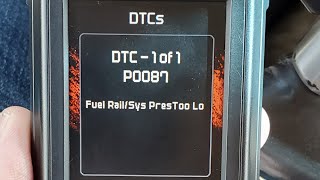
- Confirm code P0087 with a scan tool capable of reading live data.
- Check for and document any other stored codes.
- CRITICAL FIRST STEP: Replace the fuel filter with a new, high-quality filter like a Racor PFF50216. Cut the old filter open and inspect the media for metal flakes.
- Using a scan tool, monitor Desired vs. Actual Fuel Rail Pressure at idle and while driving. At idle, they should both be around 4,000-6,000 PSI. Note the conditions (e.g., towing, high RPM) where actual pressure drops more than 2,000-3,000 PSI below desired.
- Check for air leaks and loss of prime. Press the primer button on the fuel filter head until firm. Let the truck sit and check if it becomes soft again. If it never gets firm, you have an air leak. Inspect all soft fuel lines for cracks, kinks, or soft/collapsed sections, especially near the transmission.
- If the filter is new and there are no air leaks, perform a fuel pressure relief valve (FPRV) 'bottle test' to check for leaks. Any fuel returning from the valve at idle or under normal load indicates a failure.
- If the FPRV is not leaking, the Fuel Pressure Regulator (FPR) on the CP3 pump is the next mos
Parts You'll Likely Need
- Fuel Filter
(OEM #ACDelco TP3018 / Racor PFF50216)— This is the most common cause of fuel restriction and should always be the first part replaced. The Racor is the original OEM manufacturer and considered a better filter by many enthusiasts.
Trusted brands: Racor, ACDelco, Donaldson, Baldwin - Fuel Pressure Regulator (FPR/MPROP)
(OEM #Bosch 0928400673 / GM 97384667)— A very common failure point on the CP3 pump that causes surging idle and low pressure codes. Replacing this is much cheaper than replacing the whole pump.
Trusted brands: Bosch - Fuel Filter Head Rebuild Kit
(OEM #N/A (Aftermarket kits))— Fixes air leaks caused by deteriorated O-rings in the filter housing, a common source of lost prime and P0087. Kits often include a more durable aluminum bleeder screw.
Trusted brands: Merchant Automotive, DmaxStore, InjectorsDirect.com - Fuel Pressure Relief Valve
(OEM #Bosch F00R000756)— The factory valve can weaken and leak pressure back to the tank. This is a common cause for P0087 under load.
Trusted brands: Bosch, Aftermarket 'Race Plugs'
Related Codes That Often Appear With This One
- P0088 — Fuel Rail/System Pressure - Too High. Can appear with P0087 if the Fuel Pressure Regulator is failing erratically, causing pressure to swing wildly.
- P0191 — Fuel Rail Pressure Sensor Circuit Range/Performance. This points to a potential issue with the sensor itself, which could be the cause of the P0087 reading.
- P128E — A GM-specific code often seen with P0087/P0088 related to fuel rail pressure performance.
- P2635 — Fuel Pump 'A' Low Flow/Performance. This code is cited in TSB #18NA103 for cold weather issues related to the low-pressure pump.
Technical Service Bulletins (TSBs) & Recalls
- 18NA103: Notes P0087 on gasoline models in cold weather due to a weak in-tank pump.
- PIP4949E: General diagnostic bulletin for hard start/no start with codes P0087, P0088, P0191, or P128E.
- PIP5151B: Mentions P0087 in relation to fuel system contamination on gasoline models.
- Unnumbered Service Bulletin: Owners and mechanics reference a GM service bulletin that recommends upgrading the soft fuel supply line to a more robust Parker hose to prevent collapsing.
Platform-Specific Known Issues
- TSB #PIP4949E and #PIP5151B highlight issues with hard starts, no starts, and low fuel pressure that can be caused by fuel system contamination. If contamination is found, the entire fuel system may need to be cleaned or replaced.
- TSB #18NA103 notes that on gasoline engine models, P0087 can be set by a failing in-tank fuel pump in temperatures below 20°F (-6°C).
- A GM service bulletin suggests that the factory fuel supply lines on LMM engines can collapse under heat and vacuum, restricting flow. The fix involves upgrading to a more robust Parker hose.
Mechanic-Grade Diagnostic Values
- Low-Pressure Fuel System Vacuum — expected: Should not exceed 5-8 inches of Mercury (inHg) under full load/hard acceleration.. Failure: Vacuum readings higher than 8 inHg indicate a restriction, most commonly a clogged fuel filter or collapsed soft fuel line.
- Injector Return Rate (Standard Test) — expected: Maximum of 5 ml in 15 seconds for a single injector; maximum of 20 ml per bank (4 injectors).. Failure: Any measurement exceeding these volumes indicates an injector that is leaking internally and bleeding off rail pressure.
- Injector Return Rate (GM Enhanced Test) — expected: Less than 18 ml for any individual injector over a 30-second test with the engine at operating temperature and rail pressure commanded to 17,400 PSI.. Failure: An injector returning more than 18 ml must be replaced. Total return for a bank of 4 injectors should not exceed 72 ml.
- Injector Balance Rates — expected: Within ±4.0 mm³/sec at hot idle in Park or Neutral.. Failure: A strong positive number (e.g., +4.0) suggests the ECM is adding fuel to compensate for a weak injector or low compression. A strong negative number (e.g., -4.0) suggests the ECM is cutting fuel because the injector is leaking.
- Fuel Rail Pressure (FRP) Sensor Voltage — expected: Approximately 0.5V at Key On, Engine Off (KOEO). Voltage increases with pressure, reaching ~1.2-1.5V at idle (4-6k PSI) and higher under load.. Failure: A code P0192 (low voltage) or P0193 (high voltage) when the sensor is unplugged points to a wiring or sensor issue. If the sensor is new and codes persist, the ECM is suspect.
Scan Tool Commands That Help
- Tech 2 / GDS2 or equivalent professional scanner: Fuel Pressure Control / Rail Pressure Command — This bidirectional command allows a technician to manually increase desired fuel rail pressure while the engine is at idle. It is used to test the CP3 pump's ability to build pressure and to check if the Fuel Pressure Relief Valve (FPRV) is leaking below its rated pressure without having to drive the vehicle under heavy load. A healthy system should be able to achieve and hold max rail pressure (approx. 26,000 PSI or 180 MPa) at idle.
- Tech 2 / GDS2 or equivalent professional scanner: Injector Kill / Cylinder Power Balance — This function allows for deactivating one injector at a time. While observing live rail pressure data, a technician can see how much each injector's deactivation affects the system. A leaking injector, when killed, may cause a more significant change in rail pressure behavior than a healthy one. It also helps confirm if a specific cylinder is contributing to a rough idle.
Wiring & Ground Locations
- G102 / G104 — Located on the rear of the driver's side cylinder head.. These are critical ground points for the Engine Control Module (ECM) and various engine sensors. A loose or corroded connection here can cause erratic sensor readings, including the fuel rail pressure sensor, leading to incorrect data and false P0087 codes.
- G103 — Located on the front of the passenger side cylinder head.. This is another primary ground for the engine and its control systems. Ensuring this ground is clean and tight is a fundamental step in ruling out electrical issues before replacing expensive fuel system components.
- Fuel Rail Pressure (FRP) Sensor Connector — Located on the rear of the driver's side fuel rail, often tucked under the intake manifold components.. This 3-wire connector (5V Reference, Signal, Ground) is a common point of failure due to heat and vibration. The wiring pigtail can become brittle and fail, causing P0191, P0192, P0193, and sometimes P0087. Checking for a solid 5V reference and good ground at this connector is a key electrical diagnostic step.
- Fuel Supply Soft Lines — There are two primary sections of rubber hose in the fuel supply line: one near the driver's side valve cover/alternator area, and another along the frame rail near the transmission.. These specific sections are notorious for softening with age and heat, causing them to collapse internally under the vacuum of the CP3 pump. This creates a major restriction that starves the high-pressure pump for fuel, directly causing P0087 under load. This issue is often missed because the hose may look fine externally.
Real Owner Repair Stories
- YouTube user 'Held The Flashlight For Dad' (LMM Duramax) — P0087 code and limp mode, primarily when towing on hot days up a grade.
❌ Tried (didn't work) Replacing the fuel filter., Replacing the fuel pressure relief valve (FPRV) with a race plug.
✅ What actually fixed it The final fix was replacing the soft, flexible fuel line located near the hot-side intercooler pipe and alternator. The original hose had a kink and was collapsing internally under suction, but it was not obvious from a visual inspection alone. Replacing this section of hose with a new Gates fuel line resolved the fuel starvation issue. - YouTube user 'TX Duramax' (2006 GMC Duramax (LBZ, similar fuel system design)) — Hard start/no start, rolling idle, and P0087 code with limp mode.
❌ Tried (didn't work) Using starting fluid to get the engine running.
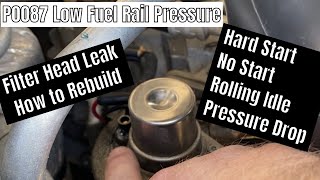
✅ What actually fixed it The fuel filter head primer pump was leaking, allowing air to be sucked into the fuel system, causing a loss of prime. When the primer was pushed, fuel could be seen bubbling out from the shaft seal. The problem was solved by rebuilding the entire fuel filter head assembly with a $20 seal and o-ring kit. - DuramaxDiesels.com forum user (2008 LMM Duramax) — P0087 code, rapid drop in fuel filter life percentage on the DIC.
❌ Tried (didn't work) Replacing the fuel filter., Squeezing the partially collapsed fuel line near the valve cover back into shape.
✅ What actually fixed it The issue was confirmed to be collapsed fuel lines, a known problem addressed by a GM service letter (PIP4526). The fix involves replacing the soft sections of the fuel supply line near the engine and transmission with a more robust hose (e.g., Parker 100R3 spec hose) and securing them with hose clamps instead of the factory crimps.
OEM Part Supersession History
GM 97369850→Bosch 0928400653 (also listed as 1465ZS0058)— This is the Fuel Pressure Regulator (FPR/MPROP) on the CP3 pump. Bosch is the original equipment manufacturer.
Heads up: While listed for LLY engines, this part is also commonly used and referenced for the LMM as they share the same CP3 pump design. Always verify fitment with the specific vehicle VIN, but Bosch is the trusted OEM brand.GM 97371618→No common supersession. This remains the standard GM part number.— This is the Fuel Pressure Relief Valve (FPRV) located on the fuel rail.
Heads up: This is a genuine GM part. Aftermarket 'race plugs' exist to block this valve off entirely, but they remove a system safety feature.
Helpful Videos
We Have This Part in Stock


The information in this article is provided for general reference and educational purposes only. Vehicle specifications, procedures, and part compatibility can vary by production date, trim level, and region. Always consult your vehicle's factory service manual and verify part numbers before purchasing or performing repairs. Safety-critical components such as airbags, seat belts, and braking systems should be installed by a qualified professional.
- Gmc SIERRA 2500:
- 🎬 Helpful Videos
- 🛍️ Shop This Part
- What's Unique About the 2010-2010 Gmc SIERRA 2500
- Diagnostic Flowchart
- Symptoms You May Notice
- Most Likely Causes
- Rare But Worth Checking
- Diagnosis Steps
- Parts You'll Likely Need
- Related Codes That Often Appear With This One
- Technical Service Bulletins (TSBs) & Recalls
- Platform-Specific Known Issues
- Mechanic-Grade Diagnostic Values
- Scan Tool Commands That Help
- Wiring & Ground Locations
- Real Owner Repair Stories
- OEM Part Supersession History
- 🎟️ Get 5% Off