

P0087 on 2010-2014 GMC Sierra: Fuel Pressure Too Low Causes and Fixes
For 2010-2013 models, P0087 is often caused by a corroded Fuel Pump Driver Module (FPDM) above the spare tire. For 2014 models with direct injection, the high-pressure fuel pump (HPFP) is a common failure point. Always check the FPDM and low-pressure system first to avoid misdiagnosis.
- For a 2010-2013 Sierra, the first part to inspect for P0087 is the Fuel Pump Driver Module (FPDM) on the frame for corrosion.
- For a 2014 Sierra, the High-Pressure Fuel Pump (HPFP) is a primary suspect, but always test the low-pressure system first to avoid misdiagnosis.
- Cold weather (below 20°F / -6°C) can trigger this code, often pointing to a weak in-tank fuel pump, as noted in a GM TSB.
- Do not drive the vehicle extensively. A sudden stall is a safety risk, and a failing HPFP on 2014 models can cause catastrophic engine damage by leaking fuel into the oil.
What's Unique About the 2010-2014 Gmc SIERRA
The 2010-2014 GMC Sierra spans two distinct generations with different fuel systems, which is critical for diagnosing P0087. The 2010-2013 models (GMT900 platform) use a standard port injection system where a corroded, frame-mounted Fuel Pump Driver Module (FPDM) is a very common point of failure. The 2014 model year introduced the K2XX platform with new direct-injected EcoTec3 engines. These engines have a more complex system with both a low-pressure in-tank pump and a high-pressure fuel pump (HPFP) on the engine, making the HPFP a primary suspect for this code on 2014 trucks.
Diagnostic Flowchart
Tap your situation to follow the diagnostic path that matches what you're seeing on this vehicle.
Generation note: This range covers the second generation (GMT900, 2010-2013) and the first year of the third generation (K2XX, 2014). The GMT900 trucks use a single low-pressure fuel system controlled by a Fuel Pump Driver Module (FPDM). The K2XX trucks introduced direct injection, which uses both a low-pressure and a high-pressure fuel system, adding the high-pressure fuel pump (HPFP) as a potential cause.
Symptoms You May Notice
- Reduced engine power or 'limp mode'
- Engine hesitation or stumbling during acceleration
- Rough idle
- Hard starting or no-start condition.
- Stalling, especially under load.
- Check Engine Light illuminated
- Strong fuel smell from engine oil (2014 models).
- Replacing the in-tank fuel pump when the corroded Fuel Pump Driver Module (FPDM) was the actual problem (2010-2013 models).
- Replacing the expensive High-Pressure Fuel Pump (HPFP) when the cheaper in-tank low-pressure pump was failing to supply it with enough fuel (2014 models).
- Replacing the HPFP when the fuel rail pressure sensor was sending faulty readings.
Most Likely Causes
- Corroded/Failed Fuel Pump Driver Module (FPDM) 🔴 High Probability On 2010-2013 models, the FPDM is mounted on the frame rail above the spare tire, making it highly vulnerable to corrosion from road salt and moisture, which damages the module and its connector.
How to confirm: Visually inspect the module and its connector for heavy corrosion, swelling, or physical damage. Check for power (Pin 32, Red/White) and ground (Pin 1, Black) at the connector. If power and ground are good but the pump is inoperative or pressure is low, the module is the likely culprit.
Typical fix: Replace the Fuel Pump Driver Module. The OEM part often requires programming by a dealer, but many aftermarket modules are pre-programmed. If the connector is corroded, it should be replaced as well.
Est. part cost: $75-$200 - Failing High-Pressure Fuel Pump (HPFP) 🔴 High Probability Applies to 2014 models with direct injection. The HPFP is a mechanical pump driven by the camshaft and is a common wear item on EcoTec3 engines.
How to confirm: Use a scan tool to monitor desired vs. actual fuel rail pressure. If low-side pressure is good but high-side pressure drops significantly under load, the HPFP is suspect. A definitive sign of failure is a strong gasoline smell in the engine oil, which indicates a failed internal seal.
Typical fix: Replacement of the high-pressure fuel pump. The intake manifold must be removed for access on V8 engines. 🎬 See this walkthrough for replacing the high-pressure fuel pump. An oil change is highly recommended to remove contaminated oil.
Est. part cost: $300-$700 - Failing In-Tank (Low-Pressure) Fuel Pump 🟡 Medium Probability TSB #18-NA-103 notes that the in-tank pump can perform poorly in cold temperatures (below 20°F / -6°C), causing P0087 and a variety of symptoms including no-start or stalling. General wear can also cause failure across all years.
How to confirm: Connect a fuel pressure gauge to the low-pressure system's Schrader valve. If pressure is below specification (typically 50-65 PSI) at idle, and the FPDM (on 2010-2013 models) is known to be good, the pump is likely failing.
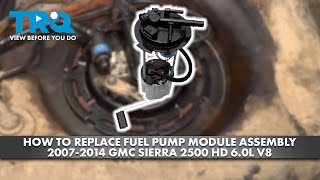
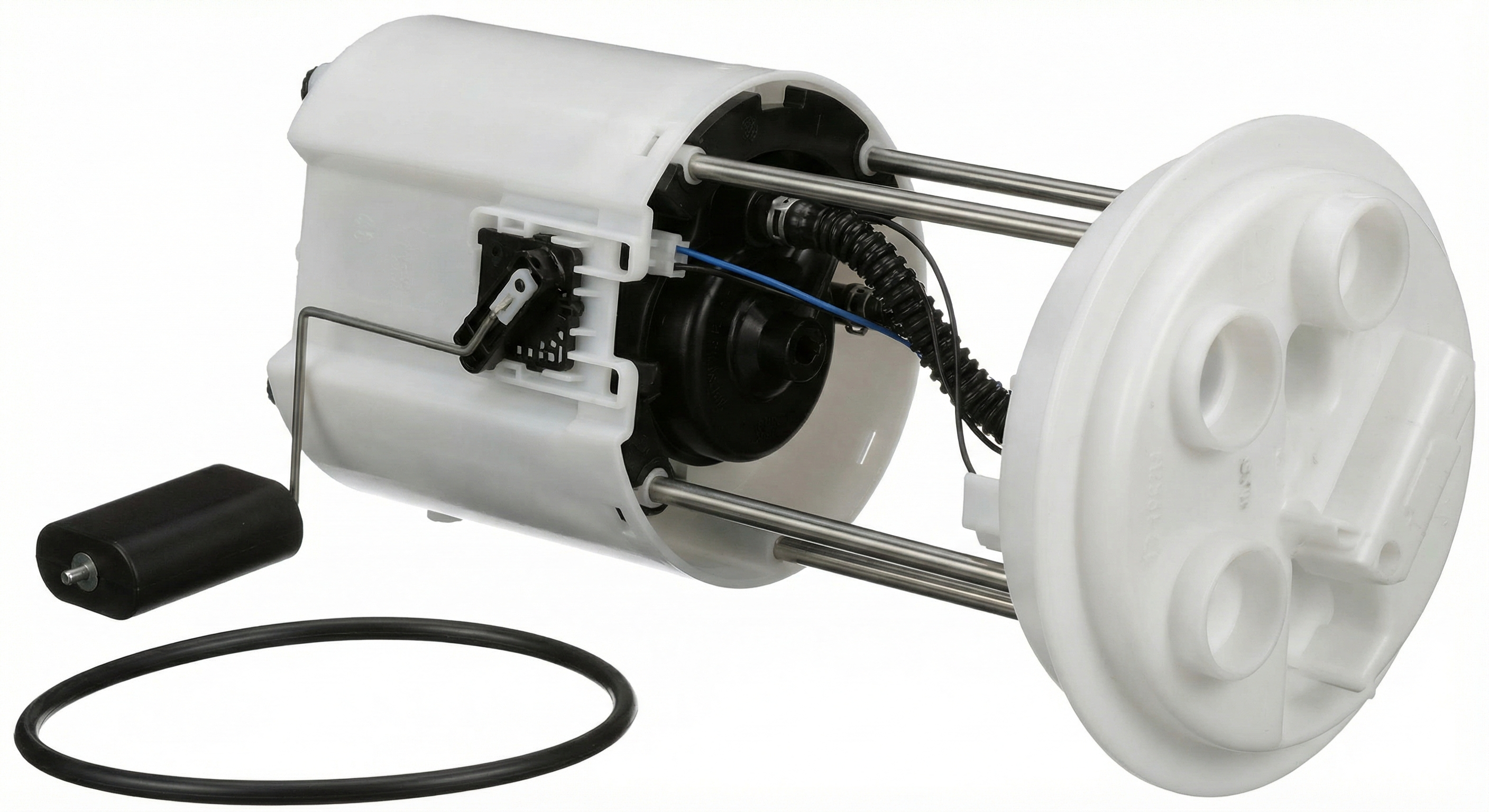
Typical fix: Replace the in-tank fuel pump module. This requires lowering or removing the fuel tank. 🎬 Watch: Step-by-step guide to replacing the in-tank fuel pump.
Est. part cost: $200-$500 - Clogged Fuel Filter ⚪ Low Probability The fuel filter is integrated into the fuel pump module inside the tank and is not a separately serviceable item on these trucks. While contamination from poor quality fuel can clog it, as noted in TSB #PIP5151A, it's less common than pump or module failure.
How to confirm: This is typically confirmed by a failed low-pressure fuel test. Since the filter is part of the pump assembly, a clogged filter necessitates replacing the entire module.
Typical fix: Replace the entire in-tank fuel pump module.
Est. part cost: $200-$500 (for the entire module) - Faulty Fuel Rail Pressure Sensor ⚪ Low Probability Sensors can fail electronically, sending incorrect low-pressure readings to the ECM. TSB #20-NA-197 mentions that corrosion at the sensor connector can cause this code on some GM vehicles.
How to confirm: With a scan tool, compare the sensor's pressure reading to a reading from a mechanical fuel pressure gauge (on the low-pressure side). If the readings differ significantly, the sensor is likely faulty. Inspect the connector for corrosion.
Typical fix: Replace the fuel rail pressure sensor. On 2014 models, the low-pressure sensor is located on the fuel line under the driver's door area.
Est. part cost: $50-$150
Rare But Worth Checking
- Fuel System Contamination: As mentioned in TSB #PIP5151A, significant debris, water, or even Diesel Exhaust Fluid (DEF) in the fuel tank can clog the pump and lines, requiring a full system cleaning or replacement.
- Worn Camshaft Lobe: On 2014 models, the HPFP is driven by a lobe on the camshaft. If this lobe or the pump's follower wears down, it cannot properly actuate the pump, leading to low pressure. This is a known issue on high-mileage EcoTec3 engines and should be inspected when replacing the HPFP.
Diagnosis Steps
- Check for other DTCs that could provide more specific information (e.g., P0191 for a sensor, P2635 for the low-pressure pump, P069E for the FPDM).
- Use a scan tool to view live data for 'Desired Fuel Rail Pressure' and 'Actual Fuel Rail Pressure'. Observe the actual pressure at idle and during a short test drive (if safe).
- For 2010-2013 models: Locate the Fuel Pump Driver Module (FPDM) on the frame crossmember, above the spare tire. Thoroughly inspect the module and its electrical connector for signs of corrosion, swelling, or physical damage. This is the most common failure point.
- For all models: Connect a mechanical fuel pressure gauge to the low-pressure fuel system. Check the pressure at idle. It should be stable and within the manufacturer's specification (typically 50-65 PSI). If low, the problem lies with the FPDM (2010-13), in-tank pump, or a clogged filter.
- For 2014 models: If low-side pressure from Step 4 is good, but the scan tool shows actual high-side pressure dropping under load, the High-Pressure Fuel Pump (HPFP) is the primary suspect.
- For 2014 models: Before replacing the HPFP, carefully check the engine oil on the dipstick for a strong smell of gasoline. A fuel smell confirms the HPFP has an internal leak and must be replaced. Also inspect the camshaft lobe for wear when the pump is removed.
- If scan tool data for the fuel pressure sensor seems erratic or doesn't match mechanical gauge readings, inspect the sensor and its wiring for damage or corrosion before replacing it.
- Inspect fuel lines for any visible kinks or damage that could restrict flow.
Parts You'll Likely Need
- Fuel Pump Driver Module (FPDM/FSCM)
(OEM #20850907 (superseded by other numbers like 23487338))— The most common cause of P0087 on 2010-2013 models due to its exposed location on the frame leading to corrosion. OEM part may require programming.
Trusted brands: ACDelco, Dorman, Standard Motor Products
OEM price range: $110-$150
Aftermarket price range: $70-$120 - High-Pressure Fuel Pump (HPFP)
(OEM #12641847)— A primary cause of P0087 on the direct-injected 2014 models. It is a mechanical wear item located on the engine.
Trusted brands: ACDelco, Bosch
OEM price range: $300-$500
Aftermarket price range: $200-$400
Related Codes That Often Appear With This One
- P0088 — Fuel Rail/System Pressure - Too High. Can appear with P0087 if the pressure is erratic due to a failing sensor or a faulty regulator within the HPFP.
- P0191 — Fuel Rail Pressure Sensor Circuit Range/Performance. This points more directly to the sensor or its wiring as a potential root cause for the P0087 reading.
- P2635 — Fuel Pump 'A' Low Flow/Performance. This code is specific to the low-pressure pump and is cited alongside P0087 in TSB #18-NA-103 for cold weather issues.
- P069E — Fuel Pump Control Module Requested MIL Illumination. This code directly implicates the FPDM and is a strong indicator that the module itself has detected a fault and commanded the check engine light on.
Technical Service Bulletins (TSBs) & Recalls
- 18-NA-103: Details issues with the in-tank fuel pump's performance in cold weather (below 20°F / -6°C) leading to P0087.
- PIP5151A: Discusses how fuel system contamination can cause P0087, P0088, and other codes, potentially requiring a full system flush.
- 20-NA-197: Mentions that corrosion at the fuel rail pressure sensor connector can be a cause for fuel pressure codes.
Platform-Specific Known Issues
- The FPDM Corrosion Epidemic (2010-2013): The location of the Fuel Pump Driver Module on the GMT900 frame, directly in the path of road spray from the tires and above the spare tire which can trap moisture, is a significant design flaw. Owners in the salt belt report this as an almost guaranteed failure. Many forums recommend applying dielectric grease or a protective coating to new modules to prolong their life.
- Cold Weather Woes (2014): TSB 18-NA-103 specifically calls out poor performance of the low-pressure fuel pump in cold weather on 2014+ models. Owners report that the truck may start and stall, or fail to start entirely, only when temperatures drop below freezing, pointing directly to a weak in-tank pump that cannot supply the HPFP.
Mechanic-Grade Diagnostic Values
- Low-Pressure Fuel System (All Years) — expected: 50-70 PSI with key on, engine running at idle.. Failure: Pressure is below 50 PSI, is unstable, or drops significantly under load.
- High-Pressure Fuel System at Idle (2014 Models) — expected: Approx. 500-600 PSI.. Failure: Scan tool 'Actual' pressure is significantly below 'Desired' pressure, or is highly erratic.
- High-Pressure Fuel System Under Load (2014 Models) — expected: Actual pressure should closely track desired pressure.. Failure: A drop of over 1000 PSI between 'Desired' and 'Actual' pressure during acceleration strongly suggests a failing HPFP.
- FPDM Connector Voltage Test (2010-2013 Models) — expected: Key On: 12V+ at Pin 32 (Red/White), good ground at Pin 1 (Black), and a 12V signal at Pin 13 (Dark Green/White) that may be constant, last 3-6 seconds, or appear only during cranking.. Failure: Absence of voltage at Pin 32 points to a fuse/power issue. Absence of a signal at Pin 13 points to a PCM or wiring issue.
Hidden / Shadow Codes Worth Checking
- P069E: Fuel Pump Control Module Requested MIL Illumination. This is not a direct performance code but an informational one, where the FPDM has performed its own internal diagnostics, found a fault, and commanded the main ECM to turn on the Check Engine Light. It strongly points to the FPDM itself or its direct wiring/power supply as the root cause. (see via Most standard OBD-II scanners can read this code. Professional scanners like the GM GDS2 or Tech2 may offer more detailed fault data from the module.)
Scan Tool Commands That Help
- GM GDS2 / Tech2 or equivalent professional scanner: Fuel Pump Relay Command / Fuel Pump On/Off Test — Use this bidirectional command to manually turn the fuel pump on and off. If the pump runs when commanded by the scan tool, it confirms the pump itself is functional and the problem likely lies in the control side (FPDM, wiring, or ECM). If the pump does not run, it points to a failed pump or a break in the power/ground circuit between the FPDM and the pump.
- GM GDS2 / Tech2 or equivalent professional scanner: Fuel Pressure Control / Commanded Fuel Rail Pressure — For 2014 models, a technician can command maximum rail pressure at idle. If the high-pressure pump cannot achieve or maintain the commanded pressure even under no-load conditions, it strongly indicates a weak or failing HPFP.
Wiring & Ground Locations
- FPDM Connector — On 2010-2013 models, it's located on the frame crossmember, directly above the spare tire.. This is the central connection for the low-pressure fuel system. Its exposed location makes it the most common point of failure due to corrosion, causing a loss of power or signal to the fuel pump.
- Fuel Pump Ground — On GMT900 trucks, a primary ground for the fuel pump circuit is located on the outside of the driver-side frame rail, typically near the wheel well.. Corrosion at this single point can cause intermittent or total fuel pump failure, mimicking a bad pump or FPDM. Cleaning this ground connection is a critical and often overlooked diagnostic step.
- G404 — Mounted on the fuel filler neck.. This ground is for the fuel filler neck assembly. While not the primary operational ground for the pump, a poor connection here can cause other system issues and is part of the overall fuel system's electrical health.
- FPDM Connector Pinout (2010-2013) — At the FPDM module connector.. Knowing the specific pin functions allows for precise testing. Pin 32 (Red/White) is battery power in, Pin 1 (Black) is ground, Pin 13 (Dark Green/White) is the command signal from the ECM, and Pin 47 (Grey) is the modulated voltage out to the fuel pump.
Real Owner Repair Stories
- Reddit user in r/gmcsierra (2023 GMC Sierra 3.0L Diesel (Principle applies to cold weather HPFP issues)) — P0087 and P228B codes, but only in cold weather (below 30°F). Engine would sputter and go into reduced acceleration mode.
❌ Tried (didn't work) Using anti-gelling fuel additive, Replacing the fuel filter, Replacing the entire fuel rail
✅ What actually fixed it The dealership replaced the high-pressure fuel pump, which resolved the cold-weather-specific fuel pressure drop. - Owner story documented by Go-Parts.com (2010-2014 Silverado/Sierra) — Intermittent 'Reduced Engine Power' message and stalling, especially when hitting bumps.
❌ Tried (didn't work) Multiple unspecified repair attempts that failed to find the cause.
✅ What actually fixed it A corroded and broken ground wire located on the passenger side of the intake manifold. Wiggling the wire would cause the fuel pump relay to click. Re-securing this ground point permanently fixed the issue.
"I Checked Everything" — The Actual Cause
- In cases where P0087 appears intermittently, especially when driving over bumps, and all fuel pressure tests seem normal, the root cause can be a faulty ground connection. An owner experienced intermittent stalling that was finally traced to a broken ground wire on the intake manifold. Standard diagnostic procedures like pressure tests or smoke tests would not identify this type of electrical fault, which perfectly mimics a failing FPDM or fuel pump.
When the Usual Fixes Don't Work
- While the FPDM is the most common cause on 2010-2013 models, do not overlook basic electrical issues. One owner chased an intermittent stalling issue with P0087, which was ultimately fixed by repairing a broken engine ground wire, not by replacing the FPDM or fuel pump.
- On 2014 models, even if symptoms point strongly to the HPFP (especially in cold weather), diagnosis can be tricky. One owner reported their dealership first replaced the fuel rail, which did not solve the problem. The issue was only resolved after the HPFP itself was replaced, confirming that even when the cause is common, misdiagnosis by replacing related components first is also common.
OEM Part Supersession History
20850907 (FPDM)→Multiple numbers, including 23487338.— GM has updated the Fuel Pump Driver Module several times for reliability.
Heads up: The original part number 20850907 and its many predecessors (e.g., 25967325, 20759945) are replaced by a single modern part. Ensure the replacement is listed as compatible with the specific year, as programming may be required.12639694 (HPFP)→12641847— Revisions to the high-pressure fuel pump design for the direct injection engines.
Heads up: Part number 12641847 for the 2014 Sierra replaces several older part numbers, including 12639694 and 12633115. Using the latest superseded part number is critical for reliability.
Model Year Variations Within This Range
- 2010-2013 (GMT900): These models use a returnless low-pressure port injection system. The most common cause of P0087 is the corrosion-prone Fuel Pump Driver Module (FPDM) located above the spare tire. Diagnosis should start here.
- 2014 (K2XX): This model year introduced direct injection (EcoTec3), adding a camshaft-driven High-Pressure Fuel Pump (HPFP) to the system. The HPFP is a primary suspect for P0087 on these trucks, a component that does not exist on the earlier models.
Helpful Videos
Used OEM Parts in Stock
New Aftermarket Parts Available


The information in this article is provided for general reference and educational purposes only. Vehicle specifications, procedures, and part compatibility can vary by production date, trim level, and region. Always consult your vehicle's factory service manual and verify part numbers before purchasing or performing repairs. Safety-critical components such as airbags, seat belts, and braking systems should be installed by a qualified professional.
- Gmc SIERRA:
- 🎬 Helpful Videos
- 🛍️ Shop This Part
- What's Unique About the 2010-2014 Gmc SIERRA
- Diagnostic Flowchart
- Symptoms You May Notice
- Most Likely Causes
- Rare But Worth Checking
- Diagnosis Steps
- Parts You'll Likely Need
- Related Codes That Often Appear With This One
- Technical Service Bulletins (TSBs) & Recalls
- Platform-Specific Known Issues
- Mechanic-Grade Diagnostic Values
- Hidden / Shadow Codes Worth Checking
- Scan Tool Commands That Help
- Wiring & Ground Locations
- Real Owner Repair Stories
- "I Checked Everything" — The Actual Cause
- When the Usual Fixes Don't Work
- OEM Part Supersession History
- Model Year Variations Within This Range
- 🎟️ Get 5% Off