

P0087 on 2017-2021 Ford F-450 SD 6.7L Power Stroke: Low Fuel Pressure Causes & Fixes
On a 2017-2021 F-450 with the 6.7L Power Stroke, P0087 most often means you have clogged fuel filters. Replacing both the engine-mounted and frame-mounted fuel filters is the first and most common fix. In cold weather, gelled fuel can also be the cause. If the code appears under load after filter replacement, it may be an early warning of a failing high-pressure fuel pump (CP4).
- Always start with the simplest and most common fixes: ensure the fuel tank isn't empty and replace the fuel filters if their age is unknown or past due.
- In cold weather, P0087 is very likely caused by gelled diesel fuel. Try moving the truck to a warm place and use an anti-gel additive.
- A whining noise from the fuel pump area often indicates air in the system, frequently caused by an incorrectly installed frame-mounted fuel filter.
- If you find metal shavings ('glitter') in your fuel filter bowl, stop driving immediately. This is a sign of a catastrophic high-pressure fuel pump failure, and continuing to run the engine will cause more expensive damage.
- Always use high-quality, preferably Motorcraft, fuel filters. The fuel system on the 6.7L Power Stroke is sensitive, and poorly fitting aftermarket filters can cause air leaks and inadequate filtration.
What's Unique About the 2017-2021 Ford F-450 SD

The 6.7L Power Stroke uses a sophisticated common-rail fuel injection system with two fuel pumps: a low-pressure lift pump and a high-pressure injection pump (the Bosch CP4.2). While this system delivers excellent power, it is highly sensitive to fuel quality and filtration. Ford has issued Technical Service Bulletins (TSBs) specifically mentioning that P0087 can be triggered by simple issues like a low fuel level or fuel gelling in cold temperatures, before more complex mechanical failures are considered. The CP4.2 high-pressure pump is a known weak point; its failure can be catastrophic, sending metal debris throughout the entire fuel system. For the 2020 model year, Ford introduced a new, higher-pressure fuel system (36,000 PSI vs 30,000 PSI) with an updated high-pressure pump and moved the lift pump into the fuel tank.
Diagnostic Flowchart

Tap your situation to follow the diagnostic path that matches what you're seeing on this vehicle.
Symptoms You May Notice
- Reduced engine power or 'limp mode'
- Check engine light is on
- Hard starting or long crank times
- Rough running or rough idle
- Lack of power, especially under load, when towing, or accelerating up a grade
- Engine stalling
- Whining or grinding noise from the engine bay, particularly the high-pressure fuel pump area
- Loud whining or buzzing from the driver's side frame rail, indicating a struggling low-pressure pump
- Replacing the high-pressure pump (CP4) before checking fuel filters. Clogged filters are a far more common and cheaper fix.
- Replacing fuel injectors. While injectors can be damaged by a failing CP4 pump, they are rarely the root cause of a P0087 code on their own.
- Ignoring aftermarket modifications. Aggressive ECU tunes can sometimes command fuel pressures outside of the stock system's capabilities, triggering the code under specific load conditions.
Most Likely Causes

- Clogged Fuel Filters 🔴 High Probability The 6.7L Power Stroke has two fuel filters (an engine-mounted secondary filter and a frame-mounted primary filter/water separator) that must be changed regularly (every 15,000-22,500 miles, or more often in severe conditions). They are designed to protect the sensitive high-pressure system, and when they become restricted, fuel flow drops, causing low pressure.
How to confirm: Check the vehicle's service history. If the filters haven't been changed in the last 15,000 miles or their age is unknown, they are the prime suspect. A visual inspection of the old filter media may show excessive dirt or debris. Using non-OEM filters is a common cause of issues due to improper fitment allowing air leaks.
Typical fix: Replace both the engine-mounted and frame-mounted fuel filters with a new Motorcraft filter kit. 🎬 Watch: Step-by-step guide to changing your fuel filters correctly. After replacement, the system must be primed correctly by cycling the key on-off 10-12 times for 15-20 seconds each cycle to purge all air.
Est. part cost: $70-$100 - Fuel Gelling in Cold Weather 🔴 High Probability As noted in multiple Ford TSBs, diesel fuel (especially biodiesel blends) can thicken and turn waxy (gel) in cold ambient temperatures, restricting its flow through fuel lines and filters. This is a common cause for P0087 in winter months.
How to confirm: The issue occurs primarily or exclusively in cold weather, often below -10°F (-23°C). The truck may run fine after it has been warmed up in a garage.
Typical fix: Move the vehicle to a warmer location to allow the fuel to liquefy. Use a quality diesel anti-gel additive, like Motorcraft PM-23-A, in the fuel tank during cold months to prevent reoccurrence.
Est. part cost: $10-$25 for additive - Failing Low-Pressure Fuel Pump (Lift Pump/DFCM) 🟡 Medium Probability The frame-mounted lift pump, also known as the Diesel Fuel Conditioning Module (DFCM), is responsible for supplying fuel from the tank to the high-pressure pump. If this electric pump weakens, it cannot provide adequate volume, starving the high-pressure side. A loud whining noise from the driver's side frame rail is a classic symptom. For 2020+ models, this pump was moved into the fuel tank.
How to confirm: Use a scan tool to monitor the low-pressure fuel sensor reading (PID: LP_PRESS). The pressure should be stable and within spec (typically 55-65 PSI). A reading that drops below 52 PSI can trigger the low-pressure warning. A physical pressure gauge can also be connected to verify pressure 🎬 See how to diagnose low pressure on the lift pump. from the lift pump.
Typical fix: Replace the low-pressure fuel pump/DFCM assembly. Ensure no air is being introduced from the tank or sending unit.
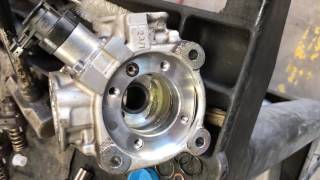
Est. part cost: $550-$650 - Failing High-Pressure Fuel Pump (HPFP / CP4) ⚪ Low Probability The Bosch CP4.2 high-pressure pump is a known potential failure point. Internal wear, often due to lack of lubrication from ultra-low sulfur diesel, air intrusion, or contamination, can cause it to fail to generate the required 20,000+ PSI. When it fails catastrophically, it sends metal debris ('glitter' or 'disco party') throughout the entire fuel system, leading to a very expensive repair.
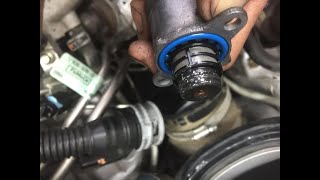
How to confirm: After ruling out filters and the lift pump, check for metal shavings in the fuel filter bowl or on the screen of the fuel volume control valve (on the CP4 pump). A high-pressure system test with a diagnostic scan tool may show that actual pressure cannot meet the desired pressure under load. This code appearing specifically during hard acceleration or towing is a classic early warning sign.
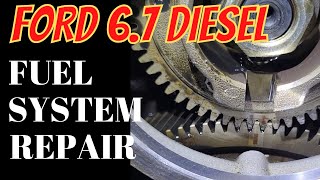
Typical fix: If metal debris is found, a full fuel system replacement is required. 🎬 Watch: What a complete fuel system replacement looks like. This includes the CP4 pump, all 8 fuel injectors, fuel rails, and all high-pressure lines, plus cleaning the tank and low-pressure lines. If no metal is present, only the CP4 pump may need replacement. Many owners proactively install a 'CP4 Disaster Prevention Kit' which reroutes pump return fuel to prevent contamination of the rest of the system in case of failure.
Est. part cost: $1,000-$2,500 for the pump; $8,000-$17,000 for a full system contamination kit and labor.
Rare But Worth Checking
- Low Fuel Level: Ford TSB SSM 49064 explicitly states that a low fuel level (under 1/4 tank) can cause this code, likely by allowing the pump to draw in air, especially on inclines or during acceleration. Always ensure the tank has adequate fuel before beginning complex diagnostics.
- Faulty Fuel Rail Pressure (FRP) Sensor: While less common than a mechanical fault, the sensor that reads the pressure can fail and send an inaccurate low reading to the PCM. This is usually diagnosed after confirming the mechanical parts of the fuel system are working correctly by comparing scan tool readings to a mechanical gauge.
- Air in the Fuel System: An improperly installed fuel filter (especially the lower frame-mounted one with a rolled or missing O-ring) can allow air to be drawn into the system, causing the lift pump to whine and leading to low pressure codes. This can also happen after running out of fuel or if there's a crack in a fuel line.
- Contaminated Fuel: Water, dirt, or even Diesel Exhaust Fluid (DEF) accidentally added to the fuel tank can cause immediate and severe damage to the entire fuel system, triggering P0087. In one documented case, a truck on a farm had dirt put in the fuel tank, which clogged the pump pickup and caused this code.
Diagnosis Steps
- Verify the fuel level in the tank is not critically low (ideally above 1/4 tank).
- Note the ambient temperature. If it is below freezing, consider fuel gelling as a primary cause.
- Using a compatible OBD-II scanner, check for other accompanying codes, especially P008A.
- Check the maintenance history for the last fuel filter change. If due or unknown, replace both fuel filters with genuine Motorcraft parts. Inspect the old fuel in the filter housing for signs of metal shavings ('glitter').
- After replacing filters, properly prime the fuel system by cycling the key-on/key-off 10-12 times for 15-20 seconds each to run the electric lift pump and purge any air.
- If the code returns, use a scan tool to monitor PIDs for Desired Fuel Rail Pressure (FRP_DSD), Actual Fuel Rail Pressure (FRP), and Low-Side Fuel Pressure (LP_PRESS). Compare the readings at idle and under a heavy load (e.g., accelerating up a hill).
- If low-side pressure (LP_PRESS) is below specification (e.g., under 55 PSI), test the low-pressure fuel pump (DFCM) and check for air intrusion in the supply lines.
- If low-side pressure is good but high-side pressure (FRP) drops significantly below desired (FRP_DSD) under load, inspect the high-pressure pump (CP4) and fuel volume control valve for issues. If no metal is found, suspect the Fuel Rail Pressure Control Valve (PCV) on the fuel rail itself.
Parts You'll Likely Need
- Fuel Filter Kit
(OEM #PC3Z-9N184-C (Motorcraft FD-4647))— This is the most frequent cause of P0087. The 6.7L Power Stroke requires regular filter changes to protect the high-pressure fuel system. This kit includes both the engine-mounted and frame-mounted filters. This part number supersedes FD-4641, FD-4624, and others.
Trusted brands: Motorcraft
OEM price range: $70-$100 - High-Pressure Fuel Pump (CP4)
(OEM #FC3Z-9A543-A (Bosch))— The CP4 pump is a common failure point that causes P0087, especially when it appears under load. If it fails and contaminates the system, a full contamination kit is needed.
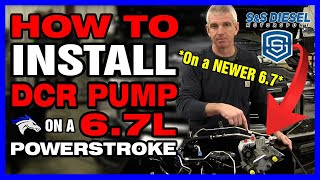
Trusted brands: Bosch (OEM), S&S Diesel Motorsport (DCR Conversion)
OEM price range: $1000-$2500 - Low-Pressure Fuel Pump (DFCM)
(OEM #BC3Z-9G282-E (and preceding versions))— If low-side fuel pressure is confirmed to be low, the frame-mounted lift pump is the likely culprit.
Trusted brands: Motorcraft
OEM price range: $550-$650 - CP4 Disaster Prevention Kit — An aftermarket preventative part. If the CP4 pump fails, this kit reroutes the metal debris away from the injectors and rails, saving thousands in repair costs by limiting the damage to just the pump itself.
Trusted brands: S&S Diesel Motorsport, XDP
OEM price range: $350-$500
Related Codes That Often Appear With This One
- P008A — This code for 'Low Pressure Fuel System Pressure - Too Low' specifically points to the lift pump side. Ford TSBs SSM 49064, SSM 50448, and SSM 49062 all mention that P0087 and P008A often appear together, indicating the issue originates in the low-pressure system.
- P2291 — This code means 'Injector Control Pressure Too Low - Engine Cranking.' It often appears with P0087 during a no-start condition, indicating the high-pressure system isn't building enough pressure to fire the injectors.
Technical Service Bulletins (TSBs) & Recalls
- SSM 49064: States that P0087 and P008A can be caused by a low fuel level.
- SSM 50448: Links P0087 and P008A to hard starts, lack of power, and rough running, potentially caused by low fuel level or fuel gelling in cold weather.
- SSM 49062: Repeats the guidance of SSM 50448, advising technicians to consider fuel gelling (especially with biodiesel) and low fuel levels as primary causes before extensive diagnostics. It notes that repairs for these conditions are not covered under warranty.
Platform-Specific Known Issues
- Fuel Gelling TSBs: Bulletins SSM 49062 and SSM 50448 directly address that P0087 can be caused by fuel gelling in cold weather, leading to hard starts and lack of power.
- Low Fuel Level TSB: Bulletin SSM 49064 notes that simply having a low fuel level can trigger P0087, likely from the pump ingesting air.
- CP4.2 Pump Failure: The Bosch CP4.2 high-pressure fuel pump used on these engines has a reputation for failing without warning. When it does, it often sends metal fragments through the entire high-pressure fuel system, necessitating a complete system replacement that can cost over $10,000.
Mechanic-Grade Diagnostic Values
- Low-Pressure Fuel System (Lift Pump) — expected: 53-73 PSI. A warning may trigger if pressure drops below 52-58 PSI.. Failure: Pressure consistently below 52 PSI, or dropping significantly under load.
- High-Pressure Fuel System Cranking — expected: Must achieve at least 5,000 PSI for injectors to fire.. Failure: Scan tool shows actual pressure not meeting desired pressure during crank.
- High-Pressure Fuel System (2017-2019 Models) — expected: Idle: ~4,400 PSI. Cruising: ~18,000 PSI. WOT: 28,000-30,000 PSI.. Failure: Actual pressure (FRP PID) fails to meet desired pressure (FRP_DSD PID) during hard acceleration or towing.
- High-Pressure Fuel System (2020-2021 Models) — expected: Maximum pressure capability increased to 36,000 PSI (2,482 BAR).. Failure: Fails to meet the higher commanded pressures of the Gen 3 engine under load.
- Fuel Injector Return Flow — expected: Ford does not provide a spec, but a common rule of thumb (from GM) is less than 3 ml in 15 seconds at idle.. Failure: A single injector returning significantly more fuel than the others, indicating an internal leak.
Scan Tool Commands That Help
- Ford IDS / FORScan: Monitor PID: LP_FUEL_SW (MODE) — To check the status of the low-pressure fuel switch on pre-2015 models, which is a simple low/not low indicator.
- Ford IDS / FORScan: Monitor PIDs: FRP (Actual Pressure) vs. FRP_A_CMD / FRP_DSD (Desired Pressure) — This is the primary diagnostic for P0087. Watch these PIDs during a power-brake test or hard acceleration to see if the actual pressure can keep up with the commanded pressure. A large deviation indicates a problem.
- Ford IDS / FORScan: Bidirectional Control: FPL_CMD (MODE) to ON/OFF — To manually command the low-pressure lift pump on (KOEO) to check its operation, listen for noise, and verify low-side pressure with a mechanical gauge without the engine running.
- Ford IDS / FORScan: Bidirectional Control: F_VCV (PER) and F_PCV (PER) — These commands control the duty cycle of the Fuel Volume Control Valve (on the HPFP) and the Fuel Pressure Control Valve (on the rail). They are used in advanced pinpoint tests (like Ford's Test M16/M17) to isolate a faulty valve by commanding it to specific states and measuring the effect on pressure or return flow.
Wiring & Ground Locations
- G400 — On the left side frame rail, in the vicinity of the fuel tank.. This is a major grounding point for the fuel pump and rear lighting on many Ford trucks. A corroded or loose G400 ground can cause intermittent or weak fuel pump operation, leading to low pressure codes.
- Fuel Pump Relay Power Wire — In the engine compartment fuse box, connected to the fuel pump relay.. This wire, often purple with a green stripe, can overheat at the fuse box connection, causing a high-resistance point that reduces voltage to the fuel pump, leading to low flow and pressure.
Real Owner Repair Stories
- Ford Truck Enthusiasts Forums user (2017 F-250 6.7L) — P0087 and P0093 under load while towing, reduced engine power.
❌ Tried (didn't work) Replacing both fuel filters (this cleared the P0093 code but not P0087)., Replacing the entire low-pressure fuel pump assembly after seeing a momentary pressure drop on scan data.
✅ What actually fixed it Replacing the fuel pressure regulator (PCV) located on the back of the high-pressure fuel rail. - Diesel Technician Society user 'kellyf' (Ford F-550 6.7L (year not specified, but post is from 2014, relevant to early engine design)) — Repeat P0087 code.
❌ Tried (didn't work) Verified fuel filters were clean., Verified low-pressure fuel system was at 62 PSI., Followed Ford's pinpoint test M16, which diagnosed a bad pressure control valve (PCV). Replaced the PCV, but the code returned.
✅ What actually fixed it Replacing the entire driver's side fuel rail. The technician suspected a loose internal part within the rail itself was causing a pressure bleed-off that the diagnostic test incorrectly attributed to the PCV. - YouTube channel 'STP Diesel' (High-mileage 2017+ 6.7L Power Stroke) — P0087 code appearing immediately after upgrading from the stock CP4 high-pressure pump to a more reliable S&S DCR (CP3-style) pump.
❌ Tried (didn't work) Assuming the new DCR pump was faulty.
✅ What actually fixed it Replacing the high-pressure fuel rail. The original fuel pressure regulator on the rail was worn from compensating for the failing CP4 for years. It could not react fast enough to the higher flow of the new DCR pump, causing pressure conflicts and the P0087 code. A new rail with a new regulator solved it.
"I Checked Everything" — The Actual Cause
- A technician reported a case where standard diagnostic tests (PCED Pinpoint Test M16) pointed to a faulty Pressure Control Valve (PCV) on the fuel rail. The valve was replaced, but the P0087 code returned. The actual cause was an internal failure within the fuel rail itself, which was bleeding off pressure. The standard test couldn't differentiate between the valve and the rail, leading to the misdiagnosis.
When the Usual Fixes Don't Work
- While clogged filters and failing pumps are the most common causes, multiple owner and technician reports confirm that P0087 appearing only under heavy load (like towing) after filters have been replaced often points to a failing Fuel Pressure Control Valve (PCV) on the high-pressure rail, or a less common internal failure of the rail itself. In these cases, the low-pressure and high-pressure pumps may be functioning perfectly at idle and during normal driving, passing basic pressure tests. The fault only manifests when maximum fuel flow and pressure are demanded.
Model Year Variations Within This Range
- 2017-2019: Uses the 2nd Generation 6.7L Power Stroke fuel system. Features a 30,000 PSI high-pressure common rail system and a frame-mounted low-pressure pump/filter assembly (DFCM).
- 2020-2021: Introduced the 3rd Generation 6.7L Power Stroke. The fuel system was significantly updated to a 36,000 PSI high-pressure system, requiring a new HPFP, new fuel rails, lines, and injectors. The low-pressure lift pump was moved from the frame rail into the fuel tank. These parts are not interchangeable with earlier models.
Helpful Videos

The information in this article is provided for general reference and educational purposes only. Vehicle specifications, procedures, and part compatibility can vary by production date, trim level, and region. Always consult your vehicle's factory service manual and verify part numbers before purchasing or performing repairs. Safety-critical components such as airbags, seat belts, and braking systems should be installed by a qualified professional.
- Ford F-450 SD:
- 🎬 Helpful Videos
- What's Unique About the 2017-2021 Ford F-450 SD
- Diagnostic Flowchart
- Symptoms You May Notice
- Most Likely Causes
- Rare But Worth Checking
- Diagnosis Steps
- Parts You'll Likely Need
- Related Codes That Often Appear With This One
- Technical Service Bulletins (TSBs) & Recalls
- Platform-Specific Known Issues
- Mechanic-Grade Diagnostic Values
- Scan Tool Commands That Help
- Wiring & Ground Locations
- Real Owner Repair Stories
- "I Checked Everything" — The Actual Cause
- When the Usual Fixes Don't Work
- Model Year Variations Within This Range
- 🎟️ Get 5% Off