

P0087 on 2017-2020 Ford F-150: Low Fuel Pressure Causes and Fixes
P0087 on a 2017-2020 F-150 indicates low pressure in the high-pressure fuel system. The most common causes are a failing high-pressure fuel pump (HPFP) or a fuel jumper line that was installed backward during a previous repair, a mistake specifically noted in Ford service messages. The HPFP can cost between $180 and $450 for the part.
- P0087 means the high-pressure fuel system is not providing enough pressure for the engine.
- Before replacing any parts, especially if recent engine work was done, check the orientation of the fuel jumper line per Ford TSB SSM 50089.
- The most common part failure causing P0087 is the high-pressure fuel pump (HPFP).
- Symptoms include significant power loss, stalling, rough idle, and difficulty starting.
- Driving with this code is a safety risk due to the potential for sudden stalling in traffic.
What's Unique About the 2017-2020 Ford F-150

The 2017-2020 F-150 engines (3.3L, 3.5L EcoBoost, 5.0L) use a sophisticated direct and/or port injection system with both a low-pressure pump in the tank and a high-pressure fuel pump (HPFP) on the engine. A very specific issue on these trucks, identified in Ford Technical Service Bulletins (SSM 50089 and SSM 48807), is that a fuel jumper line can be accidentally installed backward during repairs like injector replacement. This simple mistake, due to a one-way check valve in the line, blocks fuel flow and directly causes the P0087 code, leading to a common misdiagnosis of a failed HPFP.
Diagnostic Flowchart

Tap your situation to follow the diagnostic path that matches what you're seeing on this vehicle.
Symptoms You May Notice
- Check Engine Light is on.
- Loss of power, especially when accelerating or under load.
- Engine hesitation or stumbling.
- Rough idle.
- Engine stalling, sometimes followed by a long crank to restart.
- Difficulty starting or long crank times.
- Reduced fuel economy.
- Auto Start-Stop system shows "not available".
- Strong smell of fuel in the engine bay, which could indicate a dangerous leak.
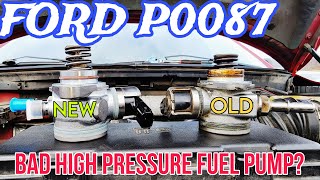
- Replacing the High-Pressure Fuel Pump (HPFP) when the fuel jumper line is simply installed backward. This is a costly mistake that is easily avoided by checking TSB SSM 50089 first. 🎬 Watch: How to identify the backward fuel jumper line issue.
Most Likely Causes

- Incorrectly Installed Fuel Jumper Line 🔴 High Probability This is a known issue documented by Ford in TSBs SSM 50089 and SSM 48807. The line has a one-way check valve and is easily installed backward after engine or injector service. This applies to the 3.3L, 3.5L EcoBoost, and 5.0L engines.
How to confirm: Visually inspect the black fuel jumper line between the high-pressure pump and the port injection rail. The Oetiker clamp (a stainless steel band) should be closest to the port injection rail side. If it's on the other end, the line is backward.
Typical fix: Remove the fuel line and reinstall it in the correct orientation. This is a labor-only fix and requires no new parts.
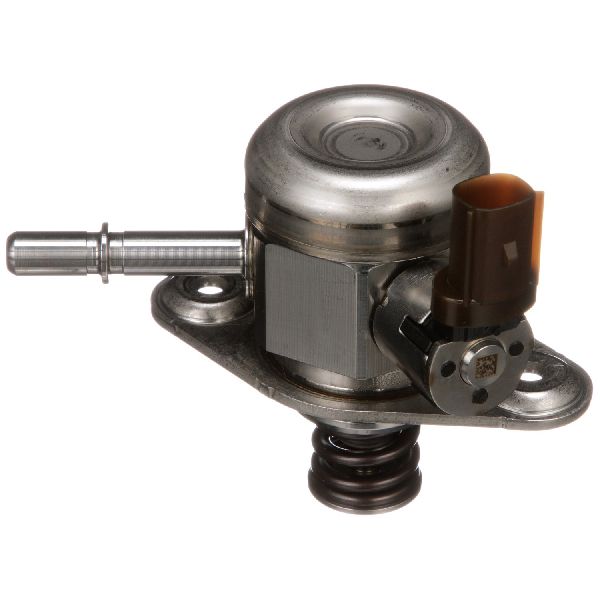
Est. part cost: $0 - Failing High-Pressure Fuel Pump (HPFP) 🔴 High Probability The HPFP is a mechanical pump driven by the camshaft that is known to wear out over time, leading to insufficient pressure. On the 2.7L and 3.5L EcoBoost, and 2018+ 5.0L, it's on the passenger side valve cover. On the 3.3L, it's on the driver's side.
How to confirm: Use a diagnostic scan tool to monitor desired vs. actual fuel rail pressure. If actual pressure is consistently low and the low-pressure system is confirmed to be working correctly (around 55-65 PSI), the HPFP is the likely culprit. 🎬 See how to diagnose a failing high-pressure pump with a scanner. A worn pump may also make a clattering noise.
Typical fix: Replace the high-pressure fuel pump. It's also recommended to replace the tappet/cam follower that drives the pump at the same time. On the 2.7L EcoBoost, the intake manifold must be removed for access.
Est. part cost: $180-$450 - Failing Fuel Rail Pressure Sensor 🟡 Medium Probability The sensor can fail and send incorrect low-pressure readings to the PCM, falsely triggering the P0087 code.
How to confirm: Test the sensor's voltage output or resistance with a multimeter to see if it's within the manufacturer's specifications. Compare scan tool pressure readings with a mechanical gauge if possible. If the scan tool shows low pressure but a mechanical gauge shows it's normal, the sensor is likely bad.
Typical fix: Replace the fuel rail pressure sensor.
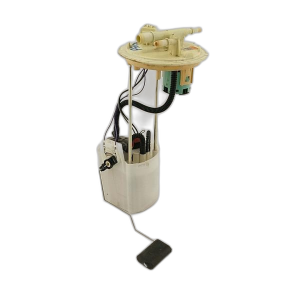
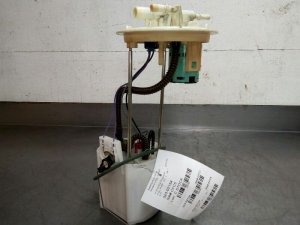
Est. part cost: $50-$120 - Weak In-Tank Low-Pressure Fuel Pump or Failing Driver Module ⚪ Low Probability The HPFP cannot generate high pressure if it isn't being fed adequate fuel from the low-pressure pump in the tank. The fuel pump driver module (FPDM) controls this pump and can also fail.
How to confirm: Test the low-side fuel pressure to ensure it meets specifications (typically 55-65 PSI). If low-side pressure is weak, the issue is with the in-tank pump or its control module. This test must be done first to avoid misdiagnosing the HPFP.
Typical fix: Replace the in-tank fuel pump assembly or the fuel pump driver module (FPDM).
Est. part cost: $100-$400 - Clogged Fuel Filter ⚪ Low Probability A clogged filter can restrict fuel flow from the tank, starving the high-pressure pump. While modern F-150s have an integrated filter in the tank pump assembly (not a separate serviceable part), debris in the tank can still cause a clog.
How to confirm: If low-side fuel pressure is low, the filter sock on the in-tank pump is a possible cause, though it usually requires replacing the entire pump assembly.
Typical fix: Replace the in-tank fuel pump assembly.
Est. part cost: $20-$60
Rare But Worth Checking
- Leaking Fuel Injector: A fuel injector stuck open can cause a drop in rail pressure. This would typically be accompanied by other codes, like a rich condition (P0172/P0175) or misfire on a specific cylinder (P030X).
- Damaged Fuel Line: A kinked or physically damaged fuel line can restrict flow, but this is usually the result of physical impact or improper service. A leak in the high-pressure line is a significant fire hazard.
- Worn Camshaft Lobe: The lobe on the camshaft that drives the HPFP can wear down, preventing the pump from generating full pressure. This is a more serious mechanical issue and would require inspecting the camshaft upon removal of the HPFP.
Diagnosis Steps
- Check for any recent engine or fuel system repairs. If work was done, immediately inspect the fuel jumper line orientation as described in TSB SSM 50089.
- Connect an OBD-II scanner and check for any other fault codes, especially P008A, P0171, or P0174.
- Use the scanner's live data function to monitor 'Desired Fuel Rail Pressure' and 'Actual Fuel Rail Pressure'.
- Test the low-pressure fuel system first. Connect a fuel pressure gauge to the low-side system to verify it is supplying adequate pressure to the HPFP (typically 55-65 PSI). If low-side pressure is weak, the problem is not the HPFP.
- At idle, the actual high-side pressure should closely match the desired pressure. If the actual pressure is significantly lower (e.g., desired is 5-600 PSI and actual is much lower), it points to a high-side problem.
- Under load (e.g., power braking or accelerating), monitor if the actual pressure can keep up with the desired pressure, which can rise to over 2000 PSI. A failing HPFP will often show a large gap here.
- Visually inspect all high-pressure fuel lines and the HPFP itself for any signs of leaks. A fuel smell is a major red flag.
- If no leaks are found, the jumper line is correct, and the low-pressure system is healthy, the most likely culprits are the fuel rail pressure sensor or the HPFP itself. Testing the sensor's electrical output can rule it out before condemning the more expensive pump.
Parts You'll Likely Need

- High-Pressure Fuel Pump (HPFP)
(OEM #BL3Z-9350-D (supercedes BL3Z-9350-C))— This is the most common component to fail that causes a genuine low-pressure condition. Forum discussions and mechanic videos frequently point to this part as the solution. Part number BL3Z-9350-D is a common replacement for the 3.5L EcoBoost.
Trusted brands: Motorcraft, Bosch
OEM price range: $250-$450
Aftermarket price range: $180-$350 - Fuel Rail Pressure Sensor
(OEM #CM-5233)— This sensor can fail and provide false low-pressure readings, leading to a P0087 code without an actual pressure loss.
Trusted brands: Motorcraft, Standard Motor Products
OEM price range: $80-$120
Aftermarket price range: $50-$90
Related Codes That Often Appear With This One
- P008A — This code indicates a problem with the low-pressure fuel system. It often appears with P0087, helping to diagnose whether the problem originates from the in-tank pump or the high-pressure system. The Ford TSBs also list this code alongside P0087.
- P0171/P0174 — These codes indicate a lean condition in one or both engine banks. Insufficient fuel pressure from the P0087 fault will prevent the engine from getting enough fuel, causing it to run lean.
- P053F — Indicates a cold start fuel pressure performance issue. This can be logged along with P0087 when the HPFP is failing and cannot build pressure correctly during startup.
Technical Service Bulletins (TSBs) & Recalls
- SSM 50089: Stalling, Lack Of Power, And/Or Low Fuel Rail Pressure - Fuel Jumper Line Incorrect Installation During Service. Affects 2017-2021 vehicles with 3.3L, 3.5L EcoBoost, or 5.0L engines.
- SSM 48807: An earlier version of the same TSB, later superseded by SSM 50089.
Platform-Specific Known Issues
- HPFP replacement is more labor-intensive.: On the 2.7L engine, the high-pressure fuel pump is located in a position that requires removing the intake manifold to gain access for replacement.
- HPFP is located on top of the passenger-side valve cover.: Access to the HPFP on these engines is generally more straightforward than on the 2.7L, as it is mounted on top of the valve cover.
- HPFP is located on the driver's side valve cover.: Unlike the V8 and EcoBoost V6 engines, the 3.3L positions the HPFP on the left (driver's side) valve cover.
Mechanic-Grade Diagnostic Values
- Low-pressure fuel system pressure (at idle) — expected: 55-65 PSI. Failure: Pressure drops significantly under load or is consistently below 55 PSI.
- High-pressure fuel system pressure (at idle) — expected: 500-600 PSI. Failure: Scan tool shows actual pressure is significantly lower than desired pressure (e.g., actual is 60 PSI when desired is 500+ PSI).
- High-pressure fuel system pressure (under load) — expected: Can exceed 2,000-3,000 PSI. Failure: Actual pressure fails to rise with desired pressure during acceleration, indicating the HPFP cannot meet demand.
- High-pressure fuel system bleed-off (Key On, Engine Off) — expected: Pressure should hold relatively steady after the pump primes.. Failure: A rapid and immediate drop in pressure after priming can indicate a stuck-open injector, which is leaking pressure from the rail.
Scan Tool Commands That Help
- Ford IDS (or equivalent like FORScan): Fuel Pressure Test — To command the fuel pumps and monitor the system's response, comparing desired vs. actual pressure readings for both the low and high-pressure sides under various conditions (idle, load) to isolate the fault.
- Ford IDS (or equivalent like FORScan): Power Balance Test — To identify specific misfiring cylinders. If P0087 is accompanied by a misfire on one or more cylinders on the same bank (e.g., P0304, P0305, P0306), it could point to a stuck injector on that bank causing the pressure drop, rather than a pump issue.
Wiring & Ground Locations
- G100 — Located on the left-hand side of the radiator support.. This is a primary ground point for the fuel pump and the fuel level sender. A poor connection here can cause erratic fuel pump operation or incorrect fuel level readings, potentially affecting the Fuel Pump Driver Module's function.
- G104 / G105 — G104 is on the right fender behind the battery. G105 is on the frame below the washer fluid container.. These are major chassis and engine bay ground points. While not directly for the fuel pump on all models, ensuring all major grounds are clean and tight is a critical step in diagnosing any electrical issue, including sensor circuits like the fuel rail pressure sensor.
- HPFP Electrical Connector — On the High-Pressure Fuel Pump itself, located on the valve cover (passenger side for 3.5L/5.0L, driver side for 3.3L).. This connector provides power to the pump's volume control solenoid. A loose or corroded connector can prevent the pump from building pressure correctly, mimicking a failed pump. The connector has a red locking tab that must be disengaged before removal.
Real Owner Repair Stories
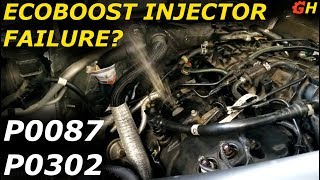
- YouTube channel 'GearHeads Garage' (2011 F-150 3.5L EcoBoost) — P0087 (Fuel Rail System Pressure Too Low Bank 1) and P0302 (Misfire Cylinder 2), rough running, heavy smoke from exhaust, strong fuel smell.
❌ Tried (didn't work) Initial diagnosis considered the low-pressure pump or the HPFP.
✅ What actually fixed it The #2 fuel injector was stuck wide open. This caused so much fuel to be dumped into the cylinder that it robbed the entire fuel rail of pressure, triggering the P0087 code. The fix was to replace the failed injector. - YouTube channel 'Ford Tech Makuloco' (2019 F-150 3.5L EcoBoost) — Runs rough, smokes, smells of raw fuel, multiple codes including P0087, P00C6, and misfires on cylinders 4, 5, and 6 (P0304, P0305, P0306).
❌ Tried (didn't work) Spark was confirmed to be good on the misfiring cylinders.
✅ What actually fixed it The diagnosis pointed towards a stuck-open fuel injector on Bank 2. A scan tool showed a rapid bleed-off of fuel pressure after shutting the engine off, indicating a leak within the system, most likely an injector not closing.
OEM Part Supersession History
BL3Z-9350-A, BL3Z-9350-B, BL3Z-9350-C→BL3Z-9350-D— Standard part revision and improvement by the manufacturer.
Heads up: BL3Z-9350-D is the current recommended replacement for the 3.5L EcoBoost in the specified year range. Using older stock (A, B, C) is not advised as D represents the latest revision.
Model Year Variations Within This Range
- 2018-2020: For the 5.0L V8 engine, 2018 marked the introduction of a dual-fuel system, adding high-pressure direct injection alongside traditional port injection. Therefore, 2018-2020 5.0L models have a high-pressure fuel pump and are susceptible to HPFP-related P0087 causes, just like the EcoBoost engines. The 2017 5.0L was port-injection only and would not have these specific HPFP failure modes.
Helpful Videos

Used OEM Parts in Stock


New Aftermarket Parts Available



The information in this article is provided for general reference and educational purposes only. Vehicle specifications, procedures, and part compatibility can vary by production date, trim level, and region. Always consult your vehicle's factory service manual and verify part numbers before purchasing or performing repairs. Safety-critical components such as airbags, seat belts, and braking systems should be installed by a qualified professional.
- Ford F-150:
- 🎬 Helpful Videos
- 🛍️ Shop This Part
- What's Unique About the 2017-2020 Ford F-150
- Diagnostic Flowchart
- Symptoms You May Notice
- Most Likely Causes
- Rare But Worth Checking
- Diagnosis Steps
- Parts You'll Likely Need
- Related Codes That Often Appear With This One
- Technical Service Bulletins (TSBs) & Recalls
- Platform-Specific Known Issues
- Mechanic-Grade Diagnostic Values
- Scan Tool Commands That Help
- Wiring & Ground Locations
- Real Owner Repair Stories
- OEM Part Supersession History
- Model Year Variations Within This Range
- 🎟️ Get 5% Off