

P0087 on 2021-2024 Ford Bronco 2.7L EcoBoost: Low Fuel Rail Pressure Causes and Fixes
Code P0087 on a 2.7L EcoBoost Bronco most often points to a failing high-pressure fuel pump (HPFP). Other causes include a weak in-tank fuel pump or a bad fuel rail pressure sensor. Diagnosis is key, as replacing the HPFP is labor-intensive and costly.
- P0087 on your Bronco means the high-pressure fuel system is not getting enough fuel.
- The most likely culprit is a failed high-pressure fuel pump (HPFP), which is an expensive and labor-intensive repair on the 2.7L engine.
- Always diagnose the low-pressure fuel system first. A cheaper, easier-to-replace in-tank pump or driver module could be the actual problem.
- Driving with this code can lead to stalling and poor performance, so it should be addressed promptly.
- Due to the complexity and need for special tools, this repair is best left to a professional mechanic.
What's Unique About the 2021-2024 Ford Bronco
On the 2.7L EcoBoost V6, the high-pressure fuel pump (HPFP) is a very common failure point leading to code P0087. Unlike the larger 3.5L EcoBoost where the pump is more accessible on top of the valve cover, the HPFP on the 2.7L is located behind the passenger-side cylinder head, requiring the removal of the intake manifold for replacement. This significantly increases the labor time and cost for what is an already common repair on EcoBoost engines.
Symptoms You May Notice
- Reduced engine power or 'limp mode'
- Engine hesitation or stumbling, especially during acceleration
- Rough or unstable idle
- Engine stalling, sometimes at low speeds or idle
- Long crank time before the engine starts
- Check Engine Light is on
- Bucking or jerking sensation when accelerating
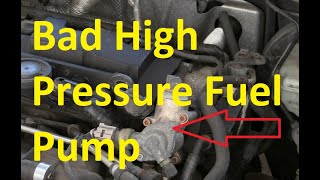
- Poor fuel economy 🎬 Watch: A breakdown of common bad high pressure fuel pump symptoms.
- Replacing the high-pressure fuel pump (HPFP) without first verifying that the low-pressure fuel pump and its driver module are supplying adequate pressure to the engine.
- Replacing fuel system components without checking for underlying electrical issues like damaged wiring or faulty PCM connections.
Most Likely Causes
- Failing High-Pressure Fuel Pump (HPFP) 🔴 High Probability The HPFP is a known failure point on many EcoBoost engines. It is a mechanical pump driven by a camshaft lobe, and either the internal pump mechanism or the plunger/follower (tappet) can wear out over time, leading to insufficient pressure. A report in NHTSA ODI #11360172 notes a similar Ford GDI system where the high-pressure pump ground into the top of the camshaft, causing fuel rail failure and P0087.
How to confirm: Use a scan tool to monitor 'Desired Fuel Rail Pressure' vs. 'Actual Fuel Rail Pressure'. If the actual pressure is significantly lower than desired under load (e.g., 200+ PSI lower), and the low-pressure fuel system is confirmed to be working correctly (typically 60-80 PSI), the HPFP is the likely culprit. 🎬 See this walkthrough on diagnosing and repairing low fuel rail pressure. Upon removal, inspect the pump's plunger and the camshaft tappet for wear or damage.
Typical fix: Replace the high-pressure fuel pump, its associated one-time-use fuel line, and the camshaft tappet/follower. On the 2.7L V6, this requires removing the upper intake manifold for access. 🎬 Watch: How to solve P0087 by replacing the 2.7L HPFP. It is highly recommended to replace the tappet (follower) at the same time, as a worn tappet can cause a new pump to fail.
Est. part cost: $400-$800 - Failing Low-Pressure Fuel Pump or Driver Module 🟡 Medium Probability The in-tank low-pressure pump must supply the HPFP with a steady volume of fuel at around 40-80 PSI. If it weakens, it can't keep up with the HPFP's demand, starving it for fuel. The Fuel Pump Driver Module (FPDM), which controls the in-tank pump, can also fail, though this is less common on the Bronco than on older Ford trucks. NHTSA ODI #11715437 describes a Ford vehicle that suffered a crank-no start condition with P0087 and P008A codes present.
How to confirm: Connect a fuel pressure gauge to the low-pressure fuel line schrader valve (if equipped) or use a scan tool to monitor the low-pressure fuel sensor data. The pressure should be stable and within the manufacturer's specification (typically 40-80 PSI). If it's low or erratic, the in-tank pump, FPDM, or a clogged filter is suspect.
Typical fix: Replace the in-tank fuel pump assembly or the Fuel Pump Driver Module (FPDM). The FPDM is often located on the vehicle's frame. Some owners on Bronco6G forums have reported needing low-pressure pump replacements under warranty.
Est. part cost: $250-$500 for the pump, $70-$150 for the FPDM - Faulty Fuel Rail Pressure (FRP) Sensor ⚪ Low Probability Sensors can fail, providing inaccurate readings to the PCM. This can trick the computer into thinking pressure is low when it is actually normal. There are both high-side and low-side pressure sensors that can fail. NHTSA ODI #11318285 highlights a case where a P0087 error was initially suspected to be a pump issue, but dealership testing confirmed the actual cause was a defective fuel rail sensor.
How to confirm: With the engine off (but key on), the FRP sensor reading should be close to the low-side fuel pressure. If the reading is erratic, zero, or clearly incorrect, the sensor is likely faulty. Comparing the live data to a mechanical gauge can also confirm a bad sensor. A faulty low-side sensor can also cause P0087 by making the PCM misinterpret the fuel supply.
Typical fix: Replace the fuel rail pressure sensor located on the high-pressure fuel rail or the low-pressure line sensor.
Est. part cost: $50-$150
Rare But Worth Checking
- Worn Camshaft Lobe: The specific camshaft lobe that drives the HPFP can wear down, preventing the pump from generating full pressure even with a new HPFP. This is a severe mechanical failure requiring significant engine repair. It's critical to inspect the lobe for scoring or wear when the HPFP is removed.
- Clogged Fuel Filter: The fuel filter is integrated into the fuel pump module in the tank and is considered a 'lifetime' filter. While not a common failure point on its own, it can become clogged from contaminated fuel, restricting flow to the HPFP.
- Leaking Fuel Injector: A fuel injector stuck open can cause a drop in rail pressure. This would typically be accompanied by other codes, like a cylinder-specific misfire (P030x) and a rich running condition, and you might smell fuel in the oil.
- Wiring/Connector Issue: A user on a ScannerDanner forum reported a case where a P0087 was ultimately traced to pushed-out connector pins at the PCM. Similarly, NHTSA ODI #11568117 reports a Ford truck where a melted pin in connector C1035A caused a poor connection for the fuel pump control module, triggering P0087 and P008A.
- Diverter Valve Failure: In some Ford applications, a failed diverter valve has been linked to loss of acceleration and P0087 during rapid acceleration attempts, as noted in NHTSA ODI #11633930.
Diagnosis Steps
- Connect an OBD-II scanner and verify P0087 is the primary code. Note any other codes present, such as P008A or misfire codes.
- Access live data on the scanner. Monitor 'Desired Fuel Rail Pressure' and 'Actual Fuel Rail Pressure'.
- Also monitor 'Low Side Fuel Pressure'. The low side should be stable, typically between 40-80 PSI.
- If low-side pressure is below specification, diagnose the in-tank fuel pump, fuel filter, and Fuel Pump Driver Module (FPDM).
- If low-side pressure is good, perform a test drive while monitoring rail pressure. Under heavy acceleration, the 'Actual' pressure should closely follow the 'Desired' pressure.
- If the 'Actual' pressure drops significantly below 'Desired' under load, the High-Pressure Fuel Pump (HPFP) is the primary suspect.
- Before replacing the HPFP, inspect the wiring and connectors to the pump and the fuel rail pressure sensor for any damage or corrosion.
- If a repair was recently performed that involved disconnecting fuel lines, check for leaks or improper connections, as this can introduce air into the system and cause a temporary P0087 code per TSB SSM 50089.
- When replacing the HPFP, it is critical to also inspect the camshaft lobe and replace the follower/tappet to prevent repeat failure.
Parts You'll Likely Need
- High-Pressure Fuel Pump (HPFP)
(OEM #NL3Z-9350-A)— This is the most frequent cause of code P0087 on the 2.7L EcoBoost engine due to internal wear or follower failure.
Trusted brands: Motorcraft, Bosch
OEM price range: $500-$800
Aftermarket price range: $350-$600 - HPFP Camshaft Follower (Tappet)
(OEM #HL3Z-6C529-A)— This small mechanical piece rides on the camshaft lobe to actuate the HPFP. It is a common wear item and should always be replaced with the HPFP to prevent premature failure of the new pump.
Trusted brands: Motorcraft
OEM price range: $30-$50
Aftermarket price range: $20-$40 - Low-Pressure Fuel Pump (In-Tank) — If diagnostic tests show low pressure from the tank, this pump is the cause. It fails less often than the HPFP but is the second most likely component.
Trusted brands: Motorcraft
OEM price range: $350-$500
Aftermarket price range: $200-$350 - Fuel Pump Driver Module (FPDM) — This module controls the voltage to the in-tank pump and is a common failure point on many Ford trucks, leading to low fuel supply.
Trusted brands: Motorcraft, Dorman
Related Codes That Often Appear With This One
- P008A — This code means 'Low Pressure Fuel System Pressure - Too Low'. It often appears with P0087, indicating the problem may originate from the in-tank fuel pump or its control circuit, which is starving the HPFP.
- P0627 — This code means 'Fuel Pump 'A' Control Circuit/Open'. It points directly to an electrical issue with the low-pressure fuel pump or its driver module (FPDM), and is a strong indicator that the cause of P0087 is on the low-pressure side.
- P030x (e.g., P0301, P0302) — Cylinder-specific misfire codes can accompany P0087. Low fuel pressure can lead to a lean condition, causing misfires as the engine struggles to get enough fuel for proper combustion.
Technical Service Bulletins (TSBs) & Recalls
- SSM 50089 - Notes that P0087 can appear after a fuel line has been removed for a separate repair, possibly due to air in the system or a poor connection.
- TSB 16-0010 - An older TSB for 2015 F-150s with the 2.7L engine, which explicitly states that if P0087 is the only code present, the fix is to replace the fuel injection (high-pressure) pump.
Platform-Specific Known Issues
- source — A YouTube video by 'Heavy Mechanic Review' details a P0087 code on a 2.7L EcoBoost F-150. The diagnosis showed high-side fuel pressure was over 200 PSI below the desired value, while low-side pressure was normal at 60 PSI, confirming a bad HPFP. The video highlights the pump's location behind the intake manifold and stresses the importance of replacing the tappet at the same time.
- source — An owner on FordF150Forum.com reported getting a P0087 code immediately after performing an aggressive launch with a new performance tune. The truck began to sputter, stall, and had no power. Other forum members immediately pointed to the High-Pressure Fuel Pump as the likely failure point, which is a common outcome when a weak or failing pump is subjected to the increased demand of a performance tune.
Mechanic-Grade Diagnostic Values
- Low-Pressure Fuel System Pressure (In-tank pump) — expected: 55-70 PSI, stable.. Failure: Pressure is below 55 PSI, is erratic, or drops under load. This must be confirmed before suspecting the HPFP.
- High-Pressure Fuel System Pressure (HPFP) at Idle — expected: ~200-450 PSI.. Failure: Actual pressure on a scan tool is significantly below desired pressure, sometimes reading as low as 30-80 PSI.
- High-Pressure Fuel System Pressure (HPFP) Under Load — expected: Should climb to over 2,000 PSI, with some systems rated up to 2,900 PSI.. Failure: Actual pressure fails to follow desired pressure and the gap widens under acceleration. A difference of 200+ PSI is a strong indicator of a failing HPFP.
Scan Tool Commands That Help
- Ford IDS / FORScan: Fuel Pump Command / Activation — This bidirectional command allows a technician to manually activate the low-pressure in-tank fuel pump without the engine running. This is used to test the pump's function and to verify if the low-pressure side is capable of delivering fuel to the HPFP.
Wiring & Ground Locations
- Fuel Pump Driver Module (FPDM) — On many Ford trucks and SUVs, the FPDM is mounted to the vehicle's frame rail, often near the spare tire at the rear of the vehicle.. The FPDM controls the voltage and speed of the in-tank low-pressure fuel pump. A failure of this module or its wiring/ground can starve the high-pressure fuel pump (HPFP) of fuel, directly causing a P0087 code.
- HPFP Connector — On the High-Pressure Fuel Pump, located behind the passenger-side cylinder head.. This is a 2-pin electrical connector, often gray, that powers the pump's control solenoid. Corrosion or damage to these pins can cause intermittent or total loss of HPFP function, leading to low pressure readings.
Real Owner Repair Stories
- Rapid Car Care LLC on YouTube (Ford F-150 with 2.7L EcoBoost (mechanically very similar to Bronco)) — Check Engine Light with code P0087.
❌ Tried (didn't work) The diagnosis immediately focused on live data, so no unnecessary parts were replaced.
✅ What actually fixed it Scan tool live data showed the low-pressure side was healthy at ~60 PSI, but the high-pressure side was over 200 PSI below the desired pressure. The fix was replacing the High-Pressure Fuel Pump (HPFP) and the associated cam follower (tappet).
"I Checked Everything" — The Actual Cause
- A commonly reported scenario for this code is a 'hot soak' failure. A technician may test the fuel pressure on a cold engine and find it to be perfectly within spec. However, the P0087 code returns for the customer. The actual cause is a component, often the HPFP or the FPDM, that begins to fail only after it reaches full operating temperature, is shut off for 30-45 minutes, and then restarted. Diagnosing this requires testing the vehicle under these specific heat-soaked conditions.
When the Usual Fixes Don't Work
- While the high-pressure fuel pump (HPFP) is the most common failure, a significant number of P0087 cases on vehicles that have had recent engine work are resolved by correcting a backward-installed fuel jumper line, as detailed in Ford TSB SSM 50089. This should be the first check after any recent service, before condemning the expensive HPFP.
OEM Part Supersession History
NL3Z-9350-A→No supersession found. This is the current part number.— N/A
Heads up: This part number is specified for 2021-2024 models. The casting number on the part itself may read NL3E-9D376-AA.
Model Year Variations Within This Range
- 2021: Early production 2.7L EcoBoost engines manufactured between May 1, 2021, and October 31, 2021, were part of a 'bad batch' that was prone to premature valve failure. While not a direct cause of P0087, a catastrophic engine failure could present with multiple codes, and owners of these specific models should be aware of this potential underlying issue.
Diagnostic Flowchart
Other Known Issues on This Vehicle
Issues unrelated to this code that are worth knowing about as an owner of this generation:
- Catastrophic Intake Valve Failure 🔴 High — Affects 2021-2022 models built before October 2021. Failure typically occurs at low mileage (<10,000 miles). Subject of NHTSA investigation EA23002 and recall 24V142000. (Ref: NHTSA EA23002 / Recall 24V142000)
- Harsh or Delayed Shifting (10R60 Transmission) 🟠 Medium — Common complaint across 2021-2023 models. Can be caused by software, valve body issues, or internal clutch drum failures. (Ref: TSB 23-2352, TSB 23-2250)
- Oil Pan Leaks 🟡 Low — More common on earlier 2.7L EcoBoost engines with a plastic oil pan, but can still occur. Leaks develop from the pan-to-block seal. (Ref: TSB 19-2205 (for older models, but relevant))
- Hard Top Quality and Rattles 🟡 Low — Widespread issue since launch. Includes poor headliner finish, uneven panel gaps, and various rattles. Ford has issued multiple TSBs to address specific noise sources. (Ref: SSM 52385, SSM 52178)
- Turbocharger Wastegate Rattle/Failure 🟠 Medium — Some owners report rattling noises from the turbo wastegates or premature turbo failure requiring replacement under warranty. Noted in owner reviews but less documented in TSBs.
- Carbon Buildup on Intake Valves 🟠 Medium — A known issue for all direct-injection engines. The second generation 2.7L EcoBoost (2018+) added port injection to mitigate this, but it can still occur over high mileage, leading to reduced performance and misfires.
Used vs. New Parts: Buying Guide for This Vehicle
When a used part is the smart pick: For electronic modules like the Fuel Pump Driver Module (FPDM) or sensors, a used part from a low-mileage donor vehicle can be a cost-effective and reliable option. A used HPFP is risky but could be considered if it comes from a verified low-mileage wreck and includes a warranty.
Donor-vehicle mileage cap: roughly under 50000 miles for the part to have meaningful remaining life.
What to inspect on the donor part:
- Check electrical connectors for corrosion, pushed-out pins, or damage.
- Ensure there is no physical damage, cracking, or signs of leaking on the part body.
- If possible, verify the donor vehicle was running before it was dismantled.
OEM-only on this vehicle (don't cheap out):
- High-Pressure Fuel Pump (HPFP)
- HPFP Camshaft Follower (Tappet)
Aftermarket brands forum-validated for this vehicle:
- Bosch (Often the OEM supplier for fuel components)
- Xtreme-DI (XDI) (Known for high-performance, upgraded HPFPs)
Real Owner Stories
Aggregated from forums and TSBs cited above. Mileages and costs reflect what owners reported in those sources.
2015 Ford F-150 2.7L EcoBoost
Symptoms: High-side fuel pressure was over 200 PSI below the desired value while the low-side pressure remained normal at 60 PSI.
What fixed it: Replacement of the High-Pressure Fuel Pump (HPFP) and the tappet.
Source hint: YouTube video by 'Heavy Mechanic Review' titled 'HPFP Failure on F-150 with 2.7L'
Ford F-150 2.7L EcoBoost
Symptoms: Immediately after an aggressive launch with a new performance tune, the truck began to sputter, stall, and had no power.
What fixed it: Replacement of the High-Pressure Fuel Pump (HPFP).
Source hint: FordF150Forum.com thread titled 'ecoboost fuel rail system pressure too low p0087 after launch'
2021-2024 Ford Bronco
Symptoms: Low-pressure fuel pump failures leading to fuel delivery issues.
What fixed it: Replacement of the in-tank low-pressure fuel pump assembly under warranty.
Source hint: Bronco6G forum thread 'second fuel pump failure'
Documented NHTSA Reports
Ford Mustang (Cross-Manufacturer Reference)
Symptoms: Vehicle displayed "miles to empty" then required a tow. Two hours post-incident, the vehicle was still in a crank-no start condition. Scanned codes included P0087:00-64, P008A:00-EC, and P00C6:00-26.
Source: NHTSA ODI #11715437
Ford Escape (Cross-Manufacturer Reference)
Symptoms: Vehicle lost acceleration during rapid acceleration attempts, such as on freeway on-ramps. The check engine light was triggered with code P0087 for low fuel rail pressure.
What fixed it: Diagnosis revealed the diverter valve had failed.
Source: NHTSA ODI #11633930
Related OBD-II Codes
Frequently Asked Questions
Does TSB 16-0010 apply to my 2021-2024 Ford Bronco with the 2.7L engine?
I just had my fuel lines disconnected for a repair and now I have a P0087 code. Is my pump broken?
Why does the 2.7L EcoBoost in the Bronco struggle with fuel pressure after a performance tune?
Is the P0087 code related to the major 2.7L EcoBoost engine recall?
When replacing the HPFP on my Bronco, do I need to replace any other parts?
What should the low-side fuel pressure be on my 2.7L Bronco?
Helpful Videos
Used OEM Parts in Stock
New Aftermarket Parts Available


The information in this article is provided for general reference and educational purposes only. Vehicle specifications, procedures, and part compatibility can vary by production date, trim level, and region. Always consult your vehicle's factory service manual and verify part numbers before purchasing or performing repairs. Safety-critical components such as airbags, seat belts, and braking systems should be installed by a qualified professional.
- Ford Bronco:
- 🎬 Helpful Videos
- 🛍️ Shop This Part
- What's Unique About the 2021-2024 Ford Bronco
- Symptoms You May Notice
- Most Likely Causes
- Rare But Worth Checking
- Diagnosis Steps
- Parts You'll Likely Need
- Related Codes That Often Appear With This One
- Technical Service Bulletins (TSBs) & Recalls
- Platform-Specific Known Issues
- Mechanic-Grade Diagnostic Values
- Scan Tool Commands That Help
- Wiring & Ground Locations
- Real Owner Repair Stories
- "I Checked Everything" — The Actual Cause
- When the Usual Fixes Don't Work
- OEM Part Supersession History
- Model Year Variations Within This Range
- Diagnostic Flowchart
- Other Known Issues on This Vehicle
- Used vs. New Parts: Buying Guide for This Vehicle
- Real Owner Stories
- 2015 Ford F-150 2.7L EcoBoost
- Ford F-150 2.7L EcoBoost
- 2021-2024 Ford Bronco
- Documented NHTSA Reports
- Ford Mustang (Cross-Manufacturer Reference)
- Ford Escape (Cross-Manufacturer Reference)
- Related OBD-II Codes
- Frequently Asked Questions
- 🎟️ Get 5% Off