

P0087 on 2010-2014 Chevrolet Express: Low Fuel Pressure Causes & Fixes
P0087 on a 2010-2014 Chevy Express most often points to a faulty Fuel Pump Driver Module (FPDM/FSCM) or a failing in-tank fuel pump. The FPDM is a common failure point due to its location on the frame rail where it's exposed to corrosion and is cheaper to replace (~$75-$150) than the fuel pump. For Duramax diesel models, this code can also point to fuel contamination or high-pressure fuel system issues.
- P0087 means the fuel pressure is too low for the engine to run correctly.
- Before replacing the expensive fuel pump, always inspect the Fuel Pump Driver Module (FPDM) on the frame rail for corrosion, as it is a very common and cheaper failure point.
- Do not drive the vehicle with this code, as the engine could stall at any time, creating a dangerous situation.
- Replacing the fuel filter is a good first step if you confirm low fuel pressure, as it's inexpensive and part of routine maintenance.
- This issue is well-documented by GM through multiple Technical Service Bulletins, particularly concerning cold weather operation and fuel contamination.
What's Unique About the 2010-2014 Chevrolet EXPRESS
The 2010-2014 Chevrolet Express, like its truck counterparts (Silverado/Sierra) and the GMC Savana, is known for issues with its Fuel Pump Driver Module (FPDM), also called a Fuel System Control Module (FSCM). This module is often mounted on the frame rail, where it is exposed to moisture and corrosion, leading to failure. Additionally, several GM Technical Service Bulletins (TSBs) specifically address issues with fuel system contamination (especially on Duramax diesels) and poor fuel pump performance in cold weather on these vans, making these known weak points. [TSB #16-NA-102, TSB #18NA103]
Diagnostic Flowchart
Tap your situation to follow the diagnostic path that matches what you're seeing on this vehicle.
Symptoms You May Notice
- Engine is hard to start or will not start. [TSB #PIP4949E, TSB #16-NA-102]
- Loss of engine power or poor acceleration, may feel like it 'falls on its face'. [TSB #18NA103, 3]
- Engine stalls, especially under load or in cold weather. [TSB #18NA103]
- Rough running or misfiring. [TSB #PIP5151F, 26]
- Illuminated Check Engine Light.
- Whining noise from the in-tank fuel pump, particularly in cold weather. [TSB #18-NA-103]
- Engine enters 'limp mode' with reduced power.
- Replacing the in-tank fuel pump without first inspecting the Fuel Pump Driver Module (FPDM/FSCM). The FPDM is a very common point of failure on these vans and is significantly easier and cheaper to replace than the pump.
- On Duramax diesels, replacing just the low-pressure fuel pump when the high-pressure injection pump has failed and contaminated the system. This leads to repeat failures. A full system diagnosis is critical.
Most Likely Causes
- Failing Fuel Pump Driver Module (FPDM/FSCM) 🔴 High Probability The module is often mounted to the frame rail above the spare tire, making it highly susceptible to corrosion and water damage, a well-documented issue on GM trucks and vans of this era.
How to confirm: Locate the module on the frame rail (often on the driver's or passenger's side, above the spare tire). Inspect the module and its connector for heavy corrosion or physical damage. A scan tool can also be used to check for communication with the module. A common failure mode is a crack in the plastic housing allowing water intrusion.
Typical fix: Replace the Fuel Pump Driver Module. The new module must be programmed to the vehicle's VIN by a GM dealer or a properly equipped independent shop.
Est. part cost: $75-$150 - Failing In-Tank Fuel Pump 🔴 High Probability TSB #18NA103 specifically notes that the in-tank fuel pump can fail to provide adequate pressure at cold temperatures (below 20°F / -6°C). [TSB #18NA103] General wear can also cause failure. Some owners report hearing the pump engage, but it still fails to build sufficient pressure.
How to confirm: Connect a mechanical fuel pressure gauge to the fuel rail. If the pressure is below specification (check service manual for exact PSI) while the FPDM is known to be good and commanded on by a scan tool, the pump is likely at fault.
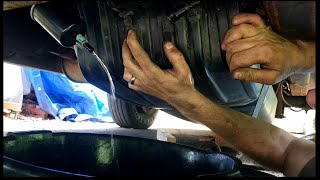
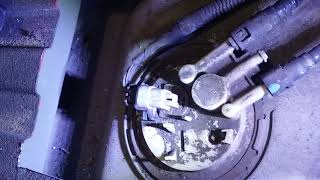
Typical fix: Replace the in-tank fuel pump module assembly. This requires dropping the fuel tank. 🎬 Pro tip: Cut an access panel to avoid dropping the tank. It is highly recommended to use a quality OEM or equivalent brand, as cheap replacements are a common source of repeat failures.
Est. part cost: $250-$450 - Clogged Fuel Filter 🟡 Medium Probability This is a standard maintenance item that is often neglected. TSBs #16-NA-102 and #PIP5151F also point to fuel system contamination being a cause for low pressure. [TSB #16-NA-102, TSB #PIP5151F] It is the cheapest and easiest potential cause to address.
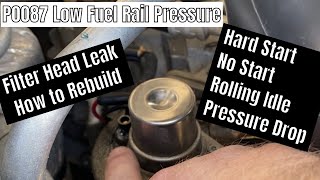
How to confirm: If fuel pressure is low, the filter is the first logical part to replace as part of diagnosis. If a new filter restores pressure, the old one was clogged. On Duramax models, a failing fuel filter housing can 🎬 See how to rebuild a leaking Duramax fuel filter head. also suck in air, causing similar symptoms.
Typical fix: Replace the fuel filter.
Est. part cost: $20-$50 - Fuel System Contamination (Especially Duramax Diesel) ⚪ Low Probability Multiple TSBs (#16-NA-102, #PIP5151F) mention debris contaminating the fuel system as a cause for low pressure and hard starting. [TSB #16-NA-102, TSB #PIP5151F] This can be from water causing rust, DEF fluid contamination, or internal failure of the high-pressure injection pump (CP3/CP4) shedding metal particles.
How to confirm: TSB #16-NA-102 instructs technicians to inspect the Fuel Pressure Regulator 1 for magnetic metal debris after pump removal. Finding debris confirms a catastrophic failure requiring extensive cleaning. Visual inspection of the fuel tank may also show rust or other contaminants.
Typical fix: If contamination is found, the entire fuel system may need to be cleaned, including the tank, lines, and rails, and the fuel pump, filter, and sometimes all injectors must be replaced.
Est. part cost: $300-$6000+ - Faulty Fuel Rail Pressure Sensor ⚪ Low Probability
How to confirm: Compare the pressure reading from a mechanical gauge to the reading from the sensor via a scan tool. If the mechanical gauge shows correct pressure but the scan tool shows low pressure, the sensor is likely faulty. TSB #20-NA-197 also points to corrosion in the sensor's electrical connector as a possible cause.
Typical fix: Replace the fuel rail pressure sensor or repair the connector.
Est. part cost: $40-$80
Rare But Worth Checking
- Kinked or Restricted Fuel Line: Damage to the underbody of the van can sometimes crimp a fuel line, restricting flow. A GM service bulletin also notes that the factory supply line on some Duramax trucks can collapse internally, and an upgraded, more rigid hose is the fix. A visual inspection of all fuel lines from the tank to the engine is necessary.
- Electrical Issues: A damaged wire or poor ground for the FPDM or fuel pump can cause intermittent low voltage and trigger this code. TSB #20-NA-197 specifically mentions corrosion at the fuel pressure sensor connector causing a host of fuel pressure codes, including P0087.
Diagnosis Steps
- Scan the ECM for P0087 and any other stored codes. Note codes like P0088, P0191, or P2635, as they provide important context.
- Visually inspect the Fuel Pump Driver Module (FPDM/FSCM) on the frame rail (usually above the spare tire) for corrosion, cracks in the housing, or loose connections.
- Connect a quality OBD-II scan tool that can read live data. Monitor the 'Desired Fuel Rail Pressure' vs. 'Actual Fuel Rail Pressure'.
- Connect a mechanical fuel pressure gauge to the service port on the engine's fuel rail.
- Start the engine (if possible) and compare the mechanical gauge reading to the scan tool's sensor reading. They should be very close. If the mechanical gauge is normal but the scan tool is low, the Fuel Rail Pressure Sensor is likely bad or its wiring is compromised.
- If both readings are low, the problem is with fuel delivery. Replace the fuel filter first, as it is a low-cost maintenance item and a common cause.
- If the filter change does not resolve the issue, command the fuel pump on with the scan tool and listen for it to prime. Check for power and ground at the FPDM connector.
- If the FPDM has power and ground but there is no output to the pump, or if the module is heavily corroded, it is the likely culprit. Note: A new FPDM requires programming.
- If the FPDM is functioning correctly, the in-tank fuel pump is the most likely cause of low pressure.
- For Duramax Diesel models: If P0087 occurs under load, investigate the high-pressure system. This can include checking the fuel pressure relief valve (FPRV) and, if necessary, inspecting the high-pressure pump's regulator for metal debris, which indicates a major pump failure.
Parts You'll Likely Need
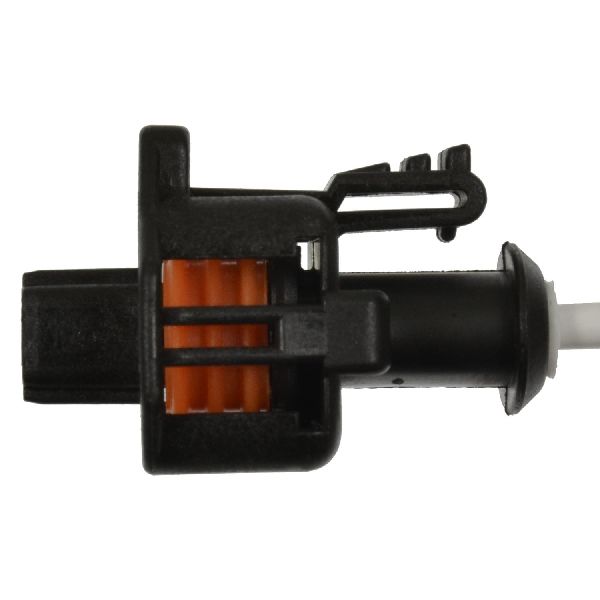
- Fuel Pump Driver Module (FSCM)
(OEM #20877116)
Related Codes That Often Appear With This One
- P0088 — This code for 'Fuel Rail/System Pressure - Too High' can appear with P0087 if the failing component (like the FPDM or pressure sensor) is causing erratic fuel pressure readings. TSBs PIP4949E and 16-NA-102 list them together. [TSB #PIP4949E, TSB #16-NA-102]
- P0191 — This code indicates a 'Fuel Rail Pressure Sensor Circuit Range/Performance' issue. It often sets alongside P0087 because the ECM sees an illogical or unstable signal from the sensor, which could be caused by the sensor itself or by the wildly fluctuating pressure from a bad pump/FPDM. [TSB #PIP4949E, TSB #16-NA-102, 3]
- P2635 — This code for 'Fuel Pump 'A' Flow Performance' directly relates to the low-pressure fuel pump's inability to deliver the volume of fuel commanded by the ECM, which is the root cause of P0087. TSB #18NA103 lists this code as a common companion to P0087 in cold weather conditions. [TSB #18NA103]
Technical Service Bulletins (TSBs) & Recalls
- 18NA103: Addresses concerns of start/stall, no start, or loss of power at cold temperatures, pointing to the in-tank fuel pump and listing P0087.
- PIP4949E: Discusses hard start or no start conditions associated with DTC P0087, P0088, P0191, or P128E.
- 16-NA-102: Provides a procedure to inspect and replace fuel components due to contamination causing hard/no start and DTC P0087.
- PIP5151F: Notes that fuel system contamination can cause hard start, no start, rough running, and low fuel pressure, setting DTC P0087.
Platform-Specific Known Issues
- Per TSB #18NA103, the in-tank fuel pump may perform poorly or whine in temperatures below 20°F (-6°C), leading to a no-start or stall with P0087. The bulletin advises against replacing the pump for this, suggesting warming the vehicle to thaw potentially gelled fuel.
- Per TSBs #16-NA-102 and #PIP5151F, Duramax diesel models are susceptible to fuel system contamination from water, DEF, or high-pressure pump failure, which can cause P0087 and require extensive, costly repairs.
- The Fuel Pump Driver Module (FSCM) is notoriously prone to failure from corrosion due to its mounting location above the spare tire, exposed to road salt and moisture.
Mechanic-Grade Diagnostic Values
- Gasoline Engine Low-Side Fuel Pressure (KOEO or Idle) — expected: 45-58 PSI. Failure: Pressure is below 45 PSI or is slow to build.
- Duramax Diesel High-Pressure Rail (Idle) — expected: ~4,000 - 6,000 PSI. Failure: Actual pressure on scan tool is significantly lower than desired pressure.
- Duramax Diesel High-Pressure Rail (Wide Open Throttle/Heavy Load) — expected: ~23,000 - 26,000 PSI. Failure: Actual pressure drops more than 2,000 PSI below desired pressure.
- Duramax Diesel Low-Side Fuel System Vacuum — expected: 5 to 8 inches of vacuum under full load. Failure: Vacuum reading is higher than 8 inches, indicating a restriction (like a clogged filter or pinched line).
Scan Tool Commands That Help
- GDS2 / Tech2 or equivalent professional scan tool: Fuel Pump On/Off Command — Used to verify if the Fuel Pump Control Module (FSCM) and the in-tank fuel pump are responding to commands from the ECM. This helps isolate the problem to the control side or the pump itself.
- GDS2 / Tech2 or equivalent professional scan tool: FSCM Replacement Programming — This is a required procedure after replacing the Fuel System Control Module. The new module must be programmed with the vehicle's VIN and specific software to function correctly.
- GDS2 / Tech2 or equivalent professional scan tool: Command Max Rail Pressure at Idle (Duramax) — A quick test for CP3 high-pressure pump health. If the pump cannot achieve maximum commanded pressure while at idle, it is likely failing.
Wiring & Ground Locations
- FSCM Connector Pin 13 (Dark Green/White wire) — At the Fuel System Control Module connector, typically on the frame rail.. This is the fuel pump relay control wire from the ECM. With the key on, it should have 12V constantly, only when cranking, or for 3-6 seconds. A lack of voltage here points to a wiring issue between the ECM and FSCM, or a faulty ECM.
- FSCM Connector Pin 32 (Red/White wire) — At the Fuel System Control Module connector.. This is the main battery positive voltage supply to the module. No power here indicates a blown fuse or a break in the power feed wire.
- FSCM Connector Pin 47 (Grey wire) — At the Fuel System Control Module connector.. This is the voltage supply wire going from the FSCM to the in-tank fuel pump. Testing here can determine if the module is sending power out to the pump.
- ECM Connector Pin 50 (Dark Green/White wire) — In the black connector at the Engine Control Module (ECM).. This is the source of the fuel pump command signal. If there is no power at Pin 13 of the FSCM, checking for 12V here can confirm if the ECM is sending the signal. If power is present here but not at the FSCM, there is a broken wire between the two modules.
Real Owner Repair Stories
- Piston Twistin' shop example (Chevy Express with LML Duramax Diesel) — Went into limp mode twice while towing a camper, with codes P0087 and P0191.
❌ Tried (didn't work) Not specified, but diagnosis showed a significant pressure drop under load.
✅ What actually fixed it The shop diagnosed that the actual fuel pressure at wide-open throttle was only 18,000 PSI when it should have been 26,000 PSI. They replaced the factory CP4 high-pressure pump with a more robust CP3 conversion kit and added an aftermarket lift pump (AirDog 165). This resolved the issue instantly.
OEM Part Supersession History
20791901, 20850927, 20827745→20877116— Standard part revision and consolidation by the manufacturer.
Heads up: The replacement module (20877116) requires programming to the vehicle after installation. It is not a plug-and-play part.
Model Year Variations Within This Range
- 2011-2014 (with Duramax LML engine): These model years are equipped with the Bosch CP4.2 high-pressure fuel pump, which is known to be more prone to catastrophic failure than the CP3 pump used in earlier Duramax engines. Failure often leads to P0087 and system-wide metal contamination.
Helpful Videos
Used OEM Parts in Stock

New Aftermarket Parts Available


The information in this article is provided for general reference and educational purposes only. Vehicle specifications, procedures, and part compatibility can vary by production date, trim level, and region. Always consult your vehicle's factory service manual and verify part numbers before purchasing or performing repairs. Safety-critical components such as airbags, seat belts, and braking systems should be installed by a qualified professional.
- Chevrolet EXPRESS:
- 🎬 Helpful Videos
- 🛍️ Shop This Part
- What's Unique About the 2010-2014 Chevrolet EXPRESS
- Diagnostic Flowchart
- Symptoms You May Notice
- Most Likely Causes
- Rare But Worth Checking
- Diagnosis Steps
- Parts You'll Likely Need
- Related Codes That Often Appear With This One
- Technical Service Bulletins (TSBs) & Recalls
- Platform-Specific Known Issues
- Mechanic-Grade Diagnostic Values
- Scan Tool Commands That Help
- Wiring & Ground Locations
- Real Owner Repair Stories
- OEM Part Supersession History
- Model Year Variations Within This Range
- 🎟️ Get 5% Off