

OBD-II Code P0081: Intake Valve Control Solenoid Circuit Malfunction (Bank 2)
What P0081 means, why it triggers, and how to fix it
- P0081 indicates an electrical circuit failure in the Bank 2 intake variable valve timing (VVT) solenoid.
- Check your engine oil level and condition immediately, as low or sludgy oil causes over 30% of VVT-related faults.
- Test the solenoid's electrical resistance before replacing it; a healthy VVT solenoid typically reads between 5 and 15 ohms.
- Fix this code within 1 to 3 months to prevent unburnt fuel from destroying your catalytic converter, a repair costing upwards of $1,500.
What Does P0081 Mean?

P0081 means the Powertrain Control Module (PCM) detects an electrical circuit failure in the Bank 2 intake Variable Valve Timing (VVT) solenoid. The VVT system adjusts camshaft timing to optimize engine performance. When this code triggers, the PCM disables the VVT system on Bank 2, causing immediate performance drops.
🎬 Watch: A complete diagnosis and repair guide for P0081Technical definition: The SAE/OBD-II definition is "Intake Valve Control Solenoid Circuit (Bank 2)". The PCM uses a pulse-width modulated (PWM) signal to control the intake camshaft's position-adjusting solenoid. If the PCM detects voltage or resistance outside the expected range on this circuit, it sets code P0081.
Can I Drive With P0081?
Yes, But With Caution. You can drive the vehicle, but it will suffer from reduced power, poor acceleration, and up to a 15% drop in fuel economy. Repair it within a few weeks. Driving for hundreds of miles with disabled valve timing causes incomplete combustion, which destroys the catalytic converter and turns a $150 repair into a $2,000 nightmare.
Common Causes

- Faulty Intake Valve Control (VVT) Solenoid (Very Common) — The solenoid fails internally from an open or shorted coil, or the moving pintle gets stuck due to carbon buildup and wear.
- Low, Dirty, or Incorrect Engine Oil (Very Common) — The VVT system relies on hydraulic oil pressure. Low oil, heavy sludge, or the wrong viscosity starves the solenoid, triggering a circuit code.
- Wiring or Connector Issues (Common) — Heat-brittle wiring, oil-contaminated connectors, or rodent damage breaks the electrical connection to the solenoid.
- Clogged Oil Passages or Filter Screens (Common) — Sludge or debris clogs the fine mesh screens on the VVT solenoid or the narrow oil passages inside the camshaft phaser.
- Blown Fuse (Less Common) — A blown fuse cuts power to the VVT solenoid circuit, resulting in an immediate open-circuit fault.
- Stretched Timing Chain or Failed Guide (Rare) — A severely stretched timing chain throws the camshaft timing out of sync, causing the PCM to flag a VVT circuit code as it fails to correct the mechanical discrepancy.
- Faulty Powertrain Control Module (PCM) (Rare) — The driver circuit inside the PCM fails, preventing it from sending the correct PWM signal to the solenoid.
Symptoms

- Check Engine Light is On — The PCM illuminates the malfunction indicator lamp and forces the engine into a failsafe mode.
- Reduced Engine Power and Acceleration — The vehicle feels sluggish and hesitates during acceleration because valve timing is locked in a default position.
- Rough Idle and Stalling — The engine shakes, runs unevenly at idle (600-800 RPM), or stalls completely at low speeds.
- Poor Fuel Economy — Fuel consumption increases by 10-15% because the engine operates inefficiently without active VVT.
- Engine Rattling Noise — A failing VVT solenoid starves the cam phaser of oil, causing a distinct metallic rattling or ticking noise from the top of the engine.
- Abnormal Freeze Frame Data (scan-tool only — no driver-felt sign) — The PCM captures engine RPM, load, and temperature at the exact moment the fault occurs, providing critical diagnostic context.
Diagnostic Flowchart
Tap your situation to follow the diagnostic path that matches what you're seeing on this code.
Common Fixes & Costs
- Perform an Engine Oil and Filter Change — Parts: $30 - $75, Labor: $20 - $50, ~0.5 hr book time (DIY)
- Replace Intake Valve Control (VVT) Solenoid
— Parts: $50 - $150, Labor: $100 - $150, ~1 hr book time
(DIY)
: OEM
: OEM
: OEM - Repair Damaged Wiring or Connectors — Parts: $10 - $50, Labor: $100 - $250, ~1.5 hr book time (Intermediate)
- Initial Diagnostic Service — Parts: $0, Labor: $150 - $200, ~1 hr book time (Professional)
- Replace Powertrain Control Module (PCM) — Parts: $600 - $900, Labor: $200 - $300, ~1.5 hr book time (Professional)
DIY vs Professional
- Replace VVT Solenoid — Beginner: Yes
Tools: 10mm socket set, torque wrench, flathead screwdriver, rags, safety glasses. - Repair Damaged Wiring — Beginner: No
Tools: Multimeter, wire strippers, crimpers, heat shrink tubing, soldering iron, wiring diagram. - Perform an Engine Oil and Filter Change — Beginner: Yes
Tools: Wrench for drain plug, oil filter wrench, drain pan, funnel, new oil and filter. - Replace PCM — Beginner: No
Tools: Professional diagnostic scan tools for programming, socket set.
Used vs. New Parts: Buying Guide
When a used part is worth it: A used OEM solenoid from a low-mileage vehicle (under 80,000 miles) is a cost-effective alternative for older vehicles where budget is the primary concern.
Donor-vehicle mileage cap: roughly under 80000 miles for the part to have meaningful remaining life.
Donor quality checklist:
- Verify the donor vehicle was not scrapped due to engine failure or heavy sludge.
- Inspect the used part for physical damage, connector corrosion, or a clogged filter screen.
- Ensure the part number is an exact match to guarantee correct internal calibration.
Decision logic:
- If The cost of a new aftermarket solenoid is under $75. → Buy new. The small savings on a used part aren't worth the risk of premature failure.
- If The vehicle is over 150,000 miles and the new OEM part is over $200. → A used OEM part is a reasonable choice, but expect a shorter remaining lifespan.
- If The part is for a vehicle known for VVT solenoid design flaws (e.g., BMW or Hyundai). → Buy a new OEM or premium aftermarket part featuring an updated, flaw-resistant design.
Warranty tradeoff: Used parts typically include a 30-day warranty covering only the part, not labor. New aftermarket parts offer 1-year to lifetime warranties.
Worst-case if a used part fails: $150 - $300 if a used solenoid fails, requiring repeat labor and a second replacement part.
What Happens If You Wait — Timeline
- 0-1 month: Check Engine Light illuminates. The Bank 2 VVT system disables, running in a default state. A slight drop in fuel economy begins. (MPG impact: 3-5%% · Added cost: $0-25 in wasted fuel)
- 1-3 months: Hesitation during acceleration and a rough idle become consistent. The engine runs inefficiently, increasing tailpipe emissions. (MPG impact: 5-10%% · Added cost: $50-100 in wasted fuel)
- 3-6 months: Inefficient combustion dumps unburnt fuel into the exhaust, overheating and degrading the catalytic converter. The engine stalls at low speeds. (MPG impact: 10-15%% · Added cost: $1,000 - $2,800 (catalytic converter replacement required))
- 6+ months: The catalytic converter is destroyed. If low oil pressure caused the code, accelerated wear on camshafts and bearings risks catastrophic engine failure. (MPG impact: 15-25%% · Added cost: $3,000 - $8,000+ (major engine repairs))
Cost of Not Fixing It
- 0-1 month: Noticeable drop in fuel economy, poor acceleration, and rough idle. Increased tailpipe emissions. (Added cost: $25 - $75 in wasted fuel.)
- 1-6 months: Continued driving with disabled VVT causes incomplete combustion, dumping unburnt fuel into the exhaust and overheating the catalytic converter. (Added cost: $1,000 - $2,800 for catalytic converter replacement.)
- 6+ months: If the root cause is low oil pressure, prolonged driving causes accelerated wear on camshafts and bearings, resulting in catastrophic engine failure. (Added cost: $3,000 - $8,000+ for major engine replacement.)
Diagnosis Steps

- Check Engine Oil Level and Condition
Pull the dipstick to check the oil level and condition. Low, old, or sludgy oil is a primary cause of VVT problems. Top off or change the oil and filter using the manufacturer-specified viscosity before proceeding.
Tools: Dipstick, Rag (Beginner) - Scan for Codes and Analyze Freeze Frame Data
Use an OBD-II scanner to confirm P0081. Note any accompanying codes (like P0080 or P030x) and analyze the freeze frame data to identify the exact engine conditions when the fault triggered.
Tools: OBD-II Scanner (Beginner) - Inspect and Wiggle Test Wiring
Visually inspect the wiring harness and connector at the Bank 2 intake VVT solenoid for heat damage, oil contamination, or frayed wires. Gently wiggle the connector while monitoring live scanner data or a multimeter to expose intermittent loose connections.
Tools: Flashlight, Digital Multimeter (Beginner) - Test Solenoid Resistance
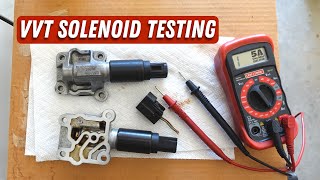
Unplug the solenoid and measure the electrical resistance across its terminals using a multimeter set to Ohms (Ω). A healthy solenoid reads between 5 and 15 ohms. A reading of infinity (OL) or near zero indicates internal failure requiring replacement.
Tools: Digital Multimeter (Intermediate) - Test Circuit Voltage and Ground
Turn the key on (engine off) and check for power at the solenoid's harness connector. One pin must show battery voltage (11-14.5V). An absence of voltage indicates a blown fuse or a broken power wire.
Tools: Digital Multimeter, Vehicle-specific wiring diagram (Intermediate) - Command the Solenoid with a Scan Tool
Use a bi-directional scan tool to command the solenoid on and off with the engine running. Listen for an audible click and watch live data for changes in camshaft angle. No change confirms a failed solenoid or PCM driver.
Tools: Advanced Bi-Directional Scan Tool (Advanced) - Check Engine Oil Pressure
Connect a mechanical oil pressure gauge to the engine's test port. Verify pressure meets manufacturer specs (typically >15 PSI at idle). Low pressure indicates a failing oil pump or internal engine wear.
Tools: Mechanical Oil Pressure Gauge, Service Manual (Advanced) - Analyze the PWM Signal
Connect an oscilloscope to the solenoid's control wire to view the PCM's Pulse Width Modulation (PWM) signal. A missing or distorted square wave confirms a PCM driver failure or a hidden wiring short.
Tools: Oscilloscope, Back-probe connectors (Professional)
When This Code Triggers (Freeze-Frame Conditions)
- Engine Coolant Temp: 180-210°F (The fault is most often detected when the engine is fully warmed up and operating in closed-loop mode.)
- Engine RPM: 1500-3000 RPM (The code sets during steady-state cruising or light acceleration, when the PCM actively commands camshaft adjustments.)
- Engine Load: 25-60% (The PCM commands the VVT system under moderate load conditions to optimize efficiency, making faults highly visible.)
- Vehicle Speed: 40-65 mph (Consistent with highway or suburban cruising speeds where the VVT system is most active.)
Related Codes
- P0082 — Indicates 'Intake Valve Control Solenoid Circuit Low'. While P0081 is a general circuit fault, P0082 specifically points to a short to ground or a solenoid with high internal resistance.
- P0080 — The identical code for Bank 1. Seeing P0080 and P0081 together guarantees a common problem affecting the entire engine, such as low oil level or a failing oil pump.
- P0018 / P0019 — Crankshaft/Camshaft Correlation codes for Bank 2. These appear alongside P0081 if a stretched timing chain causes a mechanical timing error the VVT system cannot correct.
- P0302 / P0304 — Misfire codes for Bank 2 cylinders. A malfunctioning VVT system disrupts the air/fuel mixture, causing misfires. Fixing the P0081 code usually resolves the misfires.
Climate & Environmental Factors
- Extreme Cold Weather: Temperatures below freezing thicken conventional engine oil. This increased viscosity slows oil flow, starving the VVT system on startup and triggering faults.
- High Humidity & Road Salt: Moisture and road salt cause severe corrosion on connector pins and seep into cracked wiring insulation, creating electrical shorts in the VVT circuit.
- Extreme Heat: Sustained high temperatures bake wire insulation until it becomes brittle and cracks. Heat also accelerates oil oxidation, forming hard sludge that clogs VVT screens.
- High Altitude: Altitude does not directly cause P0081, but engines run differently in thin air, making borderline VVT or oil pressure issues more noticeable.
How to Talk to a Mechanic About This Code
Say this: "I have a P0081 code and need a diagnostic. Please start by checking the oil condition, then test the Bank 2 VVT solenoid circuit for resistance, power, and ground before recommending a part replacement."
This proves you understand P0081 is a circuit code with multiple causes. It forces the mechanic to perform a logical electrical diagnosis rather than immediately upselling the most expensive part.
Avoid saying:
- 'Just fix whatever's wrong'
- 'My check engine light is on, can you look at it?'
- 'Go ahead and replace the VVT solenoid'
Questions to ask before authorizing the repair:
- What were the exact resistance and voltage readings on the solenoid circuit?
- Can you show me the old part and point out the failure (e.g., clogged screen, corrosion)?
- Did you check for any technical service bulletins (TSBs) related to this code for my vehicle?
- What is the warranty on the recommended parts and labor?
Where to Take It: Dealer vs Independent vs Chain
- Dealer:
A safe choice for German brands or if a TSB is involved, but overkill for a simple solenoid replacement on an out-of-warranty vehicle.
Best for: Vehicles under powertrain or emissions warranty., Complex manufacturer recalls (e.g., BMW VANOS bolts)., When PCM replacement and programming is required.
Downsides: Labor rates are 40-50% higher than independent shops., Dealers frequently recommend replacing entire assemblies rather than smaller components. (Typical cost: +40% vs. baseline) - Independent Shop:
The best fit for most situations. A reputable independent shop efficiently diagnoses and repairs P0081 without dealer markups.
Best for: Out-of-warranty vehicles where cost is a factor., Diagnosing electrical codes on non-exotic vehicles., Building a long-term relationship with a trusted mechanic.
Downsides: Diagnostic capabilities vary widely; always vet shops by reviews and ASE certifications., May lack access to the latest proprietary manufacturer software updates. (Typical cost: +0% vs. baseline) - Chain Shop:
Acceptable for an oil change, but avoid for diagnosing P0081. High risk of misdiagnosis or unnecessary parts replacement.
Best for: Simple jobs like an oil and filter change., Tire rotations and battery replacements.
Downsides: Technicians lack experience with in-depth electrical diagnostics., High-pressure sales tactics push unnecessary services. (Typical cost: -10% vs. baseline)
When to Walk Away From the Repair
If the estimated repair cost exceeds 50% of the car's private-party value, seriously consider selling or trading in the vehicle instead of repairing it.
- Car worth $4000, fix is $350: Fix it. This repair is a small fraction of the car's value and is necessary for engine health.
- Car worth $3000, fix is $1500: Borderline. This repair is 50% of the car's value. Get a second opinion and assess the car's overall condition before proceeding.
- Car worth $2500, fix is $2500: Walk away. The repair cost equals the car's value, and ignoring the issue risks even more expensive engine damage.
What Scan Tool You Need for This Code

Minimum: A scanner that reads/clears codes and displays live data PIDs for camshaft position and VVT duty cycle.
A basic $20 code reader only provides the P0081 code. Proper diagnosis requires bi-directional control to command the solenoid directly, a feature absent in cheap readers.
Professional: Autel MaxiCOM MK808S / MK900BT / Launch X431 Series (~$400-1200) — Offers OEM-level bidirectional diagnostics, fast processing, ECU coding, and advanced functions designed for speed in a professional workshop setting.
Rent vs buy: Auto parts stores loan basic scanners for free, but they lack bi-directional control. If you diagnose vehicles more than once a year, buying a mid-range scanner is a worthwhile investment.
How to Clear the Code After You Fix It
- Use an OBD-II scan tool to clear the P0081 trouble code.
- Reconnect the battery if it was disconnected during the repair.
- Perform a complete OBD-II drive cycle to allow the vehicle's readiness monitors to run their self-tests.
Drive cycle (~30 minutes): Start the engine cold and idle for 3 minutes. Drive in stop-and-go traffic for 15 minutes, followed by 10 minutes of steady highway driving at 55-60 mph.
Readiness monitors affected: VVT System, Catalyst (CAT), Oxygen (O2) Sensor
Before emissions retest: drive at least 100 miles to fully set monitors.
Watch out for:
- Disconnecting the battery clears the code but resets all readiness monitors to 'Not Ready', guaranteeing an emissions test failure.
- The code returns immediately if the underlying electrical short or mechanical blockage is not repaired.
- Failing to complete the full drive cycle leaves the VVT monitor incomplete.
Will This Fail Emissions / State Inspection?
Yes — this code typically fails an OBD-II emissions inspection.
- California: P0081 is an automatic failure for a Smog Check. A complete drive cycle must be performed to set all readiness monitors to 'Ready' before re-testing.
- New York: The NYS DMV inspection includes an OBD-II scan. An active P0081 code results in an immediate emissions failure.
- Texas: In the 17 Texas counties requiring emissions testing, a vehicle with an active P0081 code fails the OBD inspection.
Most Commonly Affected Vehicles
- Hyundai Tucson, Santa Fe (2016-2021) — Models with the Nu 2.0L GDI engine are highly susceptible to VVT issues. TSB 22-01-028H-1 updates engine monitoring software to address related oiling faults.
- Subaru Outback, Forester, Legacy (2013-2022) — FA and FB series engines frequently experience AVCS (VVT) codes. TSB 02-163-16R provides updated diagnostic procedures to prevent misdiagnosis.
- BMW 3-Series, X3, X5 (2006-2013) — N51/N52/N55 engines are notorious for VANOS (VVT) system failures. NHTSA Recall 23V-707 addresses shearing VANOS gear bolts that cause mechanical timing faults.
- Ford F-150 (2015-2018) — Frequently triggers P0081 due to damaged wiring connectors causing erratic solenoid operation.
- Chevrolet Silverado, Malibu (2015-2018) — Prone to P0081 from faulty solenoids and extended oil change intervals causing heavy sludge buildup.
- Infiniti G37 / FX35 (2008-2013) — Commonly suffers from heat-damaged, brittle wiring harnesses that break internally, leading to complex diagnostic scenarios.
- Mazda 6 (2014-2017) — P0081 triggers a severe 'limp mode' on this model, causing drastically reduced acceleration and heavy steering.
- Nissan Titan, Altima, Quest (2010-2019) — Faulty solenoids and vibration-damaged wiring are prevalent causes in these models.
Manufacturer-Specific Notes
- BMW: On N-series engines, aluminum bolts holding the VANOS gear to the camshaft shear off. NHTSA Recall 23V-707 replaces these bolts free of charge on affected 2010-2013 models.
- Subaru: Subaru issued TSB 09-112-23 to reprogram the ECM, updating diagnostic logic to prevent false AVCS (VVT) codes from setting on FA/FB engines.
- Hyundai / Kia: Service campaign TSB 22-01-028H-1 updates engine control software to detect abnormal bearing noise, which correlates with oiling issues that destroy VVT components.
- Mazda: On the Mazda 6, a P0081 code forces the vehicle into a severe 'limp mode' that alters power steering feel alongside drastically cutting engine power.
- Infiniti / Nissan: Wiring harnesses become extremely brittle from engine heat. Technicians frequently find broken wires hidden inside intact insulation, causing misdiagnoses.
Real Owner Stories
2011 Chevy Malibu with 2.4L Engine
Check Engine Light on, rough idle, and poor acceleration. The owner extended oil change intervals to 10,000 miles using synthetic oil.
Outcome: The solenoid screens were heavily clogged with black sludge and metallic shavings. Replacing the solenoids and performing an engine flush resolved the issue.
Lesson: Extending oil change intervals beyond 7,500 miles creates sludge that clogs VVT components and causes circuit codes, even when using high-quality synthetic oil.
2009 Infiniti G37 with V6-3.7L Engine
Persistent P0081 code and severe power loss, even after extensive repairs.
Outcome: A technician discovered a broken wire hidden inside the engine harness that had become brittle from heat. Repairing the single wire permanently fixed the code.
Lesson: P0081 is an electrical code. Thoroughly inspect and test the wiring harness for hidden breaks before replacing expensive mechanical components.
2015 Ford F-150
Intermittent P0081 code with random engine hesitation.
Outcome: A technician performing a 'wiggle test' found the electrical connector to the solenoid was damaged, causing an intermittent connection. Splicing in a new connector pigtail provided a permanent fix.
Lesson: Physically manipulating the wiring harness while monitoring scanner data reveals loose pins that visual inspections miss.
How to Prevent This Code From Triggering
- Follow manufacturer's recommended oil change intervals (Every 5,000-7,500 miles) — Removes contaminants and prevents engine sludge, the primary cause of clogged VVT solenoid screens.
- Use high-quality synthetic oil of the correct viscosity (Every oil change) — Synthetic oils resist thermal breakdown, and the correct viscosity ensures the hydraulic VVT system operates at design pressure.
- Perform an engine flush service if sludge is suspected (As needed) — Safely dissolves accumulated sludge from narrow oil passages, restoring proper flow to the VVT system.
- Avoid frequent short trips (Daily habit) — Allows engine oil to reach optimal operating temperature, burning off moisture and fuel that accelerate sludge formation.
- Periodically clean VVT solenoid filter screens (Every 60,000 miles) — Removes minor debris from accessible filter screens before it causes a significant blockage and solenoid failure.
Frequently Asked Questions
What is 'Bank 2'?
On a V-shaped engine (V6 or V8), 'Bank 1' is the side containing cylinder #1, and 'Bank 2' is the opposite side. Inline 4-cylinder engines only have one bank, so they cannot trigger a P0081 code.
What are the most common misdiagnoses for P0081?
A frequent mistake is immediately replacing the VVT solenoid without checking the oil or wiring. The code often stems from underlying issues like dirty oil, clogged passages, or broken wires. Always follow a systematic diagnostic approach, starting with the simplest causes.
Can a stretched timing chain cause a P0081 code?
Yes. A severe mechanical timing issue from a stretched chain pushes the camshaft position so far out of range that the PCM's electrical attempts to correct it fail. This triggers a circuit fault, usually alongside timing correlation codes like P0018.
How do I tell the difference between P0081 and P0082?
P0081 is a general circuit malfunction indicating an open, short to ground, or short to power. P0082 specifically means the circuit's voltage is consistently below specification, directing technicians to hunt for a short to ground.
How much does it cost to fix P0081?
A professional diagnostic costs between $150 and $200. Replacing a faulty VVT solenoid typically costs $150 to $350, while complex wiring repairs or PCM replacements exceed $1,000. If dirty oil is the culprit, an oil change costs under $100.
Can I replace the VVT solenoid myself?
Yes, replacing the VVT solenoid is a DIY-friendly repair requiring basic hand tools. The solenoid sits on the front or top of the engine's valve cover and secures with a single 10mm bolt. Always lubricate the new O-ring with fresh engine oil to prevent leaks.
Will the P0081 code go away by itself?
No. The computer stores the code because it detected a persistent fault. You must repair the underlying problem and clear the code with a scanner.
Can a bad VVT solenoid cause a no-start condition?
Yes. If a severely failed VVT solenoid locks the valve timing in an extreme position during cranking, it prevents the engine from starting.
Key Takeaways
- P0081 indicates an electrical circuit failure in the Bank 2 intake variable valve timing (VVT) solenoid.
- Check your engine oil level and condition immediately, as low or sludgy oil causes over 30% of VVT-related faults.
- Test the solenoid's electrical resistance before replacing it; a healthy VVT solenoid typically reads between 5 and 15 ohms.
- Fix this code within 1 to 3 months to prevent unburnt fuel from destroying your catalytic converter, a repair costing upwards of $1,500.
Helpful Videos


The information in this article is provided for general reference and educational purposes only. Vehicle specifications, procedures, and part compatibility can vary by production date, trim level, and region. Always consult your vehicle's factory service manual and verify part numbers before purchasing or performing repairs. Safety-critical components such as airbags, seat belts, and braking systems should be installed by a qualified professional.
- 🎬 Helpful Videos
- What Does P0081 Mean?
- Can I Drive With P0081?
- Common Causes
- Symptoms
- Diagnostic Flowchart
- Common Fixes & Costs
- DIY vs Professional
- Used vs. New Parts: Buying Guide
- What Happens If You Wait — Timeline
- Cost of Not Fixing It
- Diagnosis Steps
- When This Code Triggers (Freeze-Frame Conditions)
- Related Codes
- Climate & Environmental Factors
- How to Talk to a Mechanic About This Code
- Where to Take It: Dealer vs Independent vs Chain
- When to Walk Away From the Repair
- What Scan Tool You Need for This Code
- How to Clear the Code After You Fix It
- Will This Fail Emissions / State Inspection?
- Most Commonly Affected Vehicles
- Manufacturer-Specific Notes
- Real Owner Stories
- 2011 Chevy Malibu with 2.4L Engine
- 2009 Infiniti G37 with V6-3.7L Engine
- 2015 Ford F-150
- How to Prevent This Code From Triggering
- Frequently Asked Questions
- What is 'Bank 2'?
- What are the most common misdiagnoses for P0081?
- Can a stretched timing chain cause a P0081 code?
- How do I tell the difference between P0081 and P0082?
- How much does it cost to fix P0081?
- Can I replace the VVT solenoid myself?
- Will the P0081 code go away by itself?
- Can a bad VVT solenoid cause a no-start condition?
- Key Takeaways
- 🎟️ Get 5% Off