

P0070 on 2016-2020 Ram 2500: Ambient Air Temp Sensor Circuit Causes and Fixes
On a 2016-2020 Ram 2500, code P0070 almost always points to a faulty Ambient Air Temperature (AAT) sensor located in the driver's side mirror, a break in the wiring where it passes through the door jamb, or the installation of aftermarket mirrors lacking the sensor. A new sensor is about $15-$30, and it's a very common, easy DIY fix.
- P0070 on a 2016-2020 Ram 2500 is almost always an issue with the Ambient Air Temperature sensor or its wiring.
- Before buying parts, check the sensor nub on the bottom of the driver's mirror for damage and inspect the wires in the driver's door jamb for breaks.
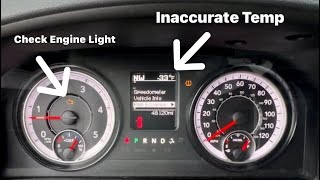
- The most common symptom is a Check Engine Light accompanied by a wild temperature reading on the dash (like -40°F) and a malfunctioning A/C.
- Replacing the sensor is a simple, inexpensive DIY job that requires minimal tools and takes less than 15 minutes.
- If a new sensor doesn't fix the problem, the cause is almost certainly a broken wire in the door harness.
What's Unique About the 2016-2020 Ram 2500
For this generation of Ram trucks, the ambient air temperature sensor is most commonly located in the bottom of the driver's side mirror. This placement makes the wiring susceptible to breaking from the repeated stress of the driver's door opening and closing. While the sensor itself can fail, the most frequent cause of P0070 on these trucks is a wiring issue within the door harness, a problem well-documented by owners in enthusiast forums. Additionally, the popularity of installing aftermarket tow mirrors, which often lack a compatible sensor, is a major cause of this code on Ram trucks.
Diagnostic Flowchart
Tap your situation to follow the diagnostic path that matches what you're seeing on this vehicle.
Generation note: This year range covers two generations: the Fourth Generation (2016-2018) and the Fifth Generation (2019-2020). On both generations, the AAT sensor is typically located in the driver's side mirror, and the failure modes are similar. However, some base model 4th gen trucks may have the sensor located behind the grille, though this is less common. A Reddit user with a 2015 model confirmed their issue was ultimately traced to aftermarket mirrors that lacked the sensor, despite initially searching behind the grille.
Symptoms You May Notice
- Check Engine Light is on
- Incorrect or blank outside temperature reading on the dash or infotainment screen (often defaults to an extreme number like -40°F).
- Automatic climate control system does not work correctly (e.g., A/C doesn't blow cold).
- Inaccurate operation of heated mirrors or other temperature-dependent features
- In rare cases with aftermarket parts, a false high temp reading can disable window operation as a safety feature.
- Replacing the PCM when the fault is in the wiring.
- Replacing the entire mirror assembly when only the small, inexpensive sensor is needed or the wiring is broken.
Most Likely Causes
- Broken or Chafed Wiring in Door Harness 🔴 High Probability The wires for the sensor run through the flexible boot between the driver's door and the truck's body. Constant opening and closing of the door eventually fatigues and breaks the wires. Forum users report finding multiple severed wires inside this boot.
How to confirm: Peel back the rubber boot in the door jamb and inspect the wires for breaks, chafing, or damage. Wiggle the harness while observing the temperature reading on the dash to see if it changes. The main connector can be unplugged from the body side to allow more room to work.
Typical fix: Repair the broken wire(s). For a durable repair in this high-flex area, it is recommended to solder the wires and protect them with heat shrink tubing. Some owners suggest adding a short length of new, more flexible wire to the repaired section to prevent future breaks at the solder joint.
Est. part cost: $5-$20 for wire repair supplies - Faulty Ambient Air Temperature (AAT) Sensor 🔴 High Probability The sensor is exposed to the elements under the mirror. The plastic tip of the sensor can become brittle from age and exposure and physically break off, causing an open circuit.
How to confirm: Visually inspect the sensor nub on the bottom of the driver's side mirror for physical damage. If it looks intact, test its resistance with a multimeter; it should be around 10,000 ohms (10kΩ) at 77°F (25°C) and change with temperature.
Typical fix: Replace the sensor. This is a simple plug-and-play part accessed by removing a small panel on the bottom of the mirror housing.
Est. part cost: $15-$40 - Installation of Aftermarket Mirrors 🟡 Medium Probability It is very common for owners to upgrade to larger tow mirrors. Many aftermarket mirror assemblies do not include a new AAT sensor or use an incompatible one, which immediately triggers code P0070 or P0073.
How to confirm: Determine if the truck has aftermarket mirrors. If the code appeared immediately after a mirror swap, this is the likely cause. The original driver's side mirror will have the sensor; the new one may not.
Typical fix: If the original mirror is available, transfer the OEM sensor to the new mirror housing. If not, purchase a new OEM sensor and a specific jumper harness (e.g., Boost Auto Parts #2843) designed to add the sensor circuit back into the mirror connector.
Est. part cost: $30-$60 for a new sensor and adapter harness
Rare But Worth Checking
- Faulty Powertrain Control Module (PCM): This is extremely rare. All other possibilities, especially wiring and the sensor itself, should be exhaustively ruled out before considering the PCM as the cause.
- Blown Fuse: A video for 2013-2018 models suggests checking fuse F99 (10A) in the engine bay fuse box, which is related to temperature sensor circuits. While not a common cause for an isolated P0070, it's a quick and easy check.
Diagnosis Steps
- Verify the complaint: Check the outside temperature reading on the dashboard. Is it showing an illogical value like -40°F or is it blank?
- Scan for codes: Confirm P0070 and check for related codes like P0071, P0072, or P0073.
- Check for Aftermarket Mirrors: Determine if non-OEM mirrors have been installed. If so, this is a primary suspect.
- Visually inspect the sensor: Locate the small, black nub on the bottom of the driver's side mirror. Check if it is damaged, broken, or missing.
- Inspect the door harness: Peel back the rubber boot between the driver's door and the A-pillar. Carefully inspect the wires inside for any signs of breaks, pinching, or chafing. This is a very common failure point.
- Inspect the connector: Carefully pry off the small access panel under the mirror. Disconnect the sensor and check the connector for corrosion or damage.
- Test the circuit: With the sensor unplugged and the key on, use a multimeter to check for voltage at the connector. You should have a 5V reference on one wire and a good ground on the other.
- Test the sensor (optional): If you have a multimeter, measure the resistance of the two pins on the sensor. The resistance should be around 10kΩ at room temperature.
- If wiring and power are good, the sensor is the most likely culprit. If there is no power or ground, the wiring is broken somewhere between the door and the PCM.
Parts You'll Likely Need
- Ambient Air Temperature Sensor
(OEM #68457701AA (supersedes 68138681AD), 5149264AB)— This is the most common failure point. The sensor element itself fails or is physically broken.
Trusted brands: Mopar, Dorman, Standard Motor Products
OEM price range: $25-$40
Aftermarket price range: $15-$30 - Wiring Repair Supplies — If the wires are broken in the door jamb, you will need butt connectors (or preferably a soldering iron) and heat shrink tubing to perform a durable repair.
Aftermarket price range: $5-$20 - AAT Sensor Jumper Harness for Aftermarket Mirrors — Required if aftermarket tow mirrors were installed without an AAT sensor, to add the circuit back.
Trusted brands: Boost Auto Parts #2843
Aftermarket price range: $20-$30
Related Codes That Often Appear With This One
- P0071 — This code indicates a 'Sensor Range/Performance' issue, often set alongside P0070 when readings are illogical but not fully open or shorted.
- P0072 — This code indicates the 'Sensor Circuit Low', pointing to a short to ground.
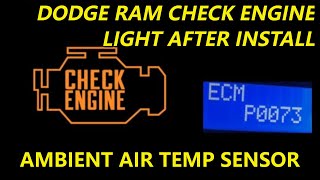
- P0073 — This code indicates the 'Sensor Circuit High', pointing to an open circuit. This is very common with a broken wire or missing sensor and is mentioned specifically in TSB #S2208000080 and by aftermarket harness suppliers.
- U110E — A communication code that can appear when the ambient air temperature data is lost.
Technical Service Bulletins (TSBs) & Recalls
- S2208000080: Addresses MIL-on with DTCs P0070-15 (Ambient Air Temperature Sensor Circuit-Circuit Short to Battery or Open) and P0073 for 2016 models.
Platform-Specific Known Issues
- The placement of the AAT sensor in the driver's side mirror leads to a high frequency of wire failures in the door jamb due to the stress of the door opening and closing.
- TSB #S2208000080 was issued for 2016 models for DTCs P0070-15 and P0073, specifically calling out a circuit short or open, which points directly to a wiring problem.
- Installation of aftermarket tow mirrors is a very common cause of this code, as they often lack the required sensor, necessitating a workaround.
Mechanic-Grade Diagnostic Values
- AAT Sensor Resistance — expected: Approx. 10 kOhms at 77°F (25°C); 336 kOhms at -40°F (-40°C); 2.488 kOhms at 131°F (55°C). Resistance should decrease as temperature increases.. Failure: Infinite resistance (open), near-zero resistance (short), or a value that does not change when temperature is altered.
- Voltage at AAT Sensor Connector (Key On, Engine Off) — expected: Approximately 5.0V reference on one pin and a good ground on the other.. Failure: 0V or significantly low voltage indicates an open or short in the power or ground circuit upstream from the sensor.
- Wiring Harness Resistance (Disconnected from modules) — expected: Below 5.0 Ohms for the signal and ground wires from the sensor connector to the Driver Door Module (DDM) connector.. Failure: Infinite resistance (OL) indicates a broken wire.
Hidden / Shadow Codes Worth Checking
- P0070-15: A manufacturer-specific sub-code indicating 'Ambient Air Temperature Sensor Circuit-Circuit Short to Battery or Open'. This is more specific than the generic P0070 and points directly to an electrical failure rather than a performance issue. (see via Dealer-level scan tools like wiTECH or some advanced professional scanners. It is explicitly mentioned in TSB #S2208000080.)
Scan Tool Commands That Help
- N/A (Vehicle Procedure): AAT Signal Update Drive Cycle — After replacing the sensor or repairing the wiring, the temperature display may not update immediately. TSB S2208000080 notes that the vehicle must be driven to verify the fix and allow the modules to recognize the new, valid signal.
Wiring & Ground Locations
- AAT Sensor Data Path — The sensor signal does not go directly to the PCM. The path is: AAT Sensor -> Driver Door Module (DDM) -> Body Control Module (BCM) -> Powertrain Control Module (PCM).. A fault can exist not just in the sensor-to-DDM wiring, but also in the DDM, BCM, or the communication network between them. This is a critical, often-missed diagnostic path.
- (G31) AAT Signal Circuit — This is the signal wire running between the AAT sensor in the mirror and the Driver Door Module (DDM).. This is the primary wire to test for continuity when diagnosing an open or short circuit.
- Z939 (Ground) — Pin 5 of the main driver's side mirror connector.. This is the ground circuit for components in the mirror, including likely the AAT sensor. A bad ground here would cause an open circuit fault.
- (C160) Driver Mirror Heater Return Circuit — A circuit within the driver's mirror assembly.. Diagnostic procedures for related code P0073 mention checking this circuit, suggesting it may share a connector or ground path with the AAT sensor, making it relevant to check for opens or high resistance.
Real Owner Repair Stories
- 5thGenRams Forum user 'Bsteiner36' (2019 Ram Laramie) — Temperature was stuck at 31 degrees for two days when the actual outside temp was 60 degrees.
❌ Tried (didn't work) Waiting for it to self-correct.
✅ What actually fixed it Turned the truck off, unplugged the sensor from the bottom of the mirror, turned the truck back on (it read 185 degrees), then plugged the sensor back in. The temperature reading returned to normal. This suggests the issue was a poor connection that was resolved by reseating the connector. - 5thGenRams Forum user 'Jplumley' (2019 Ram Laramie) — P0071 code. Outdoor temp read 84 when it was 27 degrees. After repairs, it was still inaccurate (reading 38 when it was 30).
❌ Tried (didn't work) Replacing only the AAT sensor., Replacing the entire driver's side mirror assembly.
✅ What actually fixed it The user's issue was ongoing at the time of the post and required dealer tech support, highlighting that even after replacing the most common parts, the issue can persist, potentially due to a module or software issue.
OEM Part Supersession History
68138681AD / AE→68457701AA— Standard part revision and update by manufacturer.5149264AB→
Heads up: Part number 5149264AB is also an air temperature sensor for Ram trucks, but it is typically used for intake air temperature or is located on the radiator core support or frame on different models/trims. It is not the correct part for the in-mirror AAT sensor on most 2016-2020 Ram 2500s and should not be used as a substitute for 68457701AA.
Helpful Videos

We Have This Part in Stock



The information in this article is provided for general reference and educational purposes only. Vehicle specifications, procedures, and part compatibility can vary by production date, trim level, and region. Always consult your vehicle's factory service manual and verify part numbers before purchasing or performing repairs. Safety-critical components such as airbags, seat belts, and braking systems should be installed by a qualified professional.
- Ram 2500:
- 🎬 Helpful Videos
- 🛍️ Shop This Part
- What's Unique About the 2016-2020 Ram 2500
- Diagnostic Flowchart
- Symptoms You May Notice
- Most Likely Causes
- Rare But Worth Checking
- Diagnosis Steps
- Parts You'll Likely Need
- Related Codes That Often Appear With This One
- Technical Service Bulletins (TSBs) & Recalls
- Platform-Specific Known Issues
- Mechanic-Grade Diagnostic Values
- Hidden / Shadow Codes Worth Checking
- Scan Tool Commands That Help
- Wiring & Ground Locations
- Real Owner Repair Stories
- OEM Part Supersession History
- 🎟️ Get 5% Off