

OBD-II Code P0069: Manifold Pressure vs. Barometric Pressure Mismatch
What P0069 means, why it triggers, and how to fix it
- Code P0069 triggers when the Powertrain Control Module detects a difference of more than 5-10 kPa between the MAP and BARO sensors at startup.
- Compare live MAP and BARO sensor data using an OBD-II scanner with the key on and engine off; readings must match within 1-2 kPa.
- Inspect the engine air filter and MAP sensor vacuum lines first, as a $20 clogged filter or cracked hose frequently causes this code.
- Fix this code within 1-2 months to prevent a rich air-fuel mixture from destroying the catalytic converter, a repair costing upwards of $1,500.
What Does P0069 Mean?

The Powertrain Control Module (PCM) sees a disagreement between the Manifold Absolute Pressure (MAP) sensor and the Barometric Pressure (BARO) sensor. These sensors measure air pressure to calculate the correct air-fuel mixture. When their readings fail to match during Key On, Engine Off (KOEO) self-tests, the computer logs P0069.
Technical definition: The SAE/OBD-II definition for P0069 is "Manifold Absolute Pressure – Barometric Pressure Correlation." The PCM detects that voltage signals from the MAP and BARO sensors do not correlate within a predetermined range. This check occurs with the Key On, Engine Off (KOEO), when both sensors must read atmospheric pressure, or at wide-open throttle. If the difference exceeds the manufacturer's specified tolerance (typically over 10.35 kPa), the code sets.
🎬 Watch: A quick breakdown of P0069 causes and symptoms.Can I Drive With P0069?
Yes, But With Caution. You can drive for a short time, but you will experience poor engine performance, reduced fuel economy, and stalling. Diagnose the vehicle within a week. Ignoring the issue causes abnormal wear on internal engine parts and destroys the catalytic converter from an incorrect air-fuel mixture, a repair costing $800 to $2,500.
Common Causes

- Faulty Manifold Absolute Pressure (MAP) Sensor (Very Common) — The MAP sensor fails, becomes contaminated with oil, or loses calibration, sending incorrect pressure readings to the computer.
- Damaged Vacuum Lines or Intake Leaks (Common) — The MAP sensor connects to the intake manifold via a small vacuum hose. A cracked, split, or clogged hose, or unmetered air entering through a leaking intake gasket, skews pressure readings.
- Dirty or Clogged Air Filter (Common) — A severely clogged engine air filter restricts airflow enough to artificially drop pressure in the intake manifold, triggering a correlation fault.
- Faulty Barometric Pressure (BARO) Sensor (Common) — The BARO sensor, measuring atmospheric pressure, fails. Modern vehicles integrate this sensor into the MAP sensor, Mass Airflow (MAF) sensor, or the PCM.
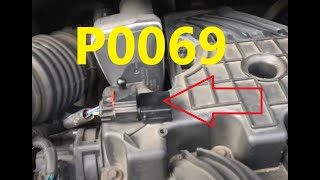
- Wiring and Connector Issues (Less Common) — Damaged, corroded, or loose wiring and electrical connectors for the MAP or BARO sensor disrupt the 5-volt reference or signal circuit. 🎬 See this step-by-step guide on testing your MAP sensor.
- Carbon Buildup in Intake Manifold (Less Common) — Direct-injection engines develop heavy carbon deposits that clog intake manifold runners or the MAP sensor port, blocking accurate pressure readings.
- Clogged Catalytic Converter (Rare) — A restricted exhaust creates backpressure in the engine, altering intake manifold pressure and triggering P0069 alongside a P0420 code.
- Faulty Powertrain Control Module (PCM) (Rare) — The vehicle's main computer fails or contains corrupted calibration data, misinterpreting sensor data. This requires a dealer software update or module replacement.
Symptoms

- Check Engine Light is On — Immediate illumination of the check engine light on the dashboard.
- Reduced Engine Power and Limp Mode — The vehicle exhibits sluggish acceleration, hesitation, or enters a protective 'limp mode' that drastically limits speed.
- Rough Idle and Stalling — The engine shakes, surges, or dies completely when stopped at a light or idling.
- Decreased Fuel Economy — Incorrect sensor readings force an inefficient air-fuel mixture, dropping fuel efficiency by 5-10%.
- Difficulty Starting — The engine cranks longer than usual before starting, especially when cold.
- Engine Detonation (Knocking) — Incorrect MAP readings cause the PCM to advance ignition timing too far, creating a pinging sound under load.
Diagnostic Flowchart
Tap your situation to follow the diagnostic path that matches what you're seeing on this code.
Common Fixes & Costs
- Replace Manifold Absolute Pressure (MAP) Sensor — Parts: $50-$150, Labor: $50-$100, ~0.5 hr book time (DIY)
- Clean or Replace Clogged Air Filter — Parts: $15-$50, Labor: $0, ~0.1 hr book time (DIY)
- Replace Damaged Vacuum Hose — Parts: $5-$20, Labor: $0-$50, ~0.3 hr book time (DIY)
- Repair or Replace Damaged Wiring — Parts: $10-$30, Labor: $100-$250, ~1.5 hr book time (Intermediate)
- Clean Intake Manifold Port — Parts: $5-$15, Labor: $75-$150, ~1 hr book time (Intermediate)
- Reprogram or Replace PCM — Parts: $600-$900, Labor: $150-$300, ~2 hr book time (Professional)
DIY vs Professional
- Replace Manifold Absolute Pressure (MAP) Sensor — Beginner:
Tools: Basic socket set or screwdriver, clean rag. - Clean or Replace Clogged Air Filter — Beginner:
Tools: Screwdriver or socket set. - Replace Damaged Vacuum Hose — Beginner:
Tools: Pliers, utility knife. - Repair or Replace Damaged Wiring — Beginner:
Tools: Multimeter, wire strippers, soldering iron, heat shrink tubing. - Clean Intake Manifold Port — Beginner:
Tools: MAF cleaner, small brushes, safety glasses. - Reprogram or Replace PCM — Beginner:
Tools: Advanced bi-directional scan tool, battery maintainer.
Used vs. New Parts: Buying Guide
When a used part is worth it: For a common and inexpensive part like a MAP sensor, buying a used one rarely makes sense due to the minimal cost savings and unknown history.
Donor-vehicle mileage cap: roughly under 50000 miles for the part to have meaningful remaining life.
Donor quality checklist:
- Match the part number exactly; aftermarket and OEM sensors are not always interchangeable.
- Avoid sensors from vehicles with high mileage or known engine problems.
- Visually inspect the sensor for physical damage, corrosion on the pins, or heavy oil contamination.
Decision logic:
- If The cost of a new OEM or reputable aftermarket sensor is under $150 → Always buy new. The risk of a used part failing shortly after installation outweighs the small savings.
- If The vehicle is very old and an OEM part is no longer available → A used OEM sensor from a low-mileage donor vehicle is a better choice than a low-quality new aftermarket part.
- If You are selling the car immediately and need a cheap, temporary fix → A used part might be considered, but it is not a recommended long-term solution.
Warranty tradeoff: Used parts from a salvage yard typically have a 30-90 day warranty. New aftermarket sensors come with a 1-year to limited lifetime warranty. New OEM parts carry a 1-year warranty.
Worst-case if a used part fails: $100-$250 if a used sensor fails, requiring repeat diagnostics and labor for replacement.
What Happens If You Wait — Timeline
- 0-1 month: Check Engine Light illuminates. The driver experiences minor engine hesitation and a 3-5% drop in fuel economy. The vehicle fails emissions testing. (MPG impact: 3-5%% · Added cost: $10-$30 in wasted fuel.)
- 1-4 months: Rough idling and hesitation become consistent. The engine runs rich, fouling spark plugs and increasing emissions. (MPG impact: 5-10%% · Added cost: $50-$150 for wasted fuel and spark plug replacement.)
- 4-8 months: The rich air-fuel mixture overheats the catalytic converter, permanently damaging the precious metal substrate. Engine knocking occurs under load. (MPG impact: 10-15%% · Added cost: $300-$800 for early catalytic converter degradation.)
- 8+ months: Complete catalytic converter failure causes severe power loss. Prolonged poor combustion accelerates wear on piston rings and cylinder walls. (MPG impact: 15-25%% · Added cost: $1000-$2500 for catalytic converter and potential engine repairs.)
Cost of Not Fixing It
- 0-1 month: Noticeable drop in fuel economy (5-10%), rough idle, and engine hesitation. Failed emissions test. (Added cost: $20-$50 per month in wasted fuel.)
- 1-6 months: The persistent incorrect air-fuel ratio causes carbon buildup on spark plugs and begins to overheat the catalytic converter. (Added cost: $100-$300 for spark plug replacement and diagnostics.)
- 6+ months: Severe damage to the catalytic converter requires replacement. Prolonged poor combustion increases wear on internal engine components. (Added cost: $800-$2500 for catalytic converter replacement.)
Diagnosis Steps

- Check KOEO Live Data (MAP vs BARO)
Use an OBD-II scanner to view live data for the MAP and BARO sensors with the key on, engine off (KOEO). Readings must be nearly identical and match atmospheric pressure (approx. 101 kPa at sea level). A difference greater than 5 kPa points directly to a sensor or circuit issue.
Tools: OBD-II Scanner with Live Data (Beginner) - Inspect the Air Filter
Remove and inspect the engine air filter. Replace it if dirty or clogged, clear the code, and test drive. A heavily restricted filter creates an artificial pressure drop.
Tools: Basic hand tools (Beginner) - Inspect Vacuum Lines and Intake Port
Examine the vacuum hose running from the intake manifold to the MAP sensor for cracks, splits, or loose connections. Verify the intake manifold port is free of carbon buildup by checking for suction while cranking.
Tools: Flashlight, Safety Glasses (Beginner) - Inspect Sensor Wiring and Connectors
Visually examine wiring and connectors for the MAP and BARO sensors. Look for melted insulation, corrosion, or loose pins. Clean dirty connections with electrical contact cleaner.
Tools: Flashlight, Electrical Contact Cleaner (Intermediate) - Check for Technical Service Bulletins (TSBs)
Search manufacturer TSBs for your specific year, make, and model. Automakers frequently issue software updates to fix overly sensitive PCM correlation logic causing false P0069 codes.
Tools: Online repair database (e.g., ALLDATA, ProDemand) (Beginner) - [PRO TIP] Test MAP Sensor Circuit Integrity
Disconnect the MAP sensor. Turn the key on. Using a multimeter, verify 5.0 volts on the reference wire and ~12 volts on the ground pin. Missing voltage indicates a wiring harness or PCM fault.
Tools: Digital Multimeter, Vehicle-specific wiring diagram (Advanced) - [PRO TIP] Test MAP Sensor Response
Back-probe the MAP signal wire with a multimeter. Voltage should read 4.5-5.0V with the key on, engine off, and drop to 0.9-2.0V at idle. Apply vacuum directly to the sensor using a hand pump; voltage must change smoothly without sticking.
Tools: Digital Multimeter, T-pins, Hand-held Vacuum Pump (Advanced) - MAP Sensor Resistance Test
With the sensor disconnected, measure resistance across the terminals using a multimeter set to Ohms. Compare the reading to the manufacturer's specification (typically 5-10 kΩ). An open circuit (OL) confirms a dead sensor.
Tools: Digital Multimeter, Repair Manual (Advanced)
When This Code Triggers (Freeze-Frame Conditions)
- Engine Coolant Temp: 0-40°F or 180-210°F (During KOEO (Key On, Engine Off) check or after engine is fully warmed up.)
- RPM: 0 (The primary check is done with Key On, Engine Off (KOEO).)
- Engine Load: 0% or >80% (The test runs either at KOEO (0% load) or during Wide-Open Throttle (WOT) conditions.)
- Vehicle Speed: 0 mph (The correlation test most often runs when the vehicle is stationary before startup.)
Related Codes
- P0106 — Indicates a MAP/BARO circuit range/performance problem. P0106 flags an erratic signal during engine operation, meaning the sensor is failing dynamically.
- P0107 — Means the MAP/BARO circuit input is low. Points directly to a short to ground, a dead sensor, or an open signal circuit.
- P0108 — Means the MAP/BARO circuit input is high. Indicates a short to power or an internally shorted sensor.
- P0068 — Indicates a correlation error between the MAP/MAF sensor and throttle position. Seeing both codes suggests a complex air intake measurement failure.
Climate & Environmental Factors
- Altitude Changes: Significant altitude changes directly affect barometric pressure. A sluggish sensor fails to correlate correctly with new atmospheric pressure, triggering P0069.
- Extreme Weather Systems: Sudden atmospheric pressure drops from severe storms cause temporary discrepancies between the BARO sensor and expected MAP readings.
- Extreme Temperatures: Extreme heat accelerates degradation of plastic vacuum lines and wiring. Extreme cold makes rubber brittle, causing vacuum leaks and temporary sensor glitches.
How to Talk to a Mechanic About This Code
Say this: "I have a P0069 code and I'd like to schedule a diagnostic. Please start by comparing the live data from the MAP and BARO sensors with the key on, engine off. I'd also like you to inspect the MAP sensor's vacuum hose and electrical connector before recommending part replacements."
This signals to the mechanic that you understand the basic diagnostic steps. It encourages a thorough diagnosis rather than immediately replacing the most expensive part.
Avoid saying:
- 'Just fix whatever's wrong'
- 'My check engine light is on, can you look at it?'
- 'Whatever you recommend'
Questions to ask before authorizing the repair:
- What were the MAP and BARO readings with the key on, engine off? What was the difference between them?
- Did you inspect the vacuum line to the MAP sensor for cracks or blockages?
- Did you test the MAP sensor's 5-volt reference and ground circuits?
- Will you provide a printout of the freeze-frame data?
- What is the warranty on this specific repair?
Where to Take It: Dealer vs Independent vs Chain
- Dealer:
Necessary for warranty work or known software/TSB issues, but an expensive option for common out-of-warranty repairs.
Best for: Vehicles still under powertrain or emissions warranty., Vehicles with known TSBs or software issues related to P0069., Complex electrical diagnostics if an independent shop fails to find the issue.
Downsides: Highest labor rates, typically 1.5-2x more than independent shops., May recommend replacing a sensor when a cheaper fix like a vacuum hose repair suffices. (Typical cost: +50% vs. baseline) - Independent Shop:
Best fit for most P0069 situations. A competent independent shop easily handles the diagnosis and repair of common causes.
Best for: Most out-of-warranty vehicles., Diagnosing and fixing common causes like bad sensors, vacuum leaks, and wiring issues., A balance of expertise and reasonable cost.
Downsides: Shop quality varies greatly; check reviews and look for ASE certifications., May lack the latest manufacturer-specific software for reflashing a PCM. (Typical cost: +0% vs. baseline) - Chain Shop:
Use with caution. Acceptable for a simple air filter replacement, but avoid for initial diagnosis due to the risk of misdiagnosis.
Best for: Simple, clear-cut part replacements if you are certain what the problem is (e.g., replacing an air filter).
Downsides: Technician skill varies dramatically., High pressure to upsell services; may replace a MAP sensor without diagnosing a simpler underlying cause., Often lack advanced diagnostic tools for complex electrical issues. (Typical cost: -10% vs. baseline)
When to Walk Away From the Repair
If the estimated repair cost exceeds 40-50% of the car's private-party value, sell or trade in the vehicle.
- Car worth $4000, fix is $2000: Borderline. The repair cost is 50% of the car's value. Get a second opinion before authorizing the repair.
- Car worth $12000, fix is $1800: Fix it. The repair cost is only 15% of the car's value, well below the walk-away threshold.
- Car worth $2500, fix is $1500: Walk away. The repair cost is 60% of the car's value. This is not a sound financial decision.
What Scan Tool You Need for This Code
Minimum: An OBD-II scanner that reads and displays live data PIDs (Parameter IDs).
A basic $20 code reader only tells you P0069 is present. It cannot show live data from the MAP and BARO sensors, which is essential to see if the sensor values correlate with the key on and engine off.
Budget: BlueDriver Pro (~$100) — Connects to your smartphone via Bluetooth and allows you to view and graph live data for the MAP and BARO sensors.
Mid-range: Foxwell NT510 Elite (~$180) — A handheld scanner providing live data with graphing capabilities. It includes manufacturer-specific data points more accurate than generic OBD-II data.
Professional: Autel MaxiCOM MK808 / MK808BT (~$450-550) — Offers full-system diagnostics, advanced live data graphing, and bidirectional controls. Fast processing makes diagnosing intermittent wiring issues easier.
Rent vs buy: For a one-time diagnosis, auto parts stores loan scanners capable of reading live data for free with a refundable deposit. Buy a scanner only if you perform diagnostics multiple times a year.
How to Clear the Code After You Fix It
- Use an OBD-II scan tool to clear the code.
- Perform a complete OBD-II drive cycle to allow readiness monitors to run.
- Re-scan the vehicle to confirm the code has not returned.
Drive cycle (~20 minutes): Cold start the engine and let it idle for 2-3 minutes. Drive in mixed city/highway conditions for 15-20 minutes, including periods of steady cruising and acceleration. Allow the vehicle to idle for another 1-2 minutes before shutting down. Let the vehicle cool completely.
Readiness monitors affected: Comprehensive Component Monitor (CCM), Catalyst (CAT) Monitor, Evaporative (EVAP) System Monitor
Before emissions retest: drive at least 50 miles to fully set monitors.
Watch out for:
- Clearing the code with a scanner does not fix the underlying issue; the code returns if the fault is still present.
- Disconnecting the battery resets all readiness monitors, guaranteeing an emissions test failure until a full drive cycle is completed.
Will This Fail Emissions / State Inspection?
Yes — this code typically fails an OBD-II emissions inspection.
- California: An active P0069 code causes an automatic failure of the smog check. All readiness monitors must be set to 'Ready' for the test to proceed.
- New York: A vehicle automatically fails the NYS inspection if the Check Engine Light is on. A drive cycle of up to a few days is needed to set readiness monitors after clearing the code.
- Texas: In counties where emissions testing is required, an illuminated Check Engine Light from a P0069 code results in an automatic failure.
Most Commonly Affected Vehicles

- Dodge Ram with Cummins Engine (2007-2018) — Often caused by a dirty air filter or a faulty Intake Air Temperature (IAT) sensor. Aftermarket performance chips are a known trigger.
- Ford F-150 / Fusion / Escape with EcoBoost (2011-2018) — These turbocharged engines are highly sensitive to pressure discrepancies. TSBs 19-2120, 20-2245, and 21-2360 address known software and wiring issues.
- Chrysler / Dodge Town & Country / Grand Caravan (2011-2016) — MAP sensor failure is common on these minivans with the 3.6L Pentastar engine, peaking between 125,000 and 150,000 miles.
- Hyundai / Kia Sonata, Tucson, Optima with 2.4L GDI Engine (2012-2018) — Commonly associated with a failing MAP sensor or heavy carbon buildup in the intake manifold.
- Honda CR-V, Civic (2018-2023) — Points to a barometric pressure sensor circuit performance problem. The BARO sensor is often integrated into the PCM.
- Volkswagen / Audi Jetta, Golf, Passat, A4 (2009-2019) — Caused by outdated PCM software that misinterprets sensor readings, requiring a dealer software update.
- General Motors Astra, Corsa, Insignia (2006-2017) — Frequently points to a faulty MAP sensor or wiring issues in the engine harness.
- BMW 3 Series, 5 Series, X3, X5 (2007-2016) — Triggered by vacuum leaks or a failing MAP sensor. A smoke test is required to find leaks in complex intake systems.
Manufacturer-Specific Notes
- Dodge/Ram (Cummins): Aftermarket performance tuners alter sensor readings and frequently trigger this code on Cummins diesels. Removing the tuner resolves it.
- Ford: EcoBoost engines use multiple pressure sensors. TSBs 19-2120, 20-2245, and 21-2360 address known software, wiring, and water intrusion issues causing false P0069 codes.
- General Motors (GM): The BARO sensor is integrated into the PCM on many models. A failure here requires professional PCM diagnosis and replacement.
- Volkswagen/Audi: Overly sensitive PCM software falsely triggers P0069. A dealer-performed software update is the primary fix after verifying sensors.
Real Owner Stories
2005 Pontiac Grand Prix GTP with P0069
Check Engine Light illuminated with P0069. The engine sputtered and died when trying to build boost.
What they tried:
- Replaced MAP sensor with a cheap aftermarket part, which failed to fix it.
- Installed two new OEM sensors for both BARO and MAP.
- Verified 5V reference and ground wiring.
- Replaced cracked vacuum hoses connected to the MAP sensor.
Outcome: Replacing the vacuum hoses restored boost and drivability. However, P0069 returned as a pending code after 150 miles, indicating a deeper mechanical issue beyond the sensors.
Lesson: Start with simple fixes like vacuum hoses, but avoid cheap aftermarket sensors. Use a quality scanner to watch live data rather than throwing parts at the problem.
2013 Ford F-150 6.7L Diesel in Cold Weather
After starting the truck in single-digit temperatures, the Check Engine Light triggered P0069. The boost gauge temporarily stuck at 37 PSI.
What they tried:
- Read the code at an auto parts store.
- Attempted to clear the code, which failed initially, but the light turned off naturally after a few drive cycles.
Outcome: The issue was a temporary fluke caused by extreme cold freezing moisture in the sensor port. It did not return.
Lesson: Extreme cold causes temporary sensor correlation issues. If the code appears after a cold start and clears itself without persistent symptoms, it is not a hard fault.
2019 Ford F-250 6.7L with 11,000 miles
Intermittent P0069 code led to power loss, a pegged factory boost gauge reading 40 PSI, and a disabled engine brake.
What they tried:
- Cleared the code to temporarily restore normal operation.
- Cleaned the MAF sensor.
- Replaced the air filter.
Outcome: Cleaning the MAF and replacing the filter aligned pressure readings at idle, but symptoms returned under load. The issue pointed to a mechanical failure in the Variable Geometry Turbo (VGT).
Lesson: On modern diesels, P0069 links to complex turbocharger systems. Temporary relief from cleaning sensors does not fix underlying mechanical boost issues.
2010 Mazda MX-5 NC after Engine Swap
A persistent P0069 code appeared after an engine swap. The car ran perfectly, but live data showed MAP at 10 kPa while BARO was 101 kPa.
What they tried:
- Replaced the MAP sensor.
- Sprayed intake cleaner to check for vacuum leaks.
- Verified wiring integrity.
Outcome: The massive 91 kPa discrepancy with the engine off confirmed a dead sensor or severed wire, not a vacuum leak.
Lesson: Compare MAP and BARO readings with the Key On, Engine Off (KOEO). A massive difference points directly to a bad sensor or wiring, ruling out vacuum leaks entirely.
How to Prevent This Code From Triggering
- Regularly Replace the Engine Air Filter (Every 15,000-30,000 miles.) — A clean filter ensures unrestricted airflow. A clogged filter creates an artificial pressure drop in the intake manifold, triggering a correlation error with the BARO sensor.
- Clean the MAP Sensor and Intake Port (Every 30,000-50,000 miles.) — Oil vapor and carbon contaminate the MAP sensor's element or clog its port, slowing response times. Use a dedicated electronics cleaner.
- Inspect Vacuum Hoses (During every oil change.) — Vacuum lines become brittle and crack from engine heat. Visual inspections prevent vacuum leaks that cause P0069.
- Use Top-Tier Fuel (Every fill-up.) — Detergents prevent carbon deposit formation in the intake manifold, keeping sensor ports clear on direct-injection engines.
Frequently Asked Questions
Can I fix a P0069 code myself?
Yes, this is a DIY-friendly repair. The most common causes—a bad MAP sensor, a dirty air filter, or a cracked vacuum hose—are accessible and straightforward to replace with basic tools.
What is the difference between a MAP sensor and a BARO sensor?
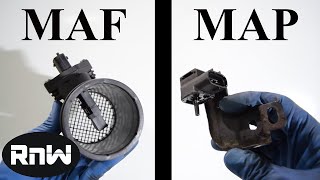
The MAP sensor measures air pressure inside the engine's intake manifold to determine engine load. The BARO sensor measures outside atmospheric pressure, which changes with altitude. The computer compares these two readings to calculate precise fuel delivery.
How much does it cost to fix P0069?
A professional diagnosis costs $100 to $165. Replacing a MAP sensor at a shop runs $100 to $250 for parts and labor. Simple fixes like a new air filter or vacuum hose cost under $50.
Where is the BARO sensor located?
The BARO sensor location varies by vehicle. It is either a standalone sensor, integrated into the MAP sensor, located inside the Mass Airflow (MAF) sensor, or built directly into the Powertrain Control Module (PCM).
Will clearing the code fix the problem?
No, clearing the code only turns off the check engine light temporarily. The code returns as soon as the computer runs its diagnostic check and detects the pressure mismatch again.
What are common misdiagnosis pitfalls for P0069?
A common mistake is replacing the MAP sensor without checking live data first. Technicians must compare MAP and BARO readings with the key on and engine off to confirm a sensor failure. Overlooking a clogged air filter or cracked vacuum line also leads to wasted money.
Can aftermarket parts cause a P0069 code?
Yes. Aftermarket performance tuners manipulate sensor signals and frequently trigger this code on diesel trucks. Low-quality aftermarket MAP sensors also provide inaccurate readings that fail the computer's correlation test.
Key Takeaways
- Code P0069 triggers when the Powertrain Control Module detects a difference of more than 5-10 kPa between the MAP and BARO sensors at startup.
- Compare live MAP and BARO sensor data using an OBD-II scanner with the key on and engine off; readings must match within 1-2 kPa.
- Inspect the engine air filter and MAP sensor vacuum lines first, as a $20 clogged filter or cracked hose frequently causes this code.
- Fix this code within 1-2 months to prevent a rich air-fuel mixture from destroying the catalytic converter, a repair costing upwards of $1,500.
Helpful Videos

The information in this article is provided for general reference and educational purposes only. Vehicle specifications, procedures, and part compatibility can vary by production date, trim level, and region. Always consult your vehicle's factory service manual and verify part numbers before purchasing or performing repairs. Safety-critical components such as airbags, seat belts, and braking systems should be installed by a qualified professional.
- 🎬 Helpful Videos
- What Does P0069 Mean?
- Can I Drive With P0069?
- Common Causes
- Symptoms
- Diagnostic Flowchart
- Common Fixes & Costs
- DIY vs Professional
- Used vs. New Parts: Buying Guide
- What Happens If You Wait — Timeline
- Cost of Not Fixing It
- Diagnosis Steps
- When This Code Triggers (Freeze-Frame Conditions)
- Related Codes
- Climate & Environmental Factors
- How to Talk to a Mechanic About This Code
- Where to Take It: Dealer vs Independent vs Chain
- When to Walk Away From the Repair
- What Scan Tool You Need for This Code
- How to Clear the Code After You Fix It
- Will This Fail Emissions / State Inspection?
- Most Commonly Affected Vehicles
- Manufacturer-Specific Notes
- Real Owner Stories
- 2005 Pontiac Grand Prix GTP with P0069
- 2013 Ford F-150 6.7L Diesel in Cold Weather
- 2019 Ford F-250 6.7L with 11,000 miles
- 2010 Mazda MX-5 NC after Engine Swap
- How to Prevent This Code From Triggering
- Frequently Asked Questions
- Can I fix a P0069 code myself?
- What is the difference between a MAP sensor and a BARO sensor?
- How much does it cost to fix P0069?
- Where is the BARO sensor located?
- Will clearing the code fix the problem?
- What are common misdiagnosis pitfalls for P0069?
- Can aftermarket parts cause a P0069 code?
- Key Takeaways
- 🎟️ Get 5% Off