

OBD-II Code P0061: A Comprehensive Guide to Oxygen Sensor Heater Resistance (Bank 2, Sensor 3)
The ultimate resource for understanding, diagnosing, and fixing DTC P0061, with pro tips and model-specific advice.
- P0061 indicates an electrical resistance failure in the heater circuit of the oxygen sensor located after the final catalytic converter on Bank 2.
- A burnt-out internal heater element inside the oxygen sensor causes over 70% of P0061 codes, requiring a direct sensor replacement.
- Driving with P0061 drops fuel economy by 2-4% and guarantees an emissions test failure, while ignoring it for months risks a $2,000 catalytic converter replacement.
- Always test the O2 heater fuse and verify 12-volt power at the sensor harness connector before spending $100+ on a replacement sensor.
- Avoid the most common DIY mistake by verifying you are replacing Bank 2, Sensor 3, which is always the furthest downstream sensor on the engine side opposite cylinder #1.
What Does P0061 Mean?

The Powertrain Control Module (PCM) detected an electrical resistance problem in the heater circuit of the Bank 2, Sensor 3 oxygen (O2) sensor. Bank 2 is the engine side opposite cylinder #1, and Sensor 3 is the sensor located after the final catalytic converter. The internal heater warms the sensor to over 600°F (316°C) within seconds of a cold start, ensuring immediate and accurate exhaust gas data.
Technical definition: The PCM continuously monitors the O2 sensor heater circuit, expecting a specific resistance (typically 5-10 Ohms at room temperature). If the measured value is too high (indicating an open circuit) or too low (indicating a short circuit), the PCM triggers P0061.
Can I Drive With P0061?
Yes, But With Caution. Yes, but address it within a few weeks. Ignoring it causes poor fuel economy and a guaranteed emissions test failure. Prolonged driving forces the engine to run rich, which overheats and permanently damages the catalytic converter. This turns a minor repair into a $800-$2,500 major expense.
Common Causes

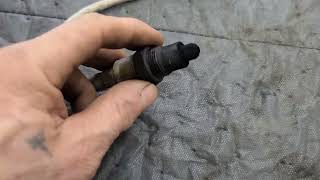
- Faulty Bank 2, Sensor 3 Oxygen Sensor (Very Common) — The internal heater element burns out or breaks from thousands of heat cycles, accounting for over 70% of P0061 cases. 🎬 See this step-by-step walkthrough for replacing oxygen sensors
- Damaged Wiring or Corroded Connectors (Common) — The O2 sensor harness is exposed to extreme heat and road debris. Melted wires, chafing, rodent damage, or water-corroded connectors create high resistance that mimics a failed sensor.
- Blown Fuse or Faulty Relay (Less Common) — A blown fuse cuts all power to the heater. If replacing the fuse causes it to blow again immediately, a short circuit exists in the wiring.
- Poor Ground Connection (Uncommon) — A corroded engine or chassis ground strap introduces unwanted resistance into the circuit, leading the PCM to incorrectly blame the sensor.
- Faulty PCM or Software Glitch (Very Rare) — In rare cases, the PCM's internal driver circuit fails, or factory software parameters are too sensitive, requiring a dealership software update.
Symptoms
- Check Engine Light is On — The Malfunction Indicator Lamp (MIL) illuminates immediately and remains on while the fault is active.
- Failed Emissions Test — An active P0061 code results in an automatic failure of any state emissions or smog inspection.
- Rough Idle and Black Smoke on Cold Starts — The engine hesitates, stumbles, or emits a brief puff of black smoke for the first minute after a cold start due to an inaccurate fuel mixture.
- Reduced Fuel Economy (also visible on scanner) — The PCM stays in 'open-loop' mode longer after a cold start, running a default rich fuel mixture that drops MPG by 2-4%.
- Carbon Buildup on Spark Plugs (scan-tool only — no driver-felt sign) — A long-term rich running condition causes excessive carbon fouling on the spark plugs, eventually leading to misfires.
Diagnostic Flowchart
Tap your situation to follow the diagnostic path that matches what you're seeing on this code.
Common Fixes & Costs
- Replace the Bank 2, Sensor 3 Oxygen Sensor
— Parts: $50-$250, Labor: $75-$150, ~1.2 hr book time
(DIY)
Land Rover Range Rover (2013-2016): OEM LR136928 (Alt: Bosch 15510, Denso 234-4981)
Ford F-150 (2015-2017 5.0L): OEM Motorcraft FL3Z-9G444-D (Alt: Bosch 15717, Denso 234-4968)
Chevrolet Silverado (2014-2018 5.3L): OEM ACDelco 12657188 (Alt: Bosch 15741, Denso 234-4974) - Repair Damaged Wiring or Clean Connector — Parts: $5-$30, Labor: $100-$200, ~1.5 hr book time (Intermediate)
- Replace Blown O2 Heater Fuse — Parts: $1-$5, Labor: $0-$75, ~0.2 hr book time (DIY)
- Repair or Replace Ground Strap — Parts: $15-$50, Labor: $50-$100, ~1 hr book time (Intermediate)
- Replace Powertrain Control Module (PCM) — Parts: $600-$1200, Labor: $200-$300, ~1.5 hr book time (Professional)
DIY vs Professional
- Replace Oxygen Sensor — Beginner:
Tools: Jack and jack stands, penetrating oil, 22mm or 7/8" oxygen sensor socket, ratchet, torque wrench. - Repair Wiring / Connector — Beginner:
Tools: Multimeter, wire strippers, soldering iron, heat shrink tubing, electrical tape. - Replace Fuse — Beginner:
Tools: Fuse puller or needle-nose pliers. - PCM Replacement — Beginner:
Tools: Professional diagnostic scan tool with programming capabilities.
Used vs. New Parts: Buying Guide
When a used part is worth it: Buying a used oxygen sensor is never recommended. It is a wear-and-tear electrical component with a finite lifespan.
Donor-vehicle mileage cap: roughly under 40000 miles for the part to have meaningful remaining life.
Donor quality checklist:
- If forced, only take one from a low-mileage vehicle wrecked for non-engine reasons.
- Avoid sensors from rust-belt vehicles or those with oil contamination.
- Test the heater resistance with a multimeter before purchase.
Decision logic:
- If The part is an oxygen sensor. → Buy a new OEM or high-quality aftermarket (Denso, Bosch, NTK) sensor.
- If The vehicle is a Toyota, Honda, or brand sensitive to sensor specifications. → Strongly prefer a new OEM or OEM-supplier part to avoid compatibility issues.
- If Budget is the absolute top priority and the vehicle is old. → A used sensor is a gamble that costs more in the long run due to repeat labor.
Warranty tradeoff: Used parts have a 30-day warranty. New quality aftermarket sensors offer a 1-year to limited lifetime warranty. OEM parts carry a 1-year warranty.
Worst-case if a used part fails: $150-$300 if a used sensor fails after installation, requiring repeat labor and a new part.
What Happens If You Wait — Timeline
- 0-2 weeks: Code P0061 is stored and the Check Engine Light turns on. The heater circuit is inactive. No other symptoms are likely to be noticed. (MPG impact: 0-2%% · Added cost: $0)
- 2 weeks - 3 months: A noticeable drop in fuel economy occurs as the engine runs in open loop for longer after cold starts. The driver perceives a rougher idle. (MPG impact: 2-5%% · Added cost: $20-$60 in wasted fuel.)
- 3-8 months: The prolonged rich-running condition damages the catalytic converter. The excess fuel overheats the catalyst substrate, causing it to lose efficiency. (MPG impact: 4-8%% · Added cost: $50-$150 in wasted fuel, plus high risk of needing a new catalytic converter.)
- 8+ months: The catalytic converter substrate melts or clogs completely from constant overheating. The engine experiences significant power loss and hesitation. (MPG impact: 10-25%% · Added cost: $1500-$3000 (catalytic converter, potentially a new O2 sensor again, and diagnostic time).)
Cost of Not Fixing It
- 0-1 Month: A noticeable 2-4% drop in fuel economy and a guaranteed failed emissions test. (Added cost: $10-$30 per month in extra fuel, plus the cost of a failed emissions test.)
- 1-6 Months: The engine running in a prolonged rich condition causes the catalytic converter to overheat, leading to reduced efficiency. (Added cost: $0 if caught early, but risk of major damage increases significantly.)
- 6+ Months: Permanent failure of the catalytic converter is highly likely. The substrate melts or clogs, causing severe loss of engine power. (Added cost: $800-$2,500 for catalytic converter replacement.)
Diagnosis Steps

- Read the Code and Freeze Frame Data
Use an OBD-II scanner to confirm P0061. Analyze freeze frame data to identify the exact engine coolant temperature and RPM when the fault occurred.
Tools: OBD-II Scanner (Beginner) - Inspect the O2 Sensor Heater Fuse
Locate the O2 sensor heater fuse in the owner's manual. Use a multimeter to check for continuity, as visual inspections miss hairline cracks.
Tools: Owner's Manual, Multimeter (Beginner) - Visually Inspect Wiring and Connector
Safely raise the vehicle and locate Bank 2, Sensor 3. Inspect the wiring harness for melting or chafing, and unplug the connector to check for water intrusion or bent pins.
Tools: Jack and Jack Stands, Flashlight (Beginner) - Test Sensor Heater Resistance
With the sensor disconnected, set a multimeter to Ohms (Ω) and probe the two heater circuit pins (often the same color wires). A reading of 'OL' (open) or near-zero (shorted) confirms a bad sensor. Normal is typically 5-10 Ohms.
Tools: Multimeter, Service Manual (Intermediate) - Check Power and Ground at Connector
Turn the ignition 'ON' (engine off). Use a multimeter set to DC Volts to verify battery voltage (11-14V) on the harness power wire and continuity to chassis ground on the ground wire.
Tools: Multimeter, Service Manual (Intermediate) - Perform a Voltage Drop Test
Back-probe the sensor connector with the engine running. A reading above 0.5V on the power side or 0.2V on the ground side indicates hidden wiring resistance.
Tools: Multimeter with back-probe pins (Advanced) - Analyze Live Data with a Scan Tool
Monitor the heater command PID and current draw (typically 0.25A to 1.5A). Zero current draw when commanded ON confirms an open circuit.
Tools: Advanced OBD-II Scan Tool (Advanced) - Check Heater Control with a Lab Scope
Connect a lab scope to the ground-side control wire. A healthy system shows a square wave. A flat line at 0V indicates a short to ground; a flat line at battery voltage indicates an open circuit.
Tools: Automotive Oscilloscope (Professional)
When This Code Triggers (Freeze-Frame Conditions)
- Engine Coolant Temp: 180-210°F (82-99°C) (The engine is fully warmed up and operating in closed loop.)
- RPM: 1200-2500 RPM (The fault is detected during steady-state cruise or light acceleration, rarely at idle.)
- Engine Load: 20-50% (Corresponds to steady highway driving or gentle acceleration.)
- Vehicle Speed: 40-65 mph (64-105 kph) (The PCM runs heater circuit diagnostics during constant speed driving.)
Related Codes
- P0060 — Indicates the same heater resistance fault, but for Bank 2, Sensor 2. If your vehicle has both, a shared wiring issue triggers both codes.
- P0162 — A general circuit malfunction for Bank 2, Sensor 3. If present with P0061, suspect a physically damaged wiring harness affecting the entire sensor.
- P0163 — Means the sensor's signal voltage is low. A broken heater (P0061) prevents the sensor from reaching operating temperature, causing this code simultaneously.
- P0164 — Indicates high voltage from the circuit. An internal short within the sensor connects the heater power circuit to the signal circuit, causing both codes.
Climate & Environmental Factors
- Cold Climates with Road Salt: Road salt and brine solutions are highly corrosive and destroy O2 sensor connectors, wiring insulation, and the sensor body itself.
- Thermal Shock: Driving through deep puddles splashes cold water onto the hot exhaust. This rapid temperature change cracks the sensor's internal ceramic element.
- High Humidity: Consistently humid environments promote moisture intrusion into non-sealed electrical connectors, leading to corrosion and high resistance.
How to Talk to a Mechanic About This Code
Say this: "I have a P0061 code for the oxygen sensor heater on Bank 2, Sensor 3. I'd like to schedule a diagnostic to confirm if the issue is the sensor itself or the wiring. Please check the sensor's resistance and verify power and ground at the connector before recommending a replacement."
This directs the technician to perform specific diagnostic steps rather than just replacing the part, preventing you from paying for a sensor you don't need if the fault is in the wiring.
Avoid saying:
- 'My check engine light is on, can you look at it?'
- 'Just fix whatever's wrong.'
- 'The code is for an O2 sensor, just replace it.'
Questions to ask before authorizing the repair:
- What was the resistance reading of the old sensor's heater circuit?
- Did you confirm there is battery voltage and a good ground at the harness connector?
- If the sensor is the fix, what is the warranty on the new part and your labor?
- Can you provide me with the old part?
Where to Take It: Dealer vs Independent vs Chain
- Dealer:
Best for: Vehicles still under a powertrain or emissions warranty., Vehicles with known manufacturer-specific quirks (e.g., Land Rover, BMW, Subaru) where TSBs or software updates are common., Complex electrical issues where a previous repair at an independent shop has failed.
Downsides: Significantly higher labor rates, often 1.5x to 2x that of an independent shop., May be more inclined to replace a whole component assembly rather than performing a targeted wiring repair. (Typical cost: +50% vs. baseline) - Independent Shop:
Best fit for most situations. P0061 is a common code that any competent independent shop can diagnose and repair effectively. Their lower labor rates provide better value.
Best for: Most out-of-warranty vehicles where cost is a factor., Straightforward sensor replacements and wiring diagnostics., Building a long-term relationship with a trusted mechanic.
Downsides: Shop quality and diagnostic skill vary widely; vet them through reviews and ASE certifications., May lack access to the very latest manufacturer-specific software for brand-new models. (Typical cost: +0% vs. baseline) - Chain Shop:
Use with caution. Acceptable for a straightforward sensor replacement if you have already diagnosed the issue yourself. AVOID for initial diagnosis.
Best for: Simple, high-volume jobs like tire changes or oil services.
Downsides: Technician skill and diagnostic equipment are inconsistent., Business models incentivize upselling, leading to recommendations for unnecessary services like fuel system flushes. (Typical cost: -10% vs. baseline)
When to Walk Away From the Repair
If the total estimated repair cost exceeds 40-50% of your car's current private-party value, seriously consider selling or trading it in instead of repairing it.
- Car worth $4000, fix is $2000: Borderline. The repair is 50% of the car's value. Get a second opinion before authorizing, and consider selling it as-is.
- Car worth $12000, fix is $1800: Fix it. The repair cost is only 15% of the vehicle's value, which is well below the threshold.
- Car worth $2500, fix is $1500: Walk away. The repair cost is 60% of the car's value. This is not a sound financial decision.
What Scan Tool You Need for This Code
Minimum: A code reader that can read and clear codes, show freeze frame data, and display live sensor data.
A basic $20 code reader only gives you the 'P0061' number. It won't let you see live data (like heater status) or freeze frame data, which are crucial for determining if the fault happened during a cold start or while driving.
Budget: BlueDriver Pro (~$100) — Connects to your smartphone via Bluetooth. It reads the P0061 code, views freeze frame data, and graphs live O2 sensor data.
Mid-range: Foxwell NT510 Elite (~$200) — Offers bi-directional control, allowing you to command the O2 sensor heater circuit on and off to test its function directly.
Professional: Autel MaxiCOM MK808BT (~$550) — Offers full bi-directional control to test the heater circuit, comprehensive live data graphing, and access to all vehicle modules for diagnosing complex wiring issues.
Rent vs buy: Many auto parts stores offer a free loaner tool program. You can 'rent' a basic OBD-II scanner by leaving a deposit, which is refunded when you return the tool.
How to Clear the Code After You Fix It
- Use an OBD-II scan tool to clear the P0061 code.
- Perform a complete drive cycle to allow the vehicle's readiness monitors to run.
- Re-scan the vehicle to confirm the code has not returned and the monitors are set.
Drive cycle (~20 minutes): 1) Cold start and idle for 2-3 minutes. 2) Drive at a steady 55 mph (88 kph) for 5-10 minutes. 3) Coast down from 55 mph to 20 mph (32 kph) without braking. 4) Drive for 5-10 minutes in stop-and-go traffic.
Readiness monitors affected: O2 Sensor Monitor, O2 Heater Monitor, Catalyst Monitor
Before emissions retest: drive at least 50 miles to fully set monitors.
Watch out for:
- Disconnecting the battery clears the code but resets all readiness monitors, requiring a full drive cycle before an emissions test.
- The code returns immediately if the root cause (e.g., bad wiring) was not fixed.
- Failing to perform a complete drive cycle leaves readiness monitors 'Not Ready', causing an emissions test failure.
Will This Fail Emissions / State Inspection?
Yes — this code typically fails an OBD-II emissions inspection.
- California: An active P0061 code is an automatic smog check failure. A full drive cycle must be completed to set OBD-II readiness monitors to 'Ready' before a re-test.
- New York: The NYS DMV vehicle inspection includes an OBD-II scan. An illuminated Check Engine Light results in an immediate failure.
- Texas: In counties requiring emissions testing, a P0061 code causes the vehicle to fail the OBD portion of the inspection.
Most Commonly Affected Vehicles
- Land Rover Range Rover / Range Rover Sport (2013-2016) — Extremely common. Multiple TSBs cite a manufacturing fault causing premature sensor failure due to thermal shock or internal misalignment.
- Land Rover Range Rover Evoque (2013-2016) — The 2.0L 4-cylinder engine only has one bank, so the 'Bank 2' designation is a software quirk referring to the downstream sensor.
- Ford F-150 (2007-2024) — On V8 models, P0061 reliably points to the downstream O2 sensor on the passenger side. The wiring harness is notoriously vulnerable to road debris.
- Chevrolet Silverado / GMC Sierra (2007-2024) — V8 models trigger this code for the sensor after the secondary catalytic converter on the passenger side. Wiring damage is a common secondary cause.
- Jeep Grand Cherokee (2011-2021) — Common on V6 and V8 models. Failures are a mix of standard sensor end-of-life and wiring harness damage due to exhaust proximity.
- Toyota Tundra (2007-2024) — On V8 models, this code is frequently caused by a failed heater element or corrosion in the electrical connector.
- Subaru Outback / Forester (2018-2019) — Owners report P0061 on 4-cylinder models, which lack a 'Bank 2'. This is a known scanner misinterpretation; the code refers to the downstream sensor (Bank 1, Sensor 2).
- BMW Various (X3, X5, 3-Series, 5-Series) (2000-2019) — Points to the post-catalyst sensor on Bank 2. Due to complex wiring, precise diagnosis is critical to avoid replacing the wrong part.
Manufacturer-Specific Notes

- Land Rover: On 4-cylinder models, the PCM logs a P0061 'Bank 2' fault even though the engine has one bank. 'Bank 2' designates the downstream sensor.
- Subaru: P0061 is a 'ghost code' on 4-cylinder Subarus, as they have no Bank 2 or Sensor 3. The actual fault is with the downstream sensor (Bank 1, Sensor 2).
- Honda / Acura: On V6 engines, Bank 2 is located against the firewall, making access to the downstream O2 sensor notoriously difficult and increasing labor costs.
- Mercedes-Benz: Uses proprietary connectors that become brittle with age. It is easy to break the locking tab during diagnosis, requiring a replacement pigtail.
- General Motors: Issued a voluntary emissions recall (14061) for some vans where condensation caused O2 sensor fracture, highlighting a known thermal shock failure pathway.
Real Owner Stories
2015 Ford F-150 at 110K miles
Check Engine Light came on with P0061. Owner noticed a 1-2 MPG drop in fuel economy over the prior month.
What they tried:
- Scanned the code and identified it as Bank 2, Sensor 3.
- Purchased a new Motorcraft sensor and replaced it themselves.
Outcome: Replacing the sensor was the correct fix. The code was cleared and did not return. Fuel economy returned to normal.
Lesson: For a high-mileage truck, a drop in MPG followed by a P0061 code is a classic symptom of the original sensor's heater element wearing out.
2013 Land Rover Range Rover Sport at 85K miles
P0061 code appeared. No noticeable driving symptoms. Owner was aware of Land Rover's reputation for O2 sensor issues.
What they tried:
- Owner took it to a dealer who diagnosed a faulty sensor based on TSBs (SSM72556).
- Replaced the Bank 2, Sensor 3 O2 sensor with an OEM part.
Outcome: The new sensor resolved the P0061 code. The repair was straightforward due to the known issue with these models.
Lesson: On certain vehicles like 2013-2016 Land Rovers, P0061 is almost certainly a bad sensor due to documented manufacturing defects. Check TSBs before extensive wiring diagnostics.
2018 Subaru Outback 2.5i at 70K miles
Owner's cheap code reader showed P0061, which refers to 'Bank 2, Sensor 3'. This was confusing as the 4-cylinder engine has no Bank 2.
What they tried:
- Owner tested resistance on both upstream and downstream sensors.
- Posted on a forum for advice, confirming this is a common scanner misinterpretation for Subarus.
Outcome: The consensus was that the scanner mislabeled the code and the actual fault was with the downstream sensor (Bank 1, Sensor 2).
Lesson: On single-bank engines (I4, I6), 'Bank 2' codes are impossible. This is a known software quirk on brands like Subaru. Use vehicle-specific knowledge to identify the correct sensor.
2014 Chevrolet Silverado with intermittent P0061
Check Engine Light would come on for a few days then go off. The problem became more frequent over several months.
What they tried:
- Replaced the Bank 2, Sensor 3 O2 sensor, but the code returned intermittently a month later.
- Shop performed a voltage drop test and found high resistance on the ground wire only when the harness was wiggled.
Outcome: A section of the ground wire had internal corrosion from road salt. Splicing in a new section permanently fixed the issue.
Lesson: If a new sensor doesn't fix the code, the problem is in the wiring. Intermittent faults require a 'wiggle test' or voltage drop test under load to find hidden issues.
How to Prevent This Code From Triggering
- Use Top Tier certified gasoline (Every fill-up) — Higher levels of detergents prevent carbon buildup on fuel injectors. This ensures complete combustion, reducing soot that fouls O2 sensors.
- Perform regular emissions system inspections (Every 30,000 miles) — Inspecting for exhaust leaks and testing sensor response times catches developing problems early before they set a code.
- Replace engine air filter at recommended intervals (Per vehicle manufacturer's schedule (typically 15,000-30,000 miles)) — A clogged air filter restricts airflow, causing the engine to run rich. This creates excess carbon that contaminates the O2 sensor.
- Address engine oil and coolant leaks promptly (As soon as detected) — Burning oil or coolant creates contaminants that coat the active surfaces of oxygen sensors, permanently destroying their ability to read exhaust gases.
- Proactively replace upstream O2 sensors (Every 100,000 miles) — Upstream sensors wear out over time. A slow sensor leads to less precise fuel control, causing the catalytic converter to run hotter and shortening downstream sensor life.
Frequently Asked Questions
What does 'Bank 2, Sensor 3' mean?
Bank 2 is the engine side opposite cylinder #1. Sensor 3 is the third sensor in the exhaust stream, located after the final catalytic converter.
What is the most common mistake when fixing P0061?
The costliest mistake is replacing the wrong O2 sensor. Always confirm you are working on Bank 2, Sensor 3. The second most common error is replacing the sensor without checking the fuse first.
Why did P0061 come back after replacing the sensor?
If the code returns, the sensor was not the root cause. The problem is likely an intermittent wiring short, a corroded connector, or a bad ground. Perform a voltage drop test to find hidden circuit resistance.
Will a P0061 code clear itself?
No. This code indicates a hard electrical fault in a monitored circuit. You must repair the underlying problem and manually clear the code with an OBD-II scanner.
Can I pass an emissions test with a P0061 code?
No. An illuminated Check Engine Light is an automatic failure. The non-operational heater also prevents the emissions control system from functioning correctly.
How much does it cost to fix P0061?
A DIY sensor replacement costs $50 to $250 for the part. Professional repair at a shop, including diagnosis and labor, ranges from $200 to $500.
Can a vacuum leak cause P0061?
No. Vacuum leaks trigger fuel trim codes like P0171. P0061 is strictly an electrical code specific to the O2 sensor's internal heater circuit.
Key Takeaways
- P0061 indicates an electrical resistance failure in the heater circuit of the oxygen sensor located after the final catalytic converter on Bank 2.
- A burnt-out internal heater element inside the oxygen sensor causes over 70% of P0061 codes, requiring a direct sensor replacement.
- Driving with P0061 drops fuel economy by 2-4% and guarantees an emissions test failure, while ignoring it for months risks a $2,000 catalytic converter replacement.
- Always test the O2 heater fuse and verify 12-volt power at the sensor harness connector before spending $100+ on a replacement sensor.
- Avoid the most common DIY mistake by verifying you are replacing Bank 2, Sensor 3, which is always the furthest downstream sensor on the engine side opposite cylinder #1.
Helpful Videos

The information in this article is provided for general reference and educational purposes only. Vehicle specifications, procedures, and part compatibility can vary by production date, trim level, and region. Always consult your vehicle's factory service manual and verify part numbers before purchasing or performing repairs. Safety-critical components such as airbags, seat belts, and braking systems should be installed by a qualified professional.
- 🎬 Helpful Videos
- What Does P0061 Mean?
- Can I Drive With P0061?
- Common Causes
- Symptoms
- Diagnostic Flowchart
- Common Fixes & Costs
- DIY vs Professional
- Used vs. New Parts: Buying Guide
- What Happens If You Wait — Timeline
- Cost of Not Fixing It
- Diagnosis Steps
- When This Code Triggers (Freeze-Frame Conditions)
- Related Codes
- Climate & Environmental Factors
- How to Talk to a Mechanic About This Code
- Where to Take It: Dealer vs Independent vs Chain
- When to Walk Away From the Repair
- What Scan Tool You Need for This Code
- How to Clear the Code After You Fix It
- Will This Fail Emissions / State Inspection?
- Most Commonly Affected Vehicles
- Manufacturer-Specific Notes
- Real Owner Stories
- 2015 Ford F-150 at 110K miles
- 2013 Land Rover Range Rover Sport at 85K miles
- 2018 Subaru Outback 2.5i at 70K miles
- 2014 Chevrolet Silverado with intermittent P0061
- How to Prevent This Code From Triggering
- Frequently Asked Questions
- What does 'Bank 2, Sensor 3' mean?
- What is the most common mistake when fixing P0061?
- Why did P0061 come back after replacing the sensor?
- Will a P0061 code clear itself?
- Can I pass an emissions test with a P0061 code?
- How much does it cost to fix P0061?
- Can a vacuum leak cause P0061?
- Key Takeaways
- 🎟️ Get 5% Off