

OBD-II Code P0058: Heated Oxygen Sensor Heater Control Circuit High (Bank 2, Sensor 2)
What P0058 means, why it triggers, and how to fix it
- Code P0058 indicates the heater circuit for the Bank 2, Sensor 2 oxygen sensor (located after the catalytic converter) is stuck at a high voltage, typically over 12.5V.
- Replacing the faulty oxygen sensor resolves this code in over 80% of cases and costs between $150 and $350 at an independent shop.
- Driving with an active P0058 code drops fuel economy by 5-10% and will permanently damage your catalytic converter within 6 months, leading to a $1,200+ repair.
- Always test the sensor's resistance (typically 2-30 Ohms) and verify 12V power at the harness connector before buying parts to rule out a simple blown fuse or melted wire.
- On 2011-2024 Chrysler, Dodge, and Jeep vehicles, check for Technical Service Bulletins (TSBs) first, as a PCM software update often fixes false P0058 codes without replacing any parts.
What Does P0058 Mean?

P0058 means your car's main computer (the ECU or PCM) detects a problem with the heater inside one of your oxygen sensors. Specifically, the voltage in the heater circuit for the 'Bank 2, Sensor 2' oxygen sensor is stuck higher than it should be. This heater is a small element designed to warm up the sensor to its effective operating temperature (around 600°F) quickly on a cold start. This allows the system to enter closed-loop fuel control faster for better efficiency and lower emissions. The code sets when the PCM sees constant voltage when it expects none, or voltage higher than the battery voltage it supplies.
Technical definition: The official SAE/OBD-II definition is "HO2S Heater Control Circuit High (Bank 2, Sensor 2)". This indicates the Powertrain Control Module (PCM) detects that the voltage on the heater control circuit for the downstream oxygen sensor on Bank 2 is above the specified range, often over 12.5V when it should be off. The PCM uses a pulse-width modulated (PWM) signal to control the heater, and this code sets when the module sees voltage higher than commanded, indicating a short to power or a stuck-closed relay.
Can I Drive With P0058?
Yes, But With Caution. Yes, you can drive with this code, but fix it within a few weeks. Ignoring it causes failed emissions tests, a 5-10% drop in fuel economy, and will eventually melt your catalytic converter. Driving for prolonged periods with a rich fuel mixture destroys the converter, turning a $200 sensor replacement into a $1,500+ exhaust repair.
Common Causes

- Faulty Bank 2, Sensor 2 Oxygen Sensor (Very Common) — This is the most frequent cause. The internal heating element within the oxygen sensor shorts out or fails from age and constant heat cycles, causing a high voltage reading. 🎬 See this walkthrough on replacing a faulty Bank 2 sensor.
- Damaged Wiring or Connectors (Common) — Hot exhaust, road salt, fluid leaks, or rodents frequently damage the wiring harness leading to the sensor. A short circuit to a power source in this harness directly causes a constant high voltage signal.
- Blown Fuse or Faulty Heater Circuit Relay (Less Common) — A fuse protects the heater circuit, and a relay controls it. If the relay gets stuck in the 'on' position, it continuously sends power to the heater, causing a high voltage fault.
- Poor Ground Connection (Less Common) — A corroded, loose, or broken ground connection for the heater circuit causes high resistance and electrical voltage spikes, leading the PCM to interpret the voltage as too high.
- Incorrect or Low-Quality Aftermarket Sensor (Less Common) — Cheap aftermarket oxygen sensors often fail to meet the exact resistance or voltage specifications of the original equipment manufacturer (OEM) part. This incompatibility causes the PCM to set a P0058 code even if the sensor is brand new.
- Exhaust Leak (Rare) — A significant leak in the exhaust system near the sensor allows outside air to enter, which throws off sensor readings and triggers various O2 sensor codes.
- Faulty Powertrain Control Module (PCM) (Rare) — The internal driver circuit that controls the sensor's heater fails, leading to an incorrect diagnosis and setting the P0058 code. Rule out all other possibilities before replacing the PCM.
Symptoms
- Check Engine Light is On — This is the most common and often the only symptom you notice. The light turns on as soon as the PCM detects the high voltage fault during its continuous monitoring.
- Decreased Fuel Economy — When the sensor heater fails, the engine's computer stays in 'open-loop' mode longer and defaults to a richer fuel mixture, dropping fuel economy by 5-10%.
- Rough Idle, Hesitation, or Stalling on Cold Starts — An incorrect reading contributes to poor engine performance like a momentary stumble, hesitation, or stalling during the initial warm-up phase.
- Visible Smoke from Exhaust — A significantly rich or lean running condition caused by faulty sensor data leads to visible black or white smoke from the tailpipe.
- Failed Emissions Test (also visible on scanner) — Bank 2, Sensor 2 is a key part of the emissions system. With its heater broken, your vehicle automatically fails an OBD-II emissions test.
Diagnostic Flowchart
Tap your situation to follow the diagnostic path that matches what you're seeing on this code.
Common Fixes & Costs

- Replace the Bank 2, Sensor 2 Oxygen Sensor — Parts: $50-$150, Labor: $100-$200, ~1 hr book time (DIY)
- Repair Damaged Wiring or Connectors — Parts: $10-$50, Labor: $150-$300, ~1.5 hr book time (Intermediate)
- Replace Blown Fuse or Faulty Relay — Parts: $5-$50, Labor: $50-$100, ~0.2 hr book time (DIY)
- Clean or Repair Ground Connection Points — Parts: $5-$20, Labor: $75-$150, ~0.8 hr book time (DIY)
- Reprogram or Replace Powertrain Control Module (PCM) — Parts: $600-$900, Labor: $150-$300, ~2 hr book time (Professional)
Used vs. New Parts: Buying Guide
When a used part is worth it: Buying a used oxygen sensor rarely makes sense. They are a wear item with a limited lifespan, and the cost savings are minimal compared to the risk of premature failure and paying for labor twice. Only consider it as a last resort from a very low-mileage donor vehicle.
Donor-vehicle mileage cap: roughly under 20000 miles for the part to have meaningful remaining life.
Donor quality checklist:
- Verify the donor vehicle was not scrapped for engine or emissions-related failures.
- Match the OEM part number exactly; aftermarket equivalents have different resistance values.
- Avoid parts from vehicles operated in rust-belt states where corrosion is likely.
Decision logic:
- If The part is an oxygen sensor → Buy a new OEM or high-quality aftermarket part (e.g., Denso, Bosch, NTK). The reliability is worth the cost.
- If Vehicle is >150K miles and budget is the absolute top priority → A used part is a high-risk option; expect less than 50% remaining life and be prepared for it to fail soon.
- If Part has a known wear-out failure mode (like an O2 sensor) → Strongly favor buying new to ensure maximum lifespan and avoid repeat repairs.
Warranty tradeoff: Used O2 sensors typically have a 30-day warranty at best, covering only the part itself. New aftermarket sensors offer a 1-3 year warranty. A new OEM part installed by a dealer is covered for 12 months/12,000 miles.
Worst-case if a used part fails: $250-$450 if a used sensor fails after installation, which includes repeat labor costs ($100-$200) and the price of a new, reliable sensor ($50-$150).
What Happens If You Wait — Timeline
- 0-2 weeks: Code P0058 sets, and the Check Engine Light turns on. The heater fails to warm the sensor, so the PCM stays in 'open loop' mode longer on cold starts. No other symptoms are likely noticed by the driver. (MPG impact: 0-5%% · Added cost: $0)
- 2 weeks - 3 months: The vehicle automatically fails any OBD-II emissions test. A subtle but consistent drop in fuel economy becomes noticeable. The PCM defaults to a richer fuel map to be safe, increasing fuel consumption. (MPG impact: 5-10%% · Added cost: $20-$60 in wasted fuel.)
- 3-8 months: The sustained rich fuel mixture overheats the catalytic converter. The internal ceramic substrate degrades and develops micro-cracks from the excessive heat, reducing its efficiency. A P0430 (Catalyst Inefficiency) code begins to appear intermittently. (MPG impact: 10-15%% · Added cost: $50-$150 in wasted fuel, plus high risk of permanent catalyst damage.)
- 8+ months: Complete catalytic converter failure. The internal substrate melts and breaks apart, creating a rattling noise and blocking the exhaust. This leads to severe loss of engine power, a flashing check engine light (from misfires), and engine damage from high backpressure. (MPG impact: 15-25%+% · Added cost: $1200-$2800 for catalytic converter replacement, plus potential for additional engine repairs.)
Cost of Not Fixing It
- 0-1 Month: Guaranteed failure of an emissions test and a fuel economy drop of 5-10%. (Added cost: $10-$30 in wasted fuel per month.)
- 1-6 Months: Sustained incorrect fuel mixture from the faulty sensor data overheats the catalytic converter, reducing its efficiency and lifespan. (Added cost: $0, but risk of major component damage is high.)
- 6+ Months: Complete failure of the catalytic converter. The internal substrate melts from excessive heat, causing a blockage and severe performance issues. (Added cost: $1200-$2800 for catalytic converter replacement.)
Diagnosis Steps

- Read the Fault Codes & Review Freeze Frame Data
Use an OBD-II scanner to confirm P0058 is the active code. Check for related codes, such as P0057 (Heater Circuit Low), P0038 (Bank 1 Heater High), or P0430 (Catalyst Efficiency Bank 2). Review the freeze frame data to see the engine conditions when the code set.
Tools: OBD-II Scanner (Beginner) - Visually Inspect the Sensor, Wiring, and Fuses
Locate the Bank 2, Sensor 2 oxygen sensor (after the catalytic converter, on the side opposite cylinder #1). Look for melted plastic, frayed wires, rodent damage, or corrosion. Consult your owner's manual to find and inspect the fuse for the O2 sensor heaters.
Tools: Flashlight, Safety Glasses, Fuse Puller (Beginner) - Test the Heater Circuit Resistance at the Sensor
Disconnect the sensor and use a multimeter set to Ohms (Ω). Measure the resistance between the two heater circuit pins on the sensor itself (often two wires of the same color). A good heater circuit reads between 2 and 30 Ohms. An infinite reading (OL) means an open circuit, while a near-zero reading indicates a shorted element; in either case, replace the sensor.
Tools: Multimeter, O2 Sensor Socket (optional) (Intermediate) - Test for Voltage at the Harness Connector
With the sensor disconnected and the key in the 'on' position (engine off), use a multimeter to check the harness-side connector. One pin must have battery voltage (around 12V). The other wire is the control wire from the PCM. If you see voltage on the control wire when there shouldn't be any, you have a short to power in the harness.
Tools: Multimeter (Intermediate) - Inspect for a Stuck Relay or Faulty TIPM
Locate the O2 sensor heater relay in the fuse box. Swap it with an identical relay (like the horn relay) to see if the problem resolves. On Chrysler/Dodge/Jeep vehicles, a faulty Totally Integrated Power Module (TIPM) causes this issue, triggering multiple O2 heater codes at once.
Tools: Owner's Manual, Pliers (Intermediate) - Perform a Ground Circuit Voltage Drop Test
Connect the red lead of your multimeter to the ground pin on the harness-side connector and the black lead to a known good chassis ground. With the heater commanded on, the reading must be less than 100 millivolts (0.1V). A higher reading indicates excessive resistance in the ground circuit that requires repair.
Tools: Multimeter with back-probe pins (Advanced) - Analyze Live Data & Perform Commanded Test with Scan Tool
Using a bi-directional scan tool, monitor the live data PID for the Bank 2 Sensor 2 heater circuit voltage. With the key on, engine off, the voltage should read near 12V. Command the heater off; the voltage must drop to near 0V. If the voltage remains above 10V when commanded off, you have confirmed a short to power or a stuck relay.
Tools: Bi-Directional Scan Tool (Advanced) - Check for PCM Software Updates (Especially Chrysler/Jeep)
On vehicles from brands like Jeep and Chrysler, this code triggers falsely due to a software glitch. A dealership or a well-equipped independent shop checks for Technical Service Bulletins (TSBs) and reprograms the PCM if an update is available.
Tools: Professional Scan Tool, Dealer-level access (Advanced)
When This Code Triggers (Freeze-Frame Conditions)
- Engine Coolant Temp: 180-200°F (82-93°C) (The code sets after the engine is fully warmed up, during continuous monitoring.)
- RPM: 1500-2500 RPM (The fault logs during steady-state cruise conditions.)
- Engine Load: 30-60% (Typical of a light to moderate load while driving at a constant speed.)
- Vehicle Speed: 35-55 mph (56-88 km/h) (The PCM runs heater circuit diagnostics during steady highway driving.)
Related Codes
- P0057 — This is the opposite code, indicating 'Heater Control Circuit Low' for the same sensor. P0058 is caused by a short to power (high voltage), while P0057 is caused by an open circuit or a short to ground (low voltage). If you test the harness connector, P0058 shows voltage when it shouldn't, while P0057 shows no voltage when it should.
- P0038 — This is the identical 'Heater Control Circuit High' fault, but for Bank 1, Sensor 2. The diagnostic procedure is identical, but it applies to the sensor on the opposite bank of the engine. If you see P0038 and P0058 at the same time, the problem is a shared component like a fuse, relay, or a faulty TIPM/PCM.
- P0430 — This code means 'Catalyst System Efficiency Below Threshold (Bank 2)'. A faulty downstream O2 sensor (Bank 2, Sensor 2) cannot properly monitor the catalytic converter. The PCM misinterprets the faulty sensor data as a failing converter. Always fix O2 sensor circuit codes like P0058 first, clear the codes, and drive the vehicle to see if the P0430 code returns.
- P0158 — This code is for 'O2 Sensor Circuit High Voltage (Bank 2, Sensor 2)'. While P0058 refers specifically to the heater circuit, P0158 refers to the sensor's signal circuit. Seeing them together strongly points to a wiring issue, a bad ground, or a systemic electrical problem, as both the heater and signal circuits are affected.
Climate & Environmental Factors
- Road Salt (Winter Climates): Salt and moisture accelerate corrosion of the wiring harness connectors and pins, leading to high resistance and short circuits that trigger P0058. Ford trucks are particularly noted for this issue.
- High Humidity / Heavy Rain: Water intrusion into a damaged or poorly sealed connector causes a short to power, directly leading to a high voltage reading and setting the code.
- Extreme Cold: Cold temperatures make the heater circuit's job more critical. A borderline or failing heater is more likely to be detected by the PCM during a cold start, as the sensor takes too long to reach its target operating temperature of over 600°F.
- High Altitude: Oxygen sensors are critical for adjusting the air-fuel mixture in the thinner air at high altitudes, making the performance symptoms of a faulty sensor (poor fuel economy, hesitation) more noticeable.
How to Talk to a Mechanic About This Code
Say this: "I have a P0058 code for the Bank 2 Sensor 2 heater circuit and I'd like to schedule a diagnostic. Can you please test the sensor's heater circuit for resistance, and check for proper voltage and ground at the harness connector before recommending any parts? I want to confirm if the issue is the sensor itself or a wiring problem."
This signals to the shop that you have done your research and understand the specific components involved. It directs them to perform a proper diagnosis to isolate the fault between the sensor and the wiring, which prevents them from simply replacing the sensor without confirming it's the true cause, saving you money on unnecessary parts or repeat labor.
Avoid saying:
- 'My check engine light is on, can you just fix it?'
- 'My car has an oxygen sensor code, just replace it.'
- 'I think I need a new catalytic converter.'
Questions to ask before authorizing the repair:
- What were the results of the resistance test on the sensor's heater circuit?
- Did you confirm good battery voltage and ground at the harness connector?
- Was there any voltage present on the PCM control wire when the heater was commanded off?
- Can you provide a written estimate that breaks down the cost of parts and labor?
- What is the warranty on the recommended parts and the labor for this specific repair?
Where to Take It: Dealer vs Independent vs Chain
- Dealer:
Best for: Vehicles still under the federal emissions warranty (8 years/80,000 miles) or a powertrain warranty., Vehicles with known manufacturer-specific issues, like the software glitches on Jeeps/Chryslers that require a PCM update.
Downsides: Significantly higher labor rates, often 1.5x to 2x more than an independent shop., Quicker to recommend replacing a module (like a TIPM) rather than diagnosing a more complex wiring issue. (Typical cost: +50% vs. baseline) - Independent Shop:
Best fit for most situations. A reputable independent shop has the tools (multimeter, scan tool) and experience to correctly diagnose a P0058 fault without the high cost of a dealership.
Best for: Most out-of-warranty vehicles where cost is a factor., Diagnosing and repairing common codes like P0058, which range from a simple sensor swap to a wiring repair.
Downsides: Shop quality and technician skill vary widely; choose a shop with good reviews and ASE-certified technicians., Lacks access to the very latest manufacturer software updates for PCM flashing. (Typical cost: +0% vs. baseline) - Chain Shop:
Acceptable, but with caution. If you are certain only the sensor needs replacing, they are a budget-friendly option. AVOID for initial diagnosis of a P0058 code, as the problem is often more complex than just the sensor.
Best for: Simple, straightforward part replacements when you have already confirmed the diagnosis yourself.
Downsides: Technicians are less experienced with electrical diagnostics., High pressure to upsell services; a P0058 code leads to a recommendation for an unnecessary catalytic converter replacement. (Typical cost: -10% vs. baseline)
When to Walk Away From the Repair
If the total estimated repair cost exceeds 40-50% of your car's private-party value (check Kelley Blue Book or Edmunds), seriously consider selling or trading in the vehicle instead of repairing it.
- Car worth $4000, fix is $2000: Borderline. The repair cost is 50% of the car's value. Get a second opinion before authorizing, as another major repair is likely right around the corner.
- Car worth $12000, fix is $1800: Fix it. The repair cost is only 15% of the vehicle's value, which is well below the threshold.
- Car worth $2500, fix is $1500: Walk away. The repair cost is 60% of the car's value. It is not financially sensible to invest this much into an older, lower-value vehicle.
What Scan Tool You Need for This Code

Minimum: A basic OBD-II code reader that displays live data for the O2 sensor voltage and heater circuit.
A simple $20 code reader only gives you the P0058 code itself. To properly diagnose the issue without guessing, you need to see the live voltage data from the heater circuit to confirm the 'high' condition. Access to Mode $06 data is also helpful to check the results of the onboard emissions monitor tests.
Budget: BlueDriver Pro (~$100) — Connects to your smartphone via Bluetooth. It reads and clears codes, displays freeze frame data, and graphs live data for the O2 sensor heater voltage, which is essential for diagnosing P0058. It also provides access to Mode 6 data.
Mid-range: Foxwell NT510 Elite (~$200) — This handheld scanner offers bidirectional control. This is a critical feature for P0058, as it allows you to manually command the O2 sensor heater on and off to see if the circuit responds correctly, definitively confirming a wiring or PCM driver fault.
Professional: Autel MaxiCOM MK808S (~$400-500) — A professional-grade tablet scanner that provides full bidirectional control, extensive live data graphing, and access to all vehicle modules. It is ideal for a small shop or serious DIYer who needs to diagnose complex electrical issues beyond just the P0058 code.
Rent vs buy: AutoZone offers a Loan-A-Tool program where you effectively rent a tool for free by paying a deposit which is fully refunded upon return within 90 days. While basic code readers are often available, their availability for loan varies by store and state. If you only need to read the code once, this is a good option. If you plan to diagnose the car yourself or perform future repairs, buying a tool like the BlueDriver is a worthwhile investment.
How to Clear the Code After You Fix It
- Reconnect battery (if disconnected for repair)
- Use an OBD-II scan tool to clear the P0058 fault code
- Perform a complete OBD-II drive cycle to run the readiness monitors
Drive cycle (~30 minutes): Start the engine from cold (sit overnight). Idle for 2-3 minutes with electrical loads on (like A/C and rear defrost) to run the heater monitor. Accelerate to 55 mph and hold a steady speed for 3-5 minutes. Coast down to 20 mph without braking. Accelerate again to 55-60 mph and hold for another 5 minutes. Cool down. This combination of city and highway driving sets all monitors.
Readiness monitors affected: O2 Sensor Heater Monitor, O2 Sensor Monitor, Catalyst Monitor
Before emissions retest: drive at least 100 miles to fully set monitors.
Watch out for:
- Clearing codes with a scanner resets all readiness monitors to 'Not Ready', causing an immediate emissions test failure.
- Disconnecting the battery clears the code but also erases all adaptive memory and readiness status.
- If the root cause of the fault is not repaired, the P0058 code returns during the drive cycle.
Will This Fail Emissions / State Inspection?
Yes — this code typically fails an OBD-II emissions inspection.
- California: An active P0058 code is an automatic smog check failure. After repair, you must complete a full drive cycle to set all required readiness monitors before retesting, which takes 100+ miles of varied driving.
- New York: The NYS DMV vehicle inspection includes an OBD-II scan. An illuminated Check Engine Light for a code like P0058 results in an automatic failure.
- Texas: In the 17 counties that require emissions testing (including Harris, Dallas, and Travis), a vehicle with an active P0058 code automatically fails the inspection.
Most Commonly Affected Vehicles
- Jeep Gladiator, Wrangler (2021-2024) — Vehicles with the 3.6L Pentastar engine set this code due to a software glitch. Check for TSBs before replacing parts. Specific updates include #18-065-24 REV. A for 2024 models and Customer Satisfaction Notification Z60 for 2021-2022 models.
- Chrysler / Dodge Town & Country, Grand Caravan, Pacifica (2011-2021) — A faulty Totally Integrated Power Module (TIPM) causes multiple, simultaneous O2 sensor heater codes. For newer Pacificas, TSBs like #18-051-21 point to required PCM software updates.
- Ford F-150 (2009-2014) — Corrosion in the wiring harness connectors is a very common problem, especially in regions that use road salt. The harness routes where it is exposed to moisture, leading to heater circuit faults.
- Chevrolet Silverado (2007-2018) — On V8 models, this code is a frequent failure due to the age and mileage of the vehicle, pointing to a standard end-of-life failure of the original oxygen sensor. Wiring damage from exhaust heat is also common.
- Kia Sportage (V6) (2005-2010) — The V6 models are documented in service manuals as being susceptible to this code, usually caused by a simple failure of the sensor's internal heater element due to age.
- Subaru Outback, Forester (2010-2018) — Commonly discussed on owner forums for O2 sensor heater circuit failures. The cause is often a failed sensor, but wiring damage from rodent activity is also frequently reported.
- Toyota Camry (V6) (2007-2017) — As a high-volume V6 model, this code is frequently reported. The cause is most often a simple failure of the original Denso oxygen sensor due to age and mileage. Using non-OEM sensors causes the code to return.
- Honda Accord (V6) (2008-2017) — Similar to the Camry, this code is common on V6 models due to the high number of vehicles on the road and the natural lifespan of the oxygen sensor's heating element. Rodent damage to the harness is also a known possibility.
Manufacturer-Specific Notes
- Chrysler / Dodge / Jeep: For vehicles with the 3.6L Pentastar engine, always check for PCM software updates before replacing parts. Numerous TSBs (e.g., #18-065-24 REV. A, Z60) fix false P0058 codes. A faulty TIPM (power distribution module) is also a known cause for multiple O2 sensor heater codes appearing at once. The Federal Emissions Warranty covers the sensor for up to 8 years/80,000 miles.
- Ford: On many Ford trucks and SUVs, the wiring harness connectors for the downstream O2 sensors are highly susceptible to water and road salt intrusion. This causes severe corrosion within the connector pins, leading to high resistance or short circuits that trigger P0058.
- Subaru: While sensor failure is common, Subaru models are frequently cited on owner forums for having wiring harnesses that attract rodents. If a P0058 code appears, a careful inspection of the harness for chew marks saves diagnostic time.
- Toyota / Honda: On high-mileage Toyota and Honda vehicles, the root cause is almost always the original equipment (Denso/NTK) sensor's heater element failing. Cheaper aftermarket sensors have different resistance values that cause the P0058 code to return. Sticking with an OEM or equivalent quality sensor is highly recommended.
Real Owner Stories
2004 Toyota 4Runner V8 - Misdiagnosis
Check Engine Light came on with codes P0038 and P0058 (heater circuit high for both Bank 1 and Bank 2 downstream sensors).
What they tried:
- Owner considered replacing both O2 sensors.
- A shop recommended replacing the ECU.
- A second shop properly diagnosed the problem.
Outcome: The O2 sensor wire harness had been fried by the hot exhaust, causing a short circuit. Replacing the harness resolved both codes.
Lesson: When both downstream (or upstream) O2 heater codes appear simultaneously, the problem is rarely both sensors failing at once. Suspect a shared component like a fuse, relay, or the wiring harness that serves both sensors.
2010 VW Scirocco at 112K km - Simple Failure
Malfunction Indicator Light appeared, accompanied by a noticeable drop in fuel economy and rough idling.
What they tried:
- Initial inspection found corroded wiring connections at the sensor plug.
- Cleaning the connections did not fix the problem; the Check Engine Light returned.
Outcome: The internal heater element of the oxygen sensor had failed. The sensor was replaced, which restored fuel economy and cleared the warning light.
Lesson: While wiring issues are common, the oxygen sensor itself is a wear-and-tear item. If cleaning connectors or checking fuses doesn't work, and the wiring appears intact, the sensor is the most likely culprit.
2012 Ford F-150 at 120K miles - Environmental Cause
Check Engine Light for P0058 appeared after a harsh winter in a 'rust belt' state. No other symptoms were present.
What they tried:
- Replaced the Bank 2, Sensor 2 O2 sensor, but the code returned within a week.
- Tested the new sensor's resistance, which was within spec (around 15 ohms).
Outcome: A detailed inspection of the harness-side connector revealed green corrosion deep within the pin sockets. Cleaning was ineffective. The connector was replaced with a new pigtail, and dielectric grease was applied. This permanently fixed the issue.
Lesson: On vehicles exposed to road salt and moisture (like Ford trucks), always suspect corrosion in the connector before condemning the sensor. A visual check isn't enough; test for voltage and ground at the connector itself to confirm it delivers power correctly.
How to Prevent This Code From Triggering
- Use Top Tier certified gasoline (Every fill-up) — Gasolines with higher levels of detergents prevent carbon buildup on injectors and valves. This ensures more complete combustion, reducing the load on the catalytic converter and preventing contamination of the O2 sensor.
- Proactively replace upstream and downstream O2 sensors (Every 100,000 miles) — O2 sensors become slow and less accurate with age, even before setting a code. A lazy sensor causes a persistent rich or lean condition that reduces fuel economy and overheats the catalytic converter, leading to premature failure.
- Address engine misfires immediately (As soon as a flashing Check Engine Light appears) — A misfire dumps raw, unburned fuel into the exhaust. This fuel ignites inside the catalytic converter, raising its temperature dramatically and melting the internal ceramic structure, causing irreversible damage within minutes.
- Fix oil and coolant leaks promptly (As soon as detected) — Leaking fluids contaminate the O2 sensor's electrical connector, causing short circuits. If burned in the engine, they coat the sensor tip and catalytic converter with deposits (silicone, ash) that insulate them and prevent them from working correctly.
- Periodically clean the Mass Airflow (MAF) sensor and replace the engine air filter (Every 15,000-30,000 miles) — A dirty MAF sensor or clogged air filter provides incorrect airflow data to the computer, leading to an improper air/fuel mixture. This fouls O2 sensors and increases the operational temperature of the catalytic converter.
Frequently Asked Questions
What is Bank 2, Sensor 2?
On a V-shaped engine, 'Bank 2' is the side opposite cylinder #1. 'Sensor 2' is the downstream sensor located in the exhaust pipe after the catalytic converter. This sensor monitors the efficiency of the catalytic converter.
How much does it cost to fix code P0058?
A diagnostic check costs $80 to $150. Replacing the oxygen sensor, the most common fix, costs $150 to $350 including parts and labor. Wiring repairs are labor-intensive and typically range from $150 to $300.
Can I fix P0058 myself?
Yes, replacing an oxygen sensor is a manageable DIY repair that takes about an hour. You need a specialized O2 sensor socket and penetrating oil to remove the old sensor safely. Diagnosing wiring issues requires a multimeter and basic electrical knowledge.
What is the first thing to check for P0058?
Start with a visual inspection of the sensor's wiring and connector for melted plastic or corrosion. Next, locate and check the fuse for the O2 sensor heater circuit in your owner's manual. These two quick steps often reveal the root cause before you need a multimeter.
Will a P0058 code clear itself?
No, a P0058 code will not clear itself because it indicates a hard electrical fault. You must repair the underlying problem and clear the code with an OBD-II scanner. The code permanently erases only after the vehicle completes a full drive cycle and verifies the repair.
Why did the code come back after I replaced the sensor?
If the code returns, the sensor was not the root cause or you installed an incompatible aftermarket part. The problem is likely a short in the wiring harness, a faulty relay, or a bad ground. Restart the diagnostic process by testing the wiring harness for proper voltage and ground.
Can a bad ground cause a P0058 code?
Yes. A corroded ground connection creates unwanted resistance in the circuit. The PCM misinterprets this resistance as a high voltage condition, triggering the P0058 code even if the sensor and power-side wiring are perfectly fine.
Key Takeaways
- Code P0058 indicates the heater circuit for the Bank 2, Sensor 2 oxygen sensor (located after the catalytic converter) is stuck at a high voltage, typically over 12.5V.
- Replacing the faulty oxygen sensor resolves this code in over 80% of cases and costs between $150 and $350 at an independent shop.
- Driving with an active P0058 code drops fuel economy by 5-10% and will permanently damage your catalytic converter within 6 months, leading to a $1,200+ repair.
- Always test the sensor's resistance (typically 2-30 Ohms) and verify 12V power at the harness connector before buying parts to rule out a simple blown fuse or melted wire.
- On 2011-2024 Chrysler, Dodge, and Jeep vehicles, check for Technical Service Bulletins (TSBs) first, as a PCM software update often fixes false P0058 codes without replacing any parts.
Helpful Videos
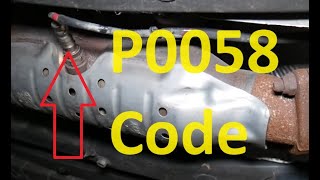
![How to Fix FORD P0058 Engine Code in 2 Minutes [1 DIY Method / Only $19.61]](https://img.youtube.com/vi/XxnN2dWXusE/mqdefault.jpg)

The information in this article is provided for general reference and educational purposes only. Vehicle specifications, procedures, and part compatibility can vary by production date, trim level, and region. Always consult your vehicle's factory service manual and verify part numbers before purchasing or performing repairs. Safety-critical components such as airbags, seat belts, and braking systems should be installed by a qualified professional.
- 🎬 Helpful Videos
- What Does P0058 Mean?
- Can I Drive With P0058?
- Common Causes
- Symptoms
- Diagnostic Flowchart
- Common Fixes & Costs
- Used vs. New Parts: Buying Guide
- What Happens If You Wait — Timeline
- Cost of Not Fixing It
- Diagnosis Steps
- When This Code Triggers (Freeze-Frame Conditions)
- Related Codes
- Climate & Environmental Factors
- How to Talk to a Mechanic About This Code
- Where to Take It: Dealer vs Independent vs Chain
- When to Walk Away From the Repair
- What Scan Tool You Need for This Code
- How to Clear the Code After You Fix It
- Will This Fail Emissions / State Inspection?
- Most Commonly Affected Vehicles
- Manufacturer-Specific Notes
- Real Owner Stories
- 2004 Toyota 4Runner V8 - Misdiagnosis
- 2010 VW Scirocco at 112K km - Simple Failure
- 2012 Ford F-150 at 120K miles - Environmental Cause
- How to Prevent This Code From Triggering
- Frequently Asked Questions
- What is Bank 2, Sensor 2?
- How much does it cost to fix code P0058?
- Can I fix P0058 myself?
- What is the first thing to check for P0058?
- Will a P0058 code clear itself?
- Why did the code come back after I replaced the sensor?
- Can a bad ground cause a P0058 code?
- Key Takeaways
- 🎟️ Get 5% Off