

P0043 on 2013-2016 Land Rover Range Rover Evoque: O2 Sensor Heater Circuit Fixes
This code almost always indicates a failed oxygen sensor (Bank 1, Sensor 3) on the 2013-2016 Evoque. Land Rover has acknowledged a manufacturing defect causing premature failure via TSB #SSM63157. Replacing the sensor, Land Rover part number LR023252 (superseded by LR057355), is the definitive fix. The part costs about $70-$220.
- P0043 on a 2013-2016 Evoque is overwhelmingly caused by a faulty Bank 1, Sensor 3 oxygen sensor.
- Land Rover issued TSB #SSM63157 acknowledging a manufacturing defect in these sensors, making it the most likely root cause.
- The correct replacement part is OEM number LR023252, which has been superseded by LR057355.
- The repair is straightforward for a DIYer with basic tools, primarily requiring a 22mm O2 sensor socket, and involves replacing the rearmost sensor on the exhaust.
- Before replacing the sensor, it's wise to perform a quick resistance check with a multimeter; a reading outside the 2-14 Ohm range confirms failure.
What's Unique About the 2013-2016 Land Rover RANGE ROVER EVOQUE
For this specific generation of Range Rover Evoque, the P0043 code is strongly linked to known issues acknowledged by Land Rover itself. Technical Service Bulletin (TSB) #SSM63157 points directly to a "Manufacturing fault at the supplier" causing an "internal misalignment" in the sensor. This misalignment creates a side load on the internal ceramic element, leading to pre-stress that, combined with normal vehicle use, causes premature failure of the heater circuit. This known defect makes the oxygen sensor itself the most probable point of failure, more so than on other vehicles where wiring or computer issues might be more common causes for a circuit code.
Diagnostic Flowchart
Tap your situation to follow the diagnostic path that matches what you're seeing on this vehicle.
Symptoms You May Notice
- Check Engine Light is on. 🎬 Watch: A quick overview of the P0043 code and its causes.
- Vehicle will fail an emissions test.
- Potentially a slight decrease in fuel economy.
- In some cases, rough or unstable idling, though this is less common for a post-catalyst sensor fault.
- Replacing the wrong oxygen sensor. The Evoque's 2.0L I4 engine has only one bank (Bank 1), but multiple sensors. P0043 specifically refers to Sensor 3, which is the rearmost, post-catalyst sensor.
Most Likely Causes
- Faulty Oxygen Sensor (Bank 1, Sensor 3) 🔴 High Probability Land Rover issued TSB #SSM63157 indicating a 'manufacturing fault at the supplier' that causes internal stress and premature failure of the sensor's heater element. This makes the sensor itself the most likely culprit.
How to confirm: After confirming the fuse and wiring are intact, test the resistance of the sensor's heater circuit with a multimeter. A good sensor should have a resistance between 2-14 Ohms. An open circuit (infinite resistance) or a reading far outside this range confirms a failed heater element.
Typical fix: Replace the Bank 1, Sensor 3 oxygen sensor. The OEM part is Land Rover P/N LR023252, which was later superseded by LR057355. Some related TSBs also recommend a PCM software update when the sensor is replaced to prevent future issues.
Est. part cost: $70-$220 - Damaged Wiring or Poor Connection 🟡 Medium Probability The oxygen sensor wiring runs along the hot exhaust system underneath the vehicle, making it susceptible to melting, chafing, or corrosion over time. A low circuit code can specifically point to a wire shorting to ground.
How to confirm: Visually inspect the entire wiring harness for the Bank 1, Sensor 3 O2 sensor, from the sensor connector back to the main harness. Look for any signs of burns, breaks, or corrosion on the connector pins. Check for battery voltage at the heater power wire in the harness connector with the ignition on.
Typical fix: Repair the damaged section of wire or clean/replace the corroded connector.
Est. part cost: $5-$50 - Blown Fuse for Heater Circuit ⚪ Low Probability Less common as the circuit is often controlled directly by the PCM, but still possible.
How to confirm: Locate the fuse for the oxygen sensor heater circuits in the vehicle's fuse box (check the owner's manual for the specific location, usually labeled O2, HEGO, or Emissions) and visually inspect it or test for continuity with a multimeter. 🎬 See this guide on how to test O2 heater circuits.
Typical fix: Replace the blown fuse. If the fuse blows again immediately, it indicates a short circuit in the wiring or the sensor itself that must be found.
Est. part cost: $1-$5
Rare But Worth Checking
- Powertrain Control Module (PCM) Fault: This is very rare. The PCM is responsible for sending power to the heater circuit. Before condemning the PCM, all other possibilities (sensor, wiring, fuses) must be exhaustively ruled out.
Diagnosis Steps
- Confirm the code P0043 is present using an OBD-II scanner.
- Visually inspect the wiring harness and connector for the Bank 1, Sensor 3 oxygen sensor. On the Evoque I4 engine, this is the rearmost sensor in the exhaust system. Look for any signs of melting, chafing, or corrosion where the harness might contact the exhaust or chassis.
- Check the fuse for the O2 sensor heater circuit in the engine bay fuse box. Refer to the owner's manual for the correct fuse location.
- If the wiring and fuse are good, disconnect the sensor. Use a multimeter to test the resistance between the two heater pins on the sensor itself (often the two wires of the same color). A good sensor should read between 2-14 Ohms. A reading of infinite resistance (open circuit) or near-zero ohms (short circuit) means the heater is broken and the sensor needs replacement.
- With the key on (engine off), check for battery voltage (approx. 12V) at the heater power wire in the sensor's harness connector. If voltage is missing, there is a problem in the power supply wiring or fuse.
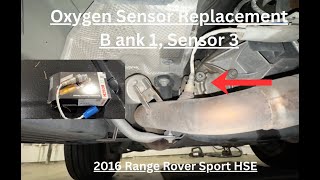
- To perform the replacement, you will need a specialized 22mm (or 7/8") oxygen sensor socket. Apply a small amount of anti-seize compound to the threads of the new sensor before installation, being careful not to get any on the sensor tip. 🎬 Watch: How to replace a downstream oxygen sensor on a Range Rover.
- If all other tests pass, the issue may be a rare fault within the Powertrain Control Module (PCM), but this should be the last consideration.
Parts You'll Likely Need
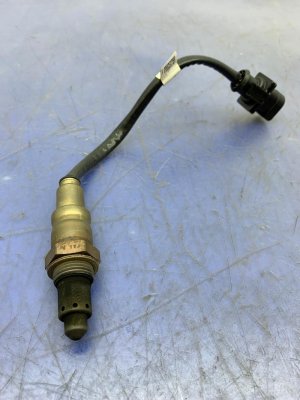
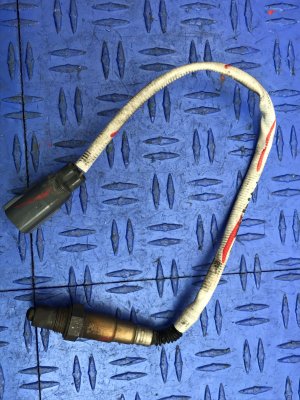
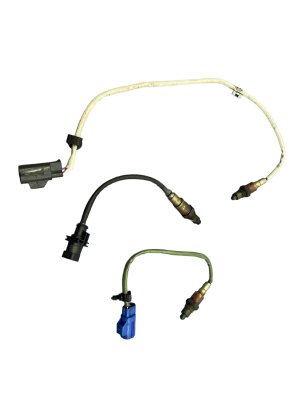
- Oxygen Sensor (Bank 1, Sensor 3)
(OEM #LR023252 (superseded by LR057355))— This is the most common failure point for code P0043 on this vehicle, as documented by Land Rover TSB #SSM63157.
Trusted brands: Denso (e.g., 234-4982), Bosch, NGK/NTK (e.g., 25756)
OEM price range: $150-$250
Aftermarket price range: $70-$180
Related Codes That Often Appear With This One
- P0042 — This code is for the same sensor (Bank 1, Sensor 3) but indicates the heater control circuit is 'On'. Both codes are listed in TSB #SSM63157 and can be caused by the same faulty sensor.
- P0044 — This code is for the same sensor but indicates a 'High' voltage condition in the heater circuit. It often points to a short circuit in the wiring or a faulty sensor.
Technical Service Bulletins (TSBs) & Recalls
- SSM63157: Oxygen sensor manufacturing fault leading to various DTCs, including P0043.
- SSM72448: A large number of oxygen sensor codes, including P0043, may be stored with no fault found upon diagnosis.
Platform-Specific Known Issues
- TSB #SSM63157: Explicitly states that DTCs including P0043 can be stored due to a manufacturing fault within the oxygen sensor. This fault is an internal misalignment causing pre-stress on the ceramic element, leading to premature failure.
- TSB #SSM72448: Lists P0043 among a large group of O2 sensor codes that may be set without a discernible fault found during diagnosis, suggesting potential intermittent connection or software issues that require following diagnostic procedures carefully.
Mechanic-Grade Diagnostic Values
- O2 Sensor Heater Circuit Voltage (at harness connector) — expected: ~12V (Battery Voltage). Failure: Voltage significantly below 12V indicates a power supply issue (fuse, relay, or wiring).
- O2 Sensor Heater Circuit Current Draw — expected: 0.25A to 1.75A. Failure: No current draw indicates an open circuit (bad heater or wiring). Excessive current indicates a short.
- PCM Control of Heater Circuit (Ground Side) — expected: With the engine running, the PCM will pulse the ground connection. Voltage on the negative wire should drop to zero or pulse.. Failure: If voltage on the negative wire remains at 12V with the engine running, the PCM is not commanding the heater on, or there is an open in the ground wire.
Scan Tool Commands That Help
- JLR SDD (Symptom Driven Diagnostics): Symptom Selection / Guided Diagnostics — When basic checks (sensor, wiring) do not resolve the issue. SDD can run guided tests, check for related software updates for the PCM, and analyze live data parameters that basic scanners may not see.
- JLR SDD (Symptom Driven Diagnostics): Service Functions / Module Updates — After replacing the oxygen sensor, as recommended by some Land Rover TSBs. The tool can be used to update the Powertrain Control Module (PCM) software to the latest calibration, which may contain revised strategies for O2 sensor heater control.
Wiring & Ground Locations
- Engine Ground Point (for jump starting) — A bolt on an engine mounting on the right-hand side of the engine bay, just behind the windscreen washer filler cap.. While not the direct ground for the O2 sensor circuit, a poor main engine-to-chassis ground can cause a variety of unpredictable electrical issues and floating voltages. Verifying this primary ground is a good practice when diagnosing any electrical fault.
- O2 Sensor Harness Connector — Underneath the vehicle, connected to the Bank 1 Sensor 3 O2 sensor, which is located on the exhaust pipe after the final catalytic converter.. This is the primary point for testing. A P0043 code often results from a short-to-ground, which can occur if this harness melts against the hot exhaust pipe, exposing the power wire.
Real Owner Repair Stories
- YouTube user @LR-TEKH (Range Rover L405 (V6/V8 Gasoline Engine) - a different model but uses similar diagnostic principles and sensor technology.) — Check Engine Light with code P0043 for Bank 1 Sensor 3.
✅ What actually fixed it The vehicle was diagnosed with a faulty Bank 1, Sensor 3 oxygen sensor. A mechanic replaced the sensor, which was located on the passenger side (right side) of the vehicle, requiring removal of a heat shield for access. The code was cleared and did not return.
OEM Part Supersession History
LR023252→LR057355— The original part number is associated with TSB #SSM63157 which cites a manufacturing defect. The supersession likely indicates a revised part to correct the internal misalignment and pre-stress issue.
Heads up: The part number LR057355 is also listed for a rear view camera on some Land Rover models. This is a common issue in parts catalogs where numbers are reused or listed incorrectly. It is critical to verify with a dealer using the VIN that LR057355 is the correct OXYGEN SENSOR for the specific vehicle, not the camera.
Model Year Variations Within This Range
- 2013-2016: The Range Rover Evoque received a facelift for the 2016 model year, which included new diesel engines and cosmetic changes. However, the 2.0L Turbocharged I4 petrol engine (Ford EcoBoost) and its associated exhaust/emissions components remained fundamentally the same through this period. Therefore, the causes and fixes for P0043 are consistent across the 2013-2016 range for petrol models.
Helpful Videos
We Have This Part in Stock



The information in this article is provided for general reference and educational purposes only. Vehicle specifications, procedures, and part compatibility can vary by production date, trim level, and region. Always consult your vehicle's factory service manual and verify part numbers before purchasing or performing repairs. Safety-critical components such as airbags, seat belts, and braking systems should be installed by a qualified professional.
- Land Rover RANGE ROVER EVOQUE:
- 🎬 Helpful Videos
- 🛍️ Shop This Part
- What's Unique About the 2013-2016 Land Rover RANGE ROVER EVOQUE
- Diagnostic Flowchart
- Symptoms You May Notice
- Most Likely Causes
- Rare But Worth Checking
- Diagnosis Steps
- Parts You'll Likely Need
- Related Codes That Often Appear With This One
- Technical Service Bulletins (TSBs) & Recalls
- Platform-Specific Known Issues
- Mechanic-Grade Diagnostic Values
- Scan Tool Commands That Help
- Wiring & Ground Locations
- Real Owner Repair Stories
- OEM Part Supersession History
- Model Year Variations Within This Range
- 🎟️ Get 5% Off