

OBD-II Code P0038: O2 Sensor Heater Control Circuit High (Bank 1, Sensor 2)
What P0038 means, why it triggers, and the definitive guide to fixing it
- P0038 indicates the Powertrain Control Module (PCM) detects abnormally high voltage (over 14.5V) in the Bank 1, Sensor 2 oxygen sensor heater circuit.
- A burnt-out internal heater element inside the oxygen sensor causes over 80% of P0038 codes, requiring a direct sensor replacement.
- Driving with P0038 drops fuel economy by 5-10% and guarantees an emissions test failure, but it is safe to drive for up to a month before risking catalytic converter damage.
- Inspect the O2 sensor wiring harness for melted insulation and test the heater circuit fuse before spending $150 on a replacement sensor.
What Does P0038 Mean?

Your car's main computer, the Powertrain Control Module (PCM), has detected that the heater circuit for a specific oxygen (O2) sensor is sending back a voltage signal that is too high. This sensor, known as 'Bank 1, Sensor 2', is located in the exhaust system after the catalytic converter. Its job is to monitor the converter's efficiency. To work accurately, the sensor must be hot (around 600°F), so it contains an internal heater to warm up quickly. This code means there is an electrical fault in that heater circuit.
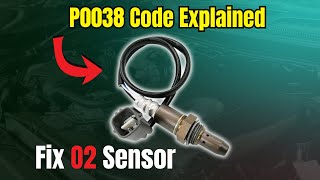
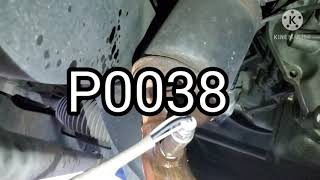
🎬 Watch: A quick breakdown of what the P0038 code means.Technical definition: The official SAE/OBD-II definition is "HO2S Heater Control Circuit High (Bank 1 Sensor 2)". This means the Powertrain Control Module (PCM) detects a voltage from the heated oxygen sensor's heater circuit that is above the specified range (typically over 14.5V) for 5-10 seconds. The PCM uses a pulse-width modulated (PWM) signal to control the heater's temperature. This code sets when the feedback from that control circuit is illogically high, indicating an open circuit or a short to power.
Can I Drive With P0038?
Yes, But With Caution. Yes, but only for a few weeks. P0038 forces the engine to run rich, dropping fuel economy by 5-10% and causing an automatic emissions test failure. Ignoring it for months risks overheating and destroying the catalytic converter, turning a $150 sensor replacement into a $2,000 repair.
Common Causes

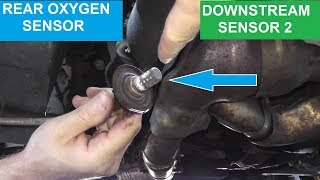
- Failed Bank 1, Sensor 2 Oxygen Sensor (Very Common) — The internal heater element within the oxygen sensor burns out or shorts internally, creating high resistance or an open circuit. The PCM interprets this as a high voltage reading. The typical life cycle of an O2 sensor is 75,000 to 100,000 miles. 🎬 Watch: How to test and replace a rear oxygen sensor.
- Damaged Wiring, Connector, or Water Intrusion (Common) — The wiring harness is exposed to extreme heat, road debris, and moisture. Wires melt against the hot exhaust pipe, fray from vibration, or suffer from water intrusion at the connector, causing a short to voltage or an open circuit.
- Blown Fuse or Faulty Relay (Less Common) — The O2 sensor heater circuit is protected by a fuse and often controlled by a relay. A blown fuse (often labeled O2 HTR, HTR, or EFI) or a stuck relay interrupts normal circuit voltage, triggering the code.
- Faulty Charging System (Rare) — An over-charging alternator creates system-wide high voltage conditions. If the vehicle's voltage consistently runs above 15V, it stresses multiple components, including the O2 heater circuit, triggering a P0038 code.
- Software Calibration Error (Rare) — Out-of-date PCM firmware misinterprets normal heater voltage under specific conditions, logging a false P0038 code. A Technical Service Bulletin (TSB) usually exists, requiring a software update from the dealer.
- Faulty Powertrain Control Module (PCM) (Very Rare) — The internal driver circuit that controls the O2 sensor heater fails. This is the absolute last possibility considered after all other causes are definitively ruled out.
Symptoms
- Check Engine Light is On — The light illuminates as soon as the PCM detects the high voltage fault for a specified duration, typically when voltage exceeds 14.5V for more than 5-10 seconds.
- Decreased Fuel Economy — With the heater not working, the sensor takes longer to enter 'closed-loop' operation. This extended 'open-loop' time wastes fuel, reducing efficiency by 5-10%.
- Failed Emissions Test — An active P0038 code and the illuminated Check Engine Light result in an automatic failure of any state-mandated emissions or smog inspection.
- Strong Exhaust Odor and Black Soot — An inefficiently running engine produces a rich fuel mixture, leading to a noticeable smell of unburned gasoline and the emission of black soot from the tailpipe.
- Rough Idle During Warm-up — Before the sensor heats up naturally from the exhaust, the engine idles roughly or hesitates. This is less common since Sensor 2's primary role is monitoring, not direct fuel control.
Diagnostic Flowchart
Tap your situation to follow the diagnostic path that matches what you're seeing on this code.
Common Fixes & Costs
- Replace Bank 1, Sensor 2 Oxygen Sensor — Parts: $50-$250, Labor: $100-$200, ~1 hr book time (DIY)
- Repair Damaged Wiring or Connector — Parts: $15-$50, Labor: $150-$300, ~2 hr book time (Intermediate)
- Replace Blown Fuse or Relay — Parts: $5-$30, Labor: $20-$60, ~0.5 hr book time (DIY)
- Update PCM Software — Parts: $0, Labor: $100-$250, ~1 hr book time (Professional)
- Replace Powertrain Control Module (PCM) — Parts: $800-$1500, Labor: $150-$300, ~1.5 hr book time (Professional)
DIY vs Professional
- Replace Oxygen Sensor — Beginner:
Tools: Jack and stands, penetrating oil, O2 sensor socket (7/8" or 22mm), ratchet, torque wrench, anti-seize compound. - Repair Wiring/Connector — Beginner:
Tools: Multimeter, wire strippers, wire cutters, heat gun, heat-shrink connectors, soldering iron (optional), vehicle-specific wiring diagram. - Replace Fuse/Relay — Beginner:
Tools: Owner's manual, fuse puller or needle-nose pliers. - Update/Replace PCM — Beginner:
Tools: Professional-grade scan tool with flashing capabilities, access to manufacturer software.
Used vs. New Parts: Buying Guide
When a used part is worth it: Buying a used oxygen sensor never makes financial sense. They are wear-and-tear parts with a finite service life of 75,000-100,000 miles. The labor cost for installation often exceeds the part cost, making it a poor financial risk.
Donor-vehicle mileage cap: roughly under 20000 miles for the part to have meaningful remaining life.
Donor quality checklist:
- Focus on buying the correct NEW part, not a used one.
- Match the part number exactly for your vehicle's make, model, and engine.
- Use reputable OEM-equivalent brands like Denso, Bosch, or NTK.
Decision logic:
- If The part is an oxygen sensor → Always buy new from a reputable brand to ensure reliability and avoid repeat labor costs.
- If You are on an extreme budget and must consider used → Only accept a part from a very low-mileage vehicle (under 20k miles) and understand it will likely fail prematurely.
Warranty tradeoff: Used parts typically have a 30-day warranty at best. New aftermarket sensors offer a 1-year to limited lifetime warranty. A new OEM sensor carries a 1-year/12,000-mile warranty.
Worst-case if a used part fails: 150-350. If a used or cheap-quality new sensor fails, you pay for repeat labor ($100-$200) plus the cost of another, better-quality sensor.
What Happens If You Wait — Timeline
- 0-2 weeks: The Check Engine Light illuminates. The PCM logs the P0038 code. There are often no noticeable symptoms in driveability as Sensor 2 is for monitoring. (MPG impact: 0-5%% · Added cost: $0-10 in wasted fuel)
- 2 weeks - 3 months: The vehicle runs in open-loop mode more often, leading to a consistent 5-10% drop in fuel economy. The vehicle automatically fails any emissions test. (MPG impact: 5-10%% · Added cost: $20-75 in wasted fuel)
- 3-9 months: Because the PCM isn't getting accurate feedback from Sensor 2, a rich fuel condition starts to overheat and degrade the catalytic converter's internal substrate. (MPG impact: 10-15%% · Added cost: $500-1200 (Risk of early catalytic converter damage increases significantly))
- 9+ months: Sustained rich conditions lead to complete failure of the catalytic converter, a very expensive repair. (MPG impact: 10-20%% · Added cost: $1500-3000 (High likelihood of catalytic converter replacement needed))
Cost of Not Fixing It
- 0-1 month: Drops fuel economy by 5-10% and guarantees an emissions test failure. (Added cost: 5-20)
- 1-6 months: The engine runs in a prolonged 'open-loop' or rich fuel condition. This causes the catalytic converter to overheat, leading to internal damage and failure. (Added cost: 1200-2800)
- 6+ months: Sustained rich running fouls spark plugs, leading to misfires. The primary risk remains catastrophic failure of the catalytic converter. (Added cost: 1500-3500+)
Diagnosis Steps

- Read Codes and Review Freeze Frame Data
Use an OBD-II scanner to confirm P0038 is active. Check for related codes (e.g., P0037, P0138, P0058) and document them. Review the freeze frame data to see engine conditions (RPM, temp) when the fault was detected.
Tools: OBD-II Scanner (Beginner) - Visually Inspect the Sensor and Wiring
Safely raise the vehicle and locate the Bank 1, Sensor 2 O2 sensor (after the catalytic converter on the side with cylinder #1). Meticulously inspect the wiring harness for melting, burns, chafing against the chassis, and corrosion on the connector pins.
Tools: Jack, Jack Stands, Flashlight (Beginner) - Check the Heater Circuit Fuse
Consult your owner's manual to locate the fuse box. Find the fuse for the O2 sensor heater circuit (labeled O2 HTR, HTR SNS, or EFI). Visually inspect the fuse and test it for continuity with a multimeter. A blown fuse indicates a short circuit.
Tools: Owner's Manual, Multimeter, Fuse Puller (Beginner) - Test the Sensor's Heater Resistance
With the sensor disconnected and the engine cool, set your multimeter to Ohms (Ω). Measure the resistance between the two heater circuit pins on the sensor itself (often the two wires of the same color). A normal reading is between 2 and 40 Ohms. An infinite reading (OL) means the heater element is broken, requiring sensor replacement.
Tools: Multimeter, Vehicle Service Manual (Intermediate) - Test for Power and Ground at the Connector
Turn the ignition to the 'On' position (engine off). Use a multimeter to verify that one pin on the harness-side connector has battery voltage (approx. 12V-14.5V). Check for a good ground on the corresponding ground pin. Lack of voltage points to a wiring or fuse issue; lack of ground points to a broken ground wire.
Tools: Multimeter, Vehicle Service Manual (Intermediate) - [ADVANCED] Analyze Live Data with a Scan Tool
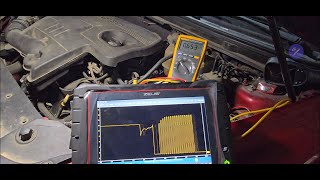
With the engine running, observe the PID for 'O2 Heater Current' or 'Amps' for B1S2 on a professional scan tool. A healthy heater draws between 0.5 and 1.5 amps. Spikes above 2 amps suggest a shorted heater element. Monitor the heater duty cycle PID; a 0% or 100% duty cycle that never changes indicates a circuit or PCM problem.
Tools: Advanced OBD-II Scanner (Advanced) - [ADVANCED] Test Heater Circuit Voltage and Amperage
Using a multimeter with an amp clamp, check the heater circuit. With the key on, engine off, voltage should be between 12V and 14.5V. Anything consistently above 14.5V points to a charging system issue or a short to power. The current draw should be stable between 0.5A and 1.5A.
Tools: Multimeter with Amperage Clamp (Advanced) - [ADVANCED] Check for a Short to Voltage
If the heater fuse blows repeatedly, you have a short to power. Disconnect the sensor and the PCM connector. Set your multimeter to Ohms. Check for continuity between the heater circuit wire at the sensor connector and the positive battery terminal. Any resistance reading confirms the wire is shorted to a power source.
Tools: Multimeter, Vehicle Service Manual (Advanced) - Verify the Repair
After replacing the faulty component, clear the P0038 code. Drive the vehicle for 15-20 minutes, including a mix of city and highway driving, to allow the computer to complete a full drive cycle. Re-scan to ensure the code does not return.
Tools: OBD-II Scanner (Beginner)
When This Code Triggers (Freeze-Frame Conditions)
- Engine Coolant Temp: 70-210°F (21-99°C) (During warm-up or when fully warm. The heater test runs soon after a cold start.)
- RPM: 650-2500 RPM (Detected during idle shortly after startup or during steady-state cruise.)
- Engine Load: 15-40% (Occurs under light to moderate engine load, not during heavy acceleration.)
- Vehicle Speed: 0 mph or 40-60 mph (Triggered while idling or during steady highway driving as the PCM continuously monitors the circuit.)
Related Codes
- P0037 — This is the direct companion code. P0038 (High) suggests an open circuit or short to power, while P0037 (Low) indicates a short to ground.
- P0138 — Indicates high voltage in the SENSOR'S signal circuit, not the heater circuit. P0038 means the heater is malfunctioning, while P0138 means the sensor itself is detecting a rich exhaust condition.
- P0058 — This is the identical fault code but for Bank 2, Sensor 2 on V6 or V8 engines.
- P0054 — Indicates that the resistance in the Bank 1, Sensor 2 heater circuit is out of range. It is closely related to P0038 and points to the same root causes.
Climate & Environmental Factors
- Cold Climates / Road Salt: Vehicles operated in the 'Rust Belt' or coastal areas are highly susceptible to P0038. Salt and moisture accelerate corrosion of the O2 sensor's electrical connector, leading to high resistance or short circuits. GM TSB 21-NA-123 specifically addresses this issue on Silverado/Sierra trucks.
- High Humidity: Sustained high humidity promotes water intrusion into poorly sealed electrical connectors, causing corrosion and intermittent voltage faults.
- Off-Roading / Debris: Driving through mud, water, or heavy debris physically damages the O2 sensor wiring harness, causing it to fray or be torn from its mounting clips, leading to contact with hot exhaust components.
How to Talk to a Mechanic About This Code
Say this: "I have an OBD-II code P0038 for the Bank 1, Sensor 2 heater circuit. Before we replace the sensor, I'd like you to verify the heater circuit fuse is good and that there's power and ground at the sensor connector. I want to confirm it's a failed sensor and not a wiring issue."
This signals you understand the P0038 code points to a circuit, not just a part. It directs the mechanic to perform a proper diagnosis, preventing them from simply replacing the most obvious part and potentially missing the true cause.
Avoid saying:
- My check engine light is on, can you just fix it?
- I think I need a new oxygen sensor.
- Just do whatever you think is best.
Questions to ask before authorizing the repair:
- What were the results of the heater circuit resistance test on the old sensor?
- Did you confirm there is good voltage and ground at the harness connector?
- Can you show me the damaged wiring or the old part?
- What is the warranty on the new sensor and your labor?
Where to Take It: Dealer vs Independent vs Chain
- Dealer:
Recommended only if the vehicle is under warranty or has a known, complex issue specific to the manufacturer that an independent shop has failed to fix.
Best for: Vehicles still under the 8-year/80,000-mile federal emissions warranty, Known manufacturer-specific software issues (TSBs) or complex electrical problems
Downsides: Significantly higher labor rates, often $150-$250 per hour., Defaults to replacing an entire assembly when a smaller component or wiring repair would suffice. (Typical cost: +50% vs. baseline) - Independent Shop:
Best fit for this code. P0038 is a common and well-understood fault that any competent independent mechanic accurately diagnoses and repairs cost-effectively.
Best for: Most out-of-warranty vehicles., Straightforward electrical diagnostics and part replacements.
Downsides: Quality and expertise vary widely; choose a shop with ASE-certified technicians., May lack the latest manufacturer-specific diagnostic software for very new models. (Typical cost: +0% vs. baseline) - Chain Shop:
Use with caution. Acceptable if you have already diagnosed the problem as a faulty sensor and simply need it replaced. AVOID for initial diagnosis of a check engine light.
Best for: Simple, high-volume jobs like oil changes and tire rotations.
Downsides: Technician skill varies dramatically., High pressure to upsell services leads to unnecessary repairs., Lacks the diagnostic depth to handle anything beyond a simple sensor replacement. (Typical cost: -10% vs. baseline)
When to Walk Away From the Repair
If the estimated repair cost exceeds 40-50% of your car's private-party value, you should pause and seriously consider selling or trading it in.
- Car worth $8000, fix is $400: Fix it. This is a routine repair and well below the threshold.
- Car worth $3000, fix is $400: Fix it. The repair cost is low relative to the car's value, preserving its functionality.
- Car worth $2000, fix is $1500: Walk away. The repair cost is 75% of the car's value. This is a bad investment, especially if the underlying cause is a rare PCM failure.
What Scan Tool You Need for This Code

Minimum: An OBD-II code reader that displays live data for O2 sensor voltage. The ability to graph this data is highly recommended.
A basic $20 code reader only shows the P0038 code, leading to guesswork. To properly diagnose the circuit, you need to see live data to confirm if the heater is working. A code only points to the problem area; it doesn't name the specific failed part.
Budget: BlueDriver Pro Scan Tool (~$100) — Connects to your smartphone via Bluetooth. It reads and clears codes, provides freeze-frame data, and graphs live O2 sensor data to confirm if the sensor responds correctly after repair.
Mid-range: Foxwell NT510 Elite (~$180) — Offers full system diagnostics and bidirectional control. This allows you to actively test components, potentially commanding the O2 sensor heater circuit on and off to verify its operation.
Professional: Autel MaxiCOM MK808S (~$450) — Provides full bidirectional control and access to all vehicle modules. For a P0038, it allows deep analysis of the heater circuit's current draw, duty cycle, and voltage in real-time.
Rent vs buy: For a one-time fix, AutoZone's Loan-A-Tool program allows you to borrow an OBD-II scanner for free after paying a refundable deposit. Buy a scanner only if you plan to perform your own diagnostics more than once a year.
How to Clear the Code After You Fix It
- Use an OBD-II scan tool to clear the P0038 code.
- Perform a complete drive cycle to allow the vehicle's readiness monitors to run.
- Re-scan the vehicle to confirm the code has not returned.
Drive cycle (~20 minutes): From a cold start (engine coolant below 122°F/50°C), start the engine and idle for 2-3 minutes. Drive at a steady speed of 45-55 mph for 5-7 minutes. Let the vehicle coast down to 20 mph without using the brakes. Repeat the steady-speed driving for another 5 minutes. This runs the O2 sensor and catalyst monitors.
Readiness monitors affected: O2 Sensor Heater Monitor, O2 Sensor Monitor, Catalyst Monitor
Before emissions retest: drive at least 50 miles to fully set monitors.
Watch out for:
- Disconnecting the battery clears the code but resets all readiness monitors, causing an immediate emissions test failure.
- The code returns immediately if the underlying electrical fault (bad sensor, wiring, fuse) is not fixed.
- Some vehicles require a specific drive cycle, such as idling for 5 minutes and shutting the engine off for 10 minutes, to run the O2 heater monitor.
Will This Fail Emissions / State Inspection?
Yes — this code typically fails an OBD-II emissions inspection.
- California: An active P0038 code results in an automatic smog check failure. After repair, a full drive cycle must be completed to set all readiness monitors before a re-test is possible.
- New York: The NYVIP3 inspection includes an OBD-II scan. An illuminated Check Engine Light for an emissions fault like P0038 is an automatic failure.
- Texas: In the 17 counties requiring emissions testing, an OBD-II scan is performed. P0038 causes the vehicle to fail this inspection.
Most Commonly Affected Vehicles
- Ford Focus, F-150, Mondeo, Fiesta (2004-2017) — Code P0038 is frequently reported. The most common cause is the failure of the original downstream oxygen sensor's heater element.
- Subaru Outback, Forester, Impreza (with 2.5L engine) (2005-2024) — The rear oxygen sensor is a very common failure item. For 2020-2024 models, TSB #09-115-24 exists for a redesigned rear sensor to prevent internal shorts. Use Denso or NTK sensors.
- Volkswagen/Audi Golf, Passat, Jetta, A3, A4 (2000-2015) — Common across many VW and Audi models. While a failed sensor is the primary cause, owners frequently report faulty fuses or wiring harness problems triggering the code.
- Chevrolet Silverado 1500, Cruze, Equinox (2019-2023) — TSB 21-NA-123 points to poor weather sealing on the O2 sensor connector, allowing moisture and road salt to cause corrosion. The fix involves cleaning the connector and applying dielectric grease.
- Honda Accord, Civic (2003-2012) — Very common on these models due to the downstream oxygen sensor's internal heater element failing at the end of its service life. A direct sensor replacement fixes over 90% of cases.
- Toyota Camry, Corolla, RAV4 (2002-2011) — Frequently experience P0038 due to the natural failure of the sensor's heater circuit. A blown EFI or A/F fuse is also a known cause, sometimes occurring after a battery replacement.
- Chrysler/Dodge/Jeep Town & Country, Grand Caravan, Gladiator, Wrangler (2011-2024) — A faulty Totally Integrated Power Module (TIPM) causes this and other O2 heater codes. TSB #18-071-22 REV. A for the Gladiator suggests a PCM reflash for vehicles built before June 29, 2022.
- Hyundai/Kia Sonata, Optima, Santa Fe, Sorento (with 2.4L GDI engine) (2011-2019) — The wiring harness for the downstream O2 sensor is prone to coming loose from its mounting clips, melting on the exhaust pipe, and causing a short circuit to power.
Manufacturer-Specific Notes
- Chrysler/Dodge/Jeep: Notoriously sensitive to aftermarket oxygen sensors. Using non-OEM sensors causes the code to persist. A faulty TIPM (fuse box) is a known issue causing multiple O2 heater codes simultaneously.
- Chevrolet/GM: On late-model Silverado and Sierra trucks (2019-2023), TSB 21-NA-123 addresses a poorly sealed sensor connector that allows water intrusion, leading to corrosion and this code.
- Hyundai/Kia: On many models with the 2.4L GDI engine, the sensor's wiring harness easily detaches from its mounting clips, melting on the exhaust pipe and causing a short to power.
- Subaru: For newer models (2020+), TSB #09-115-24 exists for an updated rear oxygen sensor part. It is highly recommended to use OEM-equivalent brands like Denso or NTK to avoid compatibility issues.
- BMW: Using non-OEM sensors causes the P0038 code to persist or appear alongside other O2 sensor codes. Always use OEM or a reputable equivalent brand sensor like Bosch or NTK.
- Ford: Some F-150 models use wideband air-fuel ratio sensors that are more expensive than conventional O2 sensors, leading to higher-than-expected repair costs.
Real Owner Stories
2005 Jeep Wrangler TJ with P0038
Check Engine Light came on with no noticeable change in driving performance. Scanned code and found P0038.
What they tried:
- Replaced the Bank 1, Sensor 2 O2 sensor. The light went off but returned the next day after a 10-minute drive.
Outcome: The owner found a damaged wiring harness where the pre-catalytic converters connect to the manifold.
Lesson: If replacing the sensor doesn't fix the code, immediately inspect the wiring and related connections. A new code immediately after a repair indicates a wiring fault or a defective new part.
2006 Dodge Stratus with P0138, then P0038
Car initially had a P0138 code (O2 Sensor Circuit High Voltage). After a mechanic replaced the sensor, the P0138 code was gone, but a new P0038 code appeared immediately.
What they tried:
- Mechanic replaced the O2 sensor to fix the original P0138 code.
Outcome: The new P0038 code proved the replacement sensor had a defective internal heater element straight out of the box.
Lesson: A new code appearing immediately after a repair points to a faulty replacement part or an issue created during the repair. Always verify the integrity of the new part.
2011 Subaru Outback 2.5L with 173k miles
Vehicle presented with a P0037 code (Heater Circuit Low), but the diagnostic process is identical for P0038.
What they tried:
- The owner performed a resistance test on the sensor's heater element using a multimeter.
- The test revealed an infinite reading (open circuit), indicating a failed heater element.
Outcome: The owner determined the sensor was bad and replaced it, permanently clearing the code.
Lesson: You can definitively test the O2 sensor's internal heater with a multimeter. A resistance test between the two heater pins confirms if the heater element has failed before you spend money on a new part.
How to Prevent This Code From Triggering
- Replace O2 sensors proactively (Every 100,000 miles) — Oxygen sensors are wear items. Replacing them before they fail prevents a decline in fuel economy and protects the catalytic converter.
- Use high-quality, top-tier gasoline (Every fill-up) — Top-tier fuels contain detergents that keep fuel injectors clean, promoting complete combustion and reducing contaminants that foul the O2 sensor.
- Perform regular visual inspections of wiring (During every oil change) — The wiring for the downstream O2 sensor is exposed to road debris and heat. Checking to ensure the harness is secure prevents melting and short circuits.
- Maintain the vehicle's charging system (Annually or if electrical issues arise) — Keeping the system voltage stable (between 13.5-14.5V) prevents stress on sensitive electronics, including the O2 sensor heater circuit.
- Address engine oil and coolant leaks promptly (As needed) — Burning oil or coolant contaminates the exhaust stream, coating the O2 sensor's tip and degrading its performance.
Frequently Asked Questions
Can I fix P0038 myself?
Yes, this is a beginner-friendly DIY repair. The most common cause is a bad oxygen sensor, accessible on the exhaust underneath the car. You can replace it using basic hand tools and a 7/8-inch O2 sensor socket.
What is the most common misdiagnosis for P0038?
The most common mistake is replacing the oxygen sensor without checking the fuse or inspecting the wiring. A blown fuse or a wire melted on the exhaust pipe causes the code to return instantly, even with a new sensor. Always check these simple, cheap components first.
My check engine light is still on after replacing the O2 sensor. What now?
First, ensure you cleared the code with a scanner. If it returns immediately, inspect the wiring for damage and verify you installed the correct OEM-equivalent sensor. If the fuse and wiring are intact, the fault requires advanced electrical diagnosis.
Will the P0038 code clear itself?
No, this electrical fault code will not clear on its own. The Check Engine Light remains illuminated until the underlying problem is fixed. You must manually clear the code with an OBD-II scanner.
What's the difference between Bank 1 and Bank 2?
On a V-shaped engine, Bank 1 is the side containing cylinder #1, while Bank 2 is the opposite side. For an inline 4-cylinder engine, there is only one bank, which is always Bank 1.
What's the difference between Sensor 1 and Sensor 2?
Sensor 1 is the 'upstream' sensor before the catalytic converter, acting as a primary input for the engine's air-fuel mixture. Sensor 2 is the 'downstream' sensor after the catalytic converter, tasked with monitoring converter health. P0038 always refers to Sensor 2.
Is a P0038 repair covered by warranty?
Yes, in specific cases. The Federal Emissions Performance Warranty covers major components for 8 years or 80,000 miles. Contact an authorized dealer to check if your specific oxygen sensor is covered under this mandate.
Should I use an OEM or aftermarket O2 sensor?
For many vehicles, a high-quality aftermarket sensor from Bosch, Denso, or NTK works perfectly and saves money. However, Chrysler, Dodge, Jeep, and BMW vehicles are highly sensitive to aftermarket sensors. For these brands, always buy an OEM sensor to avoid compatibility issues.
Key Takeaways
- P0038 indicates the Powertrain Control Module (PCM) detects abnormally high voltage (over 14.5V) in the Bank 1, Sensor 2 oxygen sensor heater circuit.
- A burnt-out internal heater element inside the oxygen sensor causes over 80% of P0038 codes, requiring a direct sensor replacement.
- Driving with P0038 drops fuel economy by 5-10% and guarantees an emissions test failure, but it is safe to drive for up to a month before risking catalytic converter damage.
- Inspect the O2 sensor wiring harness for melted insulation and test the heater circuit fuse before spending $150 on a replacement sensor.
Helpful Videos

The information in this article is provided for general reference and educational purposes only. Vehicle specifications, procedures, and part compatibility can vary by production date, trim level, and region. Always consult your vehicle's factory service manual and verify part numbers before purchasing or performing repairs. Safety-critical components such as airbags, seat belts, and braking systems should be installed by a qualified professional.
- 🎬 Helpful Videos
- What Does P0038 Mean?
- Can I Drive With P0038?
- Common Causes
- Symptoms
- Diagnostic Flowchart
- Common Fixes & Costs
- DIY vs Professional
- Used vs. New Parts: Buying Guide
- What Happens If You Wait — Timeline
- Cost of Not Fixing It
- Diagnosis Steps
- When This Code Triggers (Freeze-Frame Conditions)
- Related Codes
- Climate & Environmental Factors
- How to Talk to a Mechanic About This Code
- Where to Take It: Dealer vs Independent vs Chain
- When to Walk Away From the Repair
- What Scan Tool You Need for This Code
- How to Clear the Code After You Fix It
- Will This Fail Emissions / State Inspection?
- Most Commonly Affected Vehicles
- Manufacturer-Specific Notes
- Real Owner Stories
- 2005 Jeep Wrangler TJ with P0038
- 2006 Dodge Stratus with P0138, then P0038
- 2011 Subaru Outback 2.5L with 173k miles
- How to Prevent This Code From Triggering
- Frequently Asked Questions
- Can I fix P0038 myself?
- What is the most common misdiagnosis for P0038?
- My check engine light is still on after replacing the O2 sensor. What now?
- Will the P0038 code clear itself?
- What's the difference between Bank 1 and Bank 2?
- What's the difference between Sensor 1 and Sensor 2?
- Is a P0038 repair covered by warranty?
- Should I use an OEM or aftermarket O2 sensor?
- Key Takeaways
- 🎟️ Get 5% Off