

OBD-II Code P0034: Turbocharger/Supercharger Bypass Valve 'A' Control Circuit Low
The Ultimate Guide to Diagnosing and Fixing P0034
- Code P0034 triggers when the Powertrain Control Module (PCM) detects under 3V in the turbocharger bypass valve circuit, disabling proper boost control.
- Inspect the 10A bypass valve fuse and wiring harness for chafing before replacing any parts, as electrical shorts cause over 60% of P0034 codes.
- Driving with P0034 cuts engine power by up to 50% via limp mode and risks a $2,000+ catalytic converter failure if ignored for more than a month.
- Ford Escape owners (2017-2019) must check fuse F34 first; a known factory wiring defect rubs against the battery box, blowing the fuse and triggering this code.
- Test the bypass valve solenoid resistance with a multimeter; a healthy valve reads between 10 and 40 Ohms, while an infinite reading confirms internal failure.
What Does P0034 Mean?

P0034 indicates the Powertrain Control Module (PCM) detects low voltage in the turbocharger bypass valve's electrical control circuit. The bypass valve (or diverter valve) releases excess boost pressure when the throttle closes to protect the turbo from compressor surge. The 'low' designation specifically means the circuit voltage has dropped below the manufacturer's minimum threshold, almost always due to a short to ground, a blown fuse, or a failed solenoid.
Technical definition: The SAE/OBD-II definition for P0034 is "Turbocharger/Supercharger Bypass Valve 'A' Control Circuit Low". The PCM sends a duty-cycled signal to the bypass valve solenoid to regulate boost pressure. If the return signal or circuit voltage remains persistently below a preset threshold (e.g., under 3V on a 5V or 12V reference circuit), the PCM logs the fault. This confirms an electrical circuit failure, not a mechanical vacuum leak.
Can I Drive With P0034?
Yes, But With Caution. Yes, but limit driving to essential trips. Your vehicle will experience reduced engine power, poor acceleration, and a 5-15% drop in fuel economy. Ignoring the code forces the engine to run with improper boost regulation, which strains the turbocharger. Over time, the resulting poor combustion destroys the catalytic converter, turning a minor electrical fix into a $2,500 repair.
Common Causes

- Damaged Wiring Harness or Blown Fuse (Very Common) — Engine bay heat and vibration degrade wiring insulation, causing wires to chafe against metal brackets and short to ground. This instantly blows the circuit's protective fuse and triggers P0034. On 2017-2019 Ford Escapes, a factory routing defect causes the harness to rub against the battery box, making this the #1 cause.
- Faulty Turbocharger Bypass Valve Solenoid (Common) — The electronic solenoid inside the bypass valve fails internally. The coil shorts out, dropping the circuit's resistance and voltage. This prevents the valve from actuating, triggering the code.
- Corroded Electrical Connectors (Common) — Moisture infiltrates the bypass valve connector, corroding the pins. This corrosion creates high resistance, resulting in a voltage drop that the PCM interprets as a 'circuit low' condition.
- Faulty Boost Pressure Sensor (Less Common) — A failing boost pressure sensor incorrectly reports low pressure to the PCM. If the PCM cannot reconcile the sensor reading with the bypass valve's commanded position, it flags P0034 alongside boost-specific codes.
- Aftermarket Modifications (Less Common) — Incorrectly wired aftermarket atmospheric blow-off valves or electronic boost controllers alter the factory circuit's expected voltage, immediately triggering the code.
- Poor PCM Ground Connection (Rare) — A corroded or loose main ground strap for the engine or PCM increases circuit resistance. This causes a system-wide voltage drop that the PCM flags as a low circuit fault.
- Failed Powertrain Control Module (PCM) (Very Rare) — An internal fault within the PCM, such as a burned-out driver circuit, prevents it from sending or reading voltage on the bypass valve circuit. Rule out all wiring and component issues before condemning the PCM.
Symptoms

- Limp Mode and Reduced Power — The PCM activates 'limp mode' to protect the turbocharger, severely limiting engine RPM and cutting acceleration power by up to 50%.
- Decreased Fuel Efficiency — Without efficient turbo operation, the engine works harder to maintain speed, dropping fuel economy by 5-15%.
- Check Engine Light is On (also visible on scanner) — An illuminated Check Engine Light is the immediate and guaranteed indicator of this fault.
- Unusual Turbo Noises (also visible on scanner) — You will hear a loud fluttering, hissing, or 'compressor surge' sound (often described as a turkey gobble) when releasing the accelerator pedal.
- Excessive Exhaust Smoke (also visible on scanner) — Incorrect air-fuel mixtures caused by unregulated boost push unburned fuel into the exhaust, creating visible black smoke.
Diagnostic Flowchart
Tap your situation to follow the diagnostic path that matches what you're seeing on this code.
Common Fixes & Costs
- Replace Blown Fuse — Parts: $1-$5, Labor: $0-$50, ~0.2 hr book time (DIY)
- Repair Damaged Wiring Harness — Parts: $5-$30, Labor: $150-$450, ~2.0 hr book time (Professional)
- Replace Turbocharger Bypass Valve
— Parts: $60-$250, Labor: $100-$250, ~1.2 hr book time
(Intermediate)
Ford Escape (2017-2019): OEM CJ5Z-9U465-A (Alt: {"brand": "Standard Motor Products", "part_number": "TBV1009", "price": "$55-$110"})
Chevrolet Cruze (1.4L, 2011-2019): OEM 55499323 (Alt: {"brand": "ACDelco", "part_number": "55499323", "price": "$140-$210"})
Honda Civic (1.5T, 2016-2022): OEM 36180-59B-005 (Alt: {"brand": "Boomba Racing", "part_number": "03900012", "price": "$150-$180"}) - Clean or Replace Electrical Connector — Parts: $15-$50, Labor: $75-$150, ~1.0 hr book time (DIY)
- Replace Powertrain Control Module (PCM) — Parts: $800-$1200, Labor: $200-$300, ~1.8 hr book time (Professional)
DIY vs Professional
- Replace Blown Fuse — Beginner:
Tools: Fuse puller, owner's manual. - Clean or Replace Electrical Connector — Beginner:
Tools: Electrical contact cleaner, dielectric grease, connector pigtail kit, wire strippers, crimp tool. - Replace Turbocharger Bypass Valve — Beginner:
Tools: Socket set, torque wrench, vehicle-specific service manual. - Repair Damaged Wiring Harness — Beginner:
Tools: Multimeter, wire strippers, soldering iron, heat shrink tubing.
Used vs. New Parts: Buying Guide
When a used part is worth it: Never buy a used electronic bypass valve. The high failure rate of the internal solenoid and diaphragm makes used parts a false economy.
Donor quality checklist:
- Verify the exact OEM part number, as manufacturers frequently release updated, more reliable revisions.
- Ensure the new part includes a fresh O-ring or gasket to prevent vacuum leaks.
Decision logic:
- If The part is a known failure item with manufacturer revisions (e.g., VW 2.0T diverter valve) → Buy the latest OEM revision brand new to ensure a permanent fix.
- If An aftermarket part is available for under $100 → Buy new. The labor required to access the valve makes installing a risky used part financially illogical.
Warranty tradeoff: Used parts offer a 30-day warranty. New OEM parts carry a 1-year/12,000-mile warranty, protecting you against premature failure.
Worst-case if a used part fails: $350. This represents the cost of the failed used part plus the repeated labor charge to install a new one.
What Happens If You Wait — Timeline
- 0-1 week: Check Engine Light illuminates. Driver notices slightly sluggish acceleration. (MPG impact: 0-5%% · Added cost: $0)
- 1 week - 2 months: Vehicle feels severely underpowered. Turbo boost is absent. Vehicle enters 'limp mode'. (MPG impact: 5-15%% · Added cost: $50-$150 in wasted fuel)
- 2-6 months: Repeated over-boost events stress turbocharger bearings. Poor combustion fouls spark plugs and O2 sensors. (MPG impact: 10-20%% · Added cost: $200-$600 for sensor replacement)
- 6+ months: Sustained over-boosting destroys the turbocharger. Chronically rich conditions melt the catalytic converter. (MPG impact: 15-25%% · Added cost: $1500-$4500 for turbocharger and catalytic converter replacement)
Cost of Not Fixing It
- 0-1 Month: The vehicle enters limp mode, cutting engine power and dropping fuel economy by up to 15%. (Added cost: $50-$150 in wasted fuel.)
- 1-6 Months: Chronically incorrect air/fuel ratios from unregulated boost overheat and destroy the catalytic converter. (Added cost: $1200-$2500 for catalytic converter replacement.)
- 6+ Months: Sustained compressor surge destroys the turbocharger's internal bearings and turbine wheel. (Added cost: $2000-$4500 for turbocharger replacement.)
Diagnosis Steps

- Scan for Codes and Check TSBs
Use an OBD-II scanner to confirm P0034. If P0245 or P023A appear alongside it, you have a shared circuit failure (likely a blown fuse). Always check Technical Service Bulletins (TSBs) for your specific VIN before opening the hood.
Tools: OBD-II Scanner (Beginner) - Inspect the Bypass Valve Fuse
Locate the fuse for the turbocharger bypass valve circuit in the owner's manual (e.g., fuse F34 on 2017-2019 Ford Escapes). Pull the fuse and inspect it. A blown fuse guarantees a short to ground in the wiring harness.
Tools: Owner's Manual, Fuse Puller or Pliers (Beginner) - Visually Inspect Wiring and Connectors
Trace the wiring harness from the bypass valve to the main engine harness. Look for chafing, melted insulation, or wires rubbing against sharp metal brackets. Disconnect the valve and check the pins for green corrosion or water intrusion.
Tools: Flashlight, Inspection Mirror (Beginner) - Test Circuit Reference Voltage
Disconnect the bypass valve. Turn the ignition to 'On' (engine off). Set a multimeter to DC Volts and probe the power wire in the connector. It must read battery voltage (~12V) or a 5V reference. A reading near 0V confirms a broken wire or blown fuse.
Tools: Multimeter, Vehicle Service Manual (Intermediate) - Perform a Wiring 'Wiggle Test'
If voltage is present but the code is intermittent, connect multimeter probes to the harness connector. Systematically wiggle the wiring harness along its path to the PCM. A sudden voltage drop isolates the exact location of a hidden break or short.
Tools: Multimeter (Intermediate) - Test Bypass Valve Solenoid Resistance
Set the multimeter to Ohms (Ω). Measure the resistance between the two pins on the bypass valve itself. A healthy valve reads between 10-40 Ohms (check manual for exact spec). A reading of 'OL' (infinite) or near 0 Ohms means the valve is internally destroyed and requires replacement.
Tools: Multimeter, Vehicle Service Manual (Intermediate) - Command the Valve via Scan Tool
Use a bi-directional scan tool to command the bypass valve solenoid 'On' and 'Off'. Listen for a sharp, audible click from the valve. If it does not click despite having verified power and ground in Step 4, the valve is dead.
Tools: Professional Bi-Directional Scan Tool (Professional) - Perform a Circuit Load Test
Voltage tests can lie if a wire is partially broken. Connect a headlight bulb (or load tester) to the bypass valve harness connector. Command the circuit 'on' with a scan tool. A dim or unlit bulb proves the circuit has high resistance and cannot carry current, requiring wiring repair.
Tools: Headlight Bulb with Pigtail or Circuit Load Tester, Scan Tool (Advanced)
When This Code Triggers (Freeze-Frame Conditions)
- Engine Coolant Temp: 180-205°F (82-96°C) (The fault logs when the engine is fully warmed up and operating in closed-loop fuel control.)
- Engine Load: 30-60% (Occurs under moderate load when the turbo is actively spooling and the PCM commands the bypass valve to regulate pressure.)
- Vehicle Speed: 35-65 mph (56-105 kph) (Triggers during steady-state cruising or light acceleration, rarely at idle.)
Related Codes
- P0033 — Indicates an 'Open' circuit. While P0034 means a short to ground (low voltage), P0033 means a wire is completely broken or disconnected. If you have 12V at the connector but the valve is dead, suspect P0033.
- P0035 — Indicates a 'High' circuit. This is the exact opposite of P0034. It means the control wire has shorted directly to a power source, rather than shorting to ground.
- P0245 — Turbocharger Wastegate Solenoid 'A' Low. On vehicles like the Ford Escape, this shares a fuse with the bypass valve. Seeing P0034 and P0245 together guarantees a blown fuse caused by a wiring short.
- P023A — Charge Air Cooler Coolant Pump Control Circuit Open. Another shared-circuit code on Ford Escapes. If P0034 and P023A appear simultaneously, inspect fuse F34 immediately.
Climate & Environmental Factors
- Extreme Cold Weather: Sub-zero temperatures make plastic wiring insulation brittle. Engine vibration then cracks the insulation, exposing bare wires that short to the engine block and trigger P0034.
- High Humidity and Road Salt: Salt spray and moisture accelerate galvanic corrosion on the bypass valve's electrical pins. This corrosion chokes the voltage supply, causing the PCM to read a 'circuit low' state.
How to Talk to a Mechanic About This Code
Say this: "I have code P0034. Please check for related TSBs, inspect the bypass valve fuse, and test the wiring harness for shorts to ground before quoting a valve replacement."
This directs the shop to follow a logical diagnostic path (fuse, wiring, TSB) instead of immediately quoting an expensive part replacement, preventing a common misdiagnosis.
Avoid saying:
- 'Just fix whatever's wrong'
- 'My check engine light is on, can you look at it?'
- 'Replace my bypass valve'
Questions to ask before authorizing the repair:
- Did you find a blown fuse or a short in the wiring harness?
- If replacing the valve, what were the resistance readings from the old part that confirmed it failed?
- Did you check for any Technical Service Bulletins for my vehicle?
Where to Take It: Dealer vs Independent vs Chain
- Dealer:
A safe but expensive choice. Best if your vehicle has a known TSB for this issue.
Best for: Vehicles under warranty., Vehicles with known manufacturer TSBs (like the Ford Escape wiring issue).
Downsides: Highest labor rates., May default to replacing a larger assembly rather than repairing a single wire. (Typical cost: +50% vs. baseline) - Independent Shop:
Best fit for most vehicles. A good independent technician efficiently diagnoses wiring and fuse issues without dealer markups.
Best for: Out-of-warranty vehicles., Electrical diagnostics.
Downsides: Quality varies. Vet the shop for ASE certifications in electrical systems. (Typical cost: +0% vs. baseline) - Chain Shop:
AVOID. The risk of a costly misdiagnosis is high. They are not equipped for complex electrical diagnostics.
Best for: Oil changes, tires, and brakes.
Downsides: High pressure to sell parts leads to replacing the bypass valve without diagnosing the circuit first. (Typical cost: -10% vs. baseline)
When to Walk Away From the Repair
If the repair cost exceeds 40% of the car's Kelley Blue Book (KBB) private-party value, sell or trade the vehicle.
- Car worth $4000, fix is $2000: Borderline — get a 2nd opinion before authorizing the repair.
- Car worth $12000, fix is $1800: Fix it — this repair is well below the threshold.
- Car worth $2500, fix is $1500: Walk away — the repair cost is too high relative to the car's value.
What Scan Tool You Need for This Code
Minimum: A code reader that displays live sensor data and freeze-frame data.
A $20 reader only gives the code. To diagnose P0034, you need live data (commanded vs. actual boost) and bidirectional control to command the valve on and off.
Budget: BlueDriver Pro or Topdon TopScan (~$100) — Connects to your phone to provide live data graphing and freeze-frame data. The TopScan offers basic bidirectional capabilities.
Mid-range: XTool A30M or Thinkdiag2 (~$200) — Offers full bidirectional control. You can command the bypass valve to open and close directly from the tool, confirming functionality without removing it.
Professional: Autel MaxiCOM MK808 (~$450) — Provides OEM-level bidirectional controls, advanced data graphing, and access to all vehicle modules for comprehensive electrical diagnostics.
Rent vs buy: For a one-time fix, auto parts stores scan codes for free. Buy a midrange scanner if you plan to do your own repairs.
How to Clear the Code After You Fix It
- Connect an OBD-II scan tool and clear the P0034 code from the PCM memory.
- Perform a 30-minute drive cycle to force the vehicle's readiness monitors to run.
- Rescan the vehicle to ensure no pending codes have returned.
Drive cycle (~30 minutes): Start the engine cold and idle for 3 minutes. Drive for 15 minutes in mixed city/highway conditions, maintaining a steady 55 mph for at least 5 minutes. Perform three smooth decelerations from 45 mph to a stop without touching the brakes.
Readiness monitors affected: Comprehensive Component Monitor (CCM), Catalyst (CAT), Oxygen Sensor (O2S)
Before emissions retest: drive at least 50 miles to fully set monitors.
Watch out for:
- Disconnecting the battery clears the code but resets all emissions monitors, guaranteeing an automatic failure at a smog check until a full drive cycle is completed.
- Replacing a blown fuse without fixing the chafed wire guarantees the code will return the moment the wire touches metal again.
Will This Fail Emissions / State Inspection?
Yes — this code typically fails an OBD-II emissions inspection.
- California: An active P0034 causes an automatic smog check failure. After repair, the Comprehensive Component Monitor must read 'Ready' before retesting.
- New York: The NYS DMV inspection includes a strict OBD-II scan. A Check Engine Light with P0034 is an automatic failure.
- Texas: In emissions-testing counties, the Check Engine Light must be off and monitors set to pass. P0034 prevents this.
Most Commonly Affected Vehicles

- Ford Escape (2017-2019) — The engine wiring harness chafes against the battery box or brake vacuum pump, blowing fuse F34 (10A). Documented in TSBs SSM 47086, 47575, and 48895.
- Ford F-150 (EcoBoost) (2015-2021) — Prone to wiring harness breaks near the bypass valve connector and internal failures of the electronic valve itself.
- Chevrolet Cruze, Sonic, Trax (1.4L) (2011-2019) — The bypass valve sticks or fails electronically. On some models, the valve is integrated into the turbocharger, complicating replacement.
- Honda Civic (1.5T) (2016-2022) — Commonly caused by a faulty turbocharger bypass control solenoid valve (OEM Part: 36180-59B-005) or a blown fuse D21.
- Volkswagen/Audi GTI, A3, A4 (2.0T) (2008-2015) — The original diaphragm-style diverter valve ruptures. Upgrading to the revised piston-style valve (Revision D, part 06H145710D) is the permanent fix.
- Hyundai/Kia Veloster, Sonata, Optima (2013-2020) — The plastic gearing inside the electronic bypass valve actuator strips, preventing movement and triggering the circuit fault.
- Subaru WRX, Forester XT (2008-2021) — Triggered by bypass valve solenoid electrical failures or cracked vacuum lines that alter expected boost parameters.
Manufacturer-Specific Notes
- Ford: On 2017-2019 Escapes, P0034 is almost always caused by a blown 10A fuse (F34). The root cause is a factory wiring harness defect that rubs against the battery junction box, causing a short to ground. Do not replace the valve without checking this fuse.
- Volkswagen/Audi: On 2.0T TSI engines, the original diaphragm-style diverter valve is a guaranteed failure point. VW released multiple revisions. Always replace a failed unit with the latest piston-style valve (Revision D) for a permanent fix.
- General Motors: On 1.4L (LUV) turbo engines, the bypass valve is integrated into the turbocharger assembly. A failure often requires replacing the entire turbocharger, though specialized shops can sometimes source and replace just the valve.
Real Owner Stories
2017 Ford Escape SE (1.5L) at 97k miles
Check Engine Light illuminated with codes P0034 and P0245. The car felt underpowered but had no unusual noises.
What they tried:
- Posted on a forum for advice before visiting a mechanic.
Outcome: The owner discovered Ford TSB SSM 48895. They checked fuse F34, found it blown, and located a chafed wiring harness rubbing against the battery box. Taping the wire and replacing the fuse permanently fixed both codes.
Lesson: If you own a 2017-2019 Ford Escape with P0034 and P0245, check fuse F34 immediately. This known defect saves you from a costly turbo replacement misdiagnosis.
2014 Chevy Cruze (1.4L Turbo)
Vehicle threw multiple 'low voltage' codes (P0034, P0031, P0037, P0245). The car would not build boost.
What they tried:
- A shop misdiagnosed the issue, replacing the turbocharger and intake manifold for $1,800 with no change in symptoms.
Outcome: The owner traced the wiring diagram and found a single broken power wire in the main engine harness that supplied all the failing components. Splicing the wire resolved every code.
Lesson: When multiple components report 'circuit low' simultaneously, they share a power or ground source. Never replace individual parts; find the broken wire or blown fuse.
2016 Ford F-150 Platinum (EcoBoost) at 10k miles
Owner experienced a severe lack of power. A scanner revealed P0034, but no Check Engine Light was illuminated.
What they tried:
- Visually inspected the bypass valve wiring harness.
Outcome: The owner found a wire completely severed at the bypass valve connector, likely damaged during factory assembly. They soldered the wire, restoring full turbo functionality.
Lesson: Never assume a low-mileage vehicle is immune to wiring faults. A 60-second visual inspection of the connector can reveal obvious damage.
How to Prevent This Code From Triggering
- Install wiring harness protection (Once, especially on known problem vehicles) — Wrapping the harness in anti-abrasion tape where it passes sharp metal edges prevents the chafing that causes P0034 shorts.
- Clean and protect electrical connectors (Every 30,000 miles) — Applying dielectric grease to the bypass valve connector prevents moisture intrusion and the corrosion that causes voltage drops.
- Allow a brief cool-down period after hard driving (After spirited driving or towing) — Idling for 60 seconds before shutdown cools the turbocharger, reducing thermal stress on the bypass valve solenoid and wiring insulation.
Frequently Asked Questions
Can I just replace the fuse to fix P0034?
No. A blown fuse is a symptom of a short circuit, not the root cause. If you do not find and repair the exposed wire shorting to ground, the new fuse will blow immediately.
What is the most common misdiagnosis for P0034?
Replacing the bypass valve without testing the wiring harness. Technicians frequently install a $150 valve only to realize a $2 chafed wire was the actual cause of the low voltage.
What does 'Circuit Low' actually mean?
It means the PCM detects a voltage reading below its minimum threshold (e.g., under 3V on a 12V circuit). This is almost always caused by a wire shorting to a metal ground or a blown fuse.
Can a bad battery cause a P0034 code?
Yes. A failing battery causes low system voltage across the entire vehicle, triggering various 'low voltage' codes. However, if P0034 is the only code present, the issue is isolated to the bypass valve circuit.
What is the difference between a bypass valve and a wastegate?
A bypass valve releases pressure on the intake (cold) side of the turbo when the throttle closes. A wastegate controls turbo speed by diverting exhaust gas on the turbine (hot) side.
Is a bypass valve the same as a blow-off valve?
They perform the same function, but a bypass valve quietly recirculates air back into the intake. A blow-off valve vents air to the atmosphere, creating a loud hissing sound.
Will the Check Engine Light turn off by itself after I fix it?
Yes, the light will turn off after 3 to 5 successful drive cycles without a fault. However, using an OBD-II scanner to clear the code immediately confirms the repair worked.
Key Takeaways
- Code P0034 triggers when the Powertrain Control Module (PCM) detects under 3V in the turbocharger bypass valve circuit, disabling proper boost control.
- Inspect the 10A bypass valve fuse and wiring harness for chafing before replacing any parts, as electrical shorts cause over 60% of P0034 codes.
- Driving with P0034 cuts engine power by up to 50% via limp mode and risks a $2,000+ catalytic converter failure if ignored for more than a month.
- Ford Escape owners (2017-2019) must check fuse F34 first; a known factory wiring defect rubs against the battery box, blowing the fuse and triggering this code.
- Test the bypass valve solenoid resistance with a multimeter; a healthy valve reads between 10 and 40 Ohms, while an infinite reading confirms internal failure.
Helpful Videos
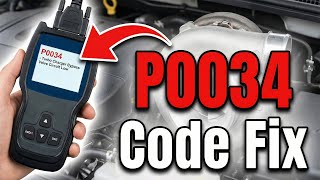

The information in this article is provided for general reference and educational purposes only. Vehicle specifications, procedures, and part compatibility can vary by production date, trim level, and region. Always consult your vehicle's factory service manual and verify part numbers before purchasing or performing repairs. Safety-critical components such as airbags, seat belts, and braking systems should be installed by a qualified professional.
- 🎬 Helpful Videos
- What Does P0034 Mean?
- Can I Drive With P0034?
- Common Causes
- Symptoms
- Diagnostic Flowchart
- Common Fixes & Costs
- DIY vs Professional
- Used vs. New Parts: Buying Guide
- What Happens If You Wait — Timeline
- Cost of Not Fixing It
- Diagnosis Steps
- When This Code Triggers (Freeze-Frame Conditions)
- Related Codes
- Climate & Environmental Factors
- How to Talk to a Mechanic About This Code
- Where to Take It: Dealer vs Independent vs Chain
- When to Walk Away From the Repair
- What Scan Tool You Need for This Code
- How to Clear the Code After You Fix It
- Will This Fail Emissions / State Inspection?
- Most Commonly Affected Vehicles
- Manufacturer-Specific Notes
- Real Owner Stories
- 2017 Ford Escape SE (1.5L) at 97k miles
- 2014 Chevy Cruze (1.4L Turbo)
- 2016 Ford F-150 Platinum (EcoBoost) at 10k miles
- How to Prevent This Code From Triggering
- Frequently Asked Questions
- Can I just replace the fuse to fix P0034?
- What is the most common misdiagnosis for P0034?
- What does 'Circuit Low' actually mean?
- Can a bad battery cause a P0034 code?
- What is the difference between a bypass valve and a wastegate?
- Is a bypass valve the same as a blow-off valve?
- Will the Check Engine Light turn off by itself after I fix it?
- Key Takeaways
- 🎟️ Get 5% Off