

P0030 on 2002-2008 Subaru Forester: Front O2 Sensor Heater Failure Causes and Fixes
On a 2002-2008 Forester, P0030 almost always means the internal heater in the front oxygen sensor (also called an Air/Fuel Ratio sensor) has failed. The most reliable fix is to replace the sensor with a Denso 234-9120 or a genuine Subaru part (22641AA280). Expect to pay ~$120-$180 for a quality aftermarket part and ~$220-$280 for an OEM part. This is a common DIY repair with a difficulty of 2/5, requiring a 22mm (or 7/8") oxygen sensor socket.
- P0030 on a 2002-2008 Forester almost certainly points to a failed heater inside the front oxygen (A/F) sensor.
- Before buying any parts, perform a quick check of the 'A/F HTR' fuse in the engine bay fuse box.
- Confirm the sensor has failed by testing the resistance between the two same-colored heater wires; a good sensor reads 2-5 ohms, while a bad one will read open (OL).
- To avoid compatibility issues, use a high-quality replacement sensor from Denso (the OEM supplier, part #234-9120) or a genuine Subaru part (22641AA280).
- This is a manageable DIY repair for those with basic tools, including a specific 22mm (7/8") oxygen sensor socket.
What's Unique About the 2002-2008 Subaru Forester
The 2.5L EJ25 engine in this generation of Forester is known for being particular about its sensors. While the P0030 code is straightforward, the vehicle's computer can be sensitive to the electrical characteristics of the replacement part. Owners and mechanics strongly recommend using either a genuine Subaru sensor or one from the original equipment manufacturer, Denso, to avoid compatibility issues that can cause the code to return even with a new part. Using other brands like Bosch is frequently advised against in owner forums due to a high likelihood of incompatibility.
🎬 Watch: What the P0030 code means and how to fix itSymptoms You May Notice
- Check Engine Light (CEL) is on
- Flashing cruise control light (a standard Subaru feature when a CEL is triggered)
- Reduced fuel economy
- Rough idle, especially when the engine is cold
- Vehicle may fail an emissions test
- Exhaust smells rich (like gasoline)
- Replacing the rear oxygen sensor (Sensor 2). P0030 is specific to the front sensor (Sensor 1).
- Replacing the sensor without first checking the fuse and wiring. A simple fuse or wiring check can save significant time and money.
- Using a cheap, universal, or non-Denso/OEM sensor. Subaru ECUs are known to be sensitive, and using an incompatible sensor can cause the code to return immediately.
Most Likely Causes
- Failed Front Air/Fuel (O2) Sensor Heater Element 🔴 High Probability The internal heating element is a common failure point in oxygen sensors due to constant heat cycles over many years and miles. It's the most frequent cause for P0030.
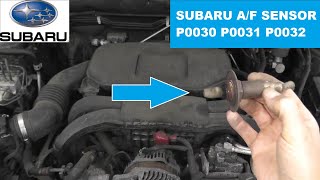
How to confirm: Disconnect the sensor and measure the resistance between the two heater circuit pins (usually the two same-colored wires, often black). A good sensor should have a low resistance, typically between 2.0 and 5.0 ohms when cold. A reading of infinite resistance (OL) confirms the heater has failed. 🎬 Watch: How to test and replace the A/F sensor
Typical fix: Replace the front oxygen sensor (Bank 1, Sensor 1).
Est. part cost: $120-$280 - Damaged Wiring or Connector 🟡 Medium Probability The wiring harness for the sensor is located in the engine bay and can be susceptible to heat damage from the exhaust manifold, or corrosion over time. The connector is located on the passenger side of the engine, near the upper radiator hose.
How to confirm: Visually inspect the sensor's wiring harness and connector for any signs of melting, fraying, corrosion, or loose pins. Check for battery voltage (~12V) at the heater power pin on the vehicle-side of the connector with the key on, engine off.
Typical fix: Repair or replace the damaged section of the wiring harness or the connector.
Est. part cost: $10-$50 - Blown Fuse for the A/F Sensor Heater Circuit ⚪ Low Probability
How to confirm: Locate the fuse for the A/F sensor heater (often labeled 'A/F HTR') in the engine bay fuse box and check if it is blown. It is typically a 15A fuse.
Typical fix: Replace the blown fuse. If the fuse blows again immediately, it indicates a short circuit in the wiring or the sensor itself that must be diagnosed.
Est. part cost: $1-$5
Rare But Worth Checking
- Faulty Engine Control Module (ECM): This is a very rare cause. The ECM's internal driver for the heater circuit can fail, but all other potential causes should be exhaustively ruled out before considering ECM replacement. One owner reported this as the ultimate fix after multiple sensor replacements failed to resolve the code.
Diagnosis Steps
- Scan the vehicle for any other stored trouble codes. Address other codes first if they are present.
- Visually inspect the front A/F sensor's wiring harness and connector for obvious damage like melting, chafing, or corrosion. The connector is typically located on the passenger side of the engine bay, near the radiator hose.
- Check the fuse for the A/F sensor heater circuit (often labeled 'A/F HTR') in the engine bay fuse box. Replace if blown.
- If the fuse is good, disconnect the sensor's electrical connector.
- Using a multimeter set to Ohms, measure the resistance across the two heater pins on the sensor side of the connector (these are typically the two wires of the same color, often black). A good sensor should read between 2-5 ohms. An 'OL' or infinite reading indicates a failed sensor.
- If the sensor resistance is good, check for power at the vehicle-side connector. With the ignition key in the 'ON' position (engine off), use a multimeter to check for battery voltage (~12V) between the heater power pin and a known good ground.
- If voltage and sensor resistance are both within spec, there may be an issue with the ground side of the circuit or, rarely, the ECM itself.
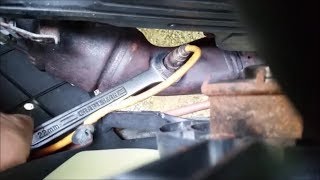
- For removal, a special 22mm (7/8") oxygen sensor socket with a slit for the wire is highly recommended. Soaking the sensor threads in penetrating oil beforehand can make removal much easier.
Parts You'll Likely Need
- Front Air/Fuel Ratio Sensor (Bank 1, Sensor 1)
(OEM #22641AA280)— The internal heater element of the original sensor is the most common failure point that triggers code P0030.
Trusted brands: Denso (OEM Manufacturer, Part #234-9120), NGK/NTK
OEM price range: $220-$280
Aftermarket price range: $120-$180
Related Codes That Often Appear With This One
- P0134 — P0134 means 'O2 Sensor Circuit No Activity Detected'. If the heater fails (P0030), the sensor won't warm up properly and won't produce a signal, which can trigger P0134 as a secondary code. Seeing both codes together strongly points to a failed sensor.
- P0031 — This code indicates the heater circuit signal is low, which can be caused by the same root issues as P0030, such as a failed heater element or wiring problem.
- P0032 — This code indicates the heater circuit signal is high, typically pointing to a short circuit in the wiring or within the sensor itself.
Platform-Specific Known Issues
- On Subarus of this era, a Check Engine Light will almost always be accompanied by a flashing cruise control light. This is normal behavior designed to get the driver's attention and does not indicate a separate fault with the cruise control system.
- The ECU is highly sensitive to the brand of A/F sensor used. Sticking to the OEM part or the Denso equivalent is critical to ensure the code does not return after repair.
Mechanic-Grade Diagnostic Values
- A/F Sensor Heater Current Draw — expected: Between 0.8A and 10A. Failure: A current draw less than 0.8A can trigger a P0031 (low circuit) code, while a draw over 10A can trigger a P0032 (high circuit) code. These values indicate the thresholds the ECM uses to determine a fault.
- Heater Circuit Power Supply Voltage — expected: ~12V (Battery Voltage) at the harness connector with Key On, Engine Off.. Failure: A voltage reading of 0V indicates an open in the power feed circuit or a blown 'A/F HTR' fuse.
- Heater Circuit Ground Control — expected: The ECM provides a ground to activate the heater. When testing the harness, one heater wire should have ~12V and the other should show continuity to ground when commanded ON by the ECM (or show high resistance when OFF).. Failure: If 12V is present on BOTH heater circuit wires at the harness (with sensor disconnected), it indicates the ECM is not providing the ground path, pointing to a faulty ECM driver.
Scan Tool Commands That Help
- Subaru Select Monitor (SSM): O2 Heater Diagnosis — This is a system self-test status that can be viewed with a dealer-level scan tool. It will report its status as 'Complete' or 'Incomplete'. This provides a quick way to confirm if the ECM has successfully run its internal test on the heater circuit after a repair, without waiting for a full drive cycle.
Wiring & Ground Locations
- E23 / B18 — The front A/F (O2) sensor electrical connector, located on the passenger side of the engine bay, near the upper radiator hose.. This is the primary connector to test for power, ground, and sensor resistance. Corrosion or damage here is a common cause of the P0030 code.
- Intake Manifold Ground — There are ground wires bolted to the top of the intake manifold runners.. The Subaru ECU gets its primary grounding through the intake manifold. A poor connection here, often caused by paint, corrosion, or installing phenolic spacers without adding a dedicated ground strap, can cause a host of bizarre electrical issues, including sensor faults.
- Main Chassis Ground — The negative battery cable grounds directly to the chassis, typically on the driver's side strut tower or nearby frame rail.. All engine electrical systems rely on a solid engine-to-chassis ground. Verifying this connection is clean and tight is a fundamental step in diagnosing any electrical fault code.
Real Owner Repair Stories
- Ultimate Subaru Message Board user (2003 Subaru Outback (with similar EJ25 engine and ECU logic)) — Persistent P0030 code.
❌ Tried (didn't work) Replacing the front A/F sensor
✅ What actually fixed it The Engine Control Module (ECM) was faulty. A technician confirmed the diagnosis by testing the sensor harness and finding 12V on BOTH heater circuit wires, which indicated the ECM was failing to provide the necessary ground to complete the circuit. Replacing the ECM resolved the code.
OEM Part Supersession History
22641AA140→22641AA280— Standard part number update by the manufacturer.
Heads up: The parts are interchangeable; 22641AA280 is the correct service replacement for vehicles that originally came with 22641AA140.
Diagnostic Flowchart
Other Known Issues on This Vehicle
Issues unrelated to this code that are worth knowing about as an owner of this generation:
- Head Gasket Failure (External Oil/Coolant Leaks) 🔴 High — Very common, especially on 2002-2004 models. Often occurs between 100,000 and 150,000 miles. Later models in this generation (2005-2008) used an improved gasket but are still susceptible.
- Failing Rear Wheel Bearings 🟠 Medium — A common issue where the rear wheel bearings become noisy (humming or grinding sound) and require replacement, often starting around 100,000 miles.
- Oil Leak from AVLS Oil Pressure Switch 🟡 Low — The oil pressure switch for the Active Valve Lift System (AVLS) located on the top rear of the driver's side cylinder head can fail and leak oil. It's a relatively common and inexpensive fix.
Used vs. New Parts: Buying Guide for This Vehicle
When a used part is the smart pick: A used part is almost never recommended for the oxygen sensor itself, as it is a wear item with a finite lifespan. However, sourcing a used wiring harness pigtail (connector) from a junkyard is a smart and cost-effective repair if your original connector is melted or corroded.
Donor-vehicle mileage cap: roughly under 100000 miles for the part to have meaningful remaining life.
What to inspect on the donor part:
- For a pigtail, ensure the plastic isn't brittle or cracked.
- Check for any signs of melting on the connector body.
- Look for green or white corrosion on the metal pins inside the connector.
- Ensure the locking tab clicks securely.
OEM-only on this vehicle (don't cheap out):
- Front Air/Fuel Ratio Sensor
Aftermarket brands forum-validated for this vehicle:
- Denso (OEM supplier)
- NTK
Brands owners have reported issues with on this vehicle:
- Bosch (frequently reported compatibility issues on Subaru forums)
- Unbranded 'universal' sensors that require splicing wires.
Real Owner Stories
Aggregated from forums and TSBs cited above. Mileages and costs reflect what owners reported in those sources.
2003 Subaru Forester
Symptoms: Intermittent check engine light that turns on and off.
What fixed it: Replacing the O2 sensor with a recommended brand like Denso, NTK, or Bosch.
Source hint: reddit.com - 2003 Subaru Forester P0030 Heater control unit code
2003 Subaru Forester 2.5xs
Symptoms: Check engine light (CEL) came on. Unplugging and reconnecting the O2 sensor made the light go away for a day before it returned.
What fixed it: Seeking sensor replacement after temporary fixes (unplugging/reconnecting) failed.
Source hint: reddit.com - Subaru Forester 2003 2.5xs
Subaru with EJ25 engine — 110000 miles
Symptoms: Recurring P0030 check engine light even after replacing the sensor.
What fixed it: Replacing the ECM (Engine Control Module) after diagnosing a failed ground driver.
Source hint: ultimatesubaru.org
Related OBD-II Codes
Frequently Asked Questions
Why is my cruise control light flashing along with the Check Engine Light on my Forester?
Where is the A/F sensor connector located on the 2.5L EJ25 SOHC engine?
What brand of replacement sensor should I use for my Subaru to fix P0030?
How can I test if the front oxygen sensor heater has actually failed?
Is there a fuse I should check before replacing the expensive front A/F sensor?
Could my Forester's P0030 code be caused by something other than the sensor itself?
Helpful Videos

We Have This Part in Stock




The information in this article is provided for general reference and educational purposes only. Vehicle specifications, procedures, and part compatibility can vary by production date, trim level, and region. Always consult your vehicle's factory service manual and verify part numbers before purchasing or performing repairs. Safety-critical components such as airbags, seat belts, and braking systems should be installed by a qualified professional.
- Subaru Forester:
- 🎬 Helpful Videos
- 🛍️ Shop This Part
- What's Unique About the 2002-2008 Subaru Forester
- Symptoms You May Notice
- Most Likely Causes
- Rare But Worth Checking
- Diagnosis Steps
- Parts You'll Likely Need
- Related Codes That Often Appear With This One
- Platform-Specific Known Issues
- Mechanic-Grade Diagnostic Values
- Scan Tool Commands That Help
- Wiring & Ground Locations
- Real Owner Repair Stories
- OEM Part Supersession History
- Diagnostic Flowchart
- Other Known Issues on This Vehicle
- Used vs. New Parts: Buying Guide for This Vehicle
- Real Owner Stories
- 2003 Subaru Forester
- 2003 Subaru Forester 2.5xs
- Subaru with EJ25 engine — 110000 miles
- Related OBD-II Codes
- Frequently Asked Questions
- 🎟️ Get 5% Off