

OBD-II Code P0027: Exhaust Valve Timing Control Solenoid Problem
What P0027 means, why it triggers, and how to fix it
- Check your engine oil level and color immediately; low or heavily sludged oil causes over 20% of P0027 codes and is the cheapest fix.
- Test the exhaust VVT solenoid's resistance with a multimeter; a reading outside the typical 5-30 Ohm range confirms the part is electrically dead and requires replacement.
- Do not replace the camshaft position sensor; P0027 points to the VVT solenoid that adjusts timing, not the sensor that monitors it.
- Stop driving if you hear a loud engine rattle on startup; this indicates oil starvation to the cam phaser, which leads to a $1,500+ timing chain or engine repair if ignored.
What Does P0027 Mean?

Your car's Engine Control Module (ECM) detected a problem with the exhaust valve control solenoid for engine Bank 1. This solenoid controls the variable valve timing (VVT) system, adjusting exhaust valve timing to optimize performance and fuel economy. Code P0027 means the solenoid's electrical signal or mechanical response falls outside expected parameters.
Technical definition: P0027 stands for Exhaust Valve Control Solenoid Circuit Range/Performance (Bank 1). The Powertrain Control Module (PCM) triggers this when the voltage, resistance, or response time of the Bank 1 exhaust VVT solenoid circuit falls outside the manufacturer's specified range. This indicates the solenoid is responding too slowly or not at all due to electrical faults, mechanical binding, or low oil pressure.
Can I Drive With P0027?
Yes, But With Caution. You can drive short distances, but ignoring P0027 risks severe engine damage. The engine will perform poorly and consume more fuel. Prolonged driving causes VVT actuator failure (a $500-$1,000 repair) or camshaft and timing component damage (a $1,500+ repair). Stop driving immediately if the Check Engine Light flashes, you hear loud knocking, or experience severe power loss.
Common Causes

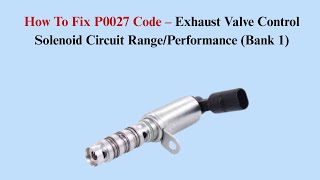
- Faulty Exhaust Valve Control Solenoid (VVT Solenoid) (Very Common) — This is the most frequent cause. The solenoid, a precise electro-hydraulic valve, becomes clogged with oil sludge, gets stuck internally, or fails electrically. Replacing this part resolves approximately 70% of P0027 codes. 🎬 Watch: How to fix the P0027 code and replace the solenoid
- Low, Dirty, or Incorrect Viscosity Engine Oil (Common) — The VVT system relies entirely on oil pressure. Low oil, heavy sludge, incorrect viscosity (e.g., 5W-30 instead of 5W-20), or a cheap oil filter restricts flow to the solenoid and cam phaser. This accounts for about 20% of cases.
- Wiring or Connector Issues (Less Common) — Corroded, loose, or frayed wiring interrupts the ECM signal. A blown fuse or faulty relay in the VVT circuit also cuts power, triggering this code.
- Faulty/Sticking Camshaft Phaser (VTC Actuator) (Uncommon) — The cam phaser is the mechanical gear that rotates the camshaft using oil pressure from the solenoid. Phasers clog with sludge or fail mechanically, triggering a performance code even if the solenoid works perfectly.
- Stretched Timing Chain or Belt (Uncommon) — On higher-mileage vehicles, a stretched timing chain or a jumped timing belt causes a correlation issue between the camshaft and crankshaft. The PCM interprets this mechanical timing error as a VVT performance problem.
- Faulty Engine Control Module (ECM/PCM) (Very Rare) — The ECM's internal driver for the solenoid circuit occasionally fails. Consider this only after exhaustively ruling out all electrical and mechanical possibilities.
Symptoms

- Check Engine Light is On — This is the first and most obvious symptom.
- Reduced Engine Power and Hesitation — The car feels sluggish, hesitates during acceleration, and lacks power because the exhaust valve timing is stuck in a non-optimal position.
- Poor Fuel Economy — Gas mileage drops by 10-20% because the engine cannot run at peak efficiency.
- Rough Idle or Stalling — The engine runs unevenly, shakes while stopped at a light, or stalls completely, particularly when cold.
- Engine Rattle or Ticking Noises — A rattling or ticking sound from the top of the engine on startup indicates a failing cam phaser or VVT components operating without sufficient oil pressure.
- VVT System Live Data Mismatch (scan-tool only — no driver-felt sign) — On a scan tool, the 'Desired' vs 'Actual' camshaft position angles fail to match, confirming a performance issue.
Diagnostic Flowchart
Tap your situation to follow the diagnostic path that matches what you're seeing on this code.
Common Fixes & Costs
- Change Engine Oil and Filter — Parts: $40-$80, Labor: $20-$50, ~0.5 hr book time (DIY)
- Replace Exhaust Valve Control (VVT) Solenoid
— Parts: $50-$150, Labor: $100-$250, ~1.0 hr book time
(Intermediate)
: OEM
: OEM
: OEM - Clean VVT Solenoid and Oil Passages — Parts: $10-$20, Labor: $50-$150, ~0.8 hr book time (Intermediate)
- Repair Wiring or Replace Connector — Parts: $10-$50, Labor: $100-$300, ~1.5 hr book time (Intermediate)
- Replace Camshaft Phaser/VTC Actuator
— Parts: $150-$400, Labor: $300-$800, ~4.5 hr book time
(Professional)
: OEM - Replace Timing Chain and Components
— Parts: $200-$600, Labor: $800-$2000, ~8.0 hr book time
(Professional)
: OEM
DIY vs Professional
- Change Engine Oil and Filter — Beginner:
Tools: Wrench set, oil filter wrench, drain pan, funnel, new oil, new filter. - Replace VVT Solenoid — Beginner:
Tools: Basic socket/wrench set, torque wrench, rags, flashlight. - Clean VVT Solenoid — Beginner:
Tools: Basic socket/wrench set, brake/MAF cleaner, compressed air, 12V power source. - Repair Wiring or Replace Connector — Beginner:
Tools: Multimeter, wire strippers, crimpers, heat shrink tubing, soldering iron, replacement pigtail. - Replace Camshaft Phaser/VTC Actuator — Beginner:
Tools: Extensive tool set, torque wrenches, timing chain holding tools, valve cover gaskets, sealants. - Replace Timing Chain and Components — Beginner:
Tools: Engine-specific timing tool kit, engine support, extensive socket set, torque-to-yield bolts.
Used vs. New Parts: Buying Guide
When a used part is worth it: Buying a used VVT solenoid only makes sense if the vehicle is over 15 years old, the budget is extremely tight, and you can verify the donor vehicle had low mileage.
Donor-vehicle mileage cap: roughly under 60000 miles for the part to have meaningful remaining life.
Donor quality checklist:
- Verify the donor car's VIN and mileage.
- Inspect the part for physical damage, connector corrosion, and sludge on the screens.
- Match the part number exactly; identical-looking solenoids are often not interchangeable.
Decision logic:
- If A new OEM or reputable aftermarket part costs under $100. → Buy new. The small savings from a used part isn't worth the risk of premature failure.
- If The vehicle is over 10 years old, has high mileage, and the new part is over $200. → A low-mileage used part is a reasonable option to save money.
- If The part is a known common failure item on your specific vehicle. → Buy a new, updated design from the OEM to ensure the original flaw is fixed.
Warranty tradeoff: Used parts carry a 30-day warranty. New aftermarket parts offer 1-year to lifetime warranties. New OEM parts offer 1-2 year warranties.
Worst-case if a used part fails: $100-$300. If the used solenoid fails, you pay for the part again and repeat the installation labor.
What Happens If You Wait — Timeline
- 0-1 month: Check Engine Light illuminates. The solenoid sticks intermittently. You experience minor hesitation when cold and a slight drop in fuel economy. (MPG impact: 0-5%% · Added cost: $0-$25 in wasted fuel)
- 1-4 months: Performance issues become consistent. Rough idling, poor acceleration, and a 10-15% drop in MPG occur. The solenoid frequently fails to actuate. (MPG impact: 10-15%% · Added cost: $50-$150 in wasted fuel)
- 4-8 months: Running with a stuck solenoid starves the mechanical cam phaser of oil, causing it to fail. A rattling noise on startup becomes prominent. (MPG impact: 15-20%% · Added cost: $500-$1,000 (cam phaser replacement))
- 8+ months: Continued operation with incorrect timing leads to a stretched or broken timing chain. Pistons hit valves, resulting in complete engine failure. (MPG impact: >20%% · Added cost: $2,000-$5,000+ (engine replacement))
Cost of Not Fixing It
- 0-1 Month: Noticeable drop in fuel economy (10-20%) and sluggish engine performance. Increased stress on valvetrain components. (Added cost: $25-$75 in wasted fuel.)
- 1-6 Months: Increased carbon and sludge buildup. Potential damage to the VVT actuator (cam phaser) from oil starvation. (Added cost: $500-$1,000 for VVT actuator replacement.)
- 6+ Months: Catastrophic damage. Continued operation with incorrect valve timing leads to stretched timing chains or piston-to-valve contact. (Added cost: $2,000-$5,000+ for major engine repair.)
Diagnosis Steps

- Check Engine Oil Level and Condition
Pull the dipstick, wipe it, re-insert it, and check the level. Top it off if low. Examine the oil's color and texture. If it is black, thick, or gritty, change it immediately. This simple step solves the problem in 20% of cases.
Tools: Rag or paper towel (Beginner) - Scan for Codes and Review Freeze Frame Data
Use an OBD-II scanner to confirm P0027 and check for related codes. Codes for other VVT components (P0026, P0028) or camshaft correlation (P0017) point to systemic oil pressure or timing chain issues. Check for Technical Service Bulletins (TSBs) related to your specific vehicle.
Tools: OBD-II Scanner (Beginner) - Visually Inspect the Solenoid and Wiring
Locate the Bank 1 exhaust VVT solenoid. Check for a loose electrical connector, frayed wires, or oil leaking from the solenoid into the connector housing.
Tools: Flashlight (Beginner) - Test the Solenoid's Resistance
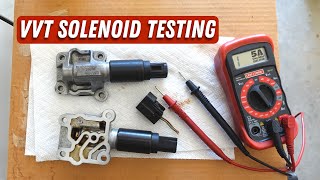
Unplug the solenoid. Set a multimeter to Ohms (Ω) and measure the resistance between the two pins. Compare the reading to your repair manual (typically 5-30 Ohms). A reading of infinity (OL) means an open circuit, and near zero means a short circuit. Both require replacement.
Tools: Multimeter, Repair Manual (Intermediate) - Test the Circuit for Power and Ground
With the key on and engine off, use a multimeter set to DC Volts. Probe the wiring harness connector. One pin must show battery voltage (11V-14V). If voltage is missing, check the VVT system fuses. The other wire is the ground control pulsed by the PCM.
Tools: Multimeter (Intermediate) - Activate the Solenoid with a Bi-Directional Scan Tool
Command the solenoid to activate while the engine idles. You will hear an audible click and observe a change in engine RPM. If the engine stumbles, the solenoid works mechanically. If nothing happens, the solenoid is stuck or dead.
Tools: Bi-directional Scan Tool (Advanced) - [ADVANCED] Check Engine Oil Pressure
Connect a mechanical oil pressure gauge. Pressure below the manufacturer's specification (typically <20 PSI at idle) indicates a worn oil pump or bearings starving the VVT system.
Tools: Mechanical Oil Pressure Gauge (Advanced) - [ADVANCED] Analyze VVT System Live Data
Monitor the live data PIDs for 'Camshaft Position - Desired' and 'Camshaft Position - Actual'. While holding RPMs at 2,000, these values must track each other closely. If 'Actual' lags or sticks, it confirms a mechanical VVT failure.
Tools: Advanced OBD-II Scan Tool (Advanced) - [PRO TIP] Analyze the Solenoid's PWM Signal
Backprobe the control wire with an oscilloscope. With the engine running, look for a square wave (PWM signal) between 70-250 Hz. A flat line indicates a wiring or PCM fault; a clean signal with no mechanical response confirms a bad solenoid.
Tools: Oscilloscope (Professional)
When This Code Triggers (Freeze-Frame Conditions)
- Engine Coolant Temp: 175-210°F (Engine at full operating temperature.)
- Engine RPM: 1500-3000 RPM (During steady cruise or light acceleration.)
- Engine Load: 25-70% (The engine is under moderate load, not idling or at full throttle.)
- Vehicle Speed: 20-60 mph (City or highway driving where the VVT system actively adjusts timing.)
Related Codes
- P0026 — This is the equivalent code for the INTAKE valve control solenoid on Bank 1. If your intake and exhaust solenoids are identical, swap them. If the code changes to P0027, the solenoid is bad. If P0026 returns, the wiring is bad.
- P0028 / P0029 — These are the identical faults for Bank 2 on V6 or V8 engines. Seeing codes for both banks simultaneously strongly suggests a systemic problem like low oil or a failing oil pump.
- P0017 — Crankshaft Position - Camshaft Position Correlation. This indicates a mechanical timing mismatch. While P0027 sometimes causes P0017, P0017 usually points directly to a stretched timing chain or failed cam phaser.
- P0365 / P0366 — Camshaft Position Sensor 'B' Circuit. These point to an electrical fault with the sensor itself, not the VVT solenoid. Do not replace the sensor to fix a P0027 code.
Climate & Environmental Factors
- Cold Weather: Cold temperatures thicken engine oil. During a cold start, thick oil flows slowly and fails to reach the VVT system quickly enough. This delay prevents the cam phaser from moving, triggering P0027. This is why the code often appears on the first start of a cold day.
- High Altitude: Lower air density at altitude reduces engine power, making VVT-related sluggishness or hesitation significantly more noticeable to the driver.
How to Talk to a Mechanic About This Code
Say this: "I have an OBD-II code P0027 for the exhaust valve control solenoid on Bank 1. I've already confirmed the engine oil level and condition are good. I'd like to book a diagnostic to test the solenoid's circuit and function before exploring more complex causes."
This signals you understand the common causes. It directs the technician to follow a logical diagnostic path (testing the cheapest parts first) and prevents them from immediately suggesting an expensive timing chain repair.
Avoid saying:
- 'My check engine light is on, can you just fix it?'
- 'My car is running rough, I think I need a new engine.'
- 'Just do whatever you think is best.'
Questions to ask before authorizing the repair:
- What were the results of the solenoid resistance test and the power/ground circuit test?
- If you recommend a cam phaser or timing chain, can you show me the live data graph of 'desired' versus 'actual' cam position that justifies it?
- Will you use an OEM or aftermarket part, and what is the warranty on both?
- Can you show me the old part after the repair is complete?
Where to Take It: Dealer vs Independent vs Chain
- Dealer:
Best for: Vehicles still under powertrain or emissions warranty., Complex cases where manufacturer-specific TSBs are critical., When an independent shop fails to diagnose the issue correctly.
Downsides: Highest labor rates, typically 1.5-2x more than independent shops., May recommend replacing an entire assembly when only a smaller component failed. (Typical cost: +50% vs. baseline) - Independent Shop:
Best fit for most situations. A reputable independent shop handles the entire P0027 diagnostic tree effectively at a lower cost than a dealer.
Best for: Most out-of-warranty vehicles where cost is a factor., Diagnosing and fixing the most common causes of P0027 (bad solenoid, wiring issue, oil change).
Downsides: Quality and expertise vary widely; vet shops based on reviews and ASE certifications., May lack expensive, factory-specific diagnostic tools for difficult cases. (Typical cost: +0% vs. baseline) - Chain Shop:
Acceptable only for an oil change. AVOID for diagnosing the P0027 code itself, as misdiagnosis is highly likely.
Best for: The most basic fix: a simple oil and filter change.
Downsides: Technician skill varies dramatically; they often lack diagnostic experience beyond reading the code., High pressure to upsell unnecessary services (e.g., engine flushes) that won't fix P0027. (Typical cost: -10% vs. baseline)
When to Walk Away From the Repair
If the estimated repair cost exceeds 50% of the car's current private-party value, seriously consider selling or trading it in.
- Car worth $5000, fix is $450: Fix it. This is a standard repair cost and is well below the 50% threshold.
- Car worth $4000, fix is $2200: Walk away. The repair cost is over 50% of the car's value. Put the money towards a replacement vehicle.
- Car worth $8000, fix is $2200: Borderline. The cost is significant but under the threshold. Get a second opinion before proceeding.
What Scan Tool You Need for This Code
Minimum: A scanner that reads and graphs live data, specifically 'Desired' vs. 'Actual' camshaft position.
A basic $20 code reader only tells you the P0027 code exists. It cannot show the live performance data needed to determine if the solenoid is slow or if the cam phaser is non-responsive.
Budget: BlueDriver Pro / Veepeak + Torque Pro (~$100) — These Bluetooth scanners connect to your smartphone and graph the essential live data PIDs (Desired vs. Actual cam angle) to confirm a performance issue.
Mid-range: Foxwell NT510 Elite / NT530 (~$180) — Adds bi-directional control. This allows you to command the VVT solenoid to activate directly from the scanner, confirming if the solenoid is mechanically stuck or electrically dead.
Professional: Autel MaxiCOM MK808 / Innova 5610 (~$450-600) — Offers full bi-directional control, advanced graphing, and access to manufacturer-specific codes. These tools provide dealership-level diagnostic capabilities for complex problems.
Rent vs buy: For a one-time diagnosis, borrow a scanner for free from an auto parts store. If you do your own maintenance regularly, buying a mid-range scanner is a worthwhile investment.
How to Clear the Code After You Fix It
- Use an OBD-II scan tool to clear the diagnostic trouble codes (DTCs).
- Perform a complete OBD-II drive cycle to allow the readiness monitors to set.
- Reconnect the battery (this clears codes but resets all vehicle memory and readiness monitors).
Drive cycle (~20 minutes): A typical drive cycle involves a cold start, idling for 3 minutes, 10 minutes of mixed city driving, 10 minutes of steady highway driving at 55-60 mph, and a cool-down period.
Readiness monitors affected: Comprehensive Component Monitor, Catalyst Monitor, Evaporative System Monitor, Oxygen Sensor Monitor
Before emissions retest: drive at least 50 miles to fully set monitors.
Watch out for:
- Disconnecting the battery clears the code but resets all readiness monitors to 'Not Ready', causing an automatic emissions test failure.
- The code returns immediately if the underlying mechanical or electrical fault was not repaired.
Will This Fail Emissions / State Inspection?
Yes — this code typically fails an OBD-II emissions inspection.
- California: An active P0027 code causes an automatic smog check failure. After repairs, you must complete a full drive cycle to set readiness monitors before re-testing.
- New York: A vehicle with an illuminated Check Engine Light for P0027 fails the mandatory annual safety and emissions inspection.
- Texas: In emissions-testing counties, an illuminated Check Engine Light or stored P0027 code results in an automatic failure.
Manufacturer-Specific Notes
- Toyota/Lexus: Engines like the 2007-2011 Camry 2.4L/2.5L are intolerant of oil sludge. P0027 is frequently a direct result of extending oil change intervals, which clogs the VVT system's tiny passages.
- Honda: On 2008-2012 Accords and 2007-2014 CR-Vs, a loud engine rattle on cold start is a classic sign of a failing VTC actuator (TSB 09-010). The repair requires replacing the actuator.
- Hyundai/Kia: On 2011-2016 Sonata and Optima 2.4L engines, VVT codes frequently appear due to Oil Control Valve (OCV) assembly failures. TSB 21-EM-003H addresses this with an updated part.
- GM/Chevrolet: On 2010-2017 2.4L Ecotec engines, VVT codes are the first warning sign of a stretched timing chain and failing plastic guides. Replacing solenoids provides only a temporary fix.
Real Owner Stories
2007 Volvo S60 2.5T with recurring code
Check Engine Light with P0027 appeared. The owner cleared the code and changed the oil. The light stayed off for two months before returning.
What they tried:
- Cleared the code
- Performed an oil change
Outcome: The code returned, proving the oil change was a temporary fix. The underlying issue was a sticking VVT solenoid.
Lesson: An oil change is a valid first step, but if the code returns, replace the solenoid. Don't assume an easy fix is permanent.
2015 Chevy Equinox 2.4L with multiple codes and no-start
Vehicle stalled and would not restart. A scan revealed P0027, P0017 (Cam/Crank Correlation), and P0016.
What they tried:
- Replaced both intake and exhaust VVT solenoids.
Outcome: Replacing the solenoids did not fix the no-start condition. The combination of codes pointed to a jumped timing chain, a known issue with this engine.
Lesson: When P0027 appears alongside correlation codes like P0016 or P0017, suspect a mechanical timing issue. Replacing solenoids wastes money and ignores the root cause.
2007 Volvo XC70 2.5T with persistent P0027
P0027 persisted despite numerous repairs. The car ran perfectly with no symptoms.
What they tried:
- Oil change
- Replaced exhaust VVT solenoid
- Replaced wiring pigtail
- Replaced camshaft position sensor
Outcome: The code temporarily cleared but always returned. A shop diagnosed an intermittent wiring fault requiring an oscilloscope to trace.
Lesson: If you replace the common culprits and the code persists without symptoms, stop throwing parts at it. Pay for professional electrical diagnostics.
How to Prevent This Code From Triggering

- Follow manufacturer's recommended oil change intervals (Every 5,000-7,500 miles) — Regular oil changes prevent the sludge and contaminants that clog VVT solenoid screens and oil passages.
- Use high-quality full synthetic engine oil (Every oil change) — Synthetic oils resist thermal breakdown and maintain viscosity in extreme temperatures, ensuring proper VVT operation on cold starts.
- Use an OEM or premium aftermarket oil filter (Every oil change) — Quality filters feature superior anti-drainback valves that keep oil in the engine's top end, delivering faster oil pressure to the VVT system on startup.
- Avoid excessive short-trip driving (Daily habit) — Short trips prevent the engine from reaching operating temperature, allowing moisture and fuel to build up in the oil and accelerate sludge formation.
Frequently Asked Questions
What does 'Bank 1' mean?
On V6 or V8 engines, Bank 1 is the side containing cylinder #1. For inline 4-cylinder engines, there is only one bank, always referred to as Bank 1.
Can I just clean the VVT solenoid to fix P0027?
Sometimes. If the solenoid is stuck due to sludge, cleaning it with brake cleaner restores function. However, if the solenoid fails electrically (open or shorted coil), cleaning won't work and it requires replacement.
How much does it cost to fix P0027?
An oil change costs $50-$100, while replacing the VVT solenoid ranges from $150 to $400. If the root cause is a stretched timing chain, repairs escalate to $1,000-$2,500+.
What is a common misdiagnosis for P0027?
The most common mistake is replacing the camshaft position sensor instead of the VVT solenoid. Another frequent error is replacing the solenoid without first checking for low or dirty engine oil.
What's the difference between P0027 and P0017?
P0027 is a circuit or performance code for the VVT solenoid, indicating electrical or sluggish mechanical response. P0017 is a correlation code that points to a mechanical timing mismatch, such as a stretched timing chain.
Will my car fail an emissions test with code P0027?
Yes. An active Check Engine Light causes an automatic failure during a smog or emissions test. The underlying fault also prevents efficient combustion, increasing harmful tailpipe emissions.
Is the exhaust VVT solenoid the same as the intake VVT solenoid?
On many vehicles, the intake and exhaust solenoids are identical and can be swapped for diagnostic purposes. However, some engines use different part numbers, so always verify compatibility before swapping.
Key Takeaways
- Check your engine oil level and color immediately; low or heavily sludged oil causes over 20% of P0027 codes and is the cheapest fix.
- Test the exhaust VVT solenoid's resistance with a multimeter; a reading outside the typical 5-30 Ohm range confirms the part is electrically dead and requires replacement.
- Do not replace the camshaft position sensor; P0027 points to the VVT solenoid that adjusts timing, not the sensor that monitors it.
- Stop driving if you hear a loud engine rattle on startup; this indicates oil starvation to the cam phaser, which leads to a $1,500+ timing chain or engine repair if ignored.
Helpful Videos

The information in this article is provided for general reference and educational purposes only. Vehicle specifications, procedures, and part compatibility can vary by production date, trim level, and region. Always consult your vehicle's factory service manual and verify part numbers before purchasing or performing repairs. Safety-critical components such as airbags, seat belts, and braking systems should be installed by a qualified professional.
- 🎬 Helpful Videos
- What Does P0027 Mean?
- Can I Drive With P0027?
- Common Causes
- Symptoms
- Diagnostic Flowchart
- Common Fixes & Costs
- DIY vs Professional
- Used vs. New Parts: Buying Guide
- What Happens If You Wait — Timeline
- Cost of Not Fixing It
- Diagnosis Steps
- When This Code Triggers (Freeze-Frame Conditions)
- Related Codes
- Climate & Environmental Factors
- How to Talk to a Mechanic About This Code
- Where to Take It: Dealer vs Independent vs Chain
- When to Walk Away From the Repair
- What Scan Tool You Need for This Code
- How to Clear the Code After You Fix It
- Will This Fail Emissions / State Inspection?
- Manufacturer-Specific Notes
- Real Owner Stories
- 2007 Volvo S60 2.5T with recurring code
- 2015 Chevy Equinox 2.4L with multiple codes and no-start
- 2007 Volvo XC70 2.5T with persistent P0027
- How to Prevent This Code From Triggering
- Frequently Asked Questions
- What does 'Bank 1' mean?
- Can I just clean the VVT solenoid to fix P0027?
- How much does it cost to fix P0027?
- What is a common misdiagnosis for P0027?
- What's the difference between P0027 and P0017?
- Will my car fail an emissions test with code P0027?
- Is the exhaust VVT solenoid the same as the intake VVT solenoid?
- Key Takeaways
- 🎟️ Get 5% Off