

OBD-II Code P0026: Intake Valve Control Solenoid Circuit Range/Performance (Bank 1)
The Ultimate Guide to Understanding, Diagnosing, and Fixing P0026
- Check your engine oil first; over 50% of P0026 codes are solved simply by topping off low oil or changing dirty, sludge-filled oil.
- On 2006-2011 Subaru 2.5L engines, replace the $30 VVL oil pressure switch before buying a $150 VVT solenoid, as the switch is the primary failure point.
- Do not drive more than 100 miles with an active P0026 code to prevent unburned fuel from causing a $1,500+ catalytic converter failure.
- Diagnose a faulty solenoid for free by swapping the Bank 1 and Bank 2 (or intake and exhaust) solenoids to see if the code follows the part.
What Does P0026 Mean?
Code P0026 means the Powertrain Control Module (PCM) detected a performance or electrical fault in the Bank 1 intake valve control solenoid. This solenoid manages oil flow to adjust intake valve timing. The code triggers when the PCM commands a timing change, but the camshaft responds too slowly or not at all.
Technical definition: The SAE/OBD-II definition is "Intake Valve Control Solenoid Circuit Range/Performance (Bank 1)". The engine control module (ECM) commanded the Bank 1 intake camshaft to change timing, but the camshaft position sensor reports the actual position does not match the target within the allowed time. This indicates a slow mechanical response or an electrical control circuit fault.
Can I Drive With P0026?
Yes, But With Caution. You can drive for essential trips under 100 miles, but prolonged driving damages the engine. Ignoring the code causes rough idling, stalling, and poor fuel economy. The most serious risk is destroying the catalytic converter with unburned fuel, a repair costing $1,500 to $2,500. Stop driving immediately if the check engine light flashes or the engine rattles loudly.
Common Causes
- Low or Dirty Engine Oil (Very Common) — The VVT system relies entirely on clean, pressurized engine oil. Low, old, or sludge-filled oil cannot operate the solenoid and cam phaser, making this the most frequent cause.
- Faulty Intake Valve Control Solenoid (Bank 1) (Very Common) — The solenoid fails electrically (open or shorted coil), clogs with debris, or sticks mechanically, preventing it from directing oil to the cam phaser.
- Faulty VVL Oil Pressure Switch (Subaru Specific) (Common) — On 2006-2011 Subaru 2.5L engines, a separate oil pressure switch confirms VVL operation. These switches frequently leak or fail electrically, triggering P0026 even when the solenoid works perfectly.
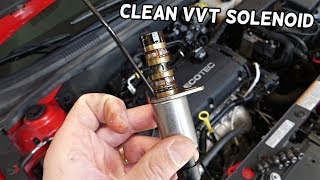
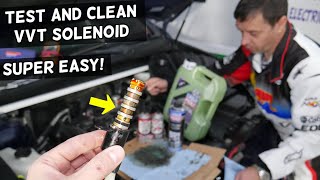
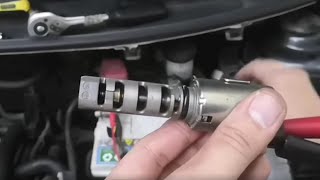
- Clogged Oil Passages or Filter Screens (Less Common) — Tiny mesh screens in the oil passages or solenoid body clog with sludge over time, 🎬 See how to clean your solenoid to restore engine power starving the VVT system of oil pressure.
- Wiring or Connector Damage (Less Common) — Corroded connectors or damaged wiring interrupt the PCM's signal, preventing solenoid activation.
- Incorrect Oil Filter (Rare) — Cheap aftermarket oil filters with incorrect pressure bypass valves cause oil pressure drops that starve the VVT system.
- Stretched Timing Chain or Faulty Phaser (Rare) — Mechanical failures like a stretched chain or broken VVT actuator prevent the camshaft from reaching its target angle, usually accompanied by startup rattling.
- Faulty Powertrain Control Module (PCM) (Very Rare) — A failed PCM driver circuit sends incorrect commands. Consider this only after exhaustively ruling out all other causes.
Symptoms
- Reduced Engine Power and Sluggish Acceleration — The engine feels unresponsive, especially during acceleration, because valve timing is not optimized for power delivery.
- Rough Idle or Stalling — The engine runs unevenly, vibrates, or stalls at low speeds because the valve timing is stuck in a position unsuitable for idling.
- Decreased Fuel Economy — An engine unable to adjust its valve timing for efficiency burns significantly more fuel.
- Engine Rattling or Ticking Noise — A distinct rattling sound on cold startups indicates low oil pressure or a failing mechanical VVT actuator (cam phaser).
- Check Engine Light is On (also visible on scanner) — The PCM illuminates the Malfunction Indicator Lamp (MIL) as soon as the fault is detected.
Diagnostic Flowchart
Tap your situation to follow the diagnostic path that matches what you're seeing on this code.
Common Fixes & Costs
- Engine Oil and Filter Change — Parts: $40-$80, Labor: $30-$60, ~0.5 hr book time (DIY)
- Replace Intake Valve Control Solenoid (VVT Solenoid) — Parts: $50-$150, Labor: $100-$200, ~1.0 hr book time (Intermediate)
- Replace VVL Oil Pressure Switch (Subaru) — Parts: $25-$50, Labor: $50-$100, ~0.8 hr book time (Intermediate)
- Clean or Replace VVT Filter Screens — Parts: $10-$30, Labor: $100-$250, ~1.5 hr book time (Advanced)
- Repair Wiring or Replace Connector — Parts: $10-$50, Labor: $100-$200, ~1.2 hr book time (Professional)
DIY vs Professional
- Engine Oil and Filter Change — Beginner: Yes
Tools: Wrench for drain plug, oil filter wrench, drain pan, funnel. - Replace Intake Valve Control Solenoid — Beginner: Yes, if easily accessible.
Tools: Basic socket/wrench set, torque wrench, rags. - Replace VVL Oil Pressure Switch (Subaru) — Beginner: Yes, with caution.
Tools: Deep socket for oil pressure switches, socket wrench, rags. - Clean or Replace VVT Filter Screens — Beginner: No.
Tools: Varies greatly; may require removal of other engine components. - Repair Wiring or Replace Connector — Beginner: No.
Tools: Multimeter, wire strippers, crimpers, soldering iron, heat shrink, wiring diagrams.
Used vs. New Parts: Buying Guide
When a used part is worth it: For a VVT solenoid, a used OEM part from a low-mileage vehicle (under 80,000 miles) is a cost-effective alternative to a new aftermarket part, often offering better fitment.
Donor-vehicle mileage cap: roughly under 80000 miles for the part to have meaningful remaining life.
Donor quality checklist:
- Verify the part number on the used solenoid exactly matches the original part.
- Source from a reputable salvage yard offering a 30-90 day warranty.
- Visually inspect the screen on the used solenoid for tears or heavy sludge.
Decision logic:
- If The cost of a new OEM solenoid is under $150. → Buy new OEM for guaranteed compatibility and warranty.
- If The vehicle is over 150,000 miles and the budget is very tight. → A used OEM part is often a better bet than a cheap, new aftermarket part of questionable quality.
- If The part is for a high-performance or newer vehicle under warranty. → Always use a new OEM part to ensure performance and avoid voiding the warranty.
Warranty tradeoff: Used parts typically have a 30-90 day functional warranty. Aftermarket new parts range from 1 year to a 'limited lifetime' warranty. New OEM parts usually carry a 1-year warranty.
Worst-case if a used part fails: $150-$300 if a used or cheap aftermarket solenoid fails shortly after installation, requiring repeat labor costs.
What Happens If You Wait — Timeline
- 0-2 weeks: Code sets and Check Engine Light is on. Driver may not notice any symptoms, or only a very slight hesitation. (MPG impact: 0-5%% · Added cost: $0)
- 2 weeks - 3 months: Noticeable drop in fuel economy, sluggish acceleration, and a rough or unstable idle become more frequent. Engine may stall at stops. (MPG impact: 5-15%% · Added cost: $20-$80 in wasted fuel.)
- 3-6 months: Incorrect valve timing causes unburned fuel to consistently enter the exhaust, starting to overheat and degrade the catalytic converter. The risk of permanent damage is now high. (MPG impact: 10-20%% · Added cost: $500-$1,500 (catalytic converter damage is likely becoming permanent).)
- 6+ months: Catalytic converter failure is highly probable. Prolonged operation with incorrect timing causes accelerated wear on valvetrain components and potentially leads to timing chain issues. (MPG impact: 15-25%% · Added cost: $1,200-$3,000+ (for catalytic converter replacement and potential related engine damage).)
Cost of Not Fixing It
- 0-1 month: Noticeable drop in fuel economy (5-15%), rough idle, and poor acceleration. Increased emissions output. (Added cost: $20-$60 in wasted fuel.)
- 1-6 months: Risk of overheating and damaging the catalytic converter due to unburned fuel entering the exhaust. This leads to a much more expensive repair. (Added cost: $900 - $2,800 for catalytic converter replacement.)
- 6+ months: Severe catalytic converter failure is highly likely. Prolonged incorrect valve timing causes accelerated wear on internal engine components. (Added cost: $2,500+ for catalytic converter and potential other engine repairs.)
Diagnosis Steps
- Check Engine Oil Level and Condition
Pull the dipstick, wipe it, reinsert it fully, and check the level. Ensure the oil is within the operating range. Inspect the oil for darkness, thickness, or a gritty texture. Low or dirty oil is the leading cause of VVT system faults.
Tools: Rag or paper towel (Beginner) - Scan for Codes and Review Live Data
Use an advanced OBD-II scanner to read all stored codes. Access the live data stream to monitor 'VVT Desired Angle' and 'VVT Actual Angle' for Bank 1. Command the solenoid on and off with the scanner and watch if the actual angle attempts to match the desired angle. A lack of response confirms a fault.
Tools: Advanced OBD-II Scanner (Intermediate) - Visually Inspect the Solenoid and Wiring
Locate the Intake Valve Control Solenoid on Bank 1 (the side with cylinder #1). Inspect the electrical connector for corrosion, pushed-out pins, or oil contamination. Follow the wiring harness looking for fraying, melting, or rodent damage.
Tools: Flashlight (Beginner) - Test the Solenoid's Resistance
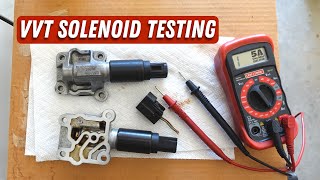
Disconnect the solenoid's electrical connector. Set a multimeter to Ohms (Ω). Measure the resistance between the two pins on the solenoid. Most VVT solenoids read between 6 and 15 Ohms at 68°F (20°C). A reading of infinity (O.L.) indicates an open circuit, while near zero indicates a short circuit. Both require replacement.
Tools: Multimeter (Intermediate) - Test for Power and Ground at the Connector
Turn the ignition to 'On' (engine off). Set the multimeter to DC Volts. Connect the black probe to the negative battery terminal. Probe the pins in the wiring harness connector. One pin must show battery voltage (10V-12.5V). The other is the PCM control wire, which grounds to activate the solenoid. No voltage indicates a blown fuse or wiring issue.
Tools: Multimeter (Intermediate) - Pro Tip: Swap the Solenoids
If the engine has identical solenoids for intake and exhaust, or Bank 1 and Bank 2, swap the suspect Bank 1 intake solenoid with a known good one. Clear codes and drive. If the fault code changes to the swapped location (e.g., P0013 or P0028), you have definitively confirmed the solenoid is faulty.
Tools: Socket set (Intermediate) - Pro Tip: Check VVL Oil Pressure Switch (Subaru)
On 2006-2011 Subarus, disconnect the single-wire connector on the VVL switch. With the engine off, check for continuity between the switch's pin and the engine block (ground). It should read under 1 Ohm. With the engine running above 3,000 RPM, the switch should open (infinity/O.L.). Replace if it fails or leaks oil.
Tools: Multimeter, Socket set (Advanced) - Advanced: Analyze Live Data PIDs
Graph 'Bank 1 Intake Camshaft Desired Position' against 'Bank 1 Intake Camshaft Actual Position'. The 'Actual' PID should mirror the 'Desired' PID with minimal delay. If 'Actual' is slow, static, or erratic, it confirms a performance issue. Monitor 'Bank 1 Intake Solenoid Duty Cycle' to ensure the PCM is actively commanding changes.
Tools: Graphing OBD-II Scanner (Advanced) - Advanced: Test VVT System Oil Pressure
Connect a mechanical oil pressure gauge to the VVT system test port. Compare readings to factory specs (e.g., 10-15 PSI at hot idle, 50+ PSI at 3000 RPM). Low pressure proves the VVT system cannot function correctly, pointing to a worn oil pump, clogged pickup tube, or internal engine wear.
Tools: Mechanical Oil Pressure Gauge, Socket Set (Advanced) - Advanced: Analyze the PCM Control Signal
Connect an oscilloscope's signal probe to the solenoid's control wire (ground side) and the ground probe to the battery negative. When commanded, you should see a clean square wave pattern (Pulse Width Modulation). A consistent square wave confirms the PCM and wiring are good, isolating the fault to mechanics or hydraulics.
Tools: Oscilloscope, Back-probe kit (Professional)
When This Code Triggers (Freeze-Frame Conditions)
- Engine Coolant Temp: 175-210°F (80-99°C) (The engine must be at full operating temperature for the VVT monitor to run.)
- RPM: 1,500-3,000 RPM (The fault is typically detected during steady-state cruising or moderate acceleration, not at idle.)
- Engine Load: 20-60% (The code sets under light to moderate engine load as the PCM actively commands camshaft angle changes.)
- Vehicle Speed: 40-65 mph (65-105 km/h) (Occurs during highway or steady suburban driving when the VVT system optimizes for fuel economy.)
Related Codes
- P0028 — This is the identical code but for Bank 2. Seeing P0026 and P0028 together strongly points to a systemic issue affecting the entire engine, such as extremely low oil level, severe sludge, or a failing oil pump.
- P0011 — 'Intake Camshaft Position Timing - Over-Advanced (Bank 1)'. Indicates the camshaft timing is stuck in a more advanced position than commanded. P0026 points to the control system's performance, while P0011 indicates the specific mechanical result.
- P0012 — 'Intake Camshaft Position Timing - Over-Retarded (Bank 1)'. The opposite of P0011, indicating cam timing is lagging. This happens due to low oil pressure, a clogged solenoid screen, or a sticky cam phaser.
- P0010 — 'Intake Camshaft Position Actuator Circuit / Open (Bank 1)'. Indicates a purely electrical fault (open or short circuit) in the solenoid's wiring or coil. P0026 is a broader performance code, while P0010 points directly to an electrical failure.
Climate & Environmental Factors
- Cold Weather: Extremely cold temperatures increase engine oil viscosity. On a cold start, thick oil flows slowly and may not build pressure quickly enough for the VVT system to respond within the PCM's timeframe, triggering P0026. Using manufacturer-recommended synthetic oil mitigates this.
- High Humidity / Salt: In regions with high humidity or road salt usage, the electrical connector and wiring for the VVT solenoid corrode faster, leading to intermittent electrical faults that trigger P0026.
How to Talk to a Mechanic About This Code
Say this: "I have a P0026 code on my [Make, Model]. I've confirmed the engine oil is full and clean. I'd like to schedule a diagnostic appointment. Please start by testing the Bank 1 intake solenoid's circuit and function, and check the live data for desired versus actual camshaft position before recommending any part replacements."
This signals you've already handled the most common cause (oil issues) and directs the technician to perform a logical, evidence-based diagnosis rather than just replacing the most obvious part. It shows you're an informed customer and helps prevent paying for unnecessary work.
Avoid saying:
- 'Just fix whatever's wrong'
- 'My check engine light is on, can you look at it?'
- 'Whatever you recommend'
Questions to ask before authorizing the repair:
- What were the results of the solenoid resistance test?
- Did you check for power and ground at the solenoid connector?
- Can you show me the live data graph of the desired vs. actual cam angle?
- For my Subaru, did you test the VVL oil pressure switch?
- What is the warranty on the recommended part and your labor?
Where to Take It: Dealer vs Independent vs Chain
- Dealer:
Best for: Vehicles still under powertrain or emissions warranty, Complex manufacturer-specific issues (e.g., Honda VTC actuator TSB, BMW VANOS faults), If prior attempts by other shops have failed
Downsides: Typically the highest labor rate (1.5-2x independent shops), May recommend replacing a whole assembly when only a smaller component has failed (Typical cost: +50% vs. baseline) - Independent Shop:
Best fit. A reputable independent shop can handle a P0026 diagnosis and repair efficiently and cost-effectively. They are very likely to have seen this common code before.
Best for: Most out-of-warranty vehicles, Common codes like P0026 where the fixes are well-documented, Building a long-term relationship with a trusted mechanic
Downsides: Quality and diagnostic capabilities can vary widely; vet shops by reviews and ASE certifications (Typical cost: +0% vs. baseline) - Chain Shop:
Use with caution. Acceptable for a basic oil change, but be wary of their diagnostic process for the P0026 code itself. Avoid if the problem is suspected to be more complex than just oil or a bad solenoid.
Best for: Simple, clear-cut repairs like an oil change if that is the diagnosed cause
Downsides: Technician skill is highly variable, High pressure to upsell services (engine flushes, additives) that may not be necessary, May lack the advanced diagnostic tools or experience for anything beyond a simple part swap (Typical cost: -10% vs. baseline)
When to Walk Away From the Repair
If the estimated repair cost exceeds 40-50% of the car's private-party value (e.g., from Kelley Blue Book), you should pause and evaluate your options.
- Car worth $5000, fix is $450: Fix it. This repair is a small fraction of the car's value and is essential for engine health.
- Car worth $3000, fix is $1800: Walk away. The repair cost is over half the car's value, indicating a major issue like a timing chain/phaser failure. It's not economically viable.
- Car worth $8000, fix is $1800: Borderline. Get a second opinion to confirm the diagnosis and cost. If the car is otherwise in great shape, it might be worth fixing.
What Scan Tool You Need for This Code
Minimum: A scanner that can display and graph live data PIDs (Parameter IDs).
A cheap $20 code reader will only tell you the P0026 code exists. It can't show you the live data, such as 'Desired vs. Actual Camshaft Position,' which is critical for diagnosing *why* the code is set. Without live data, you're just guessing at which part to replace.
Budget: BlueDriver Pro or FOXWELL NT301 (~$70) — Connects to your smartphone (BlueDriver) or as a handheld unit (NT301) to read and clear codes, view freeze frame data, and display/graph live data streams to help you see if the camshaft is responding to commands.
Mid-range: Foxwell NT510 Elite or Innova 5610 (~$150) — Adds bi-directional control. This allows you to actively command the VVT solenoid on and off through the scan tool, providing definitive proof of whether the solenoid is working or not.
Professional: Autel MaxiCOM MK808 series (MK808BT, MK808S) (~$500) — Provides comprehensive, OE-level diagnostics with fast, reliable bi-directional control for VVT systems, extensive service functions, and broad vehicle coverage.
Rent vs buy: If this is a one-time repair, many auto parts stores (like AutoZone) will read your codes for free or rent a basic scanner. However, to properly diagnose P0026 with live data, buying a budget pick for under $100 is a worthwhile investment.
How to Clear the Code After You Fix It
- Use an OBD-II scan tool to clear the diagnostic trouble codes.
- Reconnect the battery if it was disconnected for the repair.
- Perform a complete OBD-II drive cycle to allow readiness monitors to run.
Drive cycle (~30 minutes): A general drive cycle includes a cold start (engine sitting for 8+ hours), 5 minutes of idling, 10-15 minutes of mixed city/highway driving including steady speeds around 55 mph, and several smooth accelerations and decelerations. The goal is to meet the enabling criteria for all emissions monitors.
Readiness monitors affected: VVT System Monitor, Catalyst Monitor, Oxygen (O2) Sensor Monitor
Before emissions retest: drive at least 100 miles to fully set monitors.
Watch out for:
- Disconnecting the battery clears the code but resets all emissions readiness monitors to 'incomplete', causing an instant smog test failure.
- The code returns immediately if the underlying root cause was not correctly repaired.
- Some monitors, like EVAP, require specific conditions to run, such as the fuel tank being between 1/4 and 3/4 full.
Will This Fail Emissions / State Inspection?
Yes — this code typically fails an OBD-II emissions inspection.
- California: An active P0026 code results in an automatic smog check failure. After repair, a full drive cycle must be completed to set all readiness monitors before a re-test.
- New York: A vehicle with an illuminated Check Engine Light automatically fails the emissions portion of the NYS inspection. After repair, readiness monitors must be set, though NY allows one monitor to be 'not ready'.
- Texas: In the 17 counties requiring emissions testing, an active P0026 code causes the OBD-II test to fail. After repairs, readiness monitors must be complete. For vehicles 2001 and newer, one monitor may be 'not ready'.
Most Commonly Affected Vehicles
- Subaru Forester, Impreza, Outback, Legacy (2006-2011) — Extremely common on the 2.5L non-turbo engine. The primary cause is a failed VVL Oil Pressure Switch (Part #25240AA060), not the solenoid. The switch is inexpensive and a frequent oil leak point.
- Honda Accord, Civic, CR-V (2003-2017) — On K-series engines, the VVT solenoid is part of the VTEC Spool Valve Assembly. A clogged filter screen on this assembly is a very common cause. A rattling noise on cold startup indicates a failing VTC actuator (TSB 09-010).
- Toyota Camry, Corolla, RAV4, Highlander (2005-2018) — Common on 2.4L (2AZ-FE) and 2.5L (2AR-FE) engines. The issue is typically a faulty VVT solenoid (Oil Control Valve) or sludge from extended oil changes.
- Ford F-150, Explorer, Mustang (2004-2024) — On Ford's 3-valve V8 engines, VVT (VCT) solenoid issues are widespread. The problem is often linked to low oil pressure from worn timing components or non-OEM oil filters with incorrect bypass specs.
- Chevrolet / GM Equinox, Silverado, Traverse, Malibu (2010-2019) — Common on Ecotec 4-cylinder and High Feature V6 engines. The cause is often a faulty solenoid, but these engines are highly sensitive to correct oil level and viscosity.
- Nissan Altima, Murano, Rogue, Sentra (2007-2019) — Nissan vehicles set this code due to a failing intake valve timing control solenoid or low/dirty oil. Solenoids are typically accessible on the front or side of the engine.
- BMW 3-Series, 5-Series, X3, X5 (with N51/N52/N54/N55 engines) (2006-2017) — BMW's VANOS system uses solenoids that are a common failure point. A common DIY diagnostic is to swap the intake and exhaust solenoids to see if the fault code follows the solenoid.
- Hyundai / Kia Santa Fe, Sonata, Optima, Sorento (2009-2021) — Problems with the Oil Control Valve (OCV) are a known cause. These issues are frequently linked to oil sludge buildup from delayed oil changes.
Manufacturer-Specific Notes
- Subaru: For 2.5L engines (2006-2011), P0026 is most frequently caused by a failed VVL oil pressure switch, which costs around $30, rather than the $150 solenoid. Technicians almost always replace this switch first.
- Honda: Honda's VTEC solenoid is part of the 'spool valve assembly,' which has a small mesh filter notorious for clogging. A separate issue (TSB 09-010) addresses a loud, 2-second rattle on cold startup caused by a defective VTC actuator requiring mechanical replacement.
- Ford: On 5.4L 3V Triton engines, low oil pressure is a major contributor to VCT problems, often worsened by aftermarket oil filters that don't meet Ford's bypass valve standards. The solenoids are easy to change, but the underlying issue may be worn timing components.
- BMW: BMW's VANOS solenoids are a maintenance item. A highly effective diagnostic trick is to swap the intake and exhaust solenoids. If the fault code moves to an exhaust code, the solenoid is confirmed bad. Mechanics recommend replacing both at once.
Real Owner Stories
2010 Subaru Forester, 80K miles - The Classic Misdiagnosis
Check engine light and flashing cruise control light appeared during highway driving. Car drove fine otherwise. Code read P0026.
What they tried:
- Checked oil level, which was fine.
- Replaced the Bank 1 VVT solenoid ($150 part) because the code description points to it.
- Code returned within 50 miles.
Outcome: After consulting forums, owner replaced the Bank 1 VVL Oil Pressure Switch (a $30 part, P/N 25240AA060). The switch was visibly leaking oil. After replacement and clearing the code, the fault did not return.
Lesson: On 2006-2011 Subarus, the VVL oil pressure switch is a very high-failure item and the most common cause of P0026. Always inspect and consider replacing this inexpensive part before the more expensive solenoid.
2006 Honda Accord, 155K miles - The Sludge Story
Car developed a rough idle and felt sluggish. P0026 appeared. Owner admitted to stretching oil change intervals.
What they tried:
- An oil and filter change was performed. The code came back.
- The VVT solenoid (spool valve assembly) was removed for inspection.
- The small mesh screen on the solenoid gasket was found to be completely clogged with black sludge.
Outcome: The solenoid screen and valve body were thoroughly cleaned with brake cleaner, and a new gasket was installed. An engine flush chemical was used with the next oil change to help dissolve remaining deposits. The code was cleared and did not return.
Lesson: Simply changing the oil may not be enough if sludge has already clogged the tiny filter screens in the VVT system. Physical inspection and cleaning of the solenoid is often necessary.
2012 Chevy Equinox, 110K miles - The Double-Code Problem
Check engine light came on with two codes: P0026 (Bank 1) and P0028 (Bank 2). Engine was running rough and had a noticeable ticking sound.
What they tried:
- Owner initially suspected both VVT solenoids had failed simultaneously.
- A mechanic advised that seeing both codes together almost never means two parts failed at once.
Outcome: The mechanic checked the dipstick and found the oil level was dangerously low, over 2 quarts down. An oil and filter change was performed, bringing the level to full. Both codes were cleared and did not reappear. The ticking noise also vanished.
Lesson: If you see both P0026 and P0028 together, the problem is almost certainly systemic, not individual component failure. Suspect low oil level, severe sludge, or a failing oil pump before replacing any parts.
How to Prevent This Code From Triggering
- Perform regular oil changes with manufacturer-specified oil (Every 5,000-7,500 miles or as per owner's manual) — This is the single most effective way to prevent P0026. Fresh, correct-viscosity oil prevents the formation of sludge that clogs VVT solenoids and oil passages.
- Use high-quality, full-synthetic oil (Every oil change) — Synthetic oils contain superior detergents that actively clean engine internals and resist thermal breakdown, significantly reducing the risk of sludge formation compared to conventional oil.
- Use a high-quality oil filter from the OEM or a reputable brand (Every oil change) — Cheap oil filters can have incorrect pressure bypass valve specifications, leading to drops in oil pressure that starve the VVT system. This is a known issue, particularly on Ford engines.
- Consider a mild engine flush treatment before an oil change on high-mileage vehicles (Once every 30,000-50,000 miles for cars over 75k miles) — Products like Rislone Engine Treatment help dissolve existing sludge and deposits, preventing them from breaking loose and clogging critical oil passages or solenoid screens.
- On 2006-2011 Subarus, proactively replace the VVL oil pressure switches (Once per 100K miles) — These switches are a known high-failure part that leak and cause P0026/P0028. Replacing them preventatively avoids a future breakdown and misdiagnosis.
Frequently Asked Questions
What is the most common misdiagnosis for P0026?
Replacing the VVT solenoid when the actual problem is low engine oil or a clogged filter screen. On Subarus, mechanics often replace the expensive solenoid instead of the $30 oil pressure switch, which is the true culprit.
Can I pass an emissions test with a P0026 code?
No. An active P0026 code triggers the check engine light, resulting in an automatic emissions test failure. The VVT system directly impacts engine emissions.
Will P0026 clear itself?
No, you must repair the underlying fault. The check engine light might turn off intermittently, but the code remains stored in the PCM's memory. Clear the code with an OBD-II scanner after completing repairs.
What is 'Bank 1'?
Bank 1 is the side of the engine containing the #1 cylinder. Inline 4-cylinder engines only have one bank, so it is always Bank 1. For V6 or V8 engines, consult a repair manual to identify the Bank 1 side.
I just changed my oil and now I have a P0026 code. Why?
The new oil likely dislodged existing engine sludge, which then clogged the VVT solenoid's filter screen. It also happens if you use the wrong oil viscosity or overfill the crankcase. Remove and inspect the solenoid screen for debris.
Why did my P0026 code come back after I replaced the solenoid?
The solenoid was not the root cause. The most likely remaining culprits are low oil pressure, clogged oil passages, a hidden wiring fault, or a failed VVL oil pressure switch (on Subarus).
What is the difference between P0026 and P0011?
P0026 is a performance code indicating the solenoid control system isn't responding properly to commands. P0011 is a mechanical timing code indicating the camshaft is physically stuck in an over-advanced position. P0026 points to the solenoid or oil supply, while P0011 points to a stuck phaser or timing chain issue.
Key Takeaways
- Check your engine oil first; over 50% of P0026 codes are solved simply by topping off low oil or changing dirty, sludge-filled oil.
- On 2006-2011 Subaru 2.5L engines, replace the $30 VVL oil pressure switch before buying a $150 VVT solenoid, as the switch is the primary failure point.
- Do not drive more than 100 miles with an active P0026 code to prevent unburned fuel from causing a $1,500+ catalytic converter failure.
- Diagnose a faulty solenoid for free by swapping the Bank 1 and Bank 2 (or intake and exhaust) solenoids to see if the code follows the part.
Helpful Videos


The information in this article is provided for general reference and educational purposes only. Vehicle specifications, procedures, and part compatibility can vary by production date, trim level, and region. Always consult your vehicle's factory service manual and verify part numbers before purchasing or performing repairs. Safety-critical components such as airbags, seat belts, and braking systems should be installed by a qualified professional.
- 🎬 Helpful Videos
- What Does P0026 Mean?
- Can I Drive With P0026?
- Common Causes
- Symptoms
- Diagnostic Flowchart
- Common Fixes & Costs
- DIY vs Professional
- Used vs. New Parts: Buying Guide
- What Happens If You Wait — Timeline
- Cost of Not Fixing It
- Diagnosis Steps
- When This Code Triggers (Freeze-Frame Conditions)
- Related Codes
- Climate & Environmental Factors
- How to Talk to a Mechanic About This Code
- Where to Take It: Dealer vs Independent vs Chain
- When to Walk Away From the Repair
- What Scan Tool You Need for This Code
- How to Clear the Code After You Fix It
- Will This Fail Emissions / State Inspection?
- Most Commonly Affected Vehicles
- Manufacturer-Specific Notes
- Real Owner Stories
- 2010 Subaru Forester, 80K miles - The Classic Misdiagnosis
- 2006 Honda Accord, 155K miles - The Sludge Story
- 2012 Chevy Equinox, 110K miles - The Double-Code Problem
- How to Prevent This Code From Triggering
- Frequently Asked Questions
- What is the most common misdiagnosis for P0026?
- Can I pass an emissions test with a P0026 code?
- Will P0026 clear itself?
- What is 'Bank 1'?
- I just changed my oil and now I have a P0026 code. Why?
- Why did my P0026 code come back after I replaced the solenoid?
- What is the difference between P0026 and P0011?
- Key Takeaways
- 🎟️ Get 5% Off