

P0024 on 2019-2021 Ford Ranger: Exhaust Cam Timing Causes and Fixes
P0024 on a 2019-2021 Ford Ranger almost always points to a faulty exhaust VCT (Variable Camshaft Timing) solenoid, part number CJ5Z-6M280-A, or low/dirty engine oil. This is a common issue across many Ford 2.3L EcoBoost engines. Replacing the solenoid is a common, affordable DIY fix that often resolves the issue.
- P0024 on your Ranger refers to the EXHAUST camshaft timing being over-advanced.
- The most likely cause is a sticking exhaust VCT solenoid, often due to dirty oil.
- Before buying parts, check your oil level and condition. An oil change might solve the problem.
- A common DIY diagnostic is to swap the intake and exhaust VCT solenoids to see if the code follows the part.
- Always use the Ford-specified 5W-30 Synthetic Blend engine oil to ensure proper VCT system operation.
What's Unique About the 2019-2021 Ford Ranger
The main source of confusion for this code on the Ranger's 2.3L EcoBoost I-4 engine is Ford's non-standard use of the "Bank 2" designation to refer to the exhaust camshaft. While generic code readers will define it as Bank 2, for this specific engine, it pinpoints a problem in the Variable Camshaft Timing (VCT) system on the exhaust side. Ford has issued Technical Service Bulletins (TSBs) for these engines, noting that debris in the oil can cause the VCT solenoids to stick, triggering this code. This issue is not unique to the Ranger and affects other Ford vehicles with the 2.0L and 2.3L EcoBoost engines.
Diagnostic Flowchart
Tap your situation to follow the diagnostic path that matches what you're seeing on this vehicle.
Symptoms You May Notice
- Check Engine Light is on
- Rough or unstable idle
- Reduced engine power and sluggish acceleration
- Engine hesitation or stalling
- Decreased fuel economy
- Rattling, ticking, or knocking engine sounds, especially at idle
- Replacing the camshaft position sensor first, when the VCT solenoid is the more likely culprit.
- Replacing the timing chain before properly diagnosing the VCT solenoids and checking oil pressure and condition.
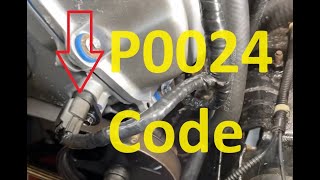
- Assuming the code means Bank 2 on a V-engine, leading to confusion on the inline-4 Ranger engine. 🎬 Watch: A quick overview of P0024 causes and common fixes.
Most Likely Causes
- Failing or Sticking Exhaust VCT Solenoid 🔴 High Probability TSB SSM 50067 specifically calls out that small debris in the oil can cause the VCT solenoid to stick. This is the most common failure point for this code across multiple Ford platforms with EcoBoost engines. A stuck solenoid cannot regulate oil flow to the cam phaser, leading to incorrect timing.
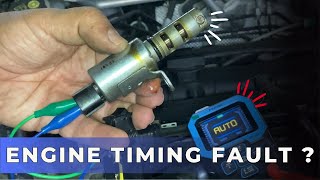
How to confirm: Use a capable OBD-II scanner to command the exhaust VCT solenoid on and off (this is Pinpoint Test HK12 mentioned in TSBs). 🎬 See this video for a deep dive into VCT solenoid diagnostics. If the engine RPM does not change or stumbles, the solenoid is likely stuck. Another effective method is to swap the intake and exhaust VCT solenoids (they are identical parts) and see if the trouble code changes to P0014 (for the intake cam). If the code moves, the solenoid is faulty. 🎬 Watch: A step-by-step guide on how to test VVT solenoids.
Typical fix: Replace the exhaust VCT solenoid. It is highly recommended to change the engine oil and filter at the same time to remove the debris that likely caused the failure.
Est. part cost: $30-$60 - Low or Dirty Engine Oil 🔴 High Probability The VCT system is hydraulic and relies on clean oil at the correct pressure to function. Delayed oil changes lead to sludge and debris that can clog the small passages and filter screens in the VCT solenoids and phasers. A Mustang owner with a P0024 code noted it appeared when the oil level was just half a quart low.
How to confirm: Check the oil level on the dipstick and inspect its condition. If the oil is low, black, or sludgy, it is overdue for a change. Ensure the level is at the 'Full' mark.
Typical fix: Perform an engine oil and filter change using the manufacturer-specified grade (5W-30 Synthetic Blend for the 2.3L EcoBoost). Clear the codes and drive to see if the code returns.
Est. part cost: $50-$100 - Faulty Camshaft Position Sensor ⚪ Low Probability
How to confirm: Monitor the sensor's output with a scan tool for erratic readings or a complete loss of signal. A failing sensor will often trigger its own specific codes (like P0345-P0349) in addition to P0024.
Typical fix: Replace the exhaust camshaft position sensor.
Est. part cost: $25-$50 - Worn Timing Components ⚪ Low Probability Less common on newer vehicles, but a stretched timing chain or failing hydraulic tensioner can cause the camshaft timing to be physically out of sync with the crankshaft. This becomes a higher probability on high-mileage engines or those with a history of poor oil maintenance.
How to confirm: This is an involved diagnosis requiring removal of the valve cover to inspect the chain for slack and verify timing marks. This is typically done after all other causes are ruled out. A persistent rattling noise from the front of the engine is a key symptom.
Typical fix: Replace the timing chain, guides, and tensioners. This is a significant repair.
Est. part cost: $400-$800
Rare But Worth Checking
- Damaged Camshaft Phaser: The phaser is the mechanical gear that the solenoid controls. While the solenoid is the more common failure, the phaser itself can fail, become clogged with sludge, or get stuck internally, requiring a more intensive repair. This is usually diagnosed after replacing the solenoid doesn't fix the issue.
- Wiring Harness Issues: A damaged wire or corroded connector for the VCT solenoid or camshaft position sensor can cause a loss of signal, leading to this code. Visually inspect the harness for any obvious damage, especially the wiring going to the top front of the engine where the solenoids are located.
- PCM Software Issue: In some cases, Ford has issued TSBs for other codes that require a Powertrain Control Module (PCM) reflash to correct software logic. While not explicitly cited for P0024 alone, it remains a possibility if all mechanical and electrical components test good.
Diagnosis Steps
- Check Engine Oil: Verify the engine oil is at the correct level and is clean. If low or dirty, perform an oil change with the correct spec oil (Ford 5W-30 Synthetic Blend) and a quality filter. This simple step resolves the issue in a surprising number of cases. Clear the code and see if it returns.
- Scan Tool Analysis: Use an OBD-II scanner to check for any other pending or active codes. Observe freeze frame data to see the engine conditions (RPM, load, temperature) when the code was set. This provides crucial context.
- Test the VCT Solenoid: Use a bidirectional scanner to command the exhaust VCT solenoid on and off. Per TSB SSM 50067, this is test HK12, which cycles the solenoid 10 times to try and clear debris. Listen for a click and watch for a change in engine idle. No response indicates a likely faulty solenoid.
- Swap Solenoids: This is the most definitive DIY test. The intake and exhaust VCT solenoids are identical and located next to each other on top of the valve cover. Swap their positions. Clear the codes. If the code changes to P0014 (Bank 1 'B' Cam), you have 100% confirmed the solenoid you moved is bad.
- Inspect Wiring: Visually inspect the wiring and connector going to the exhaust VCT solenoid for any signs of damage, corrosion, or loose connections. Ensure the connector is fully seated.
- Test Camshaft Position Sensor: If the solenoid tests good, check the camshaft position sensor's signal with a multimeter or oscilloscope for a consistent signal while the engine is running.
- Mechanical Timing Check: If all else fails, the issue may be mechanical (stretched chain, bad phaser). This involves removing the valve cover to inspect the timing chain, guides, and phasers for wear or damage. This step is best left to a professional if you are not experienced.
Parts You'll Likely Need
- Variable Camshaft Timing (VCT) Solenoid
(OEM #CJ5Z-6M280-A)— This solenoid is the most common point of failure for code P0024, often getting stuck due to oil debris as noted in Ford TSB SSM 50067. It is used across a wide range of Ford 2.0L, 2.3L, and 2.5L engines from 2012-2025.
Trusted brands: Motorcraft (OEM), Dorman, NGK/NTK, Standard Motor Products (SMP)
OEM price range: $30-$50
Aftermarket price range: $25-$45
Related Codes That Often Appear With This One
- P0014 — This is the equivalent code for the intake camshaft ('B' Camshaft Position - Timing Over-Advanced, Bank 1). If both P0014 and P0024 appear, it could point to a systemic issue like low oil pressure, severe oil contamination, or a timing problem affecting both cams.
- P052A / P052B / P052C / P052D — These codes relate to Cold Start Camshaft Position Timing Performance. Their presence alongside P0024 reinforces a problem within the VCT system, likely related to oil viscosity or flow issues during startup.
- P0016 / P0017 — These are correlation codes between the crankshaft and camshaft. Seeing these alongside P0024 suggests a more serious mechanical timing problem, such as a stretched or jumped timing chain.
Technical Service Bulletins (TSBs) & Recalls
- SSM 50067 - Illuminated MIL with various VCT DTCs due to sticking VCT solenoid.
- SSM 54366 - Illuminated MIL with various VCT DTCs, referencing updated diagnostic procedures.
- SSM 49821 - Another TSB covering 2015-2021 vehicles that lists P0024 among many other VCT codes, reinforcing the commonality of this issue.
Platform-Specific Known Issues
- TSB SSM 50067: VCT Solenoid Sticking: Notes that various VCT codes (P0011, P0012, P0014, P0015, P0016, P0017, P0018, P0019, P0021, P0022, P0024, P0025) may be caused by small debris causing the VCT solenoid to stick. It advises against immediate component replacement, instead recommending technicians first perform pinpoint test HK12 to cycle the solenoid 10 times to attempt to clear the debris.
- TSB SSM 54366: Updated Diagnostic Procedures: Also lists P0024 among a group of VCT-related DTCs and refers technicians to an updated diagnostic procedure, Pinpoint Test HK, in the official Workshop Manual.
Mechanic-Grade Diagnostic Values
- VCT Solenoid Internal Resistance — expected: 7 to 14 Ohms. Some sources specify a tighter range of 6.9 to 7.9 Ohms at room temperature.. Failure: A reading of OL (Over Limit / infinite resistance) indicates an open coil. A reading near 0 Ohms indicates a shorted coil. Test when cold and hot, as failure can be temperature-dependent.
- Scan Tool PID: VCT Advance Error (e.g., VCT_ADV_ERR, VCT_EXH_CAM_ERR_B2) — expected: Near 0 degrees (+/- 5 degrees) at a stable, warm idle.. Failure: A large, persistent value (e.g., consistently more than 5-10 degrees advanced) that does not return to zero confirms a timing control error.
- Camshaft Position Sensor (3-wire Hall Effect) Connector Voltage (Key On, Engine Off) — expected: Pin 1 (VREF): ~5 Volts. Pin 2 (Signal): ~5 Volts. Pin 3 (Ground): Should show battery voltage (~12V) when tested against the positive battery terminal.. Failure: Missing or incorrect voltage on any pin points to a wiring or PCM issue, not necessarily a bad sensor.
Scan Tool Commands That Help
- Ford IDS, FORScan, or other professional bidirectional scanner: VCT Solenoid Actuator Test / Bidirectional Control — To directly command the VCT solenoid on and off at idle. A working solenoid will cause a noticeable change in engine idle (stumble, roughness, or stall). If there is no change, the solenoid is either not activating or the oil passage is completely blocked.
- Ford IDS (as per TSB): Pinpoint Test HK (specifically HK12) — As described in TSB SSM 50067, this function cycles the solenoid 10 times. It is intended as a first step to attempt to dislodge small debris and clear a stuck solenoid before replacing it.
Wiring & Ground Locations
- Main Chassis Ground — A large bolt on the chassis, located just behind the driver's side (left) headlight, where the main negative battery cable connects.. A poor main ground can cause a host of electrical issues and unpredictable sensor readings. This is a primary point to check for corrosion or looseness in any electrical diagnosis.
- Engine to Firewall Ground Strap — A braided or solid wire strap connecting the engine block/cylinder head to the vehicle's firewall.. This ground is critical for ensuring the PCM and other cab-located electronics have a stable reference to the engine's sensors. A broken or corroded strap can cause erratic sensor data.
Real Owner Repair Stories
- Ford F150 Forum user (on a 3.5L EcoBoost with similar VCT system) (2013 Ford F-150 3.5L EcoBoost) — Check Engine Light with codes P0014 and P0024.
❌ Tried (didn't work) Initial diagnosis was uncertain, pointing towards potential timing chain or phaser issues.
✅ What actually fixed it The problem was diagnosed as oil sludging that clogged the VCT phaser oil screens. A technician performed an engine flush by replacing the engine oil with Automatic Transmission Fluid (ATF), running the engine to operating temperature, then draining the ATF and performing a standard oil and filter change. This cleared the sludge and resolved the codes.
OEM Part Supersession History
CJ5Z-6M280-A→CJ5Z-6M280-A— This part number has remained stable for the 2.3L EcoBoost engine across multiple platforms, including the Ranger.
Heads up: While other Ford engines have VCT solenoids with superseded part numbers, CJ5Z-6M280-A is the correct and consistent part for this application. Ensure you are not using a part number intended for a different Ford engine like the 5.0L V8 or 3.5L V6.
Model Year Variations Within This Range
- 2019-2021: There are no significant variations in the 2.3L EcoBoost engine's VCT system, related components, or the common causes of code P0024 for the Ford Ranger within this model year range. The diagnosis and repair procedures are identical.
Helpful Videos

Used OEM Parts in Stock
New Aftermarket Parts Available


The information in this article is provided for general reference and educational purposes only. Vehicle specifications, procedures, and part compatibility can vary by production date, trim level, and region. Always consult your vehicle's factory service manual and verify part numbers before purchasing or performing repairs. Safety-critical components such as airbags, seat belts, and braking systems should be installed by a qualified professional.
- Ford RANGER:
- 🎬 Helpful Videos
- 🛍️ Shop This Part
- What's Unique About the 2019-2021 Ford Ranger
- Diagnostic Flowchart
- Symptoms You May Notice
- Most Likely Causes
- Rare But Worth Checking
- Diagnosis Steps
- Parts You'll Likely Need
- Related Codes That Often Appear With This One
- Technical Service Bulletins (TSBs) & Recalls
- Platform-Specific Known Issues
- Mechanic-Grade Diagnostic Values
- Scan Tool Commands That Help
- Wiring & Ground Locations
- Real Owner Repair Stories
- OEM Part Supersession History
- Model Year Variations Within This Range
- 🎟️ Get 5% Off