

P0019 on 2020-2022 Subaru Outback: Crank/Cam Correlation Causes & Fixes
On a 2020-2022 Subaru Outback, code P0019 is most often caused by a software glitch that requires an ECM reprogram at a Subaru dealer, as specified in TSB 09-120-24R. This should always be the first step. If the software is current, the next most likely causes are low/dirty engine oil or a faulty oil control valve (OCV) on the driver's side exhaust.
- Before any repairs, contact a Subaru dealer to check if your Outback needs the ECM software update from TSB 09-120-24R, as this is a very common fix.
- Always check your engine oil level and condition first. Low or dirty oil is a frequent cause of this code.
- If software and oil are good, the next most likely culprit is the driver's side (Bank 2) exhaust Oil Control Valve (OCV).
- Do not immediately replace the camshaft sensor, as it's more often misdiagnosed than the actual cause of the problem.
What's Unique About the 2020-2022 Subaru OUTBACK

For the 2020-2022 Outback, this code has a well-documented history of being caused by overly sensitive diagnostic logic in the Engine Control Module (ECM). Subaru issued specific Technical Service Bulletins (TSBs) to address this with a software update. Unlike many other vehicles where P0019 immediately points to a mechanical fault like a stretched timing chain, the first step for this specific Subaru platform should always be to check if the ECM reprogram has been performed. The TSB (09-120-24R) explicitly states the software contains "enhanced logic for the self-diagnosis program" to remedy this and other related codes.
Diagnostic Flowchart
Tap your situation to follow the diagnostic path that matches what you're seeing on this vehicle.
Symptoms You May Notice
- Check Engine Light illuminated
- Rough or unstable idle
- Reduced engine power and acceleration
- Decreased fuel economy
- Engine hesitation or stalling, especially when coming to a stop
- EyeSight and/or cruise control may be disabled
- Engine making ticking or knocking noises
- Replacing the camshaft or crankshaft position sensor when the actual problem is outdated ECM software, a faulty oil control valve, or simply low engine oil.
- Proceeding with expensive mechanical timing component replacement before verifying the TSB for the ECM reprogram has been performed.
Most Likely Causes

- Engine Control Module (ECM) Software Update Needed 🔴 High Probability Subaru released TSBs 09-120-24 and the revised 09-120-24R specifically to address this code with a software patch. The original diagnostic logic was overly sensitive and could set a false positive for cam/crank correlation. This TSB applies directly to the 2020-22 Legacy/Outback 2.5L, among other models.
How to confirm: A Subaru dealer can check your vehicle's VIN to see if the reprogram has been performed. This is the first and most critical diagnostic step. Some owners on forums report this being a one-hour labor charge at the dealership.
Typical fix: Reprogramming the ECM with the updated software file at a Subaru dealership.
Est. part cost: $0 - Low or Dirty Engine Oil 🟡 Medium Probability Subaru's Active Valve Control System (AVCS) uses hydraulic oil pressure to adjust cam timing. Low, old, or contaminated oil can impede the function of the oil control valves and cam phasers, triggering correlation codes. Sludge buildup is a common reason for these components to stick.
How to confirm: Check the oil dipstick for level and inspect the oil's color and consistency. If it's low, dark, or sludgy, it needs to be changed. This is the easiest first check for any owner.
Typical fix: Perform an oil and filter change using the correct specification oil (Subaru recommends 0W-20 synthetic).
Est. part cost: $50-$100 - Faulty Oil Control Valve (OCV) / VVT Solenoid 🟡 Medium Probability These solenoids control oil flow to the cam phasers. They can become clogged with sludge or fail electronically, preventing proper cam timing adjustments. This is a common failure point on many modern engines with variable valve timing and is frequently discussed in owner forums.
How to confirm: A mechanic can command the solenoid with a scan tool to check for response. A common DIY diagnostic is to swap the suspect Bank 2 exhaust OCV with the Bank 2 intake OCV (or with the Bank 1 exhaust OCV). If the code follows the part (e.g., changes to P0018 or P0017), the OCV is confirmed bad.
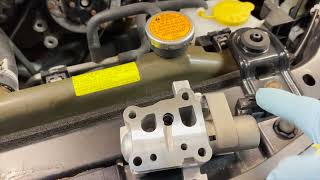
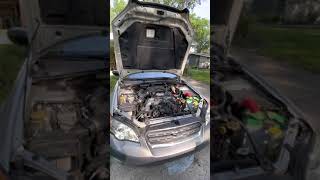
Typical fix: Replacement of the Bank 2 (driver's side) exhaust OCV. The part is held by a single 10mm bolt and is relatively easy to access. 🎬 See this walkthrough for replacing the Bank 2 exhaust solenoid.
Est. part cost: $70-$150 - Faulty Camshaft Position Sensor ⚪ Low Probability
How to confirm: The sensor's output can be checked with an oscilloscope or multimeter. However, this is often replaced unnecessarily when the OCV or software is the true cause. A diagnostic swap with the sensor from another position can also be used to see if the code moves.
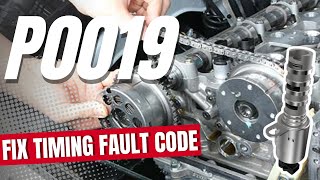
Typical fix: Replacement of the Bank 2 exhaust camshaft position sensor. 🎬 Watch: How to test and fix the P0019 correlation code.
Est. part cost: $60-$120
Rare But Worth Checking
- Stretched Timing Chain or Failed Tensioner: This is a major mechanical failure. While rare on a newer vehicle, it can happen due to severe oil maintenance neglect. Symptoms often include a rattling noise on startup. This should only be considered after all other possibilities are exhausted.
- Clogged OCV Filter Screens: Small mesh filters, sometimes located in banjo bolts in the oil feed lines, protect the OCVs from debris. If sludge or metal shavings clog these filters, oil flow can be restricted even if the OCV itself is functional. Cleaning or replacing these small filters can sometimes resolve the issue, though access can be difficult.
- Damaged Camshaft Phaser / Sprocket: The actuator (phaser) on the end of the camshaft can fail mechanically, getting stuck in one position. This is an expensive repair and is usually diagnosed after ruling out all electronic and hydraulic causes.
Diagnosis Steps
- Check engine oil level and condition. Top off or perform an oil and filter change if necessary. This is the simplest and a surprisingly common fix.
- Contact a Subaru dealer with your VIN or use a professional scan tool to verify if the ECM reprogram specified in TSB 09-120-24R has been performed. If not, this is the first and most critical step.
- If the software is up to date, use a scan tool to monitor live data from the crank and cam sensors to look for inconsistencies. A professional tool can also actuate the OCV.
- Test the Bank 2 exhaust Oil Control Valve (OCV). The most reliable DIY method is to swap it with the intake OCV on the same bank (if identical) or the exhaust OCV from Bank 1. Clear codes and drive. If the code changes to P0018 or P0017, the OCV is faulty and needs replacement.
- Inspect the wiring and connectors for the camshaft sensor, crankshaft sensor, and OCV for any damage, corrosion, or looseness.
- Check the small filter screens for the OCVs for any clogging or debris. These are often located in the cylinder head oil passages or banjo bolts.
- If all other steps fail to identify the issue, a mechanical inspection of the timing chain, tensioners, and cam phasers is necessary. This is a job for a professional mechanic.
Parts You'll Likely Need

- Oil Control Valve (VVT Solenoid)
(OEM #10921AA231)— This solenoid is a frequent point of failure, either electronically or by becoming clogged with oil debris, directly causing the correlation fault. This part number supersedes 10921AA230 and 10921AA220.
Trusted brands: Subaru Genuine, Denso, Hitachi
OEM price range: $95-$150
Aftermarket price range: $70-$120 - Camshaft Position Sensor
(OEM #22056AA140)— Though less common than the OCV, a failing sensor can send incorrect data to the ECM, triggering the code. It is often misdiagnosed when the OCV is the real culprit.
Trusted brands: Subaru Genuine, NGK/NTK, Denso
OEM price range: $80-$130
Aftermarket price range: $60-$100
Related Codes That Often Appear With This One
- P0018 — This is the correlation code for the intake camshaft ('Sensor A') on the same bank (Bank 2). If they appear together, it strongly points to a systemic issue on the driver's side, such as a timing chain problem on that bank or an oil supply issue.
- P0016 — This is the correlation code for the intake camshaft on Bank 1 (passenger side). Seeing codes for opposite banks can indicate a more serious, engine-wide problem like a stretched timing chain or severe oil contamination.
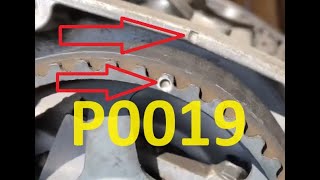
- P0017 — This is the correlation code for the exhaust camshaft on Bank 1 (passenger side). 🎬 Watch: A helpful overview of P0019 causes and fixes. If P0019 and P0017 appear together, it could point to a problem affecting both exhaust cams, such as an oil pressure issue or a stretched timing chain.
Technical Service Bulletins (TSBs) & Recalls
- 09-120-24R: Announces availability of new reprograming files for the Engine Control Module (ECM) developed to remedy DTCs P0016, P0017, P0018, and P0019. It specifically lists 2020-22 Legacy/Outback 2.5L as applicable vehicles.
- 09-120-24: The original bulletin announcing the ECM reprogram
Platform-Specific Known Issues
- A primary issue for this code on 2020-2022 Outbacks is a known software problem. Subaru issued TSBs 09-120-24 and 09-120-24R, which provide an ECM reprogram to correct overly sensitive diagnostic logic that could falsely trigger P0019 and related codes.
- Owner experiences on forums like Reddit confirm that having a dealer perform the TSB software update often resolves the code for the cost of one hour of labor, after which the code does not return.
Mechanic-Grade Diagnostic Values
- Oil Control Valve (OCV) Solenoid Resistance — expected: 6.9 - 7.9 Ohms at 68°F (20°C). Failure: A reading outside this range, or an open/infinite reading, indicates a failed coil.
- Mode $06 Diagnostic Value (Bank 2 Exhaust) — expected: Less than 1000. Failure: A value of 1000 or greater indicates the self-test for this monitor has failed.
- Live Data - VVT Advance Angle (Warm Idle) — expected: -10 to +10 degrees (typically 0). Failure: A value that is stuck or consistently outside this range at idle points to a mechanical or hydraulic fault.
- Engine Oil Pressure (Warm Engine) — expected: > 10 PSI at idle, > 30 PSI at 3000 RPM. Failure: Pressure below these specs indicates a systemic oiling problem that must be fixed before addressing VVT components.
Hidden / Shadow Codes Worth Checking
- Mode $06, MID $36, TID $8D/$8E: This is not a DTC but the result of the onboard diagnostic monitor for the Bank 2 Exhaust Camshaft Correlation test. A value of 1000 or more indicates a failure that sets P0019. (see via Subaru Select Monitor 4 (SSM4) or an equivalent professional-grade scan tool with Mode $06 capability.)
Scan Tool Commands That Help
- Subaru Select Monitor (SSM) / Pro-level Scan Tool: Active Test: Actuate Bank 2 Exhaust OCV — With the engine at warm idle, this command manually cycles the OCV. A functional solenoid and clear oil passages will cause the engine to stumble or stall. No change in engine operation points to a bad OCV, clogged passage, or wiring issue.
- Subaru Select Monitor (SSM) / Advanced Scan Tool (e.g., Thinkdiag2, Autel): Test Mode Clear / Clear Memory — After replacing an AVCS component like an OCV. This function performs a deeper reset of the AVCS learned values that a standard 'Clear Codes' or battery disconnect may not accomplish, which can be necessary to resolve a persistent code after a repair.
Wiring & Ground Locations

- ECU Ground — Terminals bolted to the top of the intake manifold.. The ECU, which makes the final decision on cam/crank correlation, gets its primary ground reference here. A poor connection due to corrosion or improper tightening can cause erratic ECU behavior and misinterpretation of sensor data, leading to false correlation codes.
- Main Engine Ground — A large cable from the battery negative terminal to the chassis and also to the engine block, often near the starter motor.. A poor main engine ground can create electrical noise and voltage drops across the entire system, affecting the accuracy of signals from both the crankshaft and camshaft position sensors.
Real Owner Repair Stories
- Reddit user /u/R2CEE2 (2018 Subaru Crosstrek (shares engine architecture and TSB with Outback)) — P0019 code
❌ Tried (didn't work) Replacing the Bank 2 exhaust (bottom) VVT solenoid., Swapping camshaft position sensors to see if the code moved.
✅ What actually fixed it Replacing the VVT solenoids AND performing a 'test mode clear' using a Thinkdiag2 scan tool. The code was resolved after the specific memory clear was performed. - Reddit user /u/Same-West (Subaru with applicable TSB) — P0019 code
❌ Tried (didn't work) Was advised by the dealer to perform more expensive fixes first (solenoid replacement).
✅ What actually fixed it An ECU software update performed by the dealer, as described in TSB 09-120-24R. The repair cost was one hour of labor.
OEM Part Supersession History
10921AA220, 10921AA230→10921AA231— Component revision and improvement by the manufacturer.
Model Year Variations Within This Range
- 2020-2022: The original ECM software on these model years has overly sensitive diagnostic logic for cam/crank correlation. The fix is a software update detailed in TSB 09-120-24R, which is a primary and unique diagnostic step for this specific generation.
Helpful Videos
We Have This Part in Stock


The information in this article is provided for general reference and educational purposes only. Vehicle specifications, procedures, and part compatibility can vary by production date, trim level, and region. Always consult your vehicle's factory service manual and verify part numbers before purchasing or performing repairs. Safety-critical components such as airbags, seat belts, and braking systems should be installed by a qualified professional.
- Subaru OUTBACK:
- 🎬 Helpful Videos
- 🛍️ Shop This Part
- What's Unique About the 2020-2022 Subaru OUTBACK
- Diagnostic Flowchart
- Symptoms You May Notice
- Most Likely Causes
- Rare But Worth Checking
- Diagnosis Steps
- Parts You'll Likely Need
- Related Codes That Often Appear With This One
- Technical Service Bulletins (TSBs) & Recalls
- Platform-Specific Known Issues
- Mechanic-Grade Diagnostic Values
- Hidden / Shadow Codes Worth Checking
- Scan Tool Commands That Help
- Wiring & Ground Locations
- Real Owner Repair Stories
- OEM Part Supersession History
- Model Year Variations Within This Range
- 🎟️ Get 5% Off