

P0017 on 2010-2016 Cadillac SRX: Timing Chain and Sensor Guide
On a 2010-2016 Cadillac SRX with the V6 engine, the P0017 code almost always indicates a stretched timing chain. This is a well-documented issue and a significant repair, often costing between $2,300 and $4,500 at a shop. The root cause is a known design flaw in the GM High Feature V6 engine family of this era.
- P0017 on a 2010-2016 SRX is a strong indicator of a stretched timing chain, not just a bad sensor.
- This is a serious issue that should be addressed promptly to avoid catastrophic engine failure.
- The repair is expensive, typically costing over $2,300, due to the high labor involved.
- Always use the correct specification engine oil and maintain regular change intervals to prolong the life of timing components.
- This repair is not recommended for DIY mechanics unless they have extensive experience and the proper tools.
What's Unique About the 2010-2016 Cadillac SRX

The second-generation SRX, particularly models with the 3.0L LF1 and 3.6L LFX V6 engines, is notorious for premature timing chain stretching. This isn't a random part failure; it's a pattern defect documented in multiple manufacturer bulletins and countless owner complaints. While other cars might get a P0017 code from a simple sensor failure, on this specific platform, the code is a strong indicator of the need for a complex and expensive timing chain service. The issue was so prevalent across GM's lineup that it was unofficially dubbed one of the 'GM Timing DEATH CODES 🎬 Watch: Why technicians call these the GM Timing Death Codes.'. Some technicians note that GM eventually released ECU software updates to allow for more variance in timing before setting a code, but this does not fix the underlying mechanical wear.
Diagnostic Flowchart

Tap your situation to follow the diagnostic path that matches what you're seeing on this vehicle.
Symptoms You May Notice
- Check Engine Light is on
- Rough or unstable idle
- Rattling or 'diesel-like' noise from the engine, especially on a cold start.
- Reduced engine power and poor acceleration
- Engine may be hard to start or have long crank times.
- Engine may shut off while idling
- Vehicle may shake or shudder during acceleration
- Replacing only the camshaft or crankshaft sensors without verifying the mechanical timing. On the SRX, the problem is almost always mechanical (the chain) rather than electrical (a sensor).
- Replacing just one sensor or solenoid when the issue is the entire timing system. This often results in the code returning shortly after the repair.
Most Likely Causes

- Stretched Timing Chains 🔴 High Probability This is a widely documented design and materials issue on GM's High Feature V6 engines of this era. Both manufacturer TSBs #PIP3423P and #12-06-01-009F directly cite stretched or loose chains as the cause for P0017. Owner complaints and repair forums consistently confirm this diagnosis as the number one cause. A mechanic theorizes the added strain of the camshaft-driven high-pressure fuel pump on these GDI engines contributes to premature chain failure.
How to confirm: A mechanic can use an advanced scan tool or a lab scope to compare camshaft and crankshaft sensor waveforms to a known-good pattern 🎬 See how to use a lab scope to confirm timing issues. to definitively confirm a timing misalignment before teardown. An advanced technique involves using in-cylinder pressure transducers to measure the exact degree of timing error by comparing when exhaust valves open between banks. A definitive diagnosis requires physical inspection of the timing chains for slack, which involves significant labor.
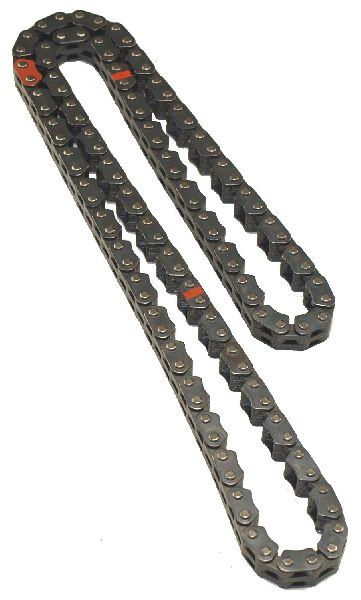
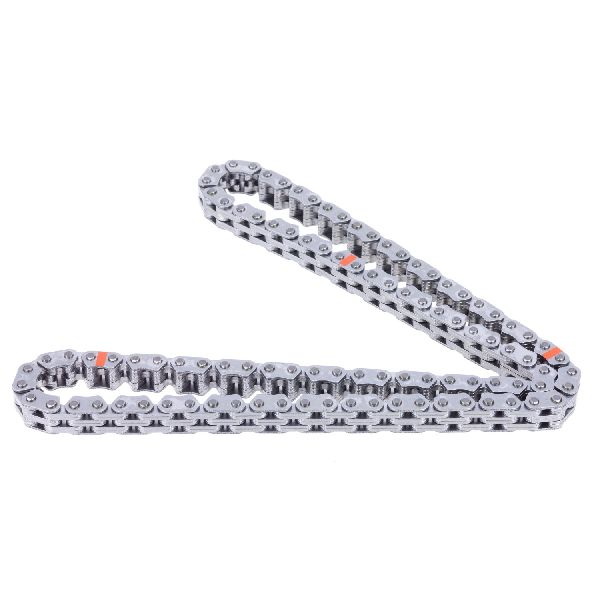
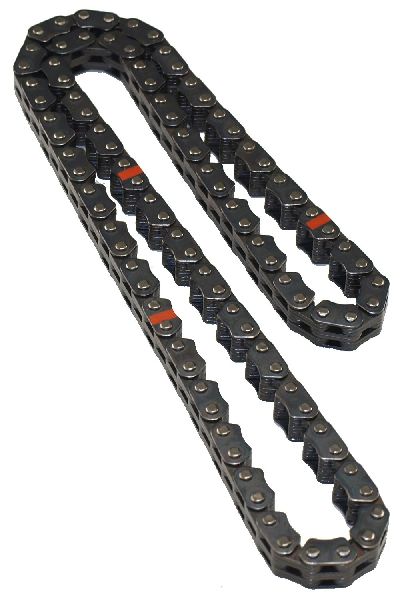
Typical fix: Replace all three timing chains, the tensioners, and the guides. This is typically done as a complete kit using the latest revised part number. It is also recommended to replace the water pump at the same time, as it is driven by the timing chain and is a common failure point.
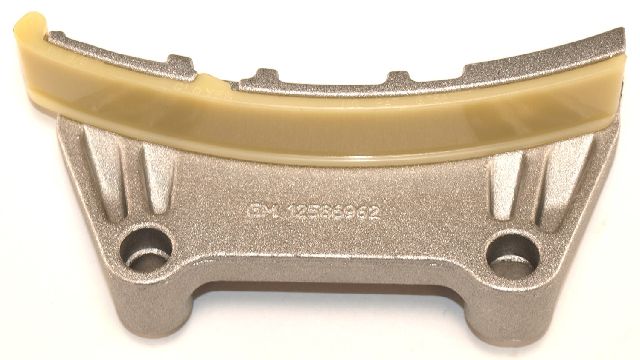
Est. part cost: $300-$700 - Failed Timing Chain Tensioners or Guides 🔴 High Probability The tensioners, which use oil pressure to keep the chains tight, can weaken or fail, leading to chain slack. The plastic guides can also become brittle and break. This is mentioned as a primary check in TSB #PIP3423P. They are always replaced as part of a timing chain job.
How to confirm: Visual inspection for broken guides or collapsed tensioners during a timing chain inspection. Broken pieces of plastic guides may be found in the oil pan.
Typical fix: Replace tensioners and guides along with the timing chains as a complete kit.
Est. part cost: Included in timing chain kits. - Low or Dirty Engine Oil 🟡 Medium Probability The camshaft phasers (actuators) and chain tensioners are hydraulically operated by engine oil. Extending oil change intervals beyond the manufacturer's recommendation or using the wrong viscosity oil can lead to sludge and reduced oil pressure. This starves the timing components, accelerating wear and causing the VVT system to function improperly, which can trigger the code.
How to confirm: Check the oil level on the dipstick and inspect the oil's condition and service history. This should be the very first check.
Typical fix: Perform an oil and filter change with a high-quality, full synthetic 5W-30 oil that meets GM's dexos1 specification. If this fixes the code, it was likely a precursor to the larger timing chain issue.
Est. part cost: $40-$80 - Faulty Camshaft Position Sensor (Bank 1 Exhaust) ⚪ Low Probability While possible, sensor failure is much less common than the mechanical timing chain issue on this vehicle. Many owners and technicians report that replacing sensors alone does not fix the problem. The ECM relies on this sensor's signal, so a bad sensor can mimic a timing issue.
How to confirm: A mechanic can swap the Bank 1 exhaust sensor with the Bank 1 intake sensor. If the code changes to P0016, the sensor is bad. A lab scope can also be used to analyze the sensor's signal.
Typical fix: Replace the faulty camshaft position sensor.
Est. part cost: $30-$70 - Faulty Crankshaft Position Sensor ⚪ Low Probability This is an uncommon cause. If the crankshaft sensor provides an erratic signal, the ECM cannot accurately determine the correlation with the camshaft. A more severe issue noted in TSB #PIP3423P is the crankshaft reluctor wheel itself slipping on the crankshaft, which is a catastrophic failure requiring crankshaft replacement.
How to confirm: Requires testing the sensor's output with a multimeter or oscilloscope. A slipped reluctor wheel can sometimes be seen with a borescope through the crank sensor hole. A definitive diagnosis requires comparing cam and crank signals with a lab scope.
Typical fix: Replace the crankshaft position sensor. If the reluctor wheel has moved, the crankshaft must be replaced.
Est. part cost: $40-$80
Rare But Worth Checking
- Faulty Camshaft Phaser / Actuator: The VVT actuator on the exhaust camshaft could be stuck or failing due to internal debris or wear. This is less common than chain stretch but can cause correlation issues. It's often replaced during a full timing chain job for peace of mind.
- Clogged VVT Solenoid (Oil Control Valve): Debris in the oil can clog the small passages in the solenoid that controls oil flow to the phaser. It can sometimes be removed and cleaned, but replacement is often the best fix. Swapping the solenoid with one from a different camshaft is a common diagnostic step.
- Slipped Crankshaft Reluctor Wheel: As mentioned in TSB #PIP3423P, the reluctor wheel pressed onto the crankshaft can physically move, throwing off the sensor reading entirely. This is a major repair that requires crankshaft replacement.
Diagnosis Steps
- Check engine oil level and condition. An oil change with the correct full synthetic oil is a cheap first step.
- Scan the ECM for any other stored trouble codes. Codes like P0008, P0016, P0018, or P0019 strongly suggest a timing chain issue.
- Using an advanced scan tool, monitor the camshaft position deviation data (e.g., 'Camshaft Position Variance'). Significant deviation that cannot be corrected by the VVT system points towards a stretched chain.
- As a simple diagnostic, swap the Bank 1 exhaust VVT solenoid with the Bank 1 intake solenoid and see if the code changes to P0016. If it does, the solenoid is faulty.
- Use a lab scope to compare crankshaft and camshaft sensor waveforms to a known-good pattern. This is the most reliable way to definitively confirm a timing misalignment without engine teardown.
- If all sensors and solenoids test good, a physical inspection of the timing chains is required. This involves removing the front engine cover to check for slack in the chains and the condition of the guides. This is a labor-intensive step and often transitions directly into the repair.
Parts You'll Likely Need
- Engine Timing Chain Kit
(OEM #12700437 (Latest known revision for LFX, verify by VIN))— This is the primary failure point for code P0017 on this vehicle. A complete kit ensures all worn components (chains, tensioners, guides, gaskets) are replaced simultaneously with updated parts.
Trusted brands: ACDelco (GM OE), Cloyes
Related Codes That Often Appear With This One
- P0008 — This code indicates a general engine timing issue (Bank 1). It's a precursor or companion to more specific codes like P0017 and is frequently cited together in TSBs.
- P0016 — This is the correlation code for the intake camshaft on the same bank (Bank 1). If multiple chains are loose, it's common to see codes for both intake and exhaust cams.
- P0018 / P0019 — These are the equivalent correlation codes for Bank 2 (the front bank). Seeing these along with P0017 points to a severe, system-wide timing chain problem affecting both cylinder banks.
Technical Service Bulletins (TSBs) & Recalls
- PIP3423P: Advises inspection of timing chains and tensioners for codes P0016, P0017, P0018, P0019, P0008, or P0009.
- 12-06-01-009F: Notes the availability of timing chain kits for repairing stretched timing chains that set DTCs including P0017.
Platform-Specific Known Issues
- A known history of premature timing chain stretching on the 3.0L and 3.6L V6 engines is the most significant issue.
- Manufacturer TSB #12-06-01-009F provides detailed information on updated timing chain kits for this repair.
- TSB #PIP3423N points to a rare but possible cause where the crankshaft reluctor wheel itself moves, requiring crankshaft replacement.
- While no specific class-action lawsuit for the timing chain issue on the SRX was found, the underlying GM 3.6L engine has been the subject of extensive complaints and some legal action across different models.
Mechanic-Grade Diagnostic Values

- VVT Solenoid (Camshaft Position Actuator Solenoid) Resistance — expected: Conflicting reports exist: 6.9 to 7.9 Ohms at 68°F (20°C), or 8.0 to 12.0 Ohms.. Failure: A reading outside the specified range. One technician considered a reading of 7.9 Ohms to be faulty, indicating a low threshold for failure.
- Camshaft Position Sensor 5V Reference Voltage — expected: 4.8 - 5.2 Volts. Failure: Voltage outside this range indicates a wiring issue or a fault in the ECM.
- Camshaft Position Sensor Signal Voltage (Hall Effect Sensor) — expected: Approximately 5 Volts with ignition on, engine off. Should drop to 0 Volts when a ferrous metal object is placed in front of the sensor tip.. Failure: Voltage does not switch between ~5V and 0V when tested, indicating a faulty sensor.
- In-Cylinder Pressure Transducer Comparison (Advanced) — expected: The point where the exhaust valve opens should be identical (in degrees of crankshaft rotation) between Bank 1 and Bank 2.. Failure: A significant difference in when the exhaust valve opens. On one diagnosed 2010 SRX, the good bank opened at 44° BTDC while the bad bank (P0017) opened at 22° BTDC, showing a ~22° timing error.
- Scan Tool Camshaft Position Variance PID — expected: Close to 0 degrees at idle.. Failure: A consistent, significant deviation. For example, a known bad engine showed a Bank 1 intake variance of -7 degrees, indicating a timing stretch.
Scan Tool Commands That Help
- GDS2 / High-End Aftermarket: VVT Solenoid Actuator Test — Used to test the function of a specific VVT solenoid. The technician commands the solenoid ON and OFF while monitoring the corresponding camshaft angle PID. If the angle does not change as commanded, it points to a faulty solenoid, clogged oil passage, or a stuck phaser.
- GDS2 / Techline Connect (TIS2Web): ECM/PCM Reprogramming — GM has released software updates that widen the acceptable variance for cam/crank correlation before setting codes like P0017. This can be used as a potential 'fix' if the timing stretch is minor, but it does not correct the underlying mechanical wear.
Wiring & Ground Locations
- Bank 1 — The cylinder bank located against the firewall (rear bank).. P0017 specifically refers to the exhaust camshaft ('Sensor B') on Bank 1. Accessing these sensors and solenoids is more difficult than on Bank 2 (front bank).
- K20 Engine Control Module (ECM) Pins — For the camshaft position sensor circuits: Terminal 1 is the low reference, Terminal 2 is the signal circuit, and Terminal 3 is the 5V reference.. Allows for testing the sensor wiring integrity directly at the ECM connector to rule out harness issues between the sensor and the module.
- Main Engine Block Ground — A heavy gauge cable connecting the engine block to the chassis. On vehicles like the SRX with a rear-mounted battery, this ground path is critical.. A poor engine block ground can cause erratic behavior in all engine sensors, including the cam and crank sensors, leading to false codes. Verifying this ground is a crucial step in any electrical diagnosis.
Real Owner Repair Stories
- ADVANCED LEVEL AUTO (YouTube) (2010 Cadillac SRX 3.0L V6) — Check engine light with code P0017 and a rough idle.
❌ Tried (didn't work) The video proceeds directly to the known common failure, implying that simpler fixes are ineffective.
✅ What actually fixed it A full timing chain replacement. The video shows the old, visibly stretched chains compared to the new set, confirming this as the definitive repair. - KY Home Garage (YouTube) (2010 Cadillac SRX) — P0017 code was present, cleared, but would eventually return.
❌ Tried (didn't work) The video focuses on avoiding unnecessary parts replacement through advanced diagnosis.
✅ What actually fixed it The vehicle was definitively diagnosed with a stretched timing chain using in-cylinder pressure transducers, which measured a ~24-degree timing discrepancy between the good and bad banks. The required fix is a timing chain replacement.
"I Checked Everything" — The Actual Cause
- In the context of P0017, the equivalent of a 'smoke test clean' scenario is when all sensors and VVT components test good, yet the timing correlation error persists. The most significant cause in this situation is a slipped crankshaft reluctor wheel. This mechanical failure mimics a timing chain issue perfectly but won't be found by testing individual electrical components. Diagnosis requires a lab scope analysis of the cam/crank signals or a visual inspection with a borescope through the crankshaft position sensor hole, as detailed in GM TSB PIP3423P. The fix is crankshaft replacement, not just a timing chain job.
OEM Part Supersession History
Multiple older part numbers (e.g., 12659672, 12693217)→12700437 (for LFX engine)— GM released multiple revisions of the timing chain kits for the High Feature V6 family to improve the durability of the chains and address the premature stretching issue.
Heads up: Using an older, superseded timing chain kit may lead to a repeat failure in a shorter time frame. It is critical to install the latest available part number to ensure the most durable components are used.
Model Year Variations Within This Range
- 2010-2011: These years primarily used the 3.0L LF1 V6 engine. While also part of the High Feature V6 family and susceptible to timing chain issues, parts like the timing kit may have different part numbers than the later LFX engine.
- 2012-2016: These years used the 3.6L LFX V6 engine. This engine was an update to the LLT V6 which had severe timing chain problems, but the issue was not entirely eliminated in the LFX. It is crucial to use the latest revised parts for this engine during a timing service.
Helpful Videos
Used OEM Parts in Stock
New Aftermarket Parts Available


The information in this article is provided for general reference and educational purposes only. Vehicle specifications, procedures, and part compatibility can vary by production date, trim level, and region. Always consult your vehicle's factory service manual and verify part numbers before purchasing or performing repairs. Safety-critical components such as airbags, seat belts, and braking systems should be installed by a qualified professional.
- Cadillac SRX:
- 🎬 Helpful Videos
- 🛍️ Shop This Part
- What's Unique About the 2010-2016 Cadillac SRX
- Diagnostic Flowchart
- Symptoms You May Notice
- Most Likely Causes
- Rare But Worth Checking
- Diagnosis Steps
- Parts You'll Likely Need
- Related Codes That Often Appear With This One
- Technical Service Bulletins (TSBs) & Recalls
- Platform-Specific Known Issues
- Mechanic-Grade Diagnostic Values
- Scan Tool Commands That Help
- Wiring & Ground Locations
- Real Owner Repair Stories
- "I Checked Everything" — The Actual Cause
- OEM Part Supersession History
- Model Year Variations Within This Range
- 🎟️ Get 5% Off