

P0016 on 2012-2019 Chevrolet Tahoe: Timing Chain and Sensor Guide
P0016 on a Tahoe usually means the timing chain is stretched or a related component has failed. Expect a costly repair, often over $1,500, as it's labor-intensive. Less common causes include faulty sensors or low oil. Do not drive the vehicle, as a complete timing failure can cause catastrophic engine damage.
- P0016 on a 2012-2019 Tahoe indicates a serious mechanical timing problem, not just a bad sensor.
- The most likely cause is a stretched timing chain, which is a labor-intensive and expensive repair.
- Always check engine oil level and condition first, as low or dirty oil can cause this code.
- A known issue on these engines is a slipped crankshaft reluctor wheel, a severe problem requiring crankshaft replacement (TSB PIP5102).
- This is not a DIY-friendly repair for most home mechanics; professional service is strongly recommended.
What's Unique About the 2012-2019 Chevrolet TAHOE

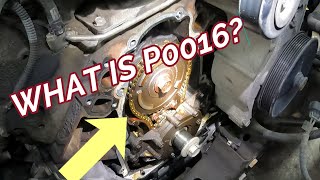
On the V8 engines in this generation of Tahoe (Gen IV and Gen V EcoTec3), P0016 is frequently a mechanical issue rather than a simple sensor failure. 🎬 Watch: A breakdown of common P0016 causes on GM trucks. These engines are known for timing chain stretch over time. More critically, they can suffer from a slipped crankshaft reluctor wheel, a serious issue confirmed by a manufacturer TSB (PIP5102). Another TSB (PIP5554A) warns that this code can appear if the timing chain was installed incorrectly during a previous repair, which points to the sensitivity of the timing system. The Active Fuel Management (AFM) and Dynamic Fuel Management (DFM) systems in these engines can also contribute to oil-related issues that affect the VVT system and may trigger the code.
Diagnostic Flowchart
Tap your situation to follow the diagnostic path that matches what you're seeing on this vehicle.
Generation note: This range covers the end of the third generation (2012-2014, GMT900 platform) and the fourth generation (2015-2019, K2XX platform). Both generations use similar V8 engines (Gen IV 5.3L/6.2L and Gen V EcoTec3 5.3L/6.2L) and are susceptible to the same primary causes like timing chain stretch and reluctor wheel issues. The provided TSBs cover vehicles in both generations.
Symptoms You May Notice
- Check Engine Light is on
- Engine runs rough or has a noticeable vibration
- Rattling noise from the front of the engine, especially on a cold start
- Difficulty starting or long crank times
- Engine cranks but will not start
- Reduced engine power and poor acceleration
- Increased fuel consumption
- Engine may stall unexpectedly
- Service Stabilitrak light may illuminate as the ECU disables traction systems in response to the engine fault
- Replacing only the camshaft or crankshaft position sensor without checking mechanical timing. The code is more often caused by a mechanical problem like a stretched chain than a bad sensor.
- Replacing the VVT solenoid without checking oil pressure and condition first. A clogged solenoid is often a symptom of a larger oil sludge problem.
Most Likely Causes

- Stretched Timing Chain or Failed Tensioner 🔴 High Probability The timing chains on these V8 engines are known to stretch over time, typically after 80,000-100,000 miles. The plastic chain guides can also wear or break, and the spring-loaded tensioner can fail, allowing the chain to become slack and jump a tooth.
How to confirm: A mechanic can observe cam/crank correlation data with a professional scan tool. A deviation of more than 4-6 degrees typically suggests a timing issue. Physical inspection by removing the front engine cover is the definitive confirmation. 🎬 See this walkthrough of a Tahoe timing chain inspection.
Typical fix: Replace the timing chain, tensioner, guides, and sprockets as a complete kit. It is also highly recommended to replace the oil pump at the same time, as it must be removed for access.
Est. part cost: $150-$400 - Slipped Crankshaft Reluctor Wheel 🟡 Medium Probability GM issued a Technical Service Bulletin (PIP5102, later superseded by PIP3423) for this issue. The reluctor wheel, which the crankshaft sensor reads, can move from its pressed-on position on the crankshaft, causing a correlation error even if the mechanical timing is perfect.
How to confirm: This is difficult to confirm without significant engine disassembly. It can sometimes be viewed with a borescope through the crank sensor hole. It is usually diagnosed after a timing chain replacement fails to fix the code. The TSB provides measurement specifications (25-26mm from the crank throw to the reluctor edge) to verify if the wheel has moved.
Typical fix: The crankshaft must be replaced, as the reluctor wheel is not serviced separately.
Est. part cost: $450-$900 - Low or Dirty Engine Oil 🟡 Medium Probability The camshaft phasers, which adjust cam timing (VVT), are operated by engine oil pressure. Low, dirty, or incorrect viscosity oil can impede the function of the phaser or the control solenoid, causing a timing correlation error. Some owners on forums report low oil pressure from a failing oil pump pickup tube O-ring can also trigger this code.
How to confirm: Check the oil level on the dipstick and review vehicle service records. If the oil is low or appears very dirty, this is a likely contributor.
Typical fix: Perform an oil and filter change using the manufacturer-specified oil grade (e.g., ACDelco Dexos). Consider an engine flush if significant sludge is suspected.
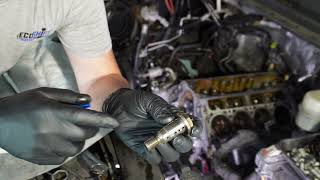
Est. part cost: $50-$100 - Faulty Camshaft Actuator Solenoid (VVT Solenoid) ⚪ Low Probability The solenoid can become clogged with sludge from dirty oil or fail electrically, preventing it from properly controlling oil flow to the cam phaser. This is a common failure point and often the first part replaced during diagnosis due to its low cost and easy access.
How to confirm: A scan tool can command the solenoid on and off to check for response. It can also be removed and tested for resistance (typically 7-14 ohms) and operation. Check the small filter screens for debris.
Typical fix: Replace the camshaft actuator solenoid.
Est. part cost: $40-$80
Rare But Worth Checking
- Incorrect Timing Chain Installation: According to TSB #PIP5554A, this code can be set immediately after an engine repair if the base timing was not set correctly. If the code appeared after a recent service, this is a strong possibility. One forum user reported this exact scenario after misaligning the timing marks by a few teeth during a DIY repair, which fixed the code upon correction.
- Faulty Crankshaft or Camshaft Position Sensor: While often suspected, a faulty sensor is a less common cause for this specific code than a mechanical timing issue. The ECM usually sets a different code (e.g., P0335, P0340) if a sensor fails outright. However, an intermittent sensor can sometimes cause P0016.
Diagnosis Steps
- Check the engine oil level and condition. If low or dirty, perform an oil change and clear the code to see if it returns.
- Use an OBD-II scanner to check for any other pending or active trouble codes. Codes for specific sensors (like P0340) can point away from a mechanical issue.
- With a professional scan tool, monitor the live data for camshaft and crankshaft position. Look for 'Camshaft Position Variance' or a similar PID. A consistent deviation beyond 4-6 degrees at idle points to a mechanical timing issue.
- Inspect the wiring and connectors for the camshaft position sensor, crankshaft position sensor, and the camshaft actuator solenoid for any damage or corrosion.
- Command the camshaft actuator solenoid with a scan tool and monitor for a change in cam timing. If there is no change, remove and inspect the solenoid and its filter screens for sludge or debris.
- If the above steps do not identify the issue, a mechanical inspection is necessary. This involves removing the engine's front cover to physically inspect the timing chain for slack, check the alignment of timing marks on the cam and crank sprockets, and examine the tensioner and guides for wear or damage.
- If the timing chain is correctly aligned and in good condition, the final step is to inspect the crankshaft reluctor wheel for any signs of movement, as indicated in TSB PIP5102/PIP3423. This may require a borescope or removal of the oil pan.
Parts You'll Likely Need

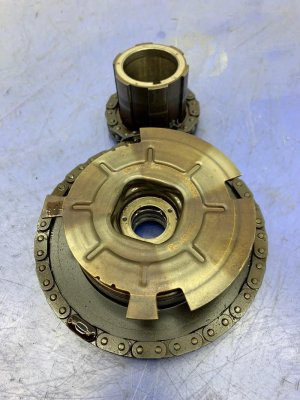
- Timing Chain Kit — This is the most common cause. A kit typically includes the chain, tensioner, guides, and sometimes sprockets to fully address wear.
Trusted brands: ACDelco, Cloyes
OEM price range: $250-$400
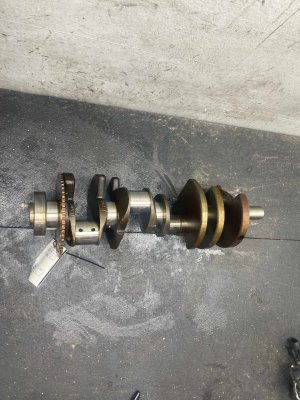
Aftermarket price range: $150-$250 - Crankshaft
(OEM #12685650)— Required if the crankshaft reluctor wheel has slipped, as per TSB PIP5102. The wheel is integral to the crankshaft.
Trusted brands: ACDelco (GM Genuine)
OEM price range: $450-$700
Aftermarket price range: $400-$700 - Camshaft Position Actuator Solenoid
(OEM #12679099)— May be clogged or failed electrically, preventing proper VVT operation. It's a common first attempt at a fix due to its accessibility and relatively low cost.
Trusted brands: ACDelco (GM Genuine)
OEM price range: $50-$90
Aftermarket price range: $30-$60
Related Codes That Often Appear With This One
- P0017 — This code indicates a correlation issue on the exhaust camshaft (Sensor 'B'). If the timing chain has stretched or jumped, it often affects both intake and exhaust cam timing, causing both codes to appear.
- P0300 — This is a 'Random Misfire' code. Incorrect cam/crank timing disrupts the combustion process, leading to misfires across multiple cylinders.
- P0521 — This code indicates an 'Engine Oil Pressure Sensor/Switch Range/Performance' issue. Since VVT operation is dependent on oil pressure, problems with the oiling system can trigger both P0521 and P0016.
Technical Service Bulletins (TSBs) & Recalls
- PIP5554A: P0016 setting after internal engine repair due to incorrect base timing.
- PIP5102 / PIP3423: DTC P0016 (and others) may be caused by a crankshaft reluctor wheel that has moved its position on the crankshaft.
Platform-Specific Known Issues
- TSB #PIP5102 (superseded by PIP3423L/P): This bulletin specifically calls out that DTC P0016 may be caused by a reluctor wheel that has moved on the crankshaft. The fix is to replace the entire crankshaft.
- TSB #PIP5554A: Warns that P0016 can be set after internal engine work if the base timing was not set correctly during reassembly, highlighting the importance of proper procedure.
- Owner Experience: A user on TahoeYukonForum.com experienced a sudden loss of power on the freeway, followed by a hard start and P0016 code, which pointed towards a significant timing chain failure.
Mechanic-Grade Diagnostic Values

- Camshaft Actuator (VVT) Solenoid Resistance — expected: 7 to 14 Ohms. Failure: A reading of less than 7 ohms may indicate an internal short, while a very high or infinite reading indicates an open circuit.
- Cam/Crank Correlation Data (Scan Tool) — expected: Less than 4 degrees of variance at idle.. Failure: A consistent deviation of more than 4-6 degrees suggests a stretched timing chain or other mechanical timing issue. The code typically sets when deviation exceeds 14 degrees.
- Crankshaft Position Sensor (CKP) Resistance — expected: Not a reliable test for 3-wire sensors.. Failure: While some generic guides suggest a resistance test, professional mechanics advise against it for the 3-wire Hall-effect sensors used in these vehicles. A resistance reading is often meaningless; the sensor's signal must be checked with an oscilloscope.
Scan Tool Commands That Help
- GDS2 / Professional Scan Tool: VVT Solenoid Actuation Test — Used to command the solenoid on and off to verify it is mechanically responding to the ECM's signal. A lack of change in cam timing during this test points to a faulty solenoid or an oil flow problem.
- Tech2 / GDS2: Crankshaft Position System Variation Learn (CASE Relearn) — This procedure is mandatory after replacing a timing chain, phaser, crankshaft, or PCM. It synchronizes the ECM with the precise position of the new components. Failure to perform this can cause a P0016 code to set even if the mechanical repair was done correctly.
Wiring & Ground Locations
- G101/G106 — G101 is located at the front of the engine on the lower block and serves as a ground for the ECM. It often jumpers to G106, located on the front center of the frame cross rail under the crank pulley.. A poor ECM ground can cause erratic sensor readings and incorrect diagnostic codes.
- G103 — Located at the left rear of the engine compartment on the cowl, above the brake booster.. This is a major chassis ground point. While not directly for the crank/cam sensors, poor grounding here can introduce electrical noise that affects various modules.
- Frame Ground (2015+) — On K2XX platform vehicles (2015-2019), there are critical grounds behind both front wheels on the frame. A user also reported a key ground on the frame rail near the driver's side door.. The grounds behind the front wheels are in a terrible location prone to corrosion from tire splash, which can lead to a host of electrical issues, including crank/no-start conditions that may be related to sensor signal integrity.
Real Owner Repair Stories
- Chevrolet Forum user (2008 5.3L (Similar Gen IV engine)) — P0016 code persisted after replacing the timing chain and tensioner.
❌ Tried (didn't work) Replacing the camshaft position sensor., A first attempt at replacing the timing chain set.
✅ What actually fixed it The user discovered they had installed the new timing chain incorrectly, with the timing marks misaligned by 2 or 3 teeth. After disassembling and correctly aligning the timing marks, the engine started immediately with no codes. - Pete's Garage YouTube Channel (2007 Chevrolet Tahoe 5.3L 4WD) — P0016 code, engine runs but not well.
❌ Tried (didn't work) The video advises against just replacing sensors, as it's rarely the cause.
✅ What actually fixed it Upon removing the timing cover, the mechanic found a completely broken plastic timing chain guide and significant slack. The timing had jumped several teeth. The fix was a complete timing job, including a new chain, gear, and tensioner, which requires removing the oil pan and front differential on 4WD models.
"I Checked Everything" — The Actual Cause
- The equivalent scenario for P0016 is when a mechanic confirms the timing chain is new and the timing marks on the sprockets are perfectly aligned, yet the code persists. The root cause in this situation is often a slipped crankshaft reluctor wheel. This is a press-fit ring on the crankshaft that the crank sensor reads. It can spin slightly, causing a discrepancy between what the sensor sees and the actual piston position, even when the cam/crank sprockets are perfectly timed. GM issued TSB PIP3423 to address this, noting it can be inspected with a borescope through the crank sensor hole or by measuring its position relative to the crankshaft throw (25-26mm is the spec for a good one).
OEM Part Supersession History
12578517, 12628347, 12646783, 12655420→12679099— Standard part evolution for improved reliability and material changes by the manufacturer.
Heads up: The newest part number, 12679099, is the correct service replacement for the earlier numbers on a wide range of GM vehicles within this era.
Model Year Variations Within This Range
- 2012-2014 (GMT900 Platform): These models use the Gen IV V8 engine. The camshaft position sensor is located in the front timing cover. The oiling system uses a more traditional oil pump.
- 2015-2019 (K2XX Platform): These models use the Gen V 'EcoTec3' V8 engine with direct injection. They feature a different, variable-vane style oil pump to meet the higher volume demands of the VVT and Active/Dynamic Fuel Management (AFM/DFM) systems. The oil pan and motor mount patterns are also different from Gen IV and are not interchangeable. Issues with this more complex oiling system could potentially contribute to VVT-related codes like P0016.
Helpful Videos
Used OEM Parts in Stock
New Aftermarket Parts Available



The information in this article is provided for general reference and educational purposes only. Vehicle specifications, procedures, and part compatibility can vary by production date, trim level, and region. Always consult your vehicle's factory service manual and verify part numbers before purchasing or performing repairs. Safety-critical components such as airbags, seat belts, and braking systems should be installed by a qualified professional.
- Chevrolet TAHOE:
- 🎬 Helpful Videos
- 🛍️ Shop This Part
- What's Unique About the 2012-2019 Chevrolet TAHOE
- Diagnostic Flowchart
- Symptoms You May Notice
- Most Likely Causes
- Rare But Worth Checking
- Diagnosis Steps
- Parts You'll Likely Need
- Related Codes That Often Appear With This One
- Technical Service Bulletins (TSBs) & Recalls
- Platform-Specific Known Issues
- Mechanic-Grade Diagnostic Values
- Scan Tool Commands That Help
- Wiring & Ground Locations
- Real Owner Repair Stories
- "I Checked Everything" — The Actual Cause
- OEM Part Supersession History
- Model Year Variations Within This Range
- 🎟️ Get 5% Off