

P0016 on 2016-2017 Chevrolet Equinox 2.4L: Timing Chain Causes & Fixes
On the 2016-2017 Equinox with the 2.4L engine, P0016 almost always means the timing chain has stretched, the tensioner has failed, or the plastic guides have broken. This is a very common and serious issue on this engine, often rooted in oil consumption problems. The only reliable fix is a full timing chain kit replacement, which is a labor-intensive and costly repair.
- P0016 on a 2016-2017 Equinox with the 2.4L engine is a serious code that almost always points to a failed timing chain system.
- Do not drive the vehicle. Further operation risks catastrophic engine failure.
- Simply replacing sensors or VVT solenoids is unlikely to fix the root cause.
- The proper repair is a complete timing chain kit replacement, which is a costly, professional-level job.
- Regularly check your engine oil. Low oil levels will accelerate the wear of timing components on this specific engine.
What's Unique About the 2016-2017 Chevrolet EQUINOX

The 2.4L Ecotec engine used in the second-generation Equinox has a well-documented, notorious history of premature timing chain failure. Issues like chain stretch, worn plastic guides that break apart, and failing hydraulic tensioners are extremely common. These problems are often accelerated by excessive oil consumption issues, which can lead to low oil levels that starve the timing components of lubrication and hydraulic pressure, causing the tensioner to go slack. While other causes are possible, a P0016 code on this specific vehicle is highly indicative of a worn timing system requiring replacement.
Diagnostic Flowchart

Tap your situation to follow the diagnostic path that matches what you're seeing on this vehicle.
Symptoms You May Notice
- Check Engine Light is on
- Engine runs rough or idles poorly
- Rattling, scraping, or buzzing noise from the engine, especially on a cold start for a few seconds
- Reduced engine power or sluggish acceleration
- Engine cranks but will not start
- StabiliTrak warning light may come on
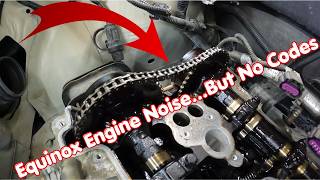
- Engine stalling, sometimes randomly at idle 🎬 See how to identify engine noises even without active codes.
- Replacing only the camshaft or crankshaft position sensors. Owners and forum threads frequently report this does not fix the issue, as the sensors are accurately reporting a real mechanical problem.
- Replacing only the VVT solenoids without addressing the underlying timing chain issue. This fails to fix the problem and the new solenoids can be damaged by debris from the failing chain guides.
- Replacing only one part of the timing system, like just the tensioner or a single chain. The components wear as a set, and a partial repair will fail prematurely.
Most Likely Causes

- Stretched Timing Chain and/or Failed Tensioner & Guides 🔴 High Probability The 2.4L Ecotec engine is known for premature wear of its timing components. The primary chain stretches, the hydraulic tensioner fails (often due to low oil pressure), and the plastic guides become brittle and break. Manufacturer TSB #PIP3423P directly advises technicians to inspect for loose timing chains or tensioners for this code.
How to confirm: A mechanic will remove the valve cover to physically inspect the chain for slack between the cam sprockets. Another key indicator is finding pieces of broken black plastic from the guides in the oil pan or clogging the screens of the VVT solenoids. A scan tool can also show a deviation between desired and actual cam angles; a persistent variance greater than +/- 4 degrees at idle points to a mechanical timing problem.
Typical fix: Replace the entire timing chain kit, including the primary chain, balance shaft chain, all tensioners, and all guides. It is critical to replace all components as a set.
Est. part cost: $150-$350 - Low or Dirty Engine Oil 🟡 Medium Probability The timing chain tensioner is hydraulic and relies on clean oil at the correct pressure to function. These engines are notorious for excessive oil consumption due to piston ring issues, making low oil levels a frequent problem that directly leads to timing component failure.
How to confirm: Check the engine oil level and condition on the dipstick. If it's low or very dirty, this is a likely root cause. GM's own service bulletins acknowledge that oil consumption can be a significant issue for this engine.
Typical fix: Perform an oil and filter change with a full synthetic oil meeting GM's dexos specification. However, if the code persists, the timing components have likely already sustained permanent damage and require replacement.
Est. part cost: $50-$90 - Faulty Camshaft Actuator Solenoid (VVT Solenoid) ⚪ Low Probability Oil debris and sludge, often from failing timing chain guides, can clog the small screens on these solenoids, causing them to stick. While they can fail, they are very often misdiagnosed when the root cause is the timing chain. Many owners replace them with no success.
How to confirm: Swap the intake and exhaust solenoids (Intake is gray connector, Exhaust is black). If the code changes to P0017 (exhaust correlation), the solenoid is bad. They can also be tested with a multimeter; resistance should be between 8 and 13 Ohms. Inspect the screens for plastic debris.
Typical fix: Replace the faulty solenoid. It is recommended to replace them in pairs (intake and exhaust) during a timing chain job.
Est. part cost: $30-$60 per solenoid
Rare But Worth Checking
- Faulty Camshaft or Crankshaft Position Sensor: While possible, it's rare for a sensor to fail in a way that sets a correlation code without also setting a sensor-specific circuit code. One owner reported replacing both with no success initially, which is a common misdiagnosis.
- Damaged Camshaft Phaser/Actuator Sprocket: The gear at the end of the camshaft can fail internally or the reluctor ring on the back of the camshaft can spin, especially after an overheat event, as described in TSB #PIP4548F. The phasers are typically replaced as part of a complete timing chain job.
Diagnosis Steps
- Verify Engine Oil Level and Condition: This is the most critical first step. Ensure the oil is full and clean. These engines consume oil, and low oil is the primary catalyst for timing failure.
- Scan for Other Codes: Check for other codes, especially P0017, P0011, P228D, and P0089. The presence of these codes together makes a timing chain failure the almost certain cause.
- Inspect VVT Solenoids: Remove, inspect, and clean the intake and exhaust VVT solenoids. Check the mesh screens for metal shavings or pieces of black plastic, which are definitive signs of guide failure.
- Listen for Startup Rattle: On a cold start, listen for a distinct rattling or scraping sound from the passenger side of the engine that lasts for 2-4 seconds. This is the sound of the loose chain before the tensioner builds oil pressure.
- Perform a Physical Inspection of the Timing Chain: This is the definitive step. Remove the valve cover and the small timing inspection plate on the side of the cylinder head. Check for excessive slack in the chain. If you can easily lift the chain off the sprocket, it is stretched and the entire system needs replacement.
Parts You'll Likely Need

- Timing Chain Kit
(OEM #12693218)— This is the most common failure point. A complete kit ensures all worn components (chains, guides, tensioners, sprockets, seals) are replaced at once. Using an incomplete kit will lead to premature failure.
Trusted brands: ACDelco (OEM), Cloyes
OEM price range: $350-$550
Aftermarket price range: $180-$300 - Camshaft Position Actuator Solenoid
(OEM #12655420 (Intake), 12655421 (Exhaust))— Often replaced as a preventative measure during a timing job, or if they are confirmed to be faulty. Debris from a failing chain can damage them. It's wise to replace them to avoid future issues.
Trusted brands: ACDelco, Delphi
OEM price range: $40-$70
Aftermarket price range: $25-$50 - Crankshaft Front Seal — This seal must be removed to access the timing cover and should always be replaced during the job to prevent oil leaks.
Trusted brands: ACDelco, Fel-Pro
OEM price range: $15-$25
Aftermarket price range: $5-$15
Related Codes That Often Appear With This One
- P0017 — This is the correlation code for the exhaust camshaft. Since the same timing chain drives both cams, it's very common for both intake (P0016) and exhaust (P0017) to be out of sync simultaneously. Seeing both codes together strongly indicates a stretched chain.
- P0011 — This code indicates the intake camshaft timing is over-advanced. On GM vehicles, this can counter-intuitively mean the cam timing is retarded (late) due to a stretched chain. It often appears with P0016.
- P228D — Fuel Pressure Regulator 1 Performance. The high-pressure fuel pump on the 2.4L engine is driven by a lobe on the intake camshaft. If the cam timing is incorrect (due to a stretched chain), the fuel pump's operation is affected, leading to fuel pressure codes. This is a key symptom, not a separate problem.
- P0089 — Fuel Pressure Regulator Performance. Similar to P228D, this code is often a direct symptom of the primary timing problem affecting the camshaft-driven high-pressure fuel pump.
Technical Service Bulletins (TSBs) & Recalls
- PIP3423P: Mentions that DTCs P0016, P0017, etc. may be set and to inspect for loose timing chains or tensioners.
- PIP4548F: Advises on what to inspect if P0016 and/or P0017 are set on an engine that appears to be properly timed, pointing to a possible spun camshaft reluctor ring.
- TSB #12-06-01-009G: While for V6 engines, it shows a history of GM addressing timing chain issues across platforms.
Platform-Specific Known Issues
- The 2.4L Ecotec engine is subject to a class-action lawsuit and multiple GM Special Coverage Adjustments regarding excessive oil consumption, which directly contributes to the failure of timing chain components.
Mechanic-Grade Diagnostic Values
- Camshaft Actuator (VVT) Solenoid Resistance — expected: 8 to 13 Ohms. Failure: A reading outside this range, or one that fluctuates wildly when wiggling the connector, indicates a faulty solenoid.
- Scan Tool Camshaft Position Variance — expected: Less than +/- 4 degrees at idle.. Failure: A persistent deviation greater than 4-6 degrees between the desired and actual camshaft position angles points to a mechanical timing problem like a stretched chain.
- ECM Ground Circuit Resistance — expected: Less than 1.0 Ohm. Failure: High resistance on the ground circuit from the PCM connector pin to the negative battery terminal can cause erratic sensor readings. A reading of 0.9 Ohms was confirmed as good in one diagnostic video.
Scan Tool Commands That Help
- GDS2 / Tech2: Camshaft Position Actuator Solenoid Control — This bidirectional control allows a technician to command the intake and exhaust solenoids on and off while monitoring the camshaft position angles. This directly tests the solenoid's and phaser's mechanical response, helping to isolate a failed solenoid from a wiring or ECM driver issue.
- GDS2 / Professional Scan Tool: Crankshaft Position System Variation Learn — This procedure is required after replacing the timing chain, crankshaft, crankshaft position sensor, or ECM. It synchronizes the components' positions with the ECM's reference values. Failure to perform this can cause P0016/P0017 to persist after repair.
Wiring & Ground Locations
- G112 — On a stud on the engine block, located under the alternator and just above the A/C compressor.. This is a primary ground for the Powertrain Control Module (PCM). Corrosion or a broken wire at this specific, hard-to-see location is a known cause of various PCM-related codes and electrical issues. A poor ground can affect sensor readings.
- G103 — At the left rear of the engine compartment on the cowl, often above the brake booster.. This is a major chassis ground for several modules, including the Body Control Module (BCM). While not a direct cause of P0016, a poor connection here can cause widespread communication faults that can complicate diagnosis.
- ECM Connectors (Black and Gray) — At the Powertrain Control Module (PCM).. The main PCM grounds are the large black-and-white wires in the top corner pin location of the black and gray connectors. These specific pins can be back-probed to test the ground circuit resistance back to the battery.
Real Owner Repair Stories
- YouTube user 'fix p0017/p0016 timing chains 2017 Chevy Equinox' (2017 Chevrolet Equinox) — P0016 and P0017 codes.
❌ Tried (didn't work) Replacing both VVT solenoids, Replacing the camshaft position sensor
✅ What actually fixed it The owner opened the engine and found a broken timing chain guide, which had caused the chain to become very loose. Replacing the timing chain components resolved the codes. - Chevy Equinox Forum user comment (2010 Chevrolet Equinox 2.4L) — Persistent P0016 and P0017 codes immediately after a used engine was installed.
❌ Tried (didn't work) Tearing down the engine multiple times to verify timing was correct, Replacing cam phasers and tensioners
✅ What actually fixed it The reluctor ring on the rear of the intake camshaft had spun, likely due to a previous overheat event on the donor engine. Because the reluctor is press-fit, it caused a timing correlation error even though the chain and sprockets were perfectly timed. The final fix was replacing the entire intake camshaft. - Chevy Equinox Forum user 'borjawil' (Unknown year Equinox with 160k miles) — P0016 and P0017 codes, random stalling at idle. A previous owner had replaced cam and crank sensors and left one cam sensor unplugged to prevent stalling.
❌ Tried (didn't work) Replacing crank sensor (again), Replacing the unplugged cam sensor
✅ What actually fixed it The user discovered the intake camshaft sensor was being physically rubbed by the spinning component behind it. A temporary fix of spacing the sensor out with an O-ring stopped the stalling, confirming the issue was excessive camshaft end-play or a loose phaser/sprocket. The ultimate diagnosis was a worn timing system requiring a full replacement.
OEM Part Supersession History
Various older designs→12608580— The original timing chain tensioner for the Ecotec engine was a known failure point. The updated design is a more robust one-piece body.
Heads up: The newest design (12608580) supersedes all previous versions and should be used for any timing chain service.
Helpful Videos

We Have This Part in Stock


The information in this article is provided for general reference and educational purposes only. Vehicle specifications, procedures, and part compatibility can vary by production date, trim level, and region. Always consult your vehicle's factory service manual and verify part numbers before purchasing or performing repairs. Safety-critical components such as airbags, seat belts, and braking systems should be installed by a qualified professional.
- Chevrolet EQUINOX:
- 🎬 Helpful Videos
- 🛍️ Shop This Part
- What's Unique About the 2016-2017 Chevrolet EQUINOX
- Diagnostic Flowchart
- Symptoms You May Notice
- Most Likely Causes
- Rare But Worth Checking
- Diagnosis Steps
- Parts You'll Likely Need
- Related Codes That Often Appear With This One
- Technical Service Bulletins (TSBs) & Recalls
- Platform-Specific Known Issues
- Mechanic-Grade Diagnostic Values
- Scan Tool Commands That Help
- Wiring & Ground Locations
- Real Owner Repair Stories
- OEM Part Supersession History
- 🎟️ Get 5% Off