

P0016 on 2012-2019 Cadillac CTS: Crank/Cam Correlation Causes and Fixes
On the 2012-2019 Cadillac CTS, especially models with the 3.6L V6 engine, the P0016 code is most often caused by stretched timing chains. This is a serious issue requiring a complex repair, with shop costs often exceeding $2,000. For both the 3.6L and 2.0L engines, other potential causes include faulty VVT solenoids, low engine oil, or sensor issues, but the timing chain is the primary suspect on the V6.
- P0016 on a 2012-2019 Cadillac CTS, especially with the 3.6L V6, strongly suggests a stretched timing chain.
- Do not immediately replace the camshaft or crankshaft sensors; they are likely reporting a real mechanical problem.
- Maintaining the correct engine oil level and quality is critical, as low or dirty oil can cause VVT system faults and accelerate timing chain wear.
- This is a serious code that should be addressed promptly to avoid the risk of severe engine damage.
- Due to the complexity of timing chain replacement, this repair should be handled by a professional mechanic.
What's Unique About the 2012-2019 Cadillac CTS
The Cadillac CTS, particularly models equipped with the 3.6L V6 engine family (LFX, LGX, and their predecessor LY7), is infamous for premature timing chain failure. These chains can stretch over time, causing slack that leads to correlation codes like P0016. This issue is so prevalent that multiple Technical Service Bulletins (TSBs), notably the comprehensive PIP3423 series, have been issued to guide technicians in diagnosing it. While the 2.0L LTG engine can also experience timing chain wear, it is less common than on the V6; for the LTG, issues like faulty VVT solenoids or oiling problems are also frequent causes of P0016.
Diagnostic Flowchart
Tap your situation to follow the diagnostic path that matches what you're seeing on this vehicle.
Generation note: This range covers the end of the second generation (2012-2014) and the entire third generation (2014-2019) of the Cadillac CTS. Both generations used versions of the 3.6L V6 (LFX and LGX) and the 2.0L Turbo 4-cylinder (LTG). The timing chain stretch issue is most famously associated with the 3.6L V6 engines (and their LY7/LLT predecessors) across both generations and numerous other GM vehicles. The 2.0L LTG was also used widely across GM brands.
Symptoms You May Notice
- Check Engine Light is on
- Rough or unstable idle.
- Engine rattling noise, especially on a cold start or from the front of the engine.
- Reduced engine power and sluggish acceleration.
- Engine cranks but may not start, or has a hard start condition.
- Worse fuel economy.
- Engine stalling unexpectedly.
- Replacing the camshaft and crankshaft position sensors when the actual fault is a stretched timing chain. This is a very common mistake that wastes money and does not fix the root cause, as documented by many owners online.
- Replacing a single VVT solenoid when the issue is actually low oil pressure or severe sludge affecting the entire VVT system.
- Assuming a sensor is bad when it is accurately reporting a mechanical timing problem.
Most Likely Causes
- Stretched Timing Chains 🔴 High Probability The 3.6L V6 engine family (LY7, LLT, LFX) has a well-documented history of premature timing chain wear and stretching. TSB #PIP3423P directly points to inspecting for loose timing chains as a primary diagnostic step for P0016. This can be exacerbated by extended oil change intervals or low oil levels. While also possible on the 2.0L LTG, it is considered a much more frequent failure on the V6.
How to confirm: A technician can use a scan tool to observe camshaft deviation data; 🎬 Watch: How to diagnose a stretched chain using scan tool data. significant variance points to a stretched chain. Physical inspection is the ultimate confirmation but requires significant labor to remove the engine's front timing cover. An experienced tech may also identify the distinct startup rattle.
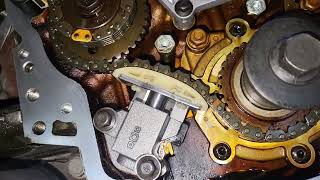
Typical fix: Replace all three timing chains (one primary, two secondary), along with the tensioners, guides, and often the water pump (which is driven by the timing chain). This is a major repair. 🎬 See this detailed walkthrough of the timing chain replacement process.
Est. part cost: $250-$600 - Low or Dirty Engine Oil 🟡 Medium Probability The camshaft phasers (part of the VVT system) are hydraulically operated by engine oil pressure. Low, old, or incorrect viscosity oil can impede the function of the phasers and VVT solenoids, causing them to respond slowly or get stuck, leading to a correlation error.
How to confirm: Check the oil level on the dipstick and inspect its condition and service history. If it's low, very dark, sludgy, or the wrong type, this is a likely contributor.
Typical fix: Perform an oil and filter change using a high-quality oil meeting the correct GM dexos specification. Clear codes and see if the issue returns.
Est. part cost: $50-$120 - Faulty Camshaft Actuator Solenoid (VVT Solenoid) 🟡 Medium Probability These solenoids control oil flow to the cam phasers. They can become clogged with sludge from poor oil maintenance or fail electrically, preventing proper camshaft adjustment. This is a common cause for P0016 on both the 2.0L and 3.6L engines and is a much easier and cheaper repair to attempt first. 🎬 Watch: How to replace the VVT solenoids yourself.
How to confirm: A technician can command the solenoid with a scan tool to check for response. It can also be removed, cleaned, and tested for resistance (typically 6.9-7.9 ohms) or by applying 12v to see if it actuates. Swapping the intake and exhaust solenoids (if they are identical) to see if the code changes (e.g., to P0017) is a common diagnostic trick.
Typical fix: Replace the Bank 1 intake camshaft actuator solenoid. It is often recommended to replace both the intake and exhaust solenoids on the affected bank at the same time.
Est. part cost: $30-$80 - Faulty Camshaft or Crankshaft Position Sensor ⚪ Low Probability While sensors can fail, they are often misdiagnosed. The P0016 code indicates a correlation *problem* between two correctly functioning sensors that are detecting a real mechanical issue. Replacing sensors is a common mistake that rarely fixes the root cause on this platform.
How to confirm: Use a scan tool or oscilloscope to analyze the sensor's output signal for a clean, consistent waveform. A visual inspection for wiring damage is also necessary.
Typical fix: Replace the faulty sensor (Bank 1 intake camshaft sensor or the crankshaft position sensor).
Est. part cost: $25-$75
Rare But Worth Checking
- Damaged or Slipped Crankshaft Reluctor Wheel: TSB PIP3423P explicitly notes that the toothed reluctor wheel pressed onto the crankshaft can physically move or slip, causing the crank sensor to send incorrect timing data to the ECM. This would cause correlation codes even with perfect timing chains. Confirming this requires either a borescope inspection through the crank sensor hole or removal of the oil pan. The fix requires crankshaft replacement.
- Crossed VVT Solenoid Connectors: TSB 23-NA-091 was issued because on some GM engines, the connectors for the camshaft actuator solenoid and the actuator park lock solenoid are identical and can be swapped during a repair, leading to P0016 or P0018 immediately after service. The fix is to verify wire colors and ensure the connectors are in their correct positions.
- Faulty ECM: In very rare cases, the Engine Control Module itself can be the source of the problem, misinterpreting correct sensor signals. This should only be considered after all other possibilities, especially mechanical ones, are exhaustively ruled out.
Diagnosis Steps
- Verify engine oil level and condition. An oil change with the correct GM dexos-spec oil is a cheap and easy first step. Clear codes and re-test.
- Use a professional scan tool to check for any other DTCs and to view live data for desired vs. actual camshaft angles for Bank 1. A significant and persistent deviation points towards a mechanical issue.
- Inspect the wiring and connectors for the Bank 1 intake camshaft position sensor, crankshaft position sensor, and the Bank 1 VVT solenoids for any damage, corrosion, or oil contamination.
- Test the Bank 1 VVT solenoids. Command them with a scan tool, listen for a click, and monitor engine response. Consider swapping the intake and exhaust solenoids to see if the code follows (e.g., P0016 becomes P0017).
- If solenoids and sensors appear to be working and oil is good, the next step is to suspect a mechanical timing issue. This requires inspecting the timing chains, tensioners, and guides for excessive play or wear, which is a labor-intensive process.
- As a final, less common check, consult TSB PIP3423P and consider inspecting the crankshaft reluctor wheel for slippage, possibly with a borescope.
Parts You'll Likely Need
- Timing Chain Kit (3.6L V6)
(OEM #12633451 (Primary Chain), 12612840 (Bank 1 Secondary), 12612839 (Bank 2 Secondary))— This is the most common cause of P0016 on the 3.6L V6. A complete kit ensures all worn components (chains, guides, tensioners) are replaced at once. Aftermarket kits often bundle all necessary parts.
Trusted brands: ACDelco (OEM), Cloyes
OEM price range: $400-$600
Aftermarket price range: $250-$400 - Camshaft Position Actuator Solenoid (VVT Solenoid)
(OEM #12633613 (Check application, may vary))— This VVT solenoid can get clogged or fail, causing timing correlation issues. It's a common point of failure and relatively easy to replace. Part number 12633613 is cited for some GM 2.5L engines but may be different for the CTS 2.0L/3.6L; always verify by VIN.
Trusted brands: ACDelco, Delphi
OEM price range: $50-$80
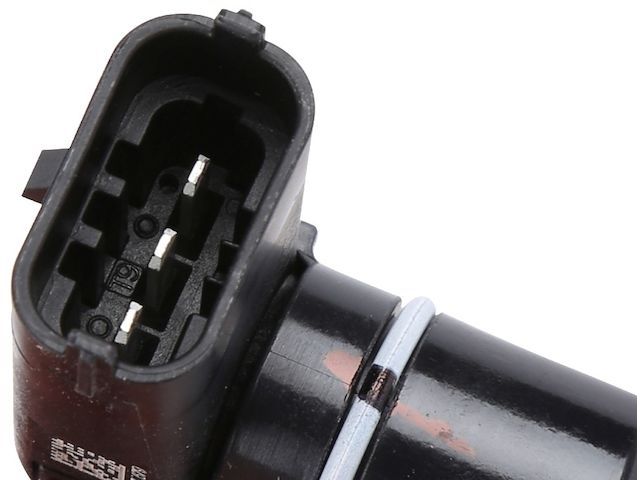
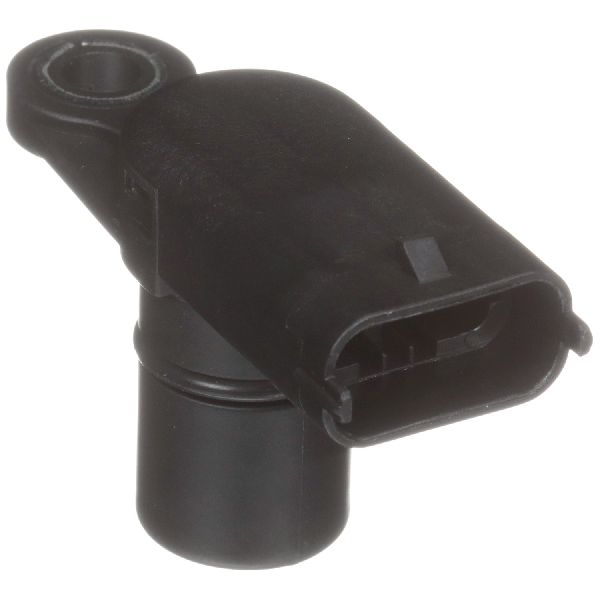
Aftermarket price range: $25-$50 - Camshaft Position Sensor
(OEM #12651420 (Check application, may vary))— Though less common than a timing chain issue, the sensor itself can fail. It's often replaced unnecessarily. Always verify fitment by VIN.
Trusted brands: ACDelco, Bosch
OEM price range: $40-$70
Aftermarket price range: $20-$45
Related Codes That Often Appear With This One
- P0008 — A GM-specific code for 'Engine Positions System Performance Bank 1'. It's a more general code that is almost always a precursor to or companion of P0016/P0017, strongly indicating a timing chain issue. TSB PIP3423P lists this as a primary code for timing chain problems.
- P0017 — This code is for the Crankshaft-Camshaft correlation on the Bank 1 *exhaust* camshaft. If the primary or a secondary timing chain is stretched, it can affect both intake and exhaust cam timing on that bank. Seeing P0016 and P0017 together makes a mechanical fault highly likely.
- P0018 / P0019 — These are the equivalent correlation codes for Bank 2 (the driver's side on a V6). Seeing these along with P0016/P0017 points even more strongly to a primary timing chain issue affecting both banks, or a slipped crankshaft reluctor wheel.
Technical Service Bulletins (TSBs) & Recalls
- 23-NA-091: Mentions rough idle and MIL on with DTCs P0016 and/or P0018 after engine repairs.
- PIP5730B: Provides additional diagnostic information for DTCs P0016 and P0018.
- PIP3423P: Advises technicians to inspect for loose timing chains or tensioners when P0016 (and related codes) are present.
Platform-Specific Known Issues
- Premature timing chain stretch on 3.6L V6 engines (LFX, LGX and predecessors) is the most significant issue related to this code. This has been a widely discussed problem among owners and mechanics for years, leading to GM Special Coverage Adjustment 11340C for some older models.
- TSB #PIP3423P (and its many revisions like K, N, etc.) is the key document for diagnosing P0016 and related codes on the V6, pointing to either stretched chains or a slipped crank reluctor wheel.
- On the 2.0L LTG engine, while timing chains can stretch, P0016 is also frequently caused by failed VVT solenoids or issues related to oil pressure/quality.
Mechanic-Grade Diagnostic Values
- Camshaft Position Actuator Solenoid (VVT Solenoid) Resistance — expected: 6.9 to 7.9 ohms at 68°F (20°C).. Failure: A reading of open loop (infinite resistance) or a very high resistance (megohms) indicates a failed solenoid coil. A reading outside the specified range can also indicate a problem.
- Camshaft Position Sensor (CMP) 5V Reference Circuit Voltage — expected: 4.8 to 5.2 Volts with ignition ON, engine OFF.. Failure: A voltage below this range could indicate a short to ground or an open/high resistance in the 5V reference circuit from the ECM.
- Camshaft Position Sensor (CMP) Low Reference Circuit Resistance — expected: Less than 5.0 ohms between the low reference circuit terminal and ground.. Failure: A reading greater than 5.0 ohms indicates high resistance or an open in the ground circuit, which can cause faulty sensor readings.
- Crankshaft Reluctor Wheel Position (3.6L LFX/LLT) — expected: 25 to 26 mm from the end of the machined surface of the crankshaft throw to the edge of the open space in the reluctor wheel.. Failure: Any measurement outside this range, viewed with a borescope through the crank sensor hole or by removing the oil pan, indicates the reluctor has slipped and the crankshaft must be replaced.
Scan Tool Commands That Help
- GDS2 (GM Dealer Scan Tool): Camshaft Position Actuator Solenoid Control — This bidirectional command allows a technician to manually command the VVT solenoid ON and OFF while monitoring engine RPM. A healthy solenoid will produce an audible click and a noticeable change in engine idle quality or RPM, confirming the solenoid is mechanically responding to the ECM's command. This helps differentiate a stuck solenoid from an electrical circuit fault.
- Labscope / Oscilloscope: Crank (CKP) vs. Cam (CMP) Waveform Analysis — This is the most definitive non-invasive test for timing chain stretch. By comparing the known-good waveform pattern of the CKP and CMP sensors, a technician can physically see if the camshaft timing has retarded (shifted to the right on the screen) relative to the crankshaft. This electronically proves a mechanical timing issue before beginning a labor-intensive teardown.
Wiring & Ground Locations
- G101 — Located at the lower front of the engine block.. This is a primary ground for the Engine Control Module (ECM) and Transmission Control Module (TCM). A poor connection here can cause erratic ECM behavior and faulty sensor readings, potentially leading to incorrect correlation codes.
- G105 / G106 — Located on the front of the vehicle; G105 is often behind cooling fan relays, and G106 is on the front center of the frame cross rail.. These grounds are critical for the front lighting and other engine compartment components. While not directly tied to the cam/crank sensors in all diagrams, ensuring all engine bay grounds are clean and tight is a crucial step in diagnosing any electrical fault to prevent stray voltage or poor sensor grounds.
- Camshaft Position Sensor Connectors — On the 3.6L V6, Bank 1 (passenger side) sensors are located at the rear of the cylinder head, often requiring removal of the engine cover for access.. GM Service Bulletin PI0090D highlights that intermittent hesitation and CMP codes can be caused by poor terminal connections in the harness connectors for the Bank 1 intake or exhaust camshaft position sensors. Inspecting these specific connectors for fretting corrosion or loose terminals is a required diagnostic step.
Real Owner Repair Stories
- YouTube channel 'Don't Tell My Wife I'm Working On Cars' (GM 3.6L V6 (specific model not stated, but engine is the focus)) — Check engine light with camshaft position sensor performance codes (P0346).
❌ Tried (didn't work) Replacing the sensor with a CarQuest aftermarket part., Replacing the sensor with a new AC Delco part from a Worldpac supplier., Replacing the sensor with a new AC Delco part from a GM dealer.
✅ What actually fixed it After three consecutive new-in-box sensors proved to be faulty (verified via oscilloscope), a fourth sensor (also a new AC Delco part) finally produced the correct waveform and fixed the code. The root cause was a string of defective replacement parts, not an actual engine or wiring issue. - YouTube channel 'The Car Care Nut' (2007 Cadillac CTS, 3.6L V6, 88,000 miles) — Check Engine Light with codes P0008 and P0017.
❌ Tried (didn't work) Replacing the Bank 1 exhaust camshaft position sensor (Sensor B). The code returned after a 5-mile test drive., Inspecting and cleaning the VVT solenoids.
✅ What actually fixed it The video creator concluded that despite replacing the sensor, the underlying issue was the timing chains, a common problem for this engine even at 88,000 miles. The sensor replacement was a failed attempt at a cheaper fix.
OEM Part Supersession History
12651450→12693218, then 12700436— GM has released multiple revisions of the timing chain kit for the 3.6L V6 engine to improve the durability of the chains and guides, aiming to combat the premature stretching issue.
Heads up: While older kits may physically fit, it is critical to use the latest available part number (e.g., 12700436 or newer) from an OEM supplier like ACDelco to get the benefit of the improved, more durable design.12628347 / 12655420→12679099— Revisions to the VVT solenoids are common to improve their resistance to failure from oil contamination and electrical issues.
Heads up: Always verify the correct part number for the specific position (Intake vs. Exhaust) and bank using the vehicle's VIN, as they are not always interchangeable. Using the wrong solenoid can cause immediate running issues or codes.
Model Year Variations Within This Range
- 2016-2019 (Third Generation Refresh): For the 2016 model year, the 3.6L V6 was updated from the LFX to the LGX engine. The LGX is a 'clean sheet redesign' and is not interchangeable with the LFX. A major reliability improvement was moving the timing chain to the rear of the engine, making the assembly more rigid and less prone to the stretching issues that plagued the LFX. The LGX also introduced a variable displacement oil pump and an improved VVT system. While P0016 is still possible on an LGX, it is considered much less likely to be caused by chain stretch compared to the LFX.
- 2012-2015 (LFX Engine): These model years use the 3.6L LFX engine, which is well-known for the timing chain stretching issue that is the most common cause of P0016. The timing chain is located at the front of the engine. Diagnosis on these engines should heavily prioritize checking for chain stretch, especially if accompanied by a startup rattle.
Helpful Videos


We Have This Part in Stock


The information in this article is provided for general reference and educational purposes only. Vehicle specifications, procedures, and part compatibility can vary by production date, trim level, and region. Always consult your vehicle's factory service manual and verify part numbers before purchasing or performing repairs. Safety-critical components such as airbags, seat belts, and braking systems should be installed by a qualified professional.
- Cadillac CTS:
- 🎬 Helpful Videos
- 🛍️ Shop This Part
- What's Unique About the 2012-2019 Cadillac CTS
- Diagnostic Flowchart
- Symptoms You May Notice
- Most Likely Causes
- Rare But Worth Checking
- Diagnosis Steps
- Parts You'll Likely Need
- Related Codes That Often Appear With This One
- Technical Service Bulletins (TSBs) & Recalls
- Platform-Specific Known Issues
- Mechanic-Grade Diagnostic Values
- Scan Tool Commands That Help
- Wiring & Ground Locations
- Real Owner Repair Stories
- OEM Part Supersession History
- Model Year Variations Within This Range
- 🎟️ Get 5% Off