

P0015 Ford F-150: Exhaust Camshaft Timing Over-Retarded (Bank 1) Causes and Fixes (2015-2021)
On a 2015-2021 Ford F-150, code P0015 is most often caused by a faulty Variable Camshaft Timing (VCT) solenoid on the passenger side exhaust camshaft. This is often due to dirty oil or small debris clogging the solenoid's internal passages. Replacing the solenoid and performing an oil change is a common fix. For a DIY repair, this can cost under $150, while a shop may charge between $250 and $450.
- P0015 on a 2015-2021 F-150 means the passenger side exhaust camshaft timing is delayed.
- The most likely cause is a sticking VCT solenoid, often due to dirty oil, a fix supported by multiple Ford TSBs.
- Always check your engine oil level and condition first; an oil change can sometimes resolve the issue.
- Replacing the VCT solenoid is a common DIY-friendly repair, but it may require removing the valve cover.
- If a new solenoid and clean oil don't fix the code, the problem is likely a more serious and expensive issue with the cam phaser or timing chain.
What's Unique About the 2015-2021 Ford F-150

Ford F-150s from this era, particularly with the 5.0L V8 and 3.5L EcoBoost engines, are well-documented to have issues with their VCT systems. The system is highly sensitive to oil quality and pressure. Ford has released multiple Technical Service Bulletins (TSBs) acknowledging that codes like P0015 are frequently caused by small debris contaminating the oil and causing the VCT solenoids to stick. [SSM 48423, SSM 47170] TSB SSM 48423 specifically advises 🎬 Watch: Ford's official explanation for these VCT solenoid codes technicians to attempt cycling the solenoid with a scan tool to clear debris before replacement. This makes a sticking solenoid a much higher probability on these trucks compared to a more serious mechanical failure, especially if oil change intervals are extended.
Diagnostic Flowchart

Tap your situation to follow the diagnostic path that matches what you're seeing on this vehicle.
Generation note: This range covers the end of the 13th generation (2015-2020) and the first year of the 14th generation (2021) F-150. The underlying engine architectures (including the 5.0L V8 and EcoBoost V6s) and their Ti-VCT (Twin Independent Variable Camshaft Timing) systems are largely similar, making the causes and fixes for P0015 consistent across these years. However, the 5.0L V8 received significant updates in 2018 (Gen 3) and 2021 (Gen 4), including a dual-injection system and revised cylinder heads, but the VCT system's operating principle remains the same.
Symptoms You May Notice

- Check Engine Light is on
- Rough or shaky idle, sometimes described as a consistent shake
- Reduced engine power and poor acceleration
- Engine may hesitate or stall, especially at low speeds or when coming to a stop
- Decreased fuel economy
- Strong smell of fuel from the exhaust due to incorrect timing
- Rattling or tapping noise from the engine, particularly on startup, sometimes described as a 'typewriter' or 'marbles in a can' sound if related to cam phasers
- Replacing the camshaft position sensor. The sensor is usually doing its job correctly by reporting the timing error. The P0015 code indicates the timing *is* off, not that the sensor itself has failed. An owner on f150forum.com replaced the sensor for a P0015/P0017 with no success before realizing it was the solenoid. 🎬 See why you should check the solenoid before the sensor
Most Likely Causes

- Sticking or Failed VCT Solenoid 🔴 High Probability Multiple Ford TSBs (SSM 48423, SSM 47170) state that debris in the engine oil can cause the VCT solenoid to stick, triggering this code. The solenoids have fine mesh screens that are easily clogged by varnish or sludge from infrequent oil changes.
How to confirm: Use a scan tool with bidirectional control (like FORScan) to command the solenoid on and off; listen for a click. A more definitive test is to swap the Bank 1 exhaust solenoid with another (like the intake or one from Bank 2), clear the codes, and see if the code follows the solenoid (e.g., changes to P0014 or P0025). Monitoring VCT error PIDs (e.g., VCT_EXH_ERR for Bank 1) can show a large deviation between desired and actual cam angle, pointing to a faulty solenoid. Resistance across the two pins of a healthy solenoid should be between 5 and 15 Ohms.
Typical fix: Replace the Bank 1 exhaust VCT solenoid. It is highly recommended to change the engine oil and filter at the same time to remove contaminants. Many owners recommend replacing all four VCT solenoids at once as a preventative measure.
Est. part cost: $30-$120 - Low or Dirty Engine Oil 🟡 Medium Probability The VCT system is operated by engine oil pressure. Ford's VCT systems are sensitive to oil viscosity and cleanliness. Delayed oil changes (beyond 5,000-7,500 miles) can lead to sludge and debris that clog the small passages in the solenoids and phasers.
How to confirm: Check the oil level on the dipstick and inspect its condition. If the oil is low, black, gritty, or past its service interval, this is a likely contributing factor. Ensure the correct oil viscosity is being used (e.g., 5W-20 or 5W-30 as specified for your engine).
Typical fix: Perform an engine oil and filter change using a high-quality full synthetic oil meeting Ford's specification and a new Motorcraft filter. Clear the codes and test drive to see if the issue is resolved. Some owners report an oil change alone fixes the problem.
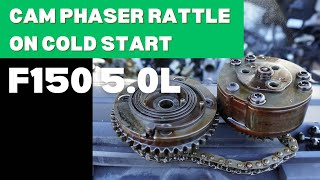
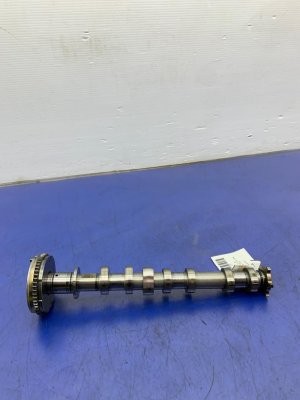
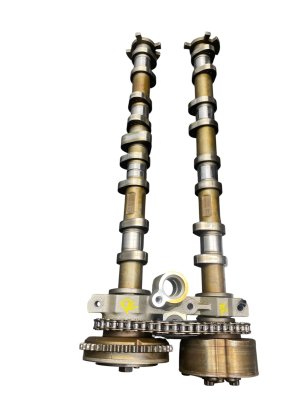
Est. part cost: $50-$100 - Failed Camshaft Phaser ⚪ Low Probability While less common than a solenoid failure for an isolated P0015 code, the mechanical phaser unit itself can fail, especially at higher mileage or with poor maintenance history. This is a widely known issue on Ford 3.5L and 5.0L engines. Failure often begins with a startup rattle.
How to confirm: This is typically diagnosed after confirming the VCT solenoid and oil are good. A persistent rattling noise on cold starts is a strong indicator. Diagnosis requires 🎬 Listen: What a failing cam phaser rattle sounds like removing the valve cover for inspection and may involve advanced scan tool data analysis showing erratic cam angle readings that don't correspond to solenoid commands.
Typical fix: This is a major repair that involves replacing the camshaft phaser, which also requires removing the timing cover and timing chain. It is strongly recommended to replace the timing chain, guides, and tensioners at the same time. This can be a multi-thousand dollar repair at a dealership.
Est. part cost: $800-$1500 for a full timing job kit
Rare But Worth Checking
- Wiring or Connector Issue: The wiring harness or connector for the VCT solenoid can become damaged, corroded, or have an oil leak causing a poor connection. This should be checked before replacing parts by inspecting the connector and testing for resistance.
- Stretched Timing Chain: On higher mileage engines (typically over 100,000 miles), the timing chain can stretch, causing a correlation issue between the crankshaft and camshafts that can trigger P0015. This is usually accompanied by rattling noises and would likely trigger other timing codes as well, such as P0017.
Diagnosis Steps
- Check Engine Oil: Verify the oil level is correct and the oil is clean and of the manufacturer-specified viscosity. If low or dirty, perform an oil change with a quality filter, clear the code, and re-test.
- Scan for Other Codes: Check for any other related DTCs that could provide more clues (e.g., P0017 often accompanies P0015).
- Inspect VCT Solenoid Wiring: Visually inspect the electrical connector and wiring going to the Bank 1 (passenger side) exhaust VCT solenoid for any signs of damage, corrosion, or loose connections.
- Test the Solenoid (DIY Swap): The easiest DIY test is to swap the suspect solenoid with an identical one from another position (e.g., the intake solenoid on the same bank). The solenoids are located on the front of the cylinder heads. Clear the codes and drive the vehicle. If the code changes to P0014 (for the intake cam), the solenoid is confirmed to be faulty.
- Advanced Diagnostics (Scan Tool): Use a tool like FORScan to monitor VCT PIDs. Look at 'VCT_EXH_DSD' (Desired) vs 'VCT_EXH_ACT' (Actual) and 'VCT_EXH_ERR' (Error) for Bank 1. A large and persistent error value under load confirms a control problem. TSB SSM 48423 also recommends using a scan tool to cycle the solenoid 10 times to try and dislodge debris.
- Professional Diagnosis: If the solenoid and oil are good, the next steps involve checking for a failed camshaft phaser or a stretched timing chain. This is an invasive and expensive repair best left to professionals, often involving removal of the timing cover.
Parts You'll Likely Need
- Variable Camshaft Timing (VCT) Solenoid
(OEM #AT4Z-6M280-C (Bank 1/Right Side Exhaust))— This is the most frequent point of failure for code P0015 on this vehicle, as confirmed by multiple Ford TSBs. It controls oil flow to the cam phaser and is prone to sticking from oil debris.
Trusted brands: Motorcraft, Dorman, SKP
OEM price range: $60-$100
Aftermarket price range: $30-$70 - Valve Cover Gasket — On 3.5L EcoBoost engines, the VCT solenoids are located under the valve covers, requiring the cover to be removed for access. The gasket should be replaced to prevent leaks. For the 5.0L V8, the solenoids are accessible on the front of the head without removing the valve cover, so this part is not needed for a simple solenoid swap.
Related Codes That Often Appear With This One
- P0017 — This code is for 'Crankshaft Position - Camshaft Position Correlation Bank 1 Sensor B'. It often appears with P0015 because if the exhaust cam timing is retarded, its position will not correlate correctly with the crankshaft's position. Seeing both together strongly points to a timing issue on that specific camshaft.
- P0011, P0012, P0014, P0021, P0022, P0024, P0025 — These are all VCT-related codes for different camshafts and banks. Seeing multiple VCT codes together can point to a more systemic issue like low oil pressure, severe oil contamination, or a timing chain problem affecting multiple components, as noted in Ford TSBs. [SSM 48423, SSM 47170]
Technical Service Bulletins (TSBs) & Recalls
- SSM 48423: Notes that debris may cause the VCT solenoid to stick on 2015-2020 models.
- SSM 47170: Similar to SSM 48423, points to debris causing a sticking VCT solenoid.
- SSM 54366: Mentions P0015 among other codes and refers to specific diagnostic tests for 2015-2021 vehicles.
- TSB-16-0093: Addresses VCT codes on low-mileage 2016 models.
- TSB 16-0038: Pertains to 2016 3.5L GTDI engines with various VCT codes, including P0015.
Platform-Specific Known Issues
- TSB #SSM 48423: For 2015-2020 models, Ford advises that various VCT codes including P0015 may be due to debris. It recommends using a scan tool to cycle the VCT solenoid 10 times to attempt to clear it before replacement.
- TSB #16-0038 & #TSB-16-0093: Specifically calls out 2016 models with the 3.5L GTDI (EcoBoost) engine with low mileage exhibiting P0015 and other VCT codes, suggesting early life failures or contamination.
- Cam Phaser Rattle: A widespread issue on both 3.5L and 5.0L engines where the phasers themselves fail, causing a loud rattle on cold starts. While this often throws other codes first, P0015 can be a symptom of a failing phaser.
Mechanic-Grade Diagnostic Values
- VCT Solenoid Internal Resistance — expected: 5.0 - 15.0 Ohms. Failure: A reading of 0 Ohms (short circuit) or infinite/O.L. (open circuit) indicates a failed solenoid. Readings outside the 5-15 Ohm range suggest an impending failure.
- VCT Solenoid Connector Voltage (Key On, Engine Off) — expected: Battery Voltage (approx. 12V). Failure: Significantly lower or no voltage suggests a wiring issue, blown fuse, or PCM driver problem.
- FORScan PID: VCT_EXH_ERR1 (Bank 1 Exhaust Camshaft Timing Error) — expected: Close to 0 degrees at stable RPM.. Failure: A large, persistent error value (positive or negative) when the PCM is commanding a change indicates the phaser is not moving as requested, pointing to a solenoid, oil pressure, or phaser mechanical issue.
Scan Tool Commands That Help
- FORScan / Ford IDS: VCT Solenoid On/Off Command (or similar bidirectional control) — Used to manually cycle the suspect VCT solenoid. TSB SSM 48423 recommends cycling the solenoid 10 times to attempt to dislodge small debris. It's also used to audibly confirm if the solenoid is clicking, which indicates the electrical circuit is functioning.
Wiring & Ground Locations
- Ground Strap on Valve Cover — A ground strap is attached to a stud on the valve cover, typically on the passenger side (Bank 1) for the 5.0L V8.. This ground is critical for the ignition coils and other sensors on the cylinder head. While not directly tied to the VCT solenoid circuit, a poor ground here can cause erratic engine behavior and misfires that can sometimes be confused with timing issues. It must be removed to take off the valve cover on some engine variants and must be cleaned and securely re-fastened.
- G104 — Engine compartment, front, LH (driver's) side.. This is a major engine and chassis ground point. Corrosion or looseness at G104 can cause a wide range of difficult-to-diagnose electrical issues, including problems with the PCM and its sensor readings.
Real Owner Repair Stories
- f150forum.com user (2011 F-150 5.0L) — Lumpy idle on cold start, bogging down, codes P0010 and P0012 (intake side, but same diagnostic principle as P0015 exhaust).
❌ Tried (didn't work) Initial diagnosis focused on wiring after confirming voltage at the connectors was good.
✅ What actually fixed it An Ohm test confirmed the intake VCT solenoid on Bank 1 was dead. The user replaced both VCT solenoids on that bank, the required updated pigtail connectors (WPT-1214), and the valve cover gasket. This resolved the codes and driveability issues.
OEM Part Supersession History
BR3Z-6M280-A (Early Gen 1 Coyote)→BR3Z-6M280-D, then BR3Z-6M280-E— Design improvement for durability and performance.
Heads up: The updated -E solenoid has a larger connector than the original -A part. When replacing an original -A solenoid with the newer -E version, the wiring harness pigtail connector must also be replaced with part number WPT-1214 to match.N/A→M-6297-M50A (Ford Performance Kit)— Offered as a high-strength upgrade for racing applications, featuring a more robust mounting design.
Heads up: For 2018-2020 5.0L F-150s, Ford Performance notes this kit fits the Intake solenoid position only.
Model Year Variations Within This Range
- 2015-2017 (Gen 2 Coyote 5.0L): These engines use port fuel injection and have a compression ratio of 11.0:1. The VCT system is well-established and parts are readily available.
- 2018-2020 (Gen 3 Coyote 5.0L): Introduced a dual-fuel system (port and direct injection), a higher 12.0:1 compression ratio, and plasma arc cylinder liners. While the VCT system's function is the same, the engine bay is more crowded and some procedures may differ slightly. These engines are also noted for potential oil consumption issues, making correct oil level and quality even more critical for VCT health.
- 2021 (Gen 4 Coyote 5.0L): Added cylinder deactivation technology and a wet drive oil pump belt. The VCT system is similar, but the engine features dual 80mm throttle bodies and a revised block, making it mechanically distinct from prior generations. The oil consumption issues of the Gen 3 were reportedly resolved for 2021+.
Helpful Videos

Used OEM Parts in Stock
New Aftermarket Parts Available


The information in this article is provided for general reference and educational purposes only. Vehicle specifications, procedures, and part compatibility can vary by production date, trim level, and region. Always consult your vehicle's factory service manual and verify part numbers before purchasing or performing repairs. Safety-critical components such as airbags, seat belts, and braking systems should be installed by a qualified professional.
- Ford F-150:
- 🎬 Helpful Videos
- 🛍️ Shop This Part
- What's Unique About the 2015-2021 Ford F-150
- Diagnostic Flowchart
- Symptoms You May Notice
- Most Likely Causes
- Rare But Worth Checking
- Diagnosis Steps
- Parts You'll Likely Need
- Related Codes That Often Appear With This One
- Technical Service Bulletins (TSBs) & Recalls
- Platform-Specific Known Issues
- Mechanic-Grade Diagnostic Values
- Scan Tool Commands That Help
- Wiring & Ground Locations
- Real Owner Repair Stories
- OEM Part Supersession History
- Model Year Variations Within This Range
- 🎟️ Get 5% Off